

Text and jpegs by courtesy of hathitrust.org www.hathitrust.org, compiled by motorracinghistory.com
Motor Age, Vol. XL (40), No. 18, October 13, 1921
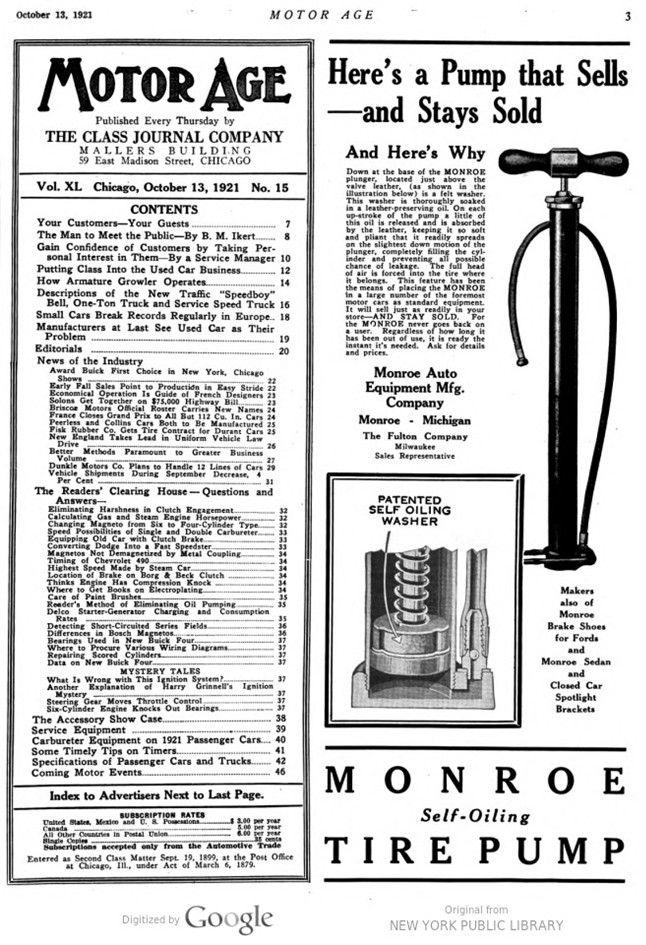
Small Cars Break Records Regularly in Europe
Rene Thomas, of Indianapolis Fame, Drives 91.5 Cu. In. Talbot-Darracq 72.1 M. P. H. in 279 Mile Race at Le Mans, France
By W. F. BRADLEY European Correspondent of Motor Age
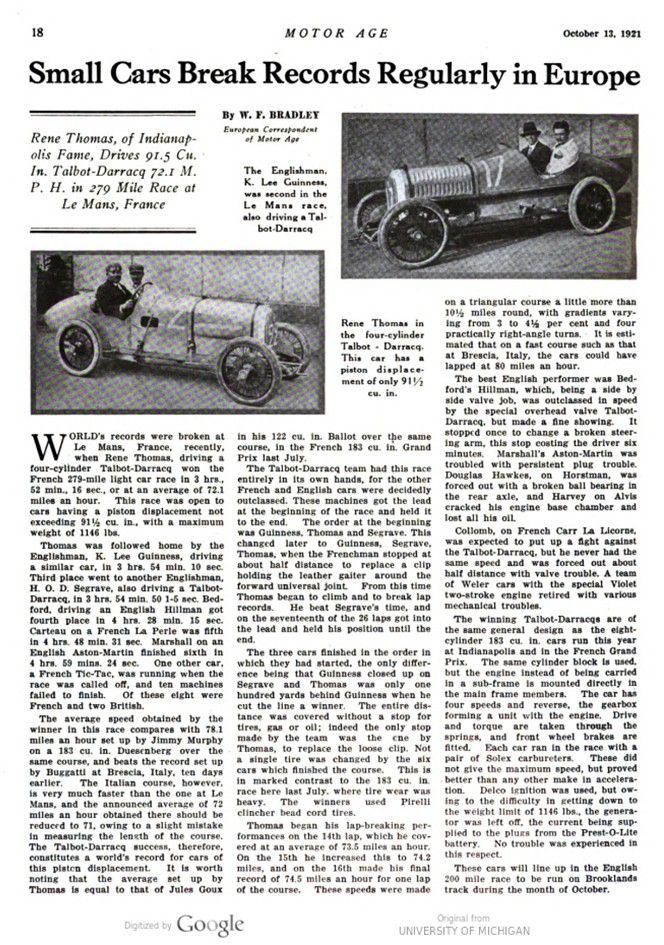
WORLD’s records were broken at Le Mans, France, recently, when Rene Thomas, driving a four-cylinder Talbot-Darracq won the French 279-mile light car race in 3 hrs., 52 min., 16 sec., or at an average of 72.1 miles an hour. This race was open to cars having a piston displacement not exceeding 912 cu. in., with a maximum weight of 1146 lbs.
Thomas was followed home by the Englishman, K. Lee Guinness, driving a similar car, in 3 hrs. 54 min. 10 sec. Third place went to another Englishman, H. O. D. Segrave, also driving a Talbot-Darracq, in 3 hrs. 54 min. 50 1-5 sec. Bed- ford, driving an English Hillman got fourth place in 4 hrs. 28 min. 15 sec. Carteau on a French La Perle was fifth in 4 hrs. 48 min. 31 sec. Marshall on an English Aston-Martin finished sixth in 4 hrs. 59 mins. 24 sec. One other car, a French Tic-Tac, was running when the race was called off, and ten machines failed to finish. Of these eight were French and two British.
The average speed obtained by the winner in this race compares with 78.1 miles an hour set up by Jimmy Murphy on a 183 cu. in. Duesenberg over the same course, and beats the record set up by Buggatti at Brescia, Italy, ten days earlier. The Italian course, however, is very much faster than the one at Le Mans, and the announced average of 72 miles an hour obtained there should be reduced to 71, owing to a slight mistake in measuring the length of the course. The Talbot-Darracq success, therefore, constitutes a world’s record for cars of this piston displacement. It is worth noting that the average set up by Thomas is equal to that of Jules Goux in his 122 cu. in. Ballot over the same course, in the French 183 cu. in. Grand Prix last July.
The Talbot-Darracq team had this race entirely in its own hands, for the other French and English cars were decidedly outclassed. These machines got the lead at the beginning of the race and held it to the end. The order at the beginning was Guinness, Thomas and Segrave. This changed later to Guinness, Segrave, Thomas, when the Frenchman stopped at about half distance to replace a clip holding the leather gaiter around the forward universal joint. From this time Thomas began to climb and to break lap records. He beat Segrave’s time, and on the seventeenth of the 26 laps got into the lead and held his position until the end.
The three cars finished in the order in which they had started, the only difference being that Guinness closed up on Segrave and Thomas was only one hundred yards behind Guinness when he cut the line a winner. The entire distance was covered without a stop for tires, gas or oil; indeed the only stop made by the team was the one by Thomas, to replace the loose clip. Not a single tire was changed by the six cars which finished the course. This is in marked contrast to the 183 cu. in. race here last July, where tire wear was heavy. The winners used Pirelli clincher bead cord tires.
Thomas began his lap-breaking performances on the 14th lap, which he cov-red at an average of 73.5 miles an hour. On the 15th he increased this to 74.2 miles, and on the 16th made his final record of 74.5 miles an hour for one lap of the course. These speeds were made on a triangular course a little more than 10½ miles round, with gradients varying from 3 to 42 per cent and four practically right-angle turns. It is estimated that on a fast course such as that at Brescia, Italy, the cars could have lapped at 80 miles an hour.
The best English performer was Bedford’s Hillman, which, being a side by side valve job, was outclassed in speed by the special overhead valve Talbot-Darracq, but made a fine showing. It stopped once to change a broken steering arm, this stop costing the driver six minutes. Marshall’s Aston-Martin was troubled with persistent plug trouble. Douglas Hawkes, Horstman, was forced out with a broken ball bearing in the rear axle, and Harvey on Alvis cracked his engine base chamber and lost all his oil.
Collomb, on French Carr La Licorne, was expected to put up a fight against the Talbot-Darracq, but he never had the same speed and was forced out about half distance with valve trouble. A team of Weler cars with the special Violet two-stroke engine retired with various mechanical troubles.
The winning Talbot-Darracqs are of the same general design as the eight-cylinder 183 cu. in. cars run this year at Indianapolis and in the French Grand Prix. The same cylinder block is used, but the engine instead of being carried in a sub-frame is mounted directly in the main frame members. The car has four speeds and reverse, the gearbox forming a unit with the engine. Drive and torque are taken through the springs, and front wheel brakes are fitted. Each car ran in the race with a pair of Solex carbureters. These did not give the maximum speed, but proved better than any other make in acceleration. Delco ignition was used, but owing to the difficulty in getting down to the weight limit of 1146 lbs., the genera- tor was left off, the current being sup- plied to the plugs from the Prest-O-Lite battery. No trouble was experienced in this respect.
These cars will line up in the English 200-mile race to be run on Brooklands track during the month of October.
Photo captions.
The Englishman, K. Lee Guinness, was second in the Le Mans race, also driving a Talbot-Darracq
Rene Thomas in the four-cylinder Talbot Darracq. This car has piston displacement of only 91½ cu. in.