One day after the 1907 Coppa Florio, a second race was held on the Brescia circuit: the Coppa della Velocità. This race was based on the more liberal regulations of the A.C.F. To the pleasure of many, again an Italian driver and car won: Alessandro Cagno on Itala. This report states that, although Italian automobile industry now is as strong as ever, it is hoped for open competition in the next year.

With permission of the Bibliothèque national francais gallica.bnf.fr == Text and fotos compiled by motorracinghistory
The New York Herald, European Edition — No. 25.943, September 3, 1907, page 1.
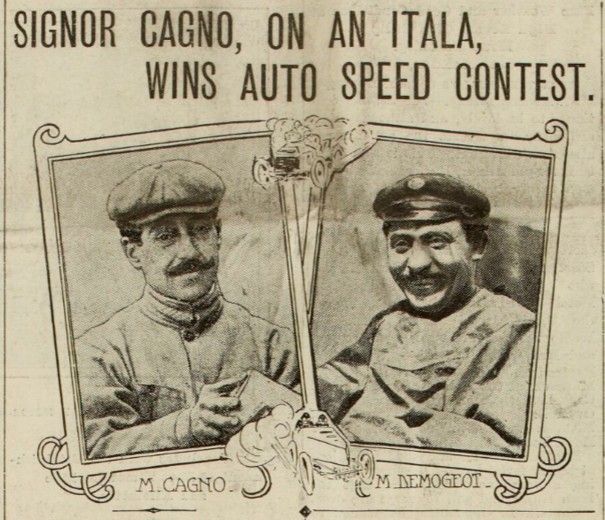
SIGNOR CAGNO, ON AN ITALA, WINS AUTO SPEED CONTEST.
Skillfully Captures Race on Brescia Circuit, Followed by a Darracq and a Lorraine-Dietrich. – TRIUMPHANT YEAR FOR ITALY.
Machines Made in That Country Have Important Victories, but French Makes Have Proved Reliability.
[SPECIAL TO THE HERALD.]
Brescia, Monday. — Signor Cagno, driving an Itala racing automobile, won the speed race on the Brescia circuit today, covering the 486 kilometres in 4h. 37min. 36sec. He thus drove at an average speed of 106 kilometres an hour, a speed somewhat inferior to that anticipated, yet higher than any previously attained on the same circuit in previous years. He was followed by M. Demogeot, driving a Darracq, and M. Rougier on a Lorraine-Dietrich. Although the contest was won by an Italian machine, as was the Circuit de Dieppe, yet the six places after the first were all taken by French machines, a fact which it is essential to bear in mind when passing judgment upon the event as a whole.
This is Signor Cagno’s second victory on an Itala automobile. Last year he drove a smaller auto to victory on the mountainous circuit of the Targa Florio in Sicily in such a brilliant manner that all who saw him drive were convinced that he had a splendid future before him in the racing field. It is also the second victory for the Itala firm on the Brescia track. Two years ago, Signor Raggio, with extraordinary dash, brought one of these machines to the winning line at a speed of 105 kilometres an hour, heating thereby the then existing speed records by far.
Winner Gets Bad Start.
The machines were sent away at half-minute intervals, commencing at twenty-one minutes to six o’clock in the morning. All got away without incident save the Itala of Cagno, which though primarily destined to be the winner, obstinately refused to start at the given signal. Five or six minutes were thus lost, and when the French machines led the way during the first half-dozen rounds Italian hopes were low. One by one, however, the fastest and surest machines got left behind by this determined driver, and in the final round he took such a lead over all his opponents that only a serious “panne” could possibly have prevented his victory.
M. Duray. on his de Dietrich, drove as he had driven in the Grand Prix, with extraordinary skill and speed, but his attempt at victory proved fruitless. He skidded in the fifth lap and his carburetor took fire. This considerably reduced the French chances of success, though Rougier and Demogeot were both driving brilliantly. They both lost time, however, and could not prevent Signor Cagno from getting home first. Mr. Fitz Shepheard on a Diatto-A. Clement might have been very near the first had not his machine left the road in a dangerous turning and flung both him and his machinist into a ravine. Mr. Fitz Shepheard was unfortunate enough to break some bones. His machinist escaped with very little damage.
Italy’s Triumphant Year.
By this victory Italy has filled to the brim its cup of success for 1907. Italian machines have beaten all opponents in every important contest of the season. Commencing at Palermo in the Targa Florio, they were able, by reason of the great skill of the F.I.A.T. engineers, to carry away the Kaiser’s Cup at Homburg and the Grand Prix of the Automobile-Club de France at Dieppe. When the F.I.A.T. house retired from the field for the year full of renown and possessed of many trophies, the Itala Company took its place, and to-day has closed the year’s account as creditably as it was begun by the older firm. Such a series of successes has not been heard of in the automobile racing field since very early years when the Panhard and Renault firms were accustomed to sweep all before them.
It should be borne in mind, however, that although the leading positions in all these races have been occupied by the Italian makers, French constructors have every reason to be satisfied with the general regularity of the vehicles engaged. France has been somewhat handicapped by lack of drivers and a certain amount of hesitation on the part of the leading firms in the choice of models at the commencement of the year. Italy, on the contrary, has made racing the keynote of the 1907 programme. Its victories have been the outcome of perseverance and organization. It is to be hoped that next year other countries besides France will put forward some effort to give the Italians more serious and continued competition.
Machines Which Finished.
The following machines finished the race: — H. M. S.
1. SIGNOR CAGNO, Itala automobile (Michelin tires. and movable rims). Hourly average, 105kil. 121m – 4 37 36
2. M. DEMOGEOT, Darracq automobile (Dunlop tires). Hourly average, 103 kilometres 892m – 4 40 43
3. M. ROUGIER, Lorraine-Dietrich automobile (Michelin tires). Hourly average, 102kil. 200m – 4 45 31
4. M. GABRIEL, Lorraine-Dietrich automobile (Michelin tires). Hourly average, 100kil. 424rn – 4 50 35
5. M. ALEZY, Bayard-Clément automobile (Michelin tires). Hourly average 99kil. 268m – 4 53 58 6. M. GARGET, Bayard-Clément automobile (Michelin tires). Hourly average, 97kil. 456m – 4 59 22
Photos.
M. CAGNO – M. DEMOGEOT