After he ws a fighter pilot in the First World war, Flight Captain Edward (Eddie) Rickenbacker turned more and more back again to motor racing. Before going into car design and development, he was a referee in the Liberty Sweepstakes, which is all too be expectedly for a wartime hero. His experiences in the Great war can be taken from „Fighting the Flying Circus“. https://archive.org/details/fightingflyingc00rickgoog/page/n7/mode/2up
Text and jpegs by courtesy of hathitrust.org www.hathitrust.org, compiled by motorracinghistory.com
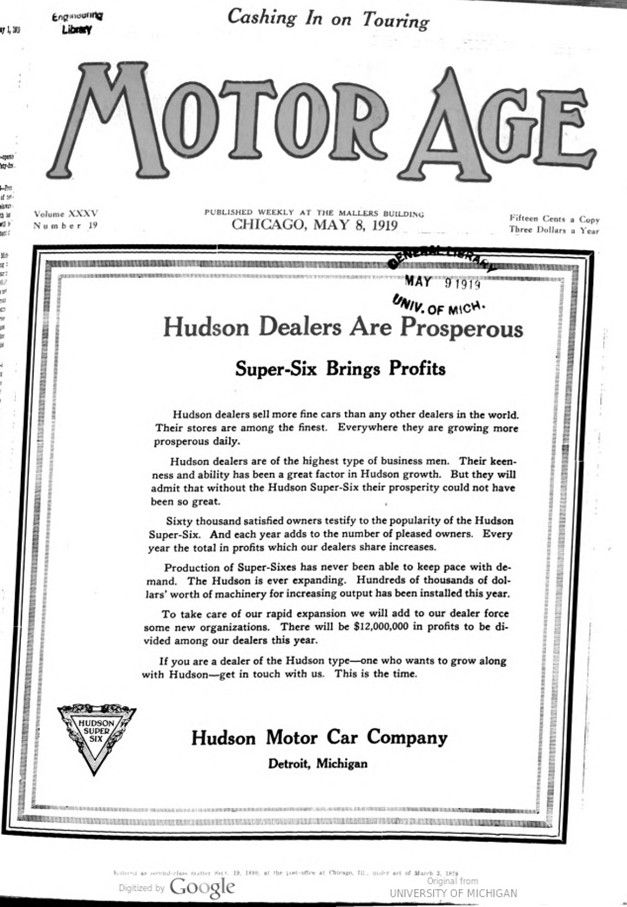
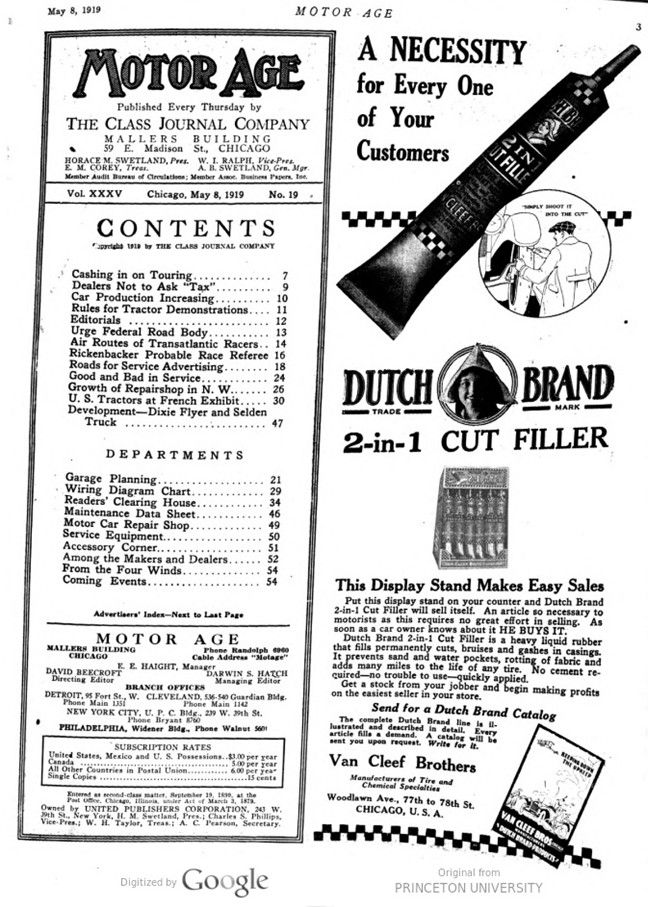
MOTOR AGE – Vol. XXV 35, No. 19, May 8 + No. 20, May 15, 1919
MOTOR AGE – Vol. XXV 35, No. 20, May 15, 1919
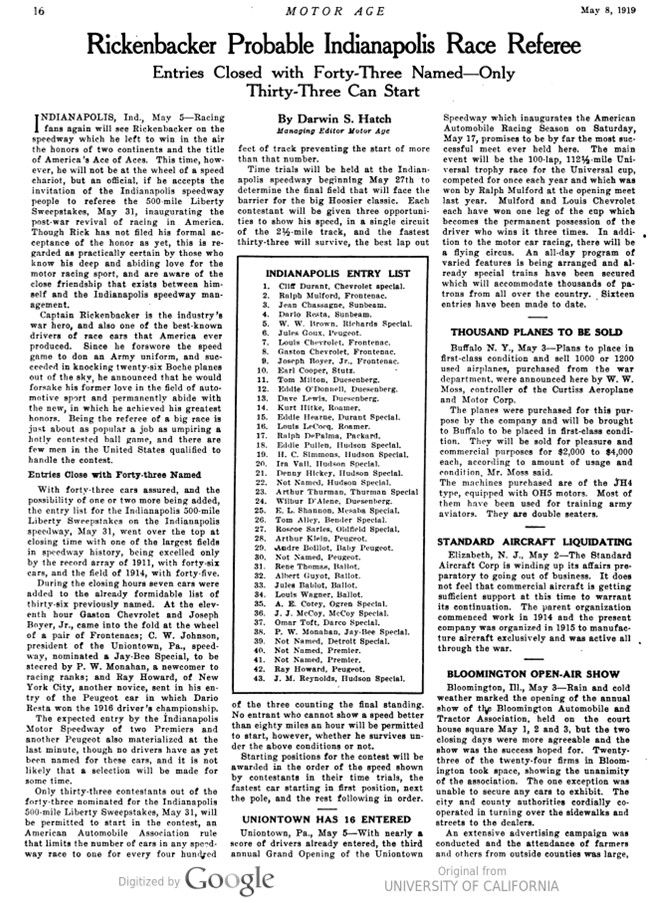
Rickenbacker Probable Indianapolis Race Referee
Entries Closed with Forty-Three Named – Only Thirty-Three Can Start
By Darwin S. Hatch – Managing Editor Motor Age
INDIANAPOLIS, Ind., May 5 – Racing fans again will see Rickenbacker on the speedway which he left to win in the air the honors of two continents and the title of America’s Ace of Aces. This time, however, he will not be at the wheel of a speed chariot, but an official, if he accepts the invitation of the Indianapolis speedway people to referee the 500-mile Liberty Sweepstakes, May 31, inaugurating the post-war revival of racing in America. Though Rick has not filed his formal acceptance of the honor as yet, this is regarded as practically certain by those who know his deep and abiding love for the motor racing sport, and are aware of the close friendship that exists between himself and the Indianapolis speedway management.
Captain Rickenbacker is the industry’s war hero, and also one of the best-known drivers of race cars that America ever produced. Since he forswore the speed game to do in an Army uniform, and succeeded in knocking twenty-six Boche planes out of the sky, he announced that he would forsake his former love in the field of automotive sport and permanently abide with the new, in which he achieved his greatest honors. Being the referee of a big race is just about as popular a job as umpiring a hotly contested ball game, and there are few men in the United States qualified to handle the contest.
MOTOR AGE – Vol. XXV 35, No. 20, May 15, 1919
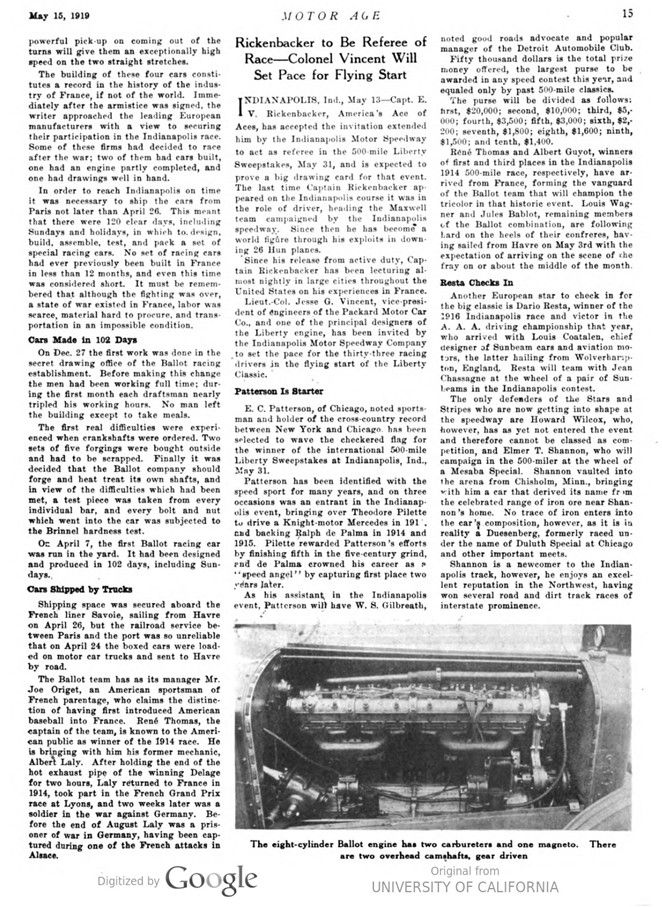
Rickenbacker to Be Referee of Race – Colonel Vincent Will Set Pace for Flying Start
INDIANAPOLIS, Ind., May 13-Capt. E. Iv. Rickenbacker, America’s Capt. B. Aces, has accepted the invitation extended him by the Indianapolis Motor Speedway to act as referee in the 500-mile Liberty Sweepstakes, May 31, and is expected to prove a big drawing card for that event. The last time Captain Rickenbacker appeared on the Indianapolis course it was in the role of driver, heading the Maxwell team campaigned by the Indianapolis‘ speedway. Since then he has become a world figure through his exploits in downing 26 Hun planes.
Since his release from active duty, Captain Rickenbacker has been lecturing al most nightly in large cities throughout the United States on his experiences in France. Lieut. Col. Jesse G. Vincent, vice-president of engineers of the Packard Motor Car Co., and one of the principal designers of the Liberty engine, has been invited by the Indianapolis Motor Speedway Company to set the pace for the thirty-three racing drivers in the flying start of the Liberty Classic.
Patterson Is Starter
E. C. Patterson, of Chicago, noted sports- man and holder of the cross-country record between New York and Chicago has been selected to wave the checkered flag for the winner of the international 500-mile Liberty Sweepstakes at Indianapolis, Ind., May 31.
Patterson has been identified with the speed sport for many years, and on three occasions was an entrant in the Indianapolis event, bringing over Theodore Pilette to drive a Knight-motor Mercedes in 191. and backing Ralph de Palma in 1914 and 1915. Pilette rewarded Patterson’s efforts by finishing fifth in the five-century grind, and de Palma crowned his career as a „speed angel“ by capturing first place two years later.
As his assistant in the Indianapolis event, Patterson will have W. S. Gilbreath, noted good roads advocate and popular manager of the Detroit Automobile Club.
Fifty thousand dollars is the total prize money offered, the largest purse to be awarded in any speed contest this year, and equaled only by past 500-mile classics. The purse will be divided as follows: first, $20,000; second, $10,000; third, $5,000; fourth, $3,500; fifth, $3,000; sixth, $2,200; seventh, $1,800; eighth, $1,600; ninth, $1,500; and tenth, $1,400.
René Thomas and Albert Guyot, winners of first and third places in the Indianapolis 1914 500-mile race, respectively, have arrived from France, forming the vanguard of the Ballot team that will champion the tricolor in that historic event. Louis Wagner and Jules Bablot, remaining members of the Ballot combination, are following hard on the heels of their confreres, having sailed from Havre on May 3rd with the expectation of arriving on the scene of the fray on or about the middle of the month.
Resta Checks In
Another European star to check in for the big classic is Dario Resta, winner of the 1916 Indianapolis race and victor in the A. A. A. driving championship that year, who arrived with Louis Coatalen, chief designer of Sunbeam cars and aviation motors, the latter hailing from Wolverhampton, England. Resta will team with Jean Chassagne at the wheel of a pair of Sunbeams in the Indianapolis contest.
The only defenders of the Stars and Stripes who are now getting into shape at the speedway are Howard Wilcox, who, however, has as yet not entered the event and therefore cannot be classed as competition, and Elmer T. Shannon, who will campaign in the 500-miler at the wheel of a Mesaba Special. Shannon vaulted into the arena from Chisholm, Minn., bringing with him a car that derived its name from the celebrated range of iron ore near Shannon’s home. No trace of iron enters into the car’s composition, however, as it is in reality a Duesenberg, formerly raced under the name of Duluth Special at Chicago and other important meets. Shannon is a newcomer to the Indianapolis track, however, he enjoys an excel- lent reputation in the Northwest, having won several road and dirt track races, of interstate prominence. „