Some two weeks before the start of the 1919 Liberty Sweepstakes, more was written on the European participating brands; the british Sunbeam and the French Ballot cars. Later, however, Sunbeam was to withdraw. But the Ballots made an impressive appearance, especially in the light of their very short developing time, short production schedule and following shipment to the United States. Later in the race, however, these cars would not live up to their expectation.
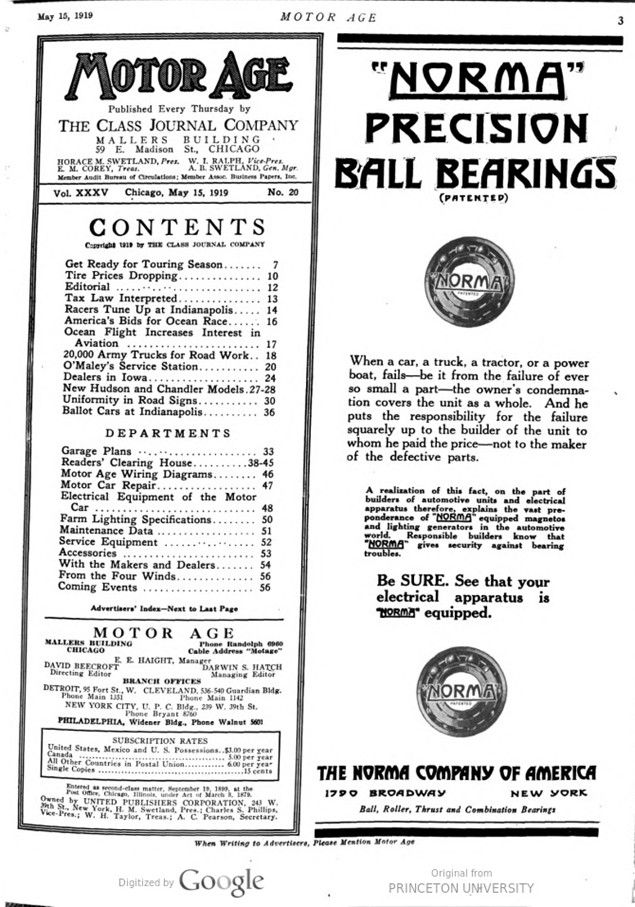
Text and jpegs by courtesy of hathitrust.org www.hathitrust.org, compiled by motorracinghistory.com
MOTOR AGE – Vol. XXV 35, No. 20, May 15, 1919
Drivers Tune up for Race
Resta-Sunbeam Combination the Favorites
Record-Breaking Crowds Expected
By Harlan C. Skinner Motor Age Editorial Staff
INDIANAPOLIS, Ind., May 12 – European drivers are out to win. This is the gist of opinion among them, and they are prepared to make a determined effort to carry away the major honors of America’s premier speedway event, the 500-mile Liberty Sweepstakes, to be staged here May 31. Eleven cars of the total of forty-three entries are of foreign design and manufacture.
Greater activity commenced at the Speedway with the arrival of two cars of the Ballot team, in addition to the Sunbeams and Peugeots, which are already at the track being groomed for the coming event. René Thomas and Albert Guyot will pilot the two Ballots, now here, and the other two, to be driven by Louis Wagner and Jules Bablot, are expected from New York in a few days.
The Ballot team is a formidable combination, as the cars were designed by Wenny, former Peugeot engineer, who has made a careful study of the conditions here and produced these cars solely for this event.
Prevailing opinion at present is that Dario Resta and his new Sunbeam will be the ruling favorite. The two Sunbeams are new creations of Coatalen, chief engineer of the Sunbeam Co., and are based on the experience gained in previous Indianapolis races. They are also designed with the same objective in view, as the Ballot but follow the usual Sunbeam practice of using a six-cylinder power plant. This will probably be Resta’s last appearance at the wheel of a racing car, as he has taken on the Sunbeam agency and will shortly open offices in New York. It is not known Ballot Eights Very Fast at this time whether or not the Sunbeams will remain in this country for further racing.
Duesenberg has two new eight-cylinder cars entered, to be driven by Edward O’Donnell and Thomas Milton. They have not arrived as yet, but rumor has it that they made a remarkable showing in their initial tryouts and that they would give the foreign entries a hard race. Jules Goux is busy preparing his Peugeot and has had it out on the track for a number of days. None of the drivers have tried to exhibit any speed as yet, but are familiarizing themselves with track conditions. Ralph De Palma is expected with the Packard the latter part of the week.
The advance sale of seats is much heavier than for any of the six previous races, and a record-breaking crowd is expected.
Ballot Eights Very Fast
French Racers Designed for Indianapolis – Cars Constructed in 102 Days
By W. F. Bradley, Motor Age Correspondent
PARIS, April 24 – The four special Ballot cars entered for the Indianapolis race and to be driven by René Thomas, J. Bablot, Albert Guyot and Louis Wagner, are new productions, built in Paris entirely at the Ballot establishment with Indianapolis track conditions specially in view.
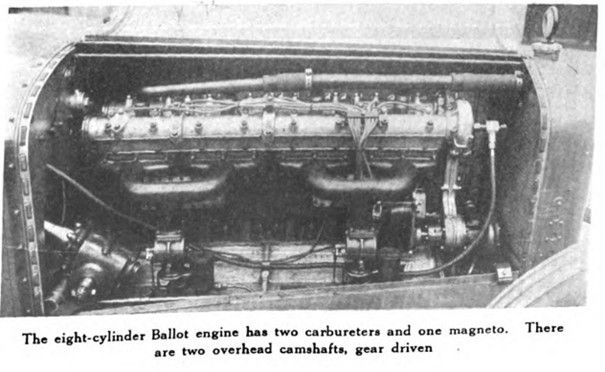
The cars have eight vertical cylinders in line and consist of two castings of four. The bore and stroke is 2.9 by 5.5 in. There are four valves per cylinder mounted in the head and operated by means of two camshafts driven by a train of gears contained within an aluminum housing at the front of the engine. The crankshaft is built up in four parts and is carried in ball bearings. I-section connecting rods and aluminum pistons are employed. The engines have a single plug per cylinder and only one magneto. There are two Claudel carbureters per engine.
Details of Eights
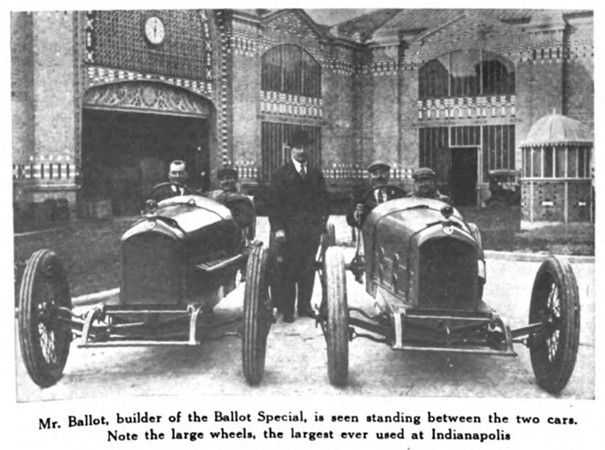
The engine, clutch and gearbox are mounted on a subframe which is attached to the main frame by three-point suspension, so that there is no misalignment no matter how much the main frame members are twisted. There are four speeds and reverse. Drive is taken through the springs, which are semi-elliptic underslung type. Front springs are also underslung. The center of gravity of these cars is exceptionally low. With 80 by 120 mm. wheels and tires (practically 34 in.) the top of the radiator is only 40 in. from the ground. No special attempt has been made at streamlining and the cars will be run without a tail.
Whilst exact figures regarding speed are not available for publication, it may be stated that these cars are the fastest 300 cu.-in. mounts ever produced in France. They will be particularly dangerous, however, on track work, by reason of their rapid acceleration. All previous French cars sent to Indianapolis have been road-racing machines built for the long straightaway stretches of French roads.
When the Ballot company undertook the construction of these machines it was guided by the experience of René Thomas, who decided that Indianapolis called for a very low center of gravity, good balance and suspension to reduce tire wear, and exceptionally rapid pick-up. The wheel diameters are the biggest ever used on Indianapolis track and the cars are the lowest ever seen in America. The final gear ratio has been laid out with the nature of the track in view.
There appears to be no doubt that these cars will be able to tackle the four turns per lap at a much higher speed than any of the others, and it is believed that their powerful pick-up on coming out of the turns will give them an exceptionally high speed on the two straight stretches.
The building of these four cars constitutes a record in the history of the industry of France, if not of the world. Immediately after the armistice was signed, the writer approached the leading European manufacturers with a view to securing their participation in the Indianapolis race. Some of these firms had decided to race after the war; two of them had cars built, one had an engine partly completed, and one had drawings well in hand.
In order to reach Indianapolis on time it was necessary to ship the cars from Paris not later than April 26. This meant that there were 120 clear days, including Sundays and holidays, in which to design, build, assemble, test, and pack a set of special racing cars. No set of racing cars had ever previously been built in France in less than 12 months, and even this time was considered short. It must be remembered that although the fighting was over, a state of war existed in France, labor was scarce, material hard to procure, and transportation in an impossible condition.
Cars Made in 102 Days
On Dec. 27 the first work was done in the secret drawing office of the Ballot racing establishment. Before making this change the men had been working full time; during the first month each draftsman nearly tripled his working hours. No man left the building except to take meals.
The first real difficulties were experienced when crankshafts were ordered. Two sets of five forgings were bought outside and had to be scrapped. Finally, it was decided that the Ballot company should forge and heat treat its own shafts, and in view of the difficulties which had been met, a test piece was taken from every individual bar, and every bolt and nut which went into the car was subjected to the Brinell hardness test.
On April 7, the first Ballot racing car was run in the yard. It had been designed and produced in 102 days, including Sundays.
Cars Shipped by Trucks
Shipping space was secured aboard the French liner Savoie, sailing from Havre on April 26, but the railroad service between Paris and the port was so unreliable that on April 24 the boxed cars were loaded on motor car trucks and sent to Havre by road.
The Ballot team has as its manager Mr. Joe Origet, an American sportsman of French parentage, who claims the distinction of having first introduced American baseball into France. René Thomas, the captain of the team, is known to the American public as winner of the 1914 race. is bringing with him his former mechanic, Albert Laly. After holding the end of the hot exhaust pipe of the winning Delage for two hours, Laly returned to France in 1914, took part in the French Grand Prix race at Lyons, and two weeks later was a soldier in the war against Germany. Be- fore the end of August Laly was a pris- oner of war in Germany, having been captured during one of the French attacks in Alsace.
Photos.
Page 14. Mr. Ballot, builder of the Ballot Special, is seen standing between the two cars. Note the large wheels, the largest ever used at Indianapolis. – The eight-cylinder Ballot engine has two carbureters and one magneto. There are two overhead camshafts, gear driven.