One of the possibilities of increasing the power output of engines at a given displacement, was increasing the speed. That could be done by reducing the weight of all up-and-down moving parts (reduce the inertia forces). Not only using lighter parts, such as pistons, connecting rods, valves, valve springs etc., but also by using smaller and more parts – to compensate for displacement. This article gives a comparison of where we stood in 1912 and where we came 15 years later.
Text and jpegs by courtesy of hathitrust.org www.hathitrust.org, compiled by motorracinghistory.com
Automotive Industries, Vol. LVIII (58), No. 25, June 23, 1928
Inertia Forces an Obstacle to Higher Racing Car Engine Speeds
More revolutions per minute probably feasible if number of cylinders can be increased, the bore reduced, and lighter metals utilized for moving parts.
By COL. W. G. WALL President, Society of Automotive Engineers
THE other day I heard an engineer remark that we probably had reached the limit of speed for our racing car engines – that in the future we would have to look to other means to get more horsepower out of them.
Was he right?
Increasing the speed has been a comparatively easy way of securing more power out of a given displacement, the horsepower being theoretically proportional to the speed (that is, the number of revolutions). Of course, a certain amount of ingenuity has had to be used and considerable work done to get engines to run at the present high speeds.
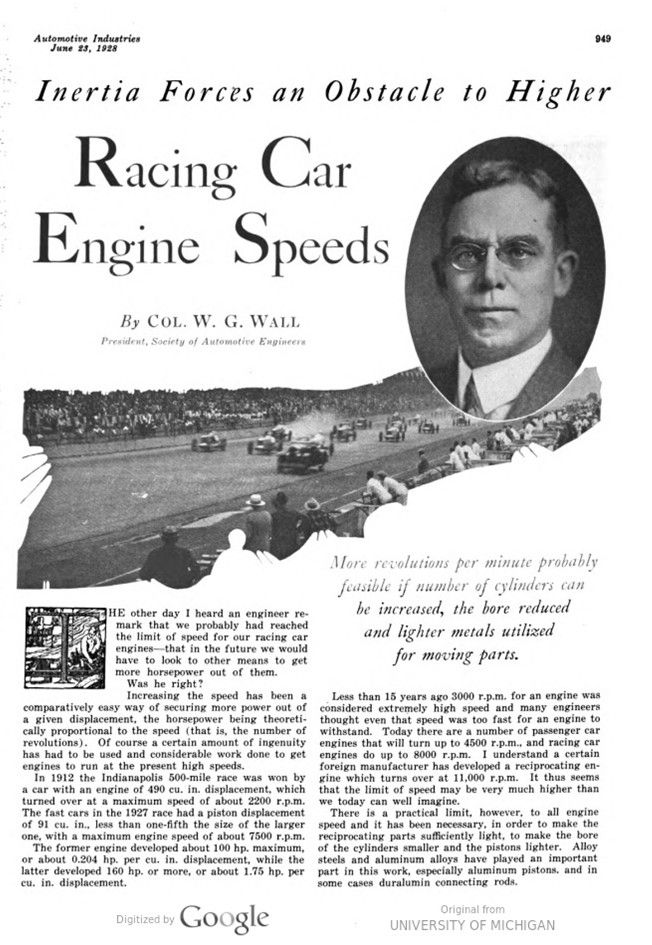
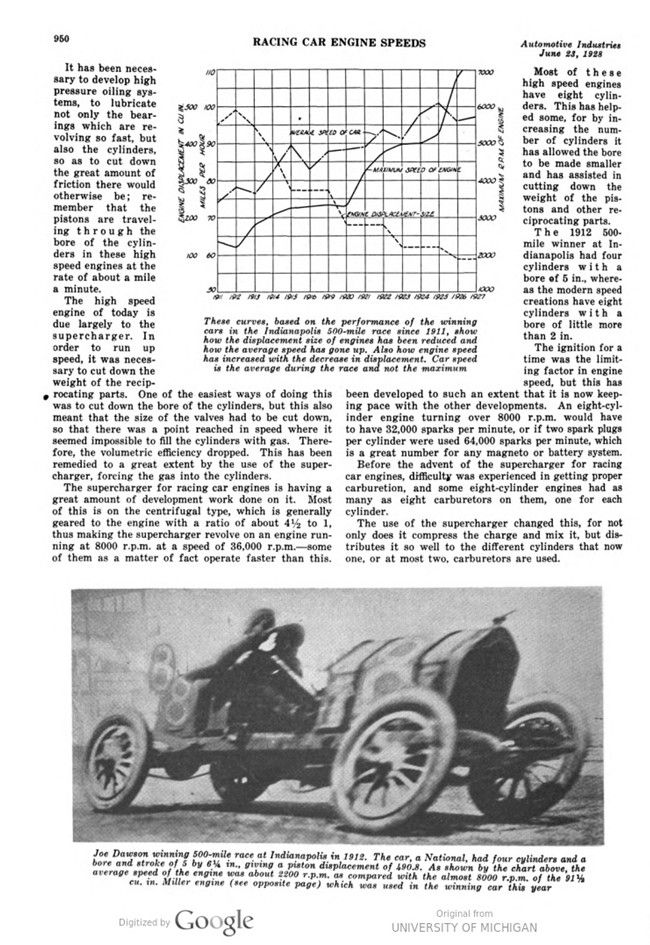
In 1912 the Indianapolis 500-mile race was won by a car with an engine of 490 cu. in. displacement, which turned over at a maximum speed of about 2200 r.p.m. The fast cars in the 1927 race had a piston displacement of 91 cu. in., less than one-fifth the size of the larger one, with a maximum engine speed of about 7500 r.p.m.
The former engine developed about 100 hp. maximum, or about 0.204 hp. per cu. in. displacement, while the latter developed 160 hp. or more, or about 1.75 hp. per cu. in. displacement.
Less than 15 years ago, 3000 r.p.m. for an engine was considered extremely high speed and many engineers thought even that speed was too fast for an engine to withstand. Today there are a number of passenger car engines that will turn up to 4500 r.p.m., and racing car engines do up to 8000 r.p.m. I understand a certain foreign manufacturer has developed a reciprocating engine which turns over at 11,000 r.p.m. It thus seems that the limit of speed may be very much higher than we today can well imagine.
There is a practical limit, however, to all engine speed and it has been necessary in order to make the reciprocating parts sufficiently light, to make the bore of the cylinders smaller and the pistons lighter. Alloy steels and aluminum alloys have played an important part in this work, especially aluminum pistons. and in some cases, duralumin connecting rods.
It has been necessary to develop high pressure oiling systems, to lubricate not only the bearings which are revolving so fast, but also the cylinders, so as to cut down the great amount of friction there would otherwise be; member that the pistons are traveling through the bore of the cylinders in these high speed engines at the rate of about a mile a minute.
The high-speed engine of today is due largely to the supercharger. In order to run up speed, it was necessary to cut down the weight of the reciprocating parts. One of the easiest ways of doing this was to cut down the bore of the cylinders, but this also meant that the size of the valves had to be cut down, so that there was a point reached in speed where it seemed impossible to fill the cylinders with gas. Therefore, the volumetric efficiency dropped. This has been remedied to a great extent by the use of the supercharger, forcing the gas into the cylinders.
The supercharger for racing car engines is having a great amount of development work done on it. Most of this is on the centrifugal type, which is generally geared to the engine with a ratio of about 4½ to 1, thus making the supercharger revolve on an engine running at 8000 r.p.m. at a speed of 36,000 r.p.m. – some of them as a matter of fact operate faster than this.
Most of these high-speed engines have eight cylinders. This has helped some, for by increasing the number of cylinders it has allowed the bore to be made smaller and has assisted in cutting down the weight of the pistons and other reciprocating parts.
The 1912 500-mile winner at Indianapolis had four cylinders with a bore of 5 in., whereas the modern speed creations have eight cylinders with a bore of little more than 2 in.
The ignition for a time was the limiting factor in engine speed, but this has been developed to such an extent that it is now keeping pace with the other developments. An eight-cylinder engine turning over 8000 r.p.m. would have to have 32,000 sparks per minute, or if two spark plugs per cylinder were used 64,000 sparks per minute, which is a great number for any magneto or battery system.
Before the advent of the supercharger for racing car engines, difficulty was experienced in getting proper carburetion, and some eight-cylinder engines had as cylinder. many as eight carburetors on them, one for each cylinder.
The use of the supercharger changed this, for not only does it compress the charge and mix it but distributes it so well to the different cylinders that now one, or at most two, carburetors are used.
One of the difficulties encountered with supercharging is the heating of the mixture, due to its being compressed, and means have to be provided for cooling the mixture between the supercharger and the cylinder. Since the pressure developed in a cylinder due to combustion increases with the difference in temperature between the incoming and exploding gas, the cooler the gas can be supplied to the cylinder, the greater the power within the limits of good ignition.
Intercoolers consisting of long tubes were at first used for this cooling of the charge. Lockhart’s speed car had a large aluminum intercooler with fins on the outside flush with the top of the bonnet, and now most of the coolers are made in some such manner.
The mean effective pressure of these engines is quite high and the weight in pounds per horsepower compares very favorably with some of the recent airplane engines.
The limiting factors in the speed of an engine are the inertia forces set up, and the strength and weight of materials used, assuming that the cylinders can be filled with gas by supercharging.
The centrifugal and reciprocating forces are the ones that worry us, as the explosive force is of very little moment at these high speeds. These forces at a given speed depend upon the mass of material moving, and the mass necessary depends upon the strength and weight of that material.
So to answer our question we might ask, Is it possible to use smaller parts and more of them, that is, a larger number of cylinders and smaller bore, or can we develop lighter and stronger steel and aluminum alloys, out of which to make pistons, rods, valves, valve springs and such parts.
All of this looks feasible, but only the future can tell us definitely regarding how far it will be carried.
Photo captions.
Page 950.
ENGINE DISPLACEMENT IN CU IN. MILES PER HOUR – AVERAGE SPEED OF CAR. MAXIMUM SPEED OF ENGINE ENGINE DISPLACEMENT-SIZE MAXIMUM RPM OF ENGINE
These curves, based on the performance of the winning cars in the Indianapolis 500-mile race since 1911, show how the displacement size of engines has been reduced and how the average speed has gone up. Also how engine speed has increased with the decrease in displacement. Car speed is the average during the race and not the maximum.
Joe Dawson winning 500-mile race at Indianapolis in 1912. The car, a National, had four cylinders and a bore and stroke of 5 by 6 in., giving a piston displacement of 490.8. As shown by the chart above, the average speed of the engine was about 2200 r.p.m. as compared with the almost 8000 r.p.m. of the 912 cu. in. Miller engine (see opposite page) which was used in the winning car this year.
Page 951.
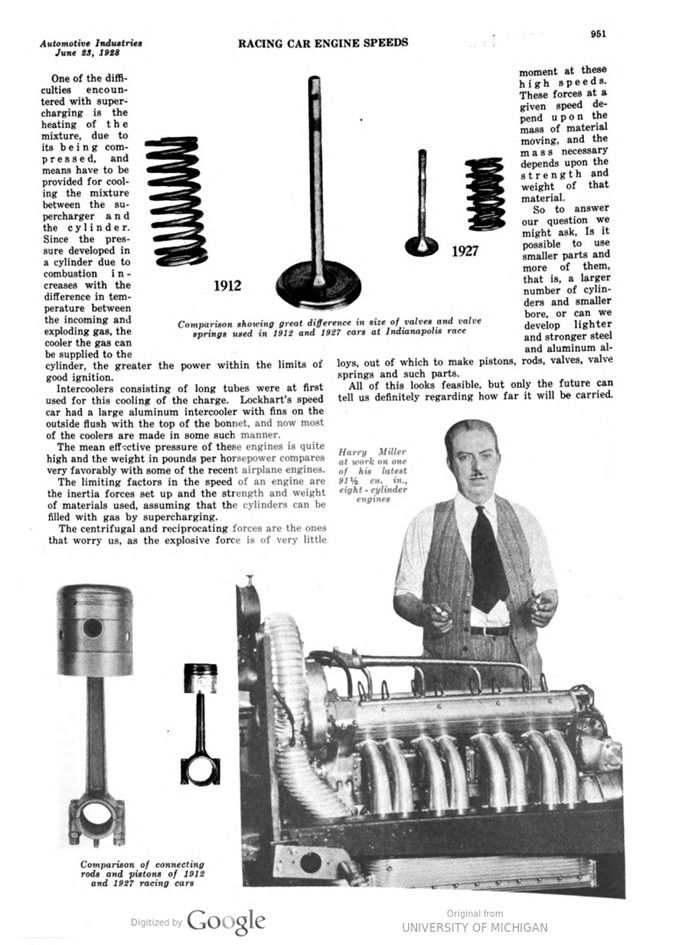
Comparison showing great difference in size of valves and valve springs used in 1912 and 1927 cars at Indianapolis race
Harry Miller at work on one of his latest 912 cu. in., eight-cylinder engines
Comparison of connecting rods and pistons of 1912 and 1927 racing cars