After superchargers appeared more and more on the race cars, one of the logical developments was the use of inter-coolers. That would reduce temperatures of compressed air-gasoline mixtures into the combustion chamber, therby increase therma efficiency and hence power output. This development already came into practice some five years after the first introduction. This article from the same author also appeared in Motor Age of May 31, 1928.
Text and jpegs by courtesy of hathitrust.org www.hathitrust.org, compiled by motorracinghistory.com
Automotive Industries, Vol. LVIII (58), No. 23, June 9, 1928
Intercoolers Viewed as Main Development at Indianapolis Race
Credited with increasing speed of cars in this year’s 500-mile contest.
Vary in design. Only one water-cooled.
By C. Edward Packer
HIGHER speeds than were ever before attained on the Indianapolis Motor Speedway were reached this year. While many refinements had been made in the cars, there was nothing that showed so much development as the intercoolers or intake manifolds connecting the superchargers with the engine. There is no doubt that in the past considerable power has been sacrificed on account of over-expansion of the mixture.
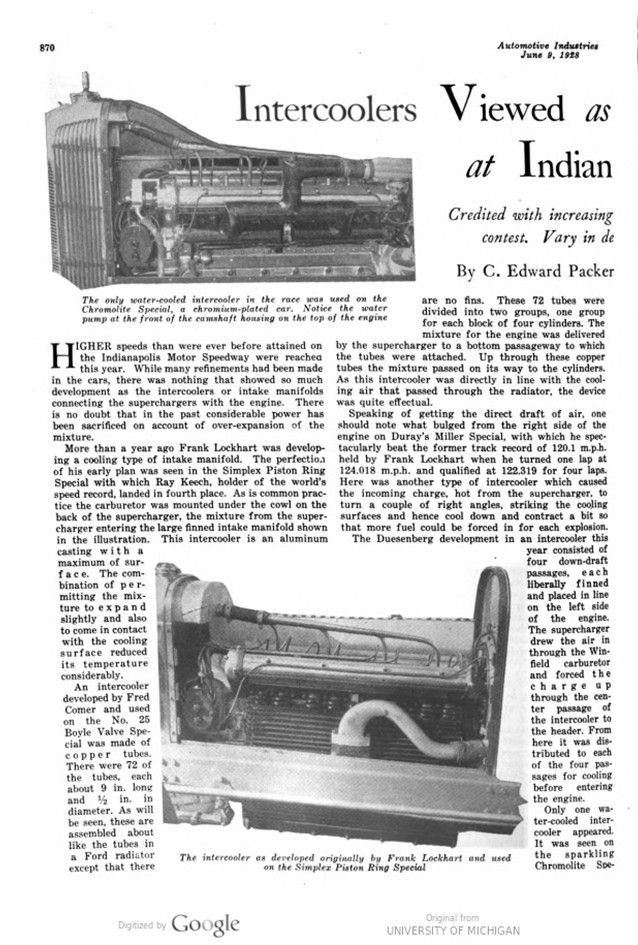
More than a year ago Frank Lockhart was developing a cooling type of intake manifold. The perfection of his early plan was seen in the Simplex Piston Ring Special with which Ray Keech, holder of the world’s speed record, landed in fourth place. As is common practice the carburetor was mounted under the cowl on the back of the supercharger, the mixture from the supercharger entering the large-finned intake manifold shown in the illustration. This intercooler is an aluminum casting with a maximum of surface. The combination of permitting the mixture to expand slightly and also to come in contact with the cooling surface reduced its temperature considerably.
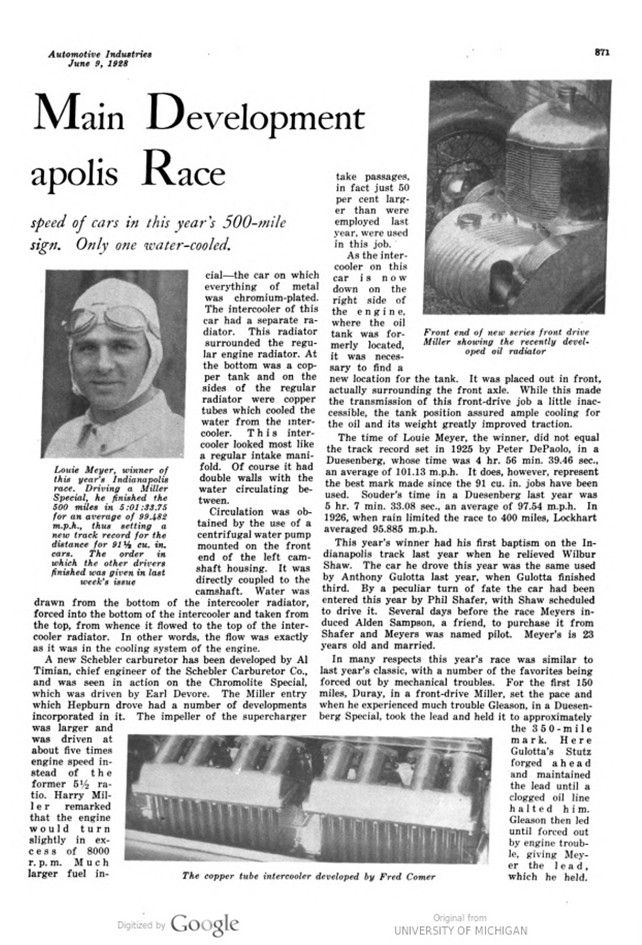
An intercooler developed by Fred Comer and used on the No. 25 Boyle Valve Special was made of copper tubes. There were 72 of the tubes, each about 9 in. long and ½ in. in diameter. As will be seen, these are assembled about like the tubes in a Ford radiator except that there are no fins. These 72 tubes were divided into two groups, one group for each block of four cylinders. The mixture for the engine was delivered by the supercharger to a bottom passageway to which the tubes were attached. Up through these copper tubes the mixture passed on its way to the cylinders. As this intercooler was directly in line with the cooling air that passed through the radiator, the device was quite effectual.
Speaking of getting the direct draft of air, one should note what bulged from the right side of the engine on Duray’s Miller Special, with which he spectacularly beat the former track record of 120.1 m.p.h. held by Frank Lockhart when he turned one lap at 124.018 m.p.h. and qualified at 122.319 for four laps. Here was another type of intercooler which caused the incoming charge, hot from the supercharger, to turn a couple of right angles, striking the cooling surfaces and hence cool down and contract a bit so that more fuel could be forced in for each explosion.
The Duesenberg development in an intercooler this year consisted of four down-draft passages, each liberally finned and placed in line on the left side of the engine. The supercharger drew the air in through the Winfield carburetor and forced the charge up through the center passage of the intercooler to the header. From here it was distributed to each of the four passages for cooling before entering the engine.
Only one water-cooled intercooler appeared. It was seen on the sparkling Chromolite Special – the car on which everything of metal was chromium-plated. The intercooler of this car had a separate radiator. This radiator surrounded the regular engine radiator. At the bottom was a copper tank and on the sides of the regular radiator were copper tubes which cooled the water from the intercooler. This inter- cooler looked most like a regular intake manifold. Of course, it had double walls with the water circulating between.
Circulation was obtained by the use of a centrifugal water pump mounted on the front end of the left cam- shaft housing. It was directly coupled to the camshaft. Water was drawn from the bottom of the intercooler radiator, forced into the bottom of the intercooler and taken from the top, from whence it flowed to the top of the intercooler radiator. In other words, the flow was exactly as it was in the cooling system of the engine.
A new Schebler carburetor has been developed by Al Timian, chief engineer of the Schebler Carburetor Co., and was seen in action on the Chromolite Special, which was driven by Earl Devore. The Miller entry which Hepburn drove had a number of developments incorporated in it. The impeller of the supercharger was larger and was driven at about five times engine speed instead of the former 5½ ratio. Harry Miller remarked that the engine would turn slightly in excess of 8000 r. p. m. Much larger fuel intake passages, in fact just 50 per cent larger than were employed last year, were used in this job.
As the intercooler on this car is now down on the right side of the engine, where the oil tank was formerly located, it was necessary to find a new location for the tank. It was placed out in front, actually surrounding the front axle. While this made the transmission of this front-drive job a little inaccessible, the tank position assured ample cooling for the oil and its weight greatly improved traction.
The time of Louie Meyer, the winner, did not equal the track record set in 1925 by Peter DePaolo, in a Duesenberg, whose time was 4 hr. 56 min. 39.46 sec., an average of 101.13 m.p.h. It does, however, represent the best mark made since the 91 cu. in. jobs have been used. Souder’s time in a Duesenberg last year was 5 hr. 7 min. 33.08 sec., an average of 97.54 m.p.h. In 1926, when rain limited the race to 400 miles, Lockhart averaged 95.885 m.p.h.
This year’s winner had his first baptism on the Indianapolis track last year when he relieved Wilbur Shaw. The car he drove this year was the same used by Anthony Gulotta last year, when Gulotta finished third. By a peculiar turn of fate, the car had been entered this year by Phil Shafer, with Shaw scheduled to drive it. Several days before the race Meyers induced Alden Sampson, a friend, to purchase it from Shafer and Meyers was named pilot. Meyer’s is 23 years old and married. In many respects this year’s race was similar to last year’s classic, with a number of the favorites being forced out by mechanical troubles. For the first 150 miles, Duray, in a front-drive Miller, set the pace and when he experienced much trouble Gleason, in a Duesenberg Special, took the lead and held it to approximately the 350-mile mark. Here Gulotta’s Stutz forged a head and maintained the lead until a clogged oil line halted him. Gleason then led until forced out by engine trouble, giving Mey- er the lead, which he held
Photos.
Page 870.
The only water-cooled intercooler in the race was used on the Chromolite Special, a chromium-plated car. Notice the water pump at the front of the camshaft housing on the top of the engine
The intercooler as developed originally by Frank Lockhart and used on the Simplex Piston Ring Special
Page 871.
Louie Meyer, winner of this year’s Indianapolis race. Driving a Miller Special, he finished the 500 miles in 5:01:33.75 for an average of 99.482 m.p.h., thus setting new track record for the distance for 9½ cu. in. cars. The order in which the other drivers finished was given in last week’s issue
Front end of new series front drive Miller showing the recently developed oil radiator
The copper tube intercooler developed by Fred Comer