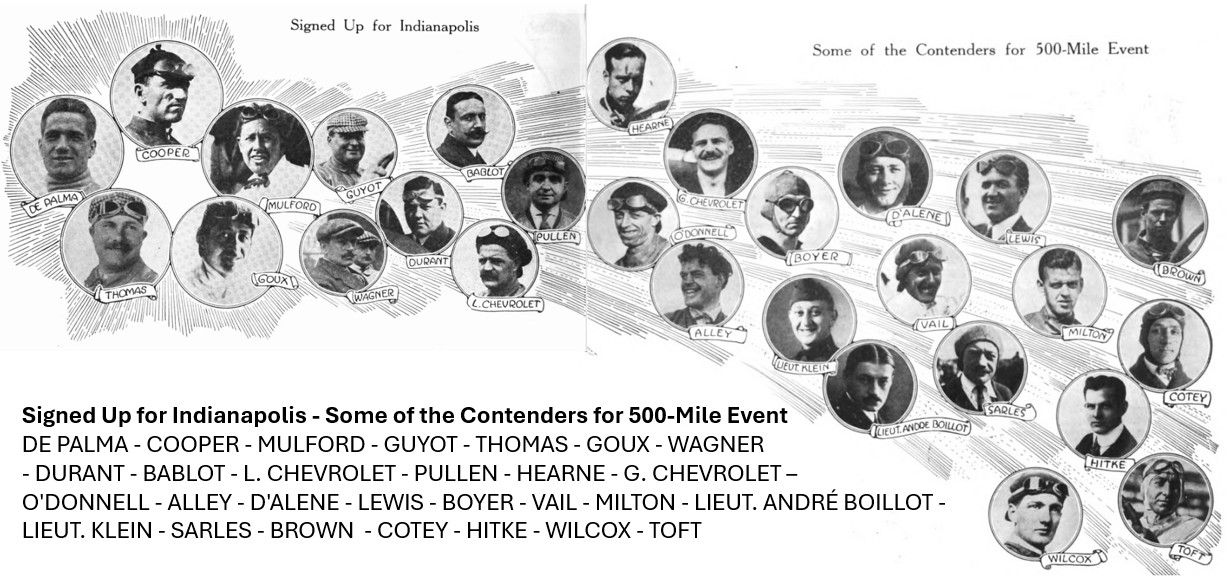
Here now a summary of all 29 race drivers who participated in the 1929 Liberty Sweepstakes. How were the caled in these days? The Valliant Knights of Horspower? How pathtetically their designations might have been in those days, they all took large risks and not all survived the challenges. This race unfortunately, two drivers and one mechanic would not survive. Names of the mechanics are not revealed., as they deserve the same glory of honour.
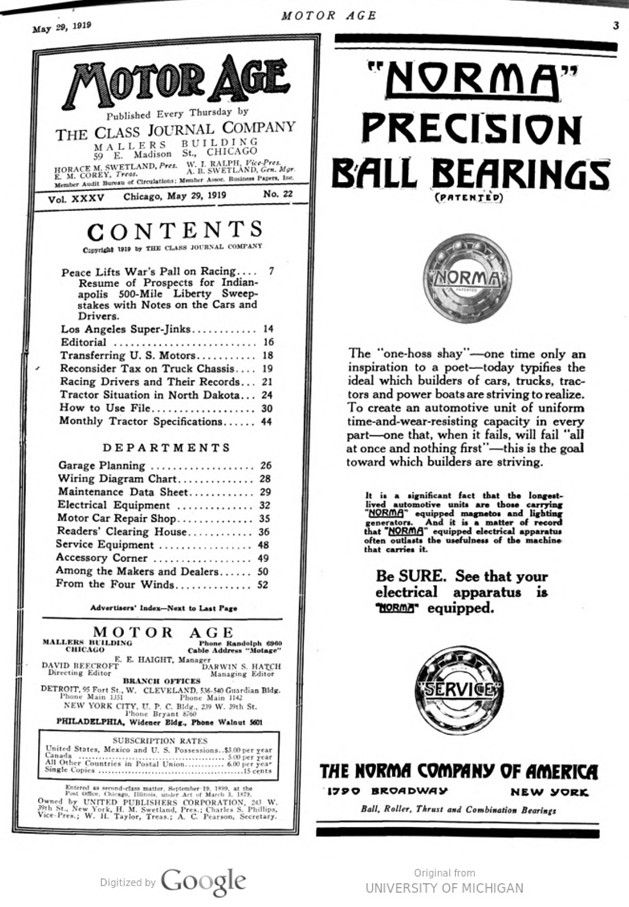
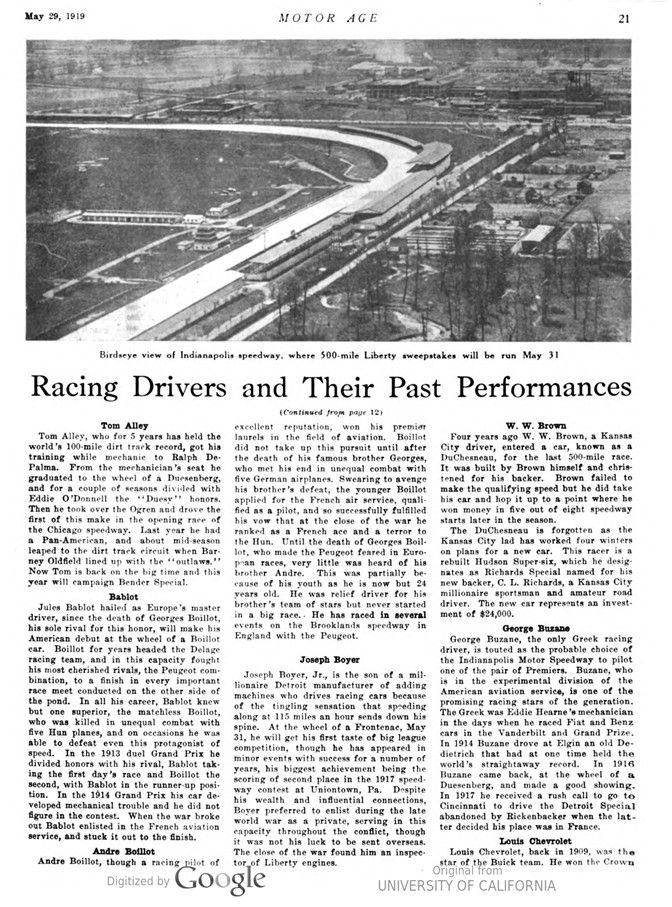
Text and jpegs by courtesy of hathitrust.org www.hathitrust.org, compiled by motorracinghistory.com
MOTOR AGE – Vol. XXV 35, No. 22, May 29, 1919
Racing Drivers and Their Past Performances
(Page 21, Continued from Page 12)
Tom Alley
Tom Alley, who for 5 years has held the world’s 100-mile dirt track record, got his training while mechanic to Ralph DePalma. From the mechanician’s seat he graduated to the wheel of a Duesenberg, and for a couple of seasons divided with Eddie O’Donnell the „Duesy“ honors. Then he took over the Ogren and drove the first of this make in the opening race of the Chicago speedway. Last year he had a Pan-American, and about mid-season leaped to the dirt track circuit when Barney Oldfield lined up with the „outlaws.“‚ Now Tom is back on the big time and this year will campaign Bender Special.
Bablot
Jules Bablot, hailed as Europe’s master driver, since the death of Georges Boillot, his sole rival for this honor, will make his American debut at the wheel of a Boillot car. Boillot for years headed the Delage racing team, and in this capacity fought his most cherished rivals, the Peugeot combination, to a finish in every important race meet conducted on the other side of the pond. In all his career, Bablot knew but one superior, the matchless Boillot, who was killed in unequal combat with five Hun planes, and on occasions he was able to defeat even this protagonist of speed. In the 1913 duel Grand Prix he divided honors with his rival, Bablot taking the first day’s race and Boillot the second, with Bablot in the runner-up position. In the 1914 Grand Prix his car developed mechanical trouble and he did not figure in the contest. When the war broke out Bablot enlisted in the French aviation service and stuck it out to the finish.
Andre Boillot
Andre Boillot, though a racing pilot of excellent reputation, won his premier laurels in the field of aviation. Boillot did not take up this pursuit until after the death of his famous brother Georges, who met his end in unequal combat with five German airplanes. Swearing to avenge his brother’s defeat, the younger Boillot applied for the French air service, qualified as a pilot, and so successfully fulfilled his vow that at the close of the war he ranked as a French ace and a terror to the Hun. Until the death of Georges Boillot, who made the Peugeot feared in European races, very little was heard of his brother Andre. This was partially because of his youth as he is now but 24 years old. He was relief driver for his brother’s team of stars but never started in a big race. He has raced in several events on the Brooklands speedway in England with the Peugeot.
Joseph Boyer
Joseph Boyer, Jr., is the son of a millionaire Detroit manufacturer of adding machines who drives racing cars because of the tingling sensation that speeding along at 115 miles an hour sends down his spine. At the wheel of a Frontenac, May 31, he will get his first taste of big league competition, though he has appeared in minor events with success for a number of years, his biggest achievement being the scoring of second place in the 1917 speedway contest at Uniontown, Pa. Despite his wealth and influential connections, Boyer preferred to enlist during the late world war as a private, serving in this capacity throughout the conflict, though it was not his luck to be sent overseas. The close of the war found him an inspector of Liberty engines.
W. W. Brown
Four years ago W. W. Brown, a Kansas City driver, entered a car, known as a DuChesneau, for the last 500-mile race. It was built by Brown himself and christened for his backer. Brown failed to make the qualifying speed, but he did take his car and hop it up to a point where he won money in five out of eight speedway starts later in the season.
The DuChesneau is forgotten as the Kansas City lad has worked four winters on plans for a new car. This racer is a rebuilt Hudson Super-six, which he designates as Richards Special named for his new backer, C. L. Richards, a Kansas City millionaire sportsman and amateur road driver. The new car represents an investment of $24,000.
George Buzane
George Buzane, the only Greek racing driver, is touted as the probable choice of the Indianapolis Motor Speedway to pilot one of the pair of Premiers. Buzane, who is in the experimental division of the American aviation service, is one of the promising racing stars of the generation. The Greek was Eddie Hearne ’s mechanician in the days when he raced Fiat and Benz cars in the Vanderbilt and Grand Prize. In 1914 Buzane drove at Elgin an old De Dietrich that had at one time held the world’s straightaway record. In 1916 Buzane came back, at the wheel of a Duesenberg, and made a good showing. In 1917 he received a rush call to go to Cincinnati to drive the Detroit Special abandoned by Rickenbacker when the latter decided his place was in France.
Louis Chevrolet
Louis Chevrolet, back in 1909, was the star of the Buick team. He won the Crown Point, Ind., race for the Cobe Cup. He had a long lead on the field when he was forced into the pits by the smashing of one piston. The mechanic disconnected the rod for the dead cylinder from the crankshaft, persuaded Chevrolet that the car could win on three and while the Franco-Swiss could not approach his average early in the race he had enough margin to win. Chevrolet flashed across the horizon of the speed world as a star in the days when he with the late Bob Burman and Louis Strang made up the Buick team. After a terrible accident in the 1910 or Vanderbilt Cup race he retired and set to work designing and building the car that bears his name. However, in 1915 he got back on the big time driving a Cornelian car. This was a light creation that did not stand the grind of 500 miles at Indianapolis. The next year, with Joe Boyer, the Detroit millionaire, he built the first three Frontenacs. These built almost entirely of an aluminum alloy, even to the rear axle housing. He won two races at Uniontown and the 1917 Memorial Day event at Cincinnati with this car.
Gaston Chevrolet
Gaston Chevrolet, junior member of the sensational Chevrolet family, will team with his elder brother Louis at the wheel of a Frontenac, together with Ralph Mulford and Joseph Boyer, Jr. Gaston has already demonstrated that he is a racing star of first caliber, being awarded third place in the 1917 Memorial Day Race at Cincinnati, after having figured that he was entitled to second. In 1918, Chevrolet went outlaw, along with Barney Oldfield, Earl Cooper and Louis Disbrow, campaigning the western dirt tracks, and his reinstatement in the ranks of A. A. A. drivers is only of recent origin.
Earl Cooper
Six seasons ago, in 1913, Earl Cooper gained the title of road-race champion of 1913 by winning five out of six big high- way events in which he started. He uses a Stutz. Cooper fought hard to win the last 500-mile race but could not overtake the flying de Palma and Resta, when the former won in 1915. Cooper however came in fourth just behind his teammate Gil Anderson. A few weeks later Cooper scored a 500-mile win on the rough course at Minneapolis. After the 1915 campaign the Stutz factory gave up its racing team and Cooper purchased his own car.
Wilbur D’Alene
his last two starts at Indianapolis, D’Alene finished second and third in a 300-and a 100-mile race, respectively. D’Alene took up racing a few years ago because it furnished new thrills. After several dirt track races, he essayed to show the major leaguers a few stunts and entered a race on the old dirt speedway at Tacoma. He went out, took the lead, and drove like a fiend. Soon his car hurtled from the track in a cloud of dust. D’Alene emerged from the wreck without serious injury. Back in 1916, the last season of racing that really counted, D’Alene finished sixth in the A. A. A. championship.
In two of the major events of the season, he romped home as runner-up, finishing two minutes behind Resta in the Indianapolis 300-mile race and four minutes behind Aitken in the Cincinnati 300-miler that opened the Sharonville board oval. Five days later he was third in the 100-mile event of the Harvest Auto Racing Classic on the Indianapolis oval. He took seventh place the same year in the Chicago 300-mile finishing eleven minutes behind Resta’s winning Peugeot.
This year D’Alene will again drive a 1916 model Duesenberg. He has formed a partnership with William Vetere, of Brooklyn, N. Y., and will race the car all season.
Ralph de Palma
This will be the sixth 500-mile race that de Palma has entered at Indianapolis and the third time that he has named an American-made car. In the 1911 event he drove a Simplex to sixth place, in 1913 his Mercer failed early in the race, his only starts with Yankee racers. In the 1912 race his Mercedes faltered with two laps to go to victory, in 1914 his Mercedes did not start, being damaged in qualifying, while in 1915 he scored a victory in the last 500-mile with the Grand Prix Mercedes.
The Packard has proved its metal in two seasons of racing and scored its most spectacular win last August on the Sheepshead Bay Speedway, when its Italian pilot put it over the jumps for five victories in five starts. In the day’s racing it won the two, 10, 20, 30 and 50-mile races and set new world’s records for the two 10, 30 and 50-mile marks in competition. That the car has speed is shown by its average of 111.1 miles an hour in the 10-mile event.
At the close of the 1917 season de Palma spent almost a month at the Sheepshead Bay track hanging up new non-competitive records for the one hour, 10-mile, six hours and all distances from 10 to 600 miles.
This is not the car, however, that de Palma used to gain the world’s records on the Daytona Beach during the winter.
Clifford Durant
The son of W. C. Durant, the General Motors head, in private life is the sedate manager of the Chevrolet factory in Oakland, Cal. As a racer he is far from conservative. It is Durant’s first start in an Indianapolis 500 and it is also reported that he has promised his father that he will retire from the racing game after he has had this opportunity to prove himself a master pilot and win the biggest race in the speed world. He drives a Chevrolet special and won the title of western champion at Tacoma last summer and won the Santa Monica event later.
Jules Goux
Jules Goux will drive a Peugeot, famous on two continents. The car that Goux will face the starter with is the same that Georges Boillot drove in the last French Grand Prix in 1914 and with which he gave the German Lautenschlager the battle of his life on the tortuous course near Amiens, France.
Goux, who was the first foreign driver to win the Hoosier classic, copped the 500-mile race in 1913 and took the Wheeler-Schebler and Prest-O-Lite trophies to France.
Goux wears a wound stripe, having been struck by a shell splinter in his left hand during the bombardment of Belfort in. 1915, where he was stationed as an artillery lieutenant. He served as artillery lieutenant during the entire war.
Albert Guyot
Albert Guyot, member of the formidable Ballot team, has competed on the big Hoosier oval on two previous occasions, taking a fourth in the 1913 500-mile race, and a third in 1914. Hard luck has deprived Guyot of the fame enjoyed by his brilliant associates in the Ballot lineup, all of whom are racing stars of first magnitude. At the outbreak of the world war Guyot went to the front as member of an infantry regiment, but later, because of his mechanical experience, was transferred to the French aviation service, in which he qualified as a pilot and instructor, serving in this capacity for the remainder of the war. The French put him into the schools until they discovered that he knew more about flying than his instructors. He was then sent as instructor to the aerial gunnery and acrobatics school at Cazeau.
Eddie Hearne
Eddie Hearne once a member of the famous Benz and Fiat racing team that swept the boards, is the lone survivor of the millionaire drivers of a decade ago. He has been nominated by Cliff Durant to drive the second Chevrolet Special which took second place in the recent Santa Monica road race of 250 miles. That Hearne can make the Chevrolet do tricks was shown in the first race in which he took the Chevrolet No. 2, and went through the race without a stop. Durant had the faster car and nosed Hearne out, despite a loss of 52 seconds at the pits in two stops.
Kurt Hitke
Although Kurt Hitke, who has been nominated to drive the Roamer-Duesenberg in the 500-mile Liberty Sweepstakes at Indianapolis, May 31, is starting in his first major league race as a driver, he is not a novice. Before he came to this country he was a successful rider in bicycle and motorcycle races in Europe. During 1916 while a member of the Duesenberg team, Hitke rode as mechanic to Ralph Mulford and Wilbur D’Alene. He also sat beside Earl DeVore for a part of that year’s races. In 1917 he was Pete Henderson’s mechanic until the Canadian speed merchant entered the aviation service. Last season he rode with Tommy Milton.
Lieut. Arthur Klein
Airplane tactics in track racing will receive exposition at the hands of Lieut. Arthur Klein, the first American army officer and aviator to enter that event. Lieut. Klein is by no means a newcomer to the Indianapolis classic, having competed in the 1914 and 1915 five century events, at the wheel of a King car. The maize and blue colors he sported on those occasions he will wear again this year, in honor of the Detroit Automobile Club, which he will represent. His car is a Peugeot, a mate to the car in which Dario Resta won the 1916 driver’s championship and to the car which Jules Goux, winner of the 1913 Indianapolis event, will drive in this year’s contest.
Lieutenant Klein is newly returned from France. His entry is made by Frank P. Book, who backed de Palma in 1916.
Dave Lewis
Dave Lewis, member of the Duesenberg team is a veteran of the racing game, having made his debut on the dirt track at Brighton Beach, N. Y., many years ago. Lewis was seen at the wheel of Stutz cars for several seasons, always driving a hard, consistent race, and usually finishing well up among the winners. Prior to the outbreak of the war, he drove on the Premier team backed by the Indianapolis Motor Speedway.
J. J. McCoy
J. J. McCoy, of Ortonville, Minn., competed at the Indianapolis track once before, as a member of the Velie team in the inaugural contest on the brick oval in 1911 without getting into the money, however. During the last few years McCoy has been appearing with success in dirt track contests throughout the northwest, and he also competed in a couple of the events held on the Minneapolis speedway.
Tommy Milton
Milton comes from St. Paul, having made his debut as a professional at Sioux City in 1913. He gained his experience on the dirt tracks, first campaigning a Mercer and later joining the barnstorming crew with the Case team under the management of Alex Sloan. Later he returned to the big time at the wheel of a Duesenberg, finishing fourth in 1916 at Minneapolis, third at Omaha and second at Tacoma and tenth in the Astor Cup classic at New York, winning sixth place in the A. A. A. championship. The next season he finished fourth at the Cincinnati Memorial Day sweepstakes. His latest achievement was winning the Uniontown speedway race May 19, this year.
Ralph Mulford
Starting his racing career in 1907, Mulford won the 24-hour race on the Point Breeze track in Philadelphia. In his debut he was merely relief driver for Harry Michner but succeeded in winning the race. For years he was one of the most feared race drivers when the road race was king in the speed sport. He won the opening race at Elgin in 1910, and a year later annexed the Vanderbilt Cup at Savannah. He won three 24-hour races after his start at Philadelphia. In 1910 he had a unique record, either winning or finishing fifth or better in every race of the season. In 1912 he finished tenth with a Knox, in 1913 he was seventh with a Mercedes and in 1914 eleventh in the same car. In 1915 he failed for the first time to complete the five centuries going only half way. In the 1916 championship, Mulford finished tenth and gained his first points by finishing third to Dario Resta in the Indianapolis race both driving Peugeot cars. Later in the season he brought out the first Hudson racer and was the star of the Hudson’s crack team in 1917 which was abandoned when the factory started war work. Last year he drove a Frontenac, purchasing the car to finish the 1917 season. Ralph won two Uniontown Speedway races last summer and was second to de Palma in a series of five sprint races at New York.
Eddie O’Donnell
Eddie O’Donnell, the star of the Duesenberg team three and four seasons back, has been out of the game since the race on Kansas City’s dirt speedway in the summer of 1916 when he sustained a broken arm. The arm was set but the bone would not knit and after having it rebroken three times O’Donnell has finally succeeded in getting it in shape.
The first big race of the 1916 season went to O’Donnell, in a Duesenberg, at Corona. It was at this race that the late Bob Bur- man met his fate. During the 1915 season he made eight starts; came in second twice, came in third three times, annexed fifth place once and finished seventh once, and was unplaced once.
Eddie Pullen
Eddie Pullen, who holds the American and world’s road race record of 87.8 m.p.h., established at Corona, Cal., in 1914, has handled a Mercer ever since he joined the Mercer crew as mechanic nearly ten years ago. Pullen first took the wheel in a big race in the 1913 Vanderbilt and Grand Price. In the latter race he sprang from the role of relief driver to the position of American long-distance road race champion.
Roscoe Sarles
The man who takes Barney Oldfield’s place at the wheel of the Oldfield Special has been active in racing in the West for several years. He drove in and promoted dirt track events before joining Louis Chevrolet in helping to build the Frontenac cars. He rode with Chevrolet for two seasons and then drove the Frontenac at Minneapolis in 1918, finishing fourth. He then did experimental work on airplane engines and government equipment orders for Harry Miller. Sarles won the Ascot Park speedway race in January this year in the Roamer Special, finishing 2 miles ahead of the nearest competitor. He won the Washington’s Birthday sweepstakes at Bakersfield, establishing a record for that track, and won the Ascot Park race in March, establishing a new track record.
Rene Thomas
Rene Thomas, head of the French Ballot team that rules a favorite, is well known to American followers of the sport because of his victory in the Indianapolis 1914 500-mile race, when he triumphed over the most formidable field of American and European drivers ever assembled in this country. Thomas broke into the racing game as a bicycle rider, like most of the veteran stars of the gasoline pastime and won an enviable reputation for himself in the early days at the wheel of Delage, Peugeot and Rochet-Schneider cars. His victory at Indianapolis was the major achievement of his career, stamping him as one of the foremost drivers of both the old world and the new. At the outbreak of the world war, Thomas entered the French aviation service, with which he remained throughout as pilot and instructor.
Robert Laly, who rode with Rene Thomas when he won the Indianapolis 1914 500- mile race and will sit beside him again this year, spent most of the four years of the recent world war in a German prison camp, having been captured in 1914.
Omar Toft
Omar Toft, one of California’s hopes in the Indianapolis 500-mile Liberty Sweepstakes, May 31, entered his car under the rather odd name of Darco Special. Thereby hangs a tale. Recently Toft and his car took part in a photoplay entitled „The Roaring Road.“ The name bestowed on the car in the manuscript of the play was the Darco Special.
Ira Vail
Ira Vail, the Brooklyn youth who stamped himself as a star driver in the Metropolitan Cup Race at Sheepshead Bay three years ago, has entered his Hudson Super-Six. This is the first time that Vail has made a bid for Indianapolis. During 1916, with a stock demonstrator that he had converted into a race car, Vail had made a consistent showing with the Hudson and really proved to the factory the possibilities of its engine for speed work. During that year he scored enough points to land fourteenth in the A. A. A. driving championship, with two-thirds at Sheepshead Bay and places in two Chicago events. During 1917 he scored a victory at Minneapolis; got second place in the Cincinnati 300-mile race, and also in two Providence races and at Uniontown; tallied a third at Uniontown; a fifth at Sheepshead Bay, and an eighth at Chicago.
Louis Wagner
Louis Wagner, veteran member of the Ballot team, is to European automobile racing what Honus Wagner was to baseball or Barney Oldfield to American speed sport – the grand old man of the game. Wagner was already a star when the present flock of European speed contenders was learning to hold a steering wheel, dividing honors in the Gordon-Bennett cup races, the Paris-Madrid contests and the Targa Florio road events with such old-time celebrities as Lancia, Hemery and Jenatzy. Altogether Wagner’s racing career covers a span of more than 15 years, during which he has started in nearly all of the important contests of Europe, and, in the early days of American racing, participated in the big road events on this side of the Atlantic as well, winning the 1906 Vanderbilt on Long Island and the 1908 Grand Prize at Savannah. Despite the Teutonic ring of Wagner’s name, he is French by birth and education. He served in the French artillery during 1914 and 1915. Later he was transferred to the air service and made a test pilot.
Howard Wilcox
Howard Wilcox, the last of a celebrated vintage of Hoosier racing stars, will team with Jules Goux at the wheel of an Indianapolis speedway-owned Peugeot. Wilcox must be figured as one of the most dangerous contenders in the field, as he is thoroughly at home on the Indianapolis track, where he received his early schooling, and has to his credit the fastest official lap ever turned on the big brick saucer in a racing car of the type eligible to this year’s contest, with one exception. This was in 1915, when he completed the 22-mile circuit in 1:31, a speed of 99 m.p.h. The last year that Wilcox engaged in competition, before the speedway abandoned racing in 1916, Wilcox handled a Premier, one of the cars that he may drive in this year’s Indianapolis event. He scored one win, on the dirt track at Sioux City.