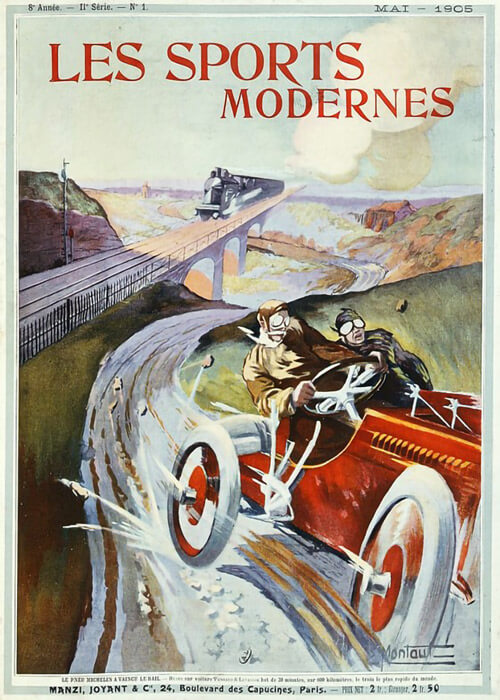
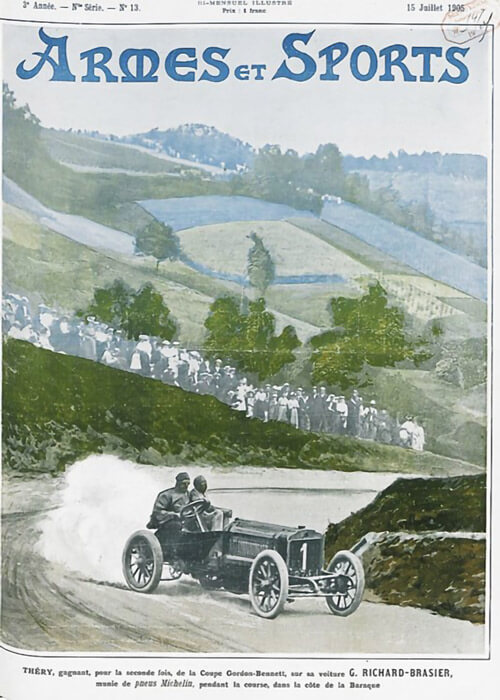
The Scientific American published a report on the Paris-Berlin race some three weeks later than the French L’Illustration, applying several pen paintings of the French partner. A very extensive list of the finishing cars and drivers, as well as a comprehensive race report are given here.
Text and jpegs by courtesy of hathitrust.org www.hathitrust.org, compiled by motorracinghistory.com
Scientific American Supplement, Vol. LII, No. 1334, July 27, 1901
Paris-Berlin Motor Carriage Race
THE Paris-Berlin motor carriage race, from the point of view of its great distance, was the most important ever run, although the speeds were hardly as great as in the Paris-Bordeaux race. There are, however, many reasons why a greater speed was not obtained. In the first place, the distance was much greater; secondly, the roads were not as good, and, finally, great precautions had to be taken in running through the cities and towns, which served to materially reduce the running time. All of the towns and many of the villages on the route of the journey were „neutralized,“ each carriage being piloted by cyclist marshals at slow speed until the outer limit was reached. The competition was divided into three classes: Class A, for touring carriages whose owners wished to show the merits of the various systems; Class B, for touring carriages whose owners did not desire any restrictions, and Class C, for racing cars. The first two classes started five days earlier than the racing cars, and the distance was covered in eight laps which varied from 79 to 128 miles in length.
The route was via Rheims, Luxembourg, Coblentz, Frankfort, Eisenach, Leipzig, Potsdam, to Berlin. Little attention was paid to their doings, although the Kaiser caused to be erected for their benefit a military bridge across the Moselle at Treves-the first indication of the amity which was subsequently so abundantly displayed.
It was the speed brigade, however, which aroused the liveliest interest on the route. The racing class took an entirely different route, starting on Thursday, June 27, instead of the preceding Saturday: The distance was divided into three sections: Paris to Aix-la-Chapelle, 282 miles; Aix-la-Chapelle to Hanover, 276 miles; Hanover to Berlin, 184 miles. For a fortnight before the race the vague odor of petroleum was hanging about the streets and boulevards, and day and night were made hideous by the exhaust of the autocars and the tooting of trumpets. The Auto-Velo, the daily journal devoted to the interests of the sport, came out as an eight-page paper and published a special edition in the evening giving the results of each day’s race.
Nothing in the sporting world has created such interest in years as this race, although the automobile has never been popular with a large mass of the inhabitants of Paris, and they are simply detested by the peasants. These wild races from one end of France to the other are beginning to wear upon their nerves.
One hundred and seventy vehicles entered for the race, and their motors were of all sizes up to 70 horsepower. Out of the 170 machines entered, 110 started from Champigny, near Paris. Among them were forty large racing cars, forty-eight light carriages and ten motorcycles. Forty of the racing cars made the trip successfully from the banks of the Marne to the banks of the Spree, including eleven light carriages, four voiturettes and four motorcycles. At the starting place, and for miles up and down the road, enormous throngs were gathered. Several hundred motor carriages which were not entered for the race carried their occupants to see the start, and the gay parties breakfasted by lantern light. The racing vehicles stretched half a mile along the road. The photographers were kept busy making negatives by limelight. Finally, the machine of Fournier started amid the cheers of the crowd. The same stirring scene was repeated every two minutes until 7 o’clock in the morning, when the last of the horseless vehicles had started. The crowd was particularly enthusiastic when Mme. Du Gast, the only woman racing, wearing a gray leather costume and a heavy dust veil, wound up the procession.
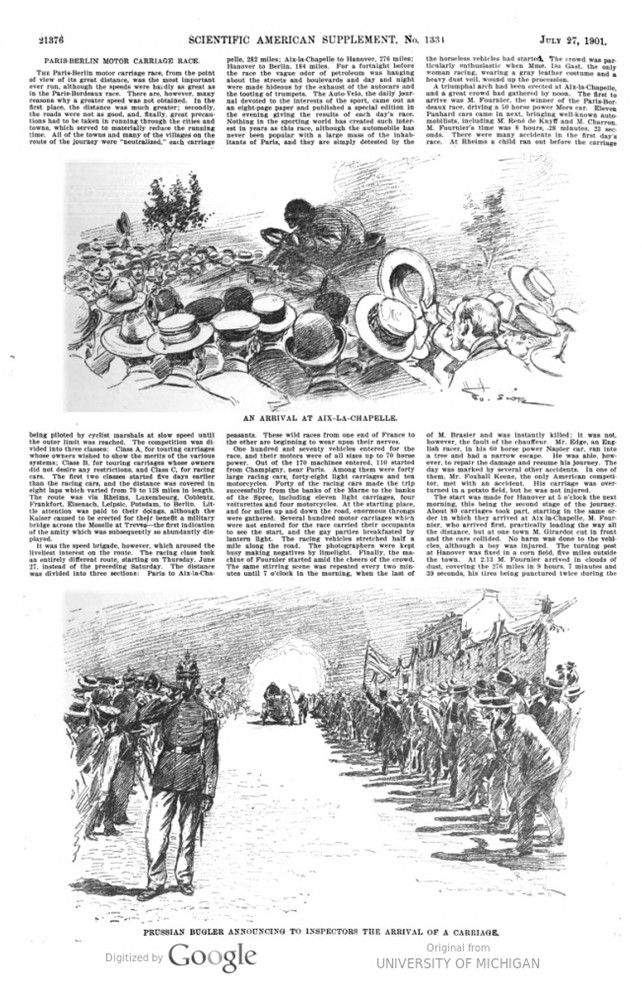
A triumphal arch had been erected at Aix-la-Chapelle, and a great crowd had gathered by noon. The first to arrive was M. Fournier, the winner of the Paris-Bordeaux race, driving a 50 horsepower Mors car. Eleven Panhard cars came in next, bringing well-known automobilists, including M‘. Rene de Knyff and M. Charron. M. Fournier’s time was 8 hours, 28 minutes, 23 seconds. There were many accidents in the first day’s race. At Rheims a child ran out before the carriage of M. Brasier and was instantly killed; it was not, however, the fault of the chauffeur. Mr. Edge, an English racer, in his 60 horsepower Napier car, ran into a tree and had a narrow escape. He was able, however, to repair the damage and resume his journey. The day was marked by several other accidents. In one of them, Mr. Foxhall Keene, the only American competitor, met with an accident. His carriage was ‚Overturned in a potato field, but he was not injured.
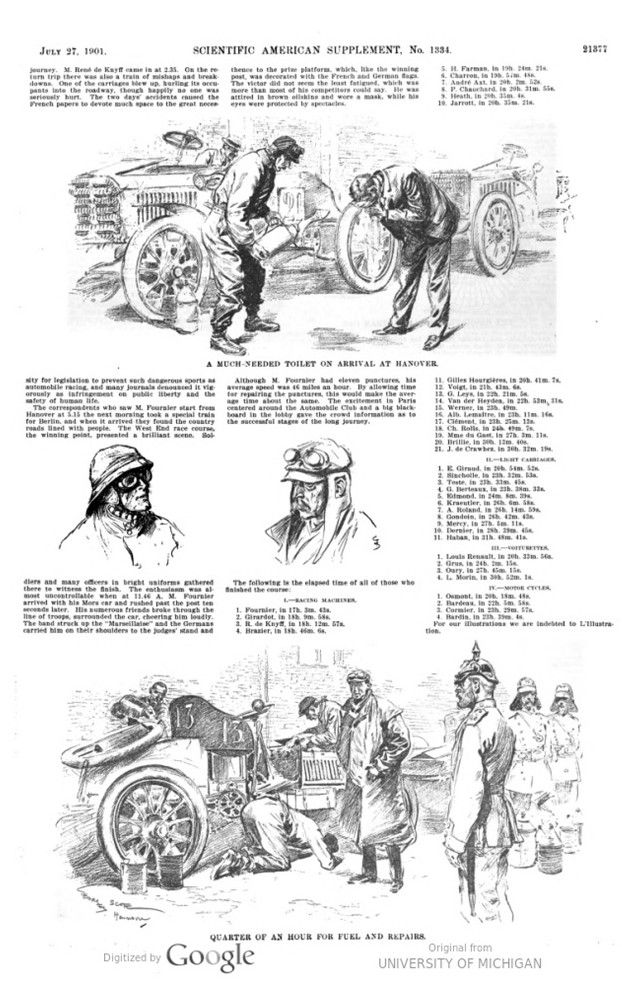
The start was made for Hanover at 5 o’clock the next morning, this being the second stage of the journey. About 80 carriages took part, starting in the same order in which they arrived at Aix-la-Chapelle, M. Fournier, who arrived first, practically leading the way all the distance, but at one town M. Girardot cut in front and the cars collided. No harm was done to the vehicles, although a boy was injured. The turning post at Hanover was fixed in a corn field, five miles outside the town. At 2.13 M. Fournier arrived in clouds of dust, covering the 276 miles in 9 hours, 7 minutes and 39 seconds, his tires being punctured twice during the journey. M. Rene de Knyff came in at 2.35. On the return trip there was also a train of mishaps and breakdowns. One of the carriages blew up, hurling its occupants into the roadway, though happily no one was seriously hurt. The two days‘ accidents caused the French papers to devote much space to the great necessity for legislation to prevent such dangerous sports as automobile racing, and many journals denounced it vigorously as infringement on public liberty and the safety of human life.
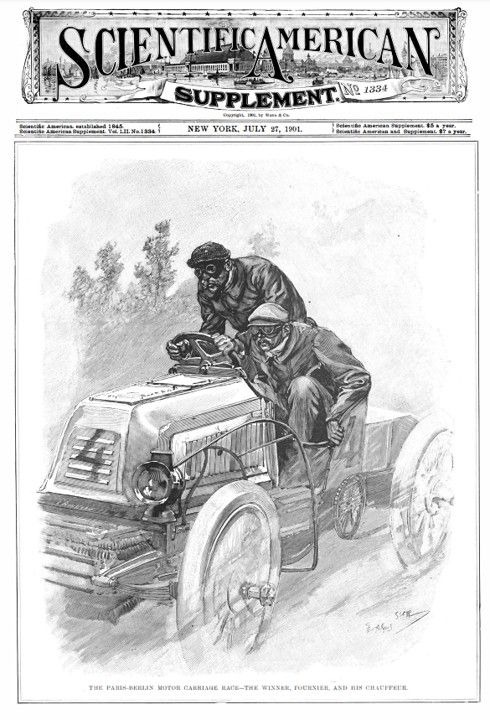
The correspondents who saw M. Fournier start from Hanover at 5.15 the next morning took a special train for Berlin, and when it arrived, they found the country roads lined with people. The West End racecourse, the winning point, presented a brilliant scene. Soldiers and many officers in bright uniforms gathered there to witness the finish. The enthusiasm was almost uncontrollable when at 11.46 A. M. Fournier arrived with his Mors car and rushed past the post ten seconds later. His numerous friends broke through the line of troops, surrounded the car, cheering him loudly. The band struck up the „Marseillaise“ and the Germans carried him on their shoulders to the judges‘ stand and thence to the prize platform, which, like the winning post, was decorated with the French and German flags. The victor did not seem the least fatigued, which was more than most of his competitors could say. He was attired in brown oilskins and wore a mask, while his eyes were protected by spectacles. Although M. Fournier had eleven punctures, his average speed was 46 miles an hour. By allowing time for repairing the punctures, this would make the average time about the same. The excitement in Paris centered around the Automobile Club and a big blackboard in the lobby gave the crowd information as to the successful stages of the long journey.
The following is the elapsed time of all of those who finished the course:
I. – RACING MACHINES.
1. Fournier, in 17h. 3m. 43s.
2. Girardot, in 18h. 9m. 58s.
3. R. de Knyff, in 18h. 12m. 57s.
4. Brazier, in 18h. 46m. 6s.
5. H. Farman, in 19h. 24m. 21s.
6. Charron, in 19h. 57m. 48s.
7. André Axt, in 20h. 2m. 52s.
8. P. Chauchard, in 20h. 31m. 55s.
9. Heath, in 20h. 35m. 4s.
10. Jarrott, in 20h. 35m. 21s.
11. Gilles Hourgières, in 20h. 41m. 7s.
12. Voigt, in 21h. 43m. 6s.
13. G. Leys, in 22h. 21m. 5s.
14. Van der Heyden, in 22h. 53m. 31s.
15. Werner, in 23h. 49m.
16. Alb. Lemaitre, in 23h. 11m. 16s.
17. Clement, in 23h. 25m. 13s.
18. Ch. Rolls, in 24h. 49m. 7s.
19. Mme du Gast, in 27h. 3m. 11s.
20. Brillie, in 30h. 13m. 40s.
21. J. de Crawhez, in 30h. 32m. 19s.
II. – LIGHT CARRIAGES.
1. E. Giraud, in 20h. 54m. 52s.
2. Sincholle, in 23h. 32m. 53s.
3. Teste, in 23h. 33m. 45s.
4. G. Berteaux, in 23h. 38m. 33s.
5. Edmond, in 24m. 8m. 39s.
6. Kraeutler, in 26h. 6m. 58s.
7. A. Roland, in 26h. 14m. 59s.
8. Gondoin, in 26h. 42m. 43s.
9. Mercy, in 27h. 5m. 11s.
10. Dernier, in 28h. 39m. 45s.
11. Haban, in 31h. 48m. 41s.
III.- VOITURETTES,
1. Louis Renault, in 20h. 33m. 56s.
2. Grus, in 24h. 2m. 15s.
3. Oury, in 27h. 45m. 15s.
4. L. Morin, in 30h. 52m. 1s.
IV.- MOTOR CYCLES.
1. Osmont, in 20h. 18m. 48s.
2. Bardeau, in 22h. 5m. 58s.
3. Cormier, in 23h. 29m. 57s.
4. Bardin, in 23h. 39m. 4s.
For our illustrations we are indebted to L’Illustration.
Photos.
front.
THE PARIS-BERLIN MOTOR CARRIAGE RACE – THE WINNER, FOURNIER, AND HIS CHAUFFEUR.
Page 21376.
AN ARRIVAL AT AIX-LA-CHAPELLE. – PRUSSIAN BUGLER ANNOUNCING TO INSPECTORS THE ARRIVAL OF A CARRIAGE,
Page 21377.
A MUCH-NEEDED TOILET ON ARRIVAL AT HANOVER – QUARTER OF AN HOUR FOR FUEL AND REPAIRS.