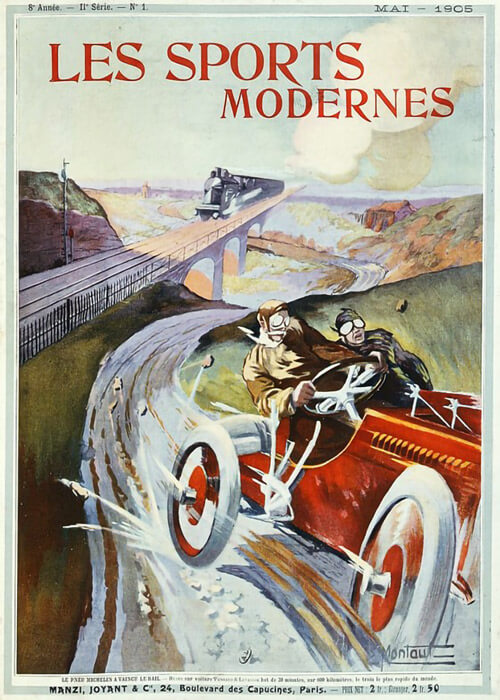
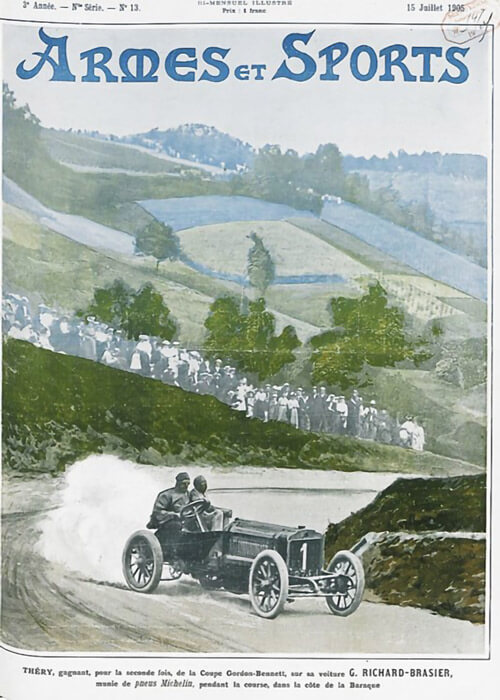
The magazine L’Illustration brought reports of very different events all over the world. This Paris-Berlin account was written by Abeniacar. Henri and Charles Abeniacar were two Italian brothers who worked for and cooperated with the L’Illustration magazine. This report not only summarizes the race, its progress and results, as well as some organisational procedures.
Text and photos with permission of the Bibliothèque national français, gallica.bnf.fr/ https://www.bnf.fr/fr
Compiled by par motorracinghistory.com. Translation by DeepL.com
L’Illustration, Vol. 15, No. 3045, Saturday July 6, 1901
PARIS-BERLIN
At 3:30 a.m. on Thursday, June 27, the official timekeeper of the Automobile Club of France gave the starting signal to the first car heading for Berlin, and successively, every two minutes, 108 vehicles (40 heavy cars; 49 light cars; 9 small cars; 9 motorcycles; 2 motorcycles) set off in pursuit of the first.
The day before, all these cars had been stamped and sealed by the Automobile Club, and the owners had had to pay the tax authorities 12% of their value, or the round sum of 1,250,000 francs, as a guarantee that they would return to France.
This sporting event, which was obviously of exceptional importance, had caused a stir throughout the motoring world. French manufacturers had been able to conquer a leading position in the new industry in a very short time; the machines that had come out of their workshops had so far been at the forefront in all competitions, where, moreover, few foreign competitors had entered the fray: this time, England and Germany were entering the fray more seriously.
The route chosen through eastern France, Belgium, Luxembourg, and Germany was difficult and perilous: 1,198 kilometers in three stages—456 kilometers from Paris to Aachen; 445 kilometers from Aachen to Hanover; 297 kilometers from Hanover to Berlin. In the last two stages, the narrow, uneven roads, some of which were paved, presented unfavorable conditions for the axles and tires. The average speeds of 80 kilometers per hour easily achieved in the Paris-Bordeaux race on smooth roads could no longer be expected. More than ever, it was necessary to show composure and decisiveness, especially as the population, still unfamiliar with this new form of transport and attracted by the racers‘ passage by understandable curiosity, created additional difficulties for them.
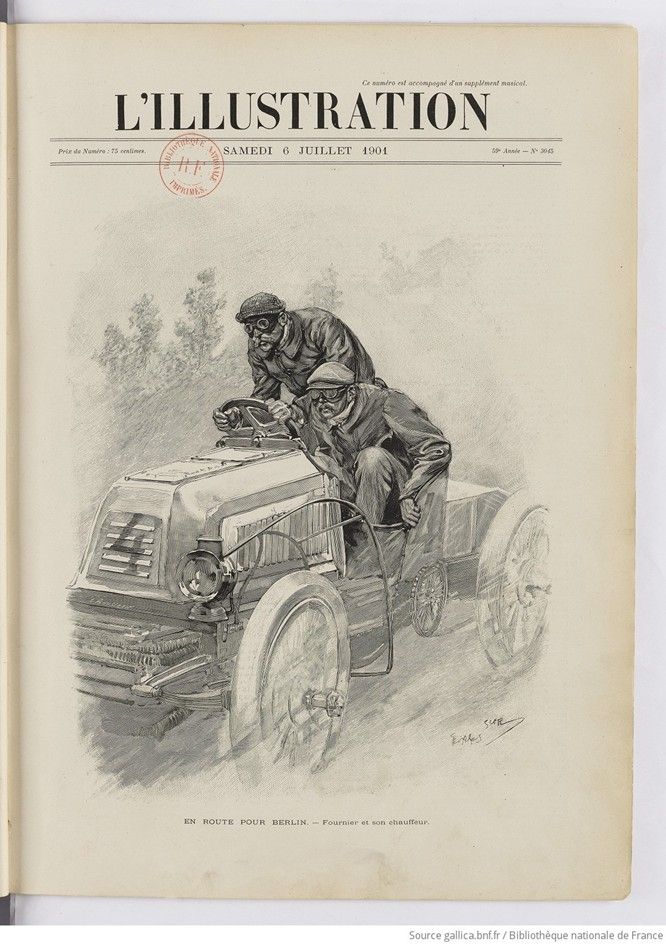
Despite all these difficulties, the winner of the race, Fournier, driving a French car from the Mors company fitted with Michelin tires, reached Berlin in 16 hours and 6 minutes, beating the Nord-Express by about 1½ hours. And his feat was not exceptional: behind him, Girardot arrived in 17 hours and 1 minute, René de Knyff in 17 hours and 4 minutes, and in the light car category, Giraud took only 19 hours and 33 minutes. 1 minute, René de Knyff in 17 hours and 4 minutes; in the light car category, Giraud took only 19 hours and 33 minutes; Louis Renault, in the first of the small cars, 19 hours, 16 minutes and 25 seconds; Osmont, on a simple motorcycle, 18 hours, 59 minutes and 50 seconds.
We have attempted to summarize this hotly contested race in pictures and to highlight its unique character as much as possible.
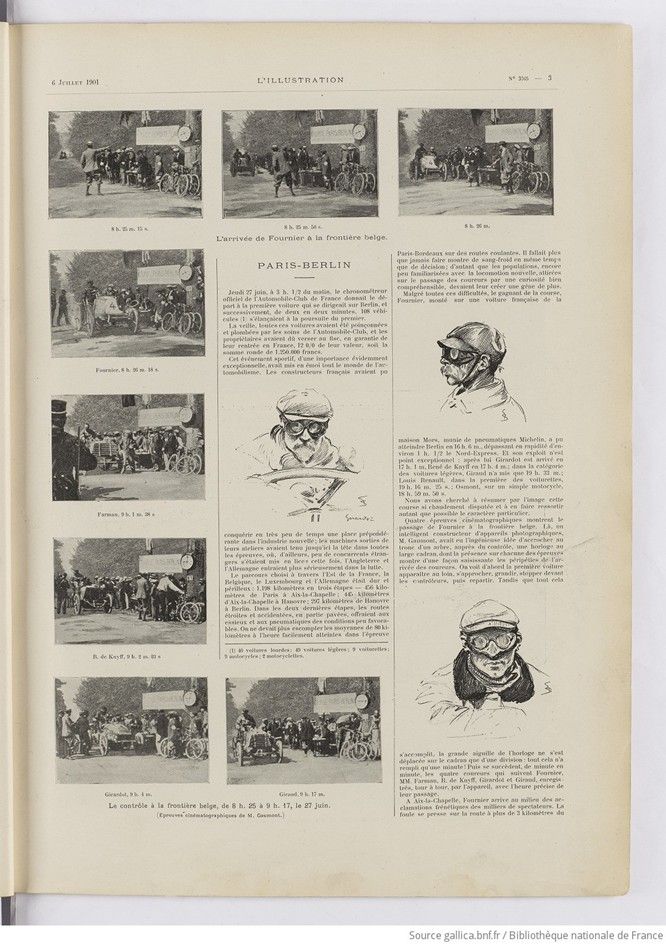
Four picture clips show Fournier crossing the Belgian border. There, an intelligent camera manufacturer, Mr. Gaumont, had the ingenious idea of hanging a large clock on the trunk of a tree near the checkpoint, the presence of which on each of the films vividly shows the twists and turns of the racers‘ arrival. First, we see the first car appear in the distance, approach, grow larger, stop in front of the officials, then drive off again. While all this is happening, the big hand of the clock has moved only one division on the face: the whole thing took just one minute! Then, one after another, the four riders following Fournier, Messrs. Farman, R. de Knyff, Girardot, and Giraud, are recorded by the device, with the exact time of their passage.
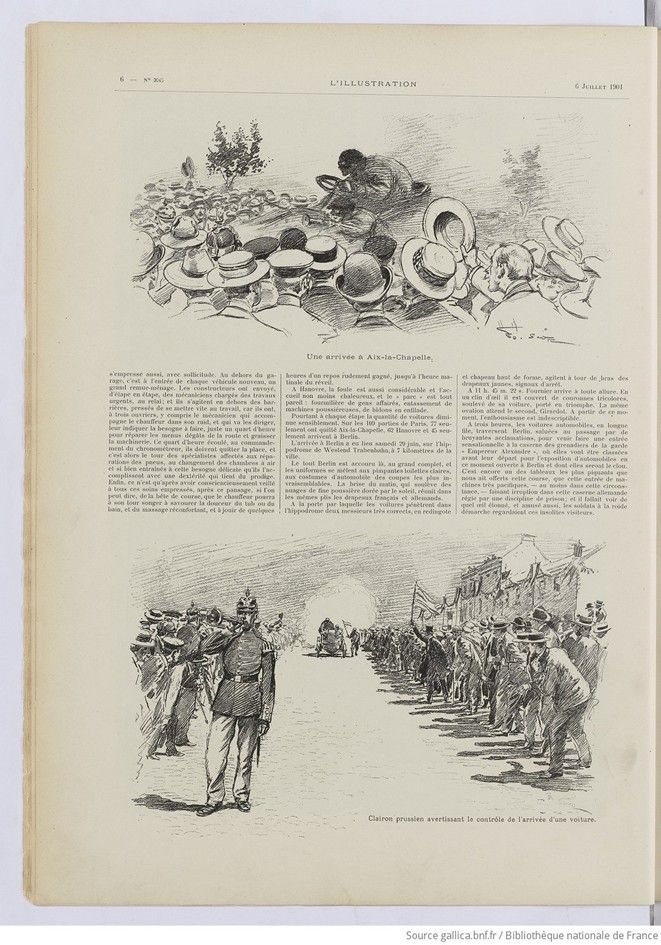
In Aachen, Fournier arrived to the frenetic cheers of thousands of spectators. The crowd pressed forward on the road more than 3 kilometers from the checkpoint, ignoring the orders of the soldiers who were maintaining order, blocking all passage until the last minute, when the military bugle sounded — a bugle with a pointed helmet, a rather unexpected sight for us, but quite natural in this overly militarized country — to warn both the controllers of the approach of a car and the overly enthusiastic spectators to move aside to make way for the arrival.
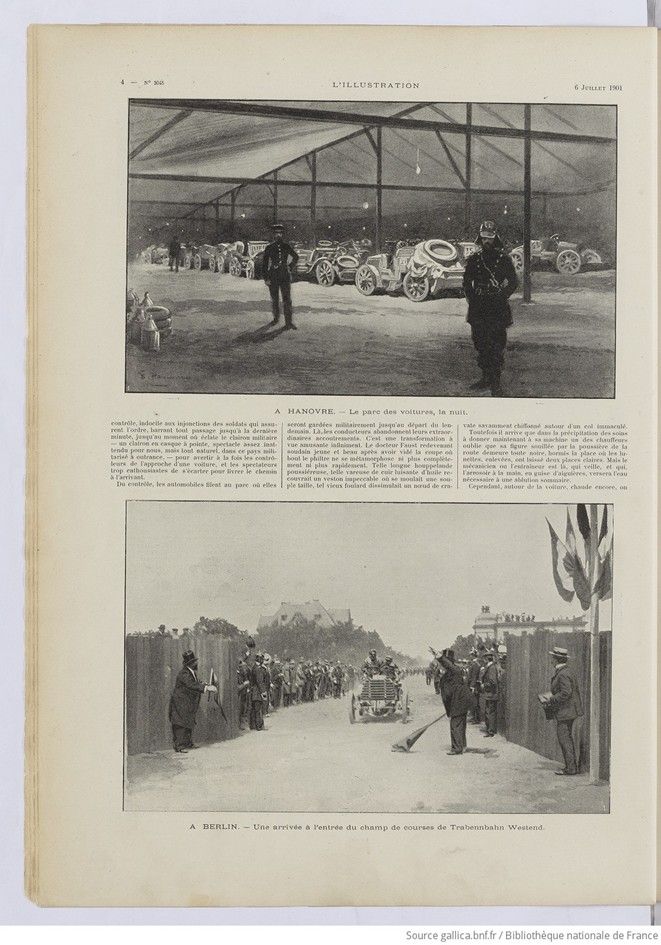
After being checked, the cars speed off to the park where they will be guarded by the military until the next day’s departure. There, the drivers abandon their extraordinary costumes. It is an infinitely amusing transformation to behold. Doctor Faust suddenly becoming young and handsome again after emptying the cup containing the potion does not undergo a more complete or rapid metamorphosis. Long dusty cloaks and oil-glistening leather jackets cover impeccable jackets that mold to supple waists, and old scarves conceal ties skillfully knotted around immaculate collars.
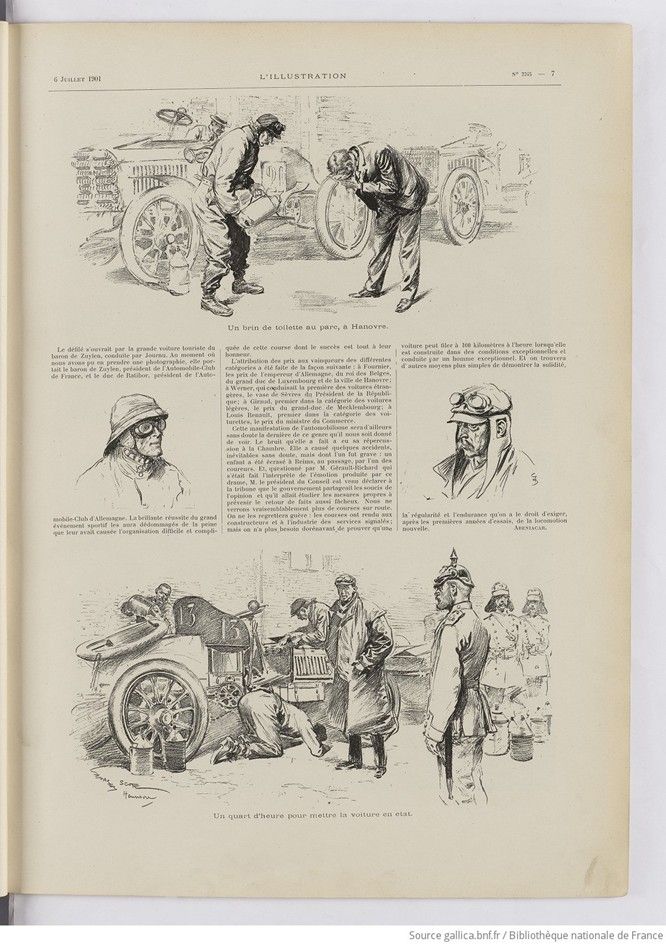
However, in the rush to attend to his machine, one of the drivers forgets that his face, stained with road dust, remains completely black, except for the two clear patches where his glasses have been removed. But the mechanic or coachman is there, watching, and with a watering can in his hand, he pours the water needed for a quick wash.
Meanwhile, around the car, which is still hot, everyone is bustling about solicitously. Outside the garage, there is a great commotion at the entrance of each new vehicle. The manufacturers have sent mechanics from stage to stage to take over the urgent work; and they bustle about outside the barriers, eager to get to work quickly, because they have just fifteen minutes to repair minor damage caused by the road and grease the machinery, with only three workers, including the mechanic who accompanies the driver on his trip and who will direct them and tell them what to do. Once the quarter of an hour is up, at the signal from the timekeeper, they must leave the scene, and then it is the turn of the specialists assigned to repairing tires and changing inner tubes, who are so well trained in this delicate task that they perform it with almost miraculous dexterity. Finally, only after conscientiously attending to all these urgent tasks, after grooming the racehorse, so to speak, can the driver think about enjoying the comfort of his tub or bath and a soothing massage, and enjoy a few hours of hard-earned rest until the early morning wake-up call.
In Hanover, the crowd is just as large and the welcome no less warm, and the “park” is much the same: a hive of busy people, a jumble of dusty machines and rows of cans.
However, at each stage, the number of cars decreases significantly. Of the 109 that left Paris, only 77 left Aachen, 62 left Hanover, and only 45 arrive in Berlin.
The arrival in Berlin took place on Saturday, June 29, at the Westend Trabenbahn racecourse, 7 kilometers from the city.
The whole of Berlin had turned out in force, and uniforms mingled with smart light-colored suits and the most improbable motorized outfits. The morning breeze, raising clouds of fine dust gilded by the sun, gathered the French and German flags together in the same folds.
At the gate through which the cars enter the racecourse, two very proper gentlemen in frock coats and top hats wave yellow flags, signaling to stop.
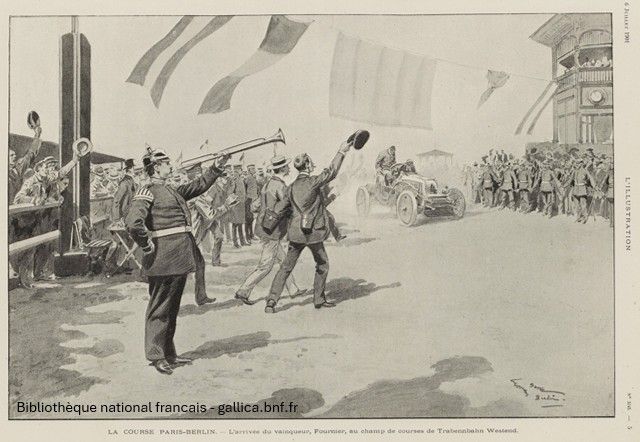
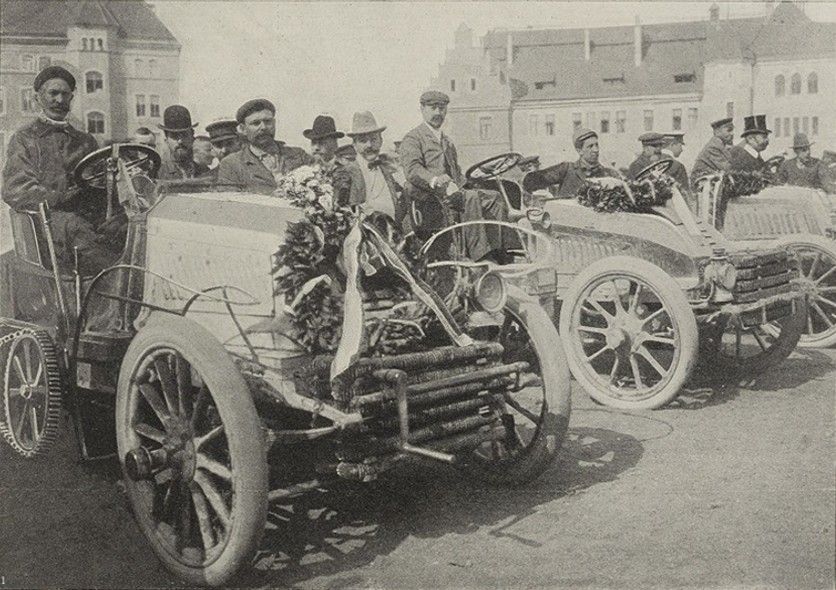
At 11:45:22 a.m., Fournier arrives at full speed. In the blink of an eye, he is covered with tricolor wreaths, lifted out of his car, and carried in triumph. The same ovation awaits the second driver, Girardot. From that moment on, the enthusiasm is indescribable.
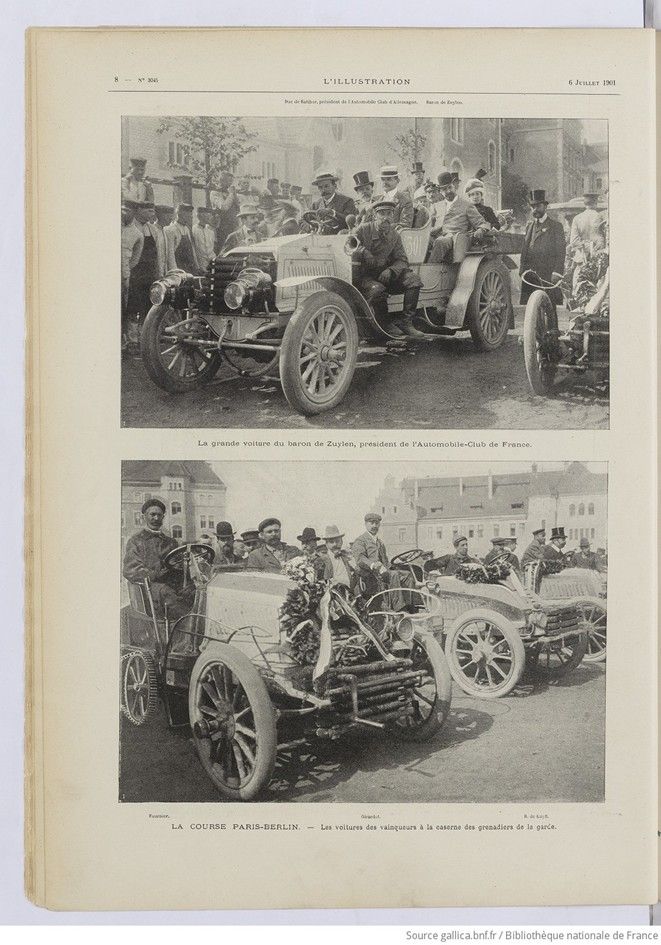
At 3:00 p.m., the cars, in a long line, crossed Berlin, greeted by loud cheers as they passed, to make a sensational entrance at the barracks of the “Emperor Alexander” guard grenadiers, where they were to be classified before leaving for the automobile exhibition currently open in Berlin, where they would be the highlight. This was one of the most striking scenes of the race, the arrival of these peaceful machines—at least in this circumstance—bursting into the German barracks governed by prison discipline. One had to see the astonished and amused looks on the faces of the stiffly marching soldiers as they watched these unusual visitors.
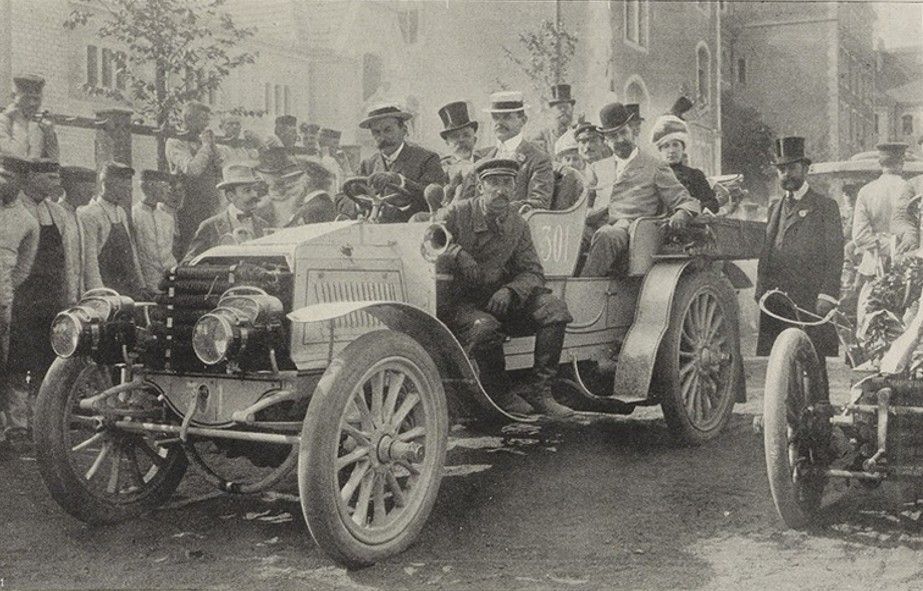
The parade was led by Baron de Zuylen’s large tourist car, driven by Journu. When we were able to take a photograph, it was carrying Baron de Zuylen, president of the Automobile Club de France, and the Duke of Ratibor, president of the Automobile Club of Germany. The brilliant success of this great sporting event compensated them for the trouble caused by the difficult and complicated organization of this race, whose success is entirely to their credit.
The prizes were awarded to the winners of the various categories as follows: to Fournier, the prizes of the Emperor of Germany, the King of Belgium, the Grand Duke of Luxembourg, and the city of Hanover; Werner, who drove the first of the foreign cars, received the Sèvres vase from the President of the Republic; Giraud, first in the light car category, received the prize from the Grand Duke of Mecklenburg; Louis Renault, first in the microcar category, received the prize from the Minister of Commerce.
This motor show will undoubtedly be the last of its kind that we will ever see. The noise it made had repercussions in the House. It caused a few accidents, which were undoubtedly inevitable, but one of which was serious: a child was run over in Reims by one of the drivers. When questioned by Mr. Gérault-Richard, who expressed the emotion caused by this tragedy, the President of the Council stated from the podium that the government shared the concerns of the public and would study measures to prevent such unfortunate events from happening again. We will probably not see any more road races.
They will not be greatly missed: the races have brought significant benefits to manufacturers and the service industry, but there is no longer any need to prove that a car can travel at 100 kilometers per hour when it is built under exceptional conditions and driven by an exceptional man. And we will find other, simpler ways to demonstrate the solidity, regularity, and endurance that we have the right to demand from locomotion, after the first few years of testing.
ABENIACAR
Photos.
Front page. – ON THE WAY TO BERLIN. – Fournier and his driver.
Page 3. – Fournier’s arrival at the Belgian border. 8:25:15 a.m. – 8:25:50 a.m. – 8:26 a.m.
Fournier, 8:26:18 a.m. – Farman, 9:01:38 a.m. – R. de Knyff, 9:02:23 a.m. – Girardot, 9:04 a.m. – Giraud, 9:17 a.m.
Border control at the Belgian border, from 8:25 a.m. to 9:17 a.m. on June 27. (Film footage by Mr. Gaumont.)
Page 4. – IN HANNOVER – The car park at night. – IN BERLIN – An arrival at the entrance to the Trabennbahn Westend racecourse.
Page 5. – THE PARIS-BERLIN RACE. – The arrival of the winner, Fournier, at the Trabennbahn Westend racecourse.
Page 6. – An arrival in Aachen. – Prussian bugle warning the control of the arrival of a car.
Page 7. – A touch-up in the park, in Hanover. – Fifteen minutes to get the car ready.
Page 8. – The grand carriage of Baron de Zuylen, president of the Automobile Club de France. – Fourier. – Girardot. – R. de Knyff.
THE PARIS-BERLIN RACE. – The winners‘ cars at the grenadier barracks at the station.