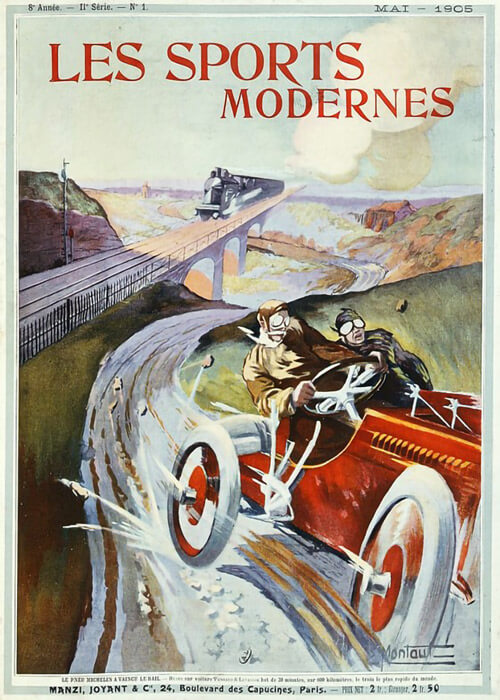
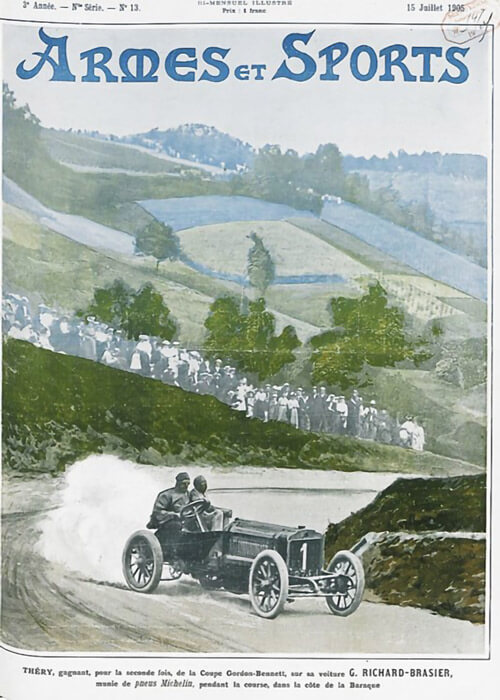
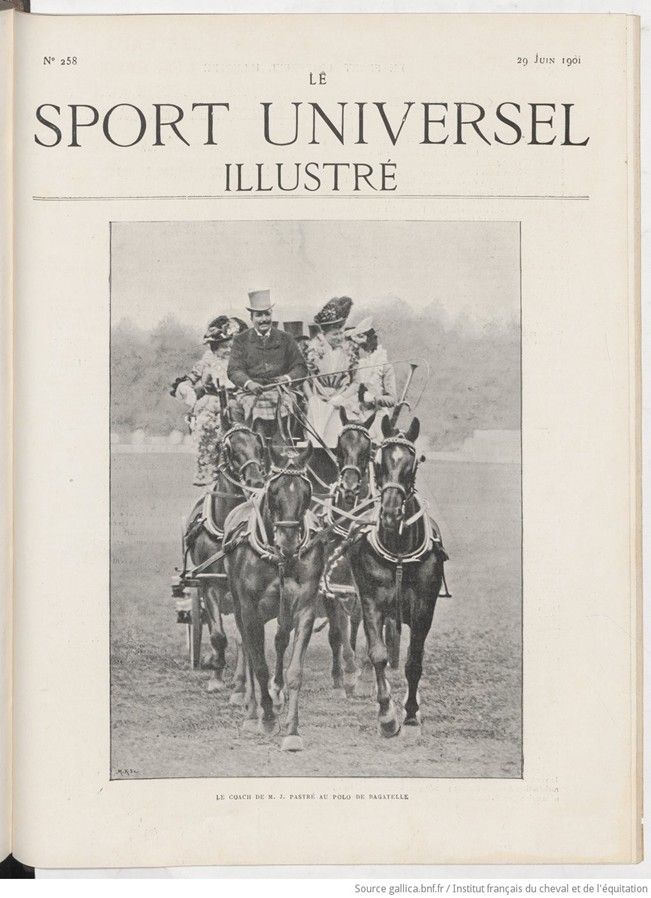
The French magazine Le Sport Universel Illustré mostly covered hippic. Since the coming of the „sans-chevaux“, more and more was written on vehicle events such as trials and City-to-City races over open roads. So, as with the 1901 Paris-Berlin race, consistting of two classes: „Touristes“ and „Vitesse“. The latter of course dealing with the shortest possible time. Each class had his own route, with some differences between both, but about the same distance, i.e. around 1.200 kilometers. Tourist class, covering 75 cars, started on June 22 and finished June 29 and was divided into eight stages. In the „Vitesse“ category, no less than 160 entries,consisted of three stages. They started June 27 and finished on June 29, same as the touring class.
With permission of the Bibliothèque national francais – gallica.bnf.fr
Text and photos compiled by motorracinghistory.com. Translation by DeepL.com
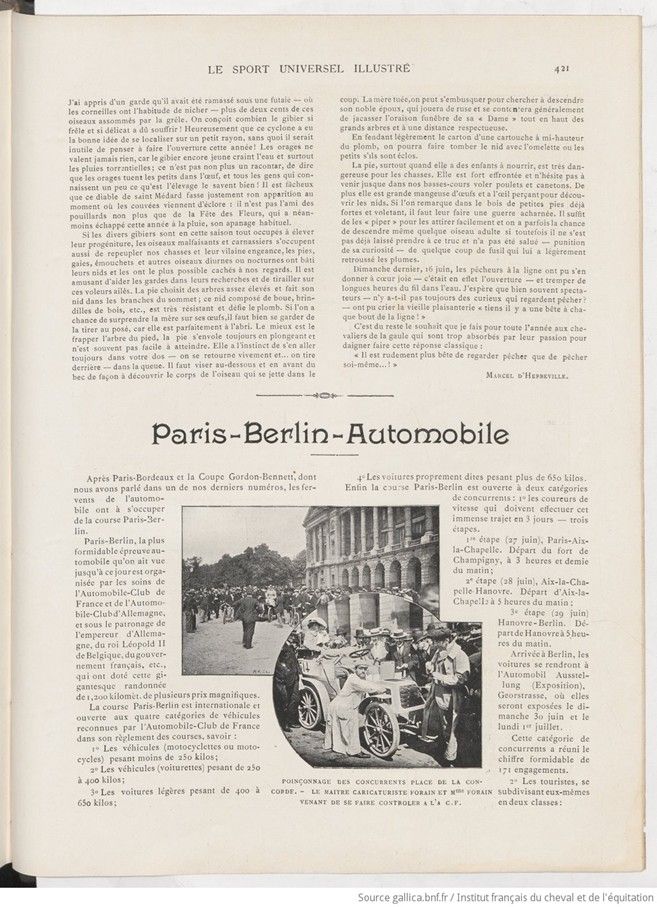
Le Sport Universel Illustré – Vol. 6, No. 258, June 29, 1901
Paris – Berlin – Automobile
Following the Paris-Bordeaux race and the Gordon-Bennett Cup, which we covered in one of our recent issues, automobile enthusiasts now have the Paris-Berlin race to look forward to.
Paris-Berlin, the most formidable automobile event seen to date, is organized by the Automobile Club of France and the Automobile Club of Germany, and under the patronage of the German Emperor, King Leopold II of Belgium, the French government, etc., who have endowed this gigantic 1,200-kilometer journey with several magnificent prizes.
The Paris-Berlin race is international and open to the four vehicle categories recognized by the Automobile Club of France in its racing regulations, namely:
1. Vehicles (motorcycles) weighing less than 250 kilograms;
2. Vehicles (light cars) weighing between 250 and 400 kilograms;
3° Light cars weighing between 400 and 650 kilograms;
4° Cars proper weighing over 650 kilograms.
Finally, the Paris-Berlin race is open to two categories of competitors:
1° speed racers who must complete this immense journey in 3 days—three stages.
1st stage (June 27), Paris–Aachen. Departure from Fort Champigny at 3:30 a.m.;
Stage 2 (June 28), Aachen–Hanover. Departure from Aachen at 5:00 a.m.;
Stage 3 (June 29), Hanover–Berlin. Departure from Hanover at 5 a.m.
Upon arrival in Berlin, the cars will proceed to the Automobil Ausstellung (Exhibition) on Georstrasse, where they will be on display on Sunday, June 30, and Monday, July 1.
This category of competitors attracted an impressive total of 171 entries.
2. Tourists, subdivided into two classes:
1. Class A: Vehicles subject to continuous monitoring to ensure consistent speed.
2. Class B: Vehicles checked at the start and finish of each daily stage.
For the tourists, the route was divided into 8 stages as follows:
June 22. — Paris to Reims, 160 kilometers, via Coulommiers, La Ferté-Gaucher, Montmirail, Épernay.
June 23. — Reims to Luxembourg, 210 kilometers, via Rethel, Vouziers, Stenay, Montmédy, Longuyon, Longwy.
June 24. — Luxembourg to Koblenz, 185 kilometers, via Trier.
June 25. — Koblenz to Frankfurt am Main, 130 kilometers, via Bingen, Mainz.
June 26. — Frankfurt am Main to Eisenach, 181 kilometers, via Hanau, Hunfeld.
June 27. — Eisenach to Leipzig, 174 kilometers, via Gotha, Erfurt, Weimar, Naumburg, Weissenfels.
June 28. — Leipzig to Potsdam, 138 kilometers, via Delitzsch, Bitterfeld, Wittenberg.
June 29. — Potsdam to Berlin, 31 kilometers.
As can be seen, the two routes were calculated so that arrivals in Berlin would occur on the same day, today, Saturday.
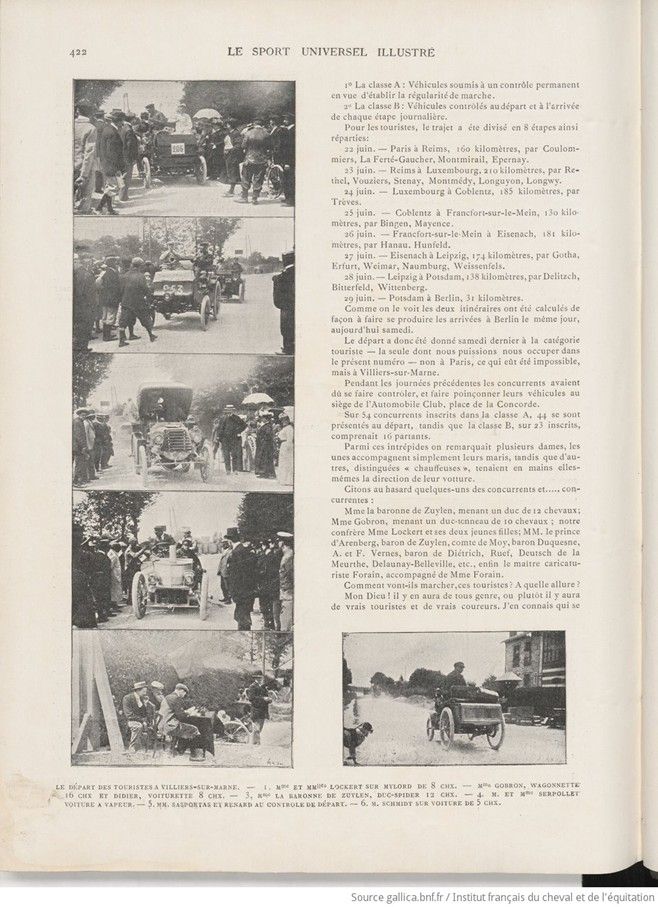
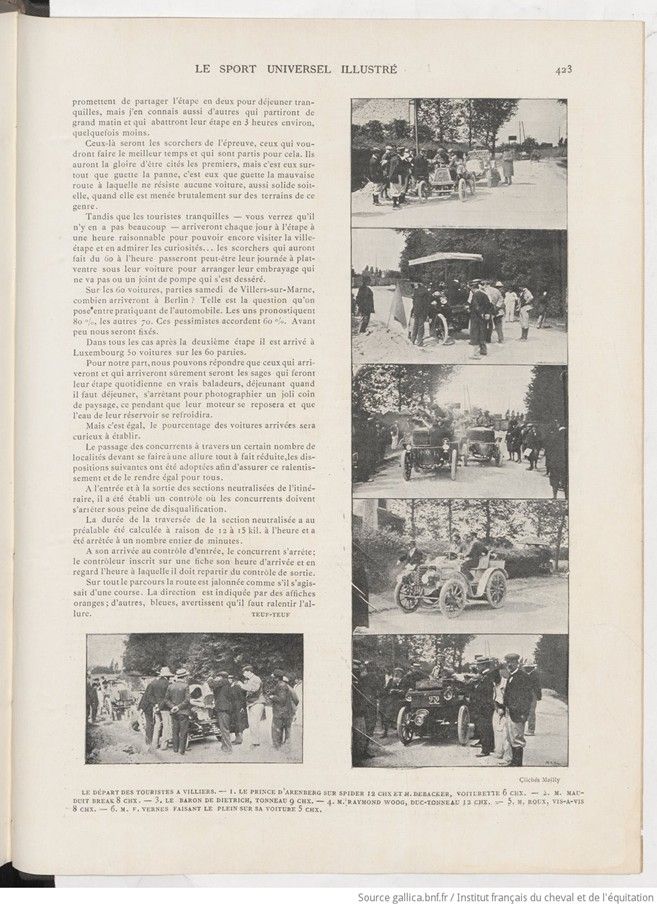
The start was therefore given last Saturday for the tourist category — the only one we can cover in this issue — not in Paris, which would have been impossible, but in Villiers-sur-Marne.
During the preceding days, the competitors had to undergo inspection and have their vehicles stamped at the Automobile Club headquarters on the Place de la Concorde.
Of the 54 competitors registered in Class A, 44 appeared at the start, while Class B, with 23 registered, had 16 starters.
Among these intrepid participants were several ladies; some were simply accompanying their husbands, while others, distinguished “female drivers,” were at the wheel of their own cars.
Let us mention a few of the competitors at random:
Baroness de Zuylen, driving a 12-horse duc;
Mrs. Gobron, driving a 10-horse duc-tonneau; our colleague Mrs. Lockert and her two young daughters; His Highness the Prince of Arenberg, Baron de Zuylen, Count de Moy, Baron Duquesne, A. and F. Vernes, Baron de Diétrich, Ruef, Deutsch de la Meurthe, Delaunay-Belleville, etc., and finally the master caricaturist Forain, accompanied by Mrs. Forain.
How will these tourists fare? At what pace?
Good heavens! There will be all sorts, or rather, there will be true tourists and true runners. I know some who plan to split the stage in two to have a leisurely lunch, but I also know others who will set out early in the morning and cover their stage in about three hours, sometimes less.
These will be the “scorchers” of the race, those who want to set the best time and have set out to do just that. They’ll have the glory of being named first, but they’re the ones most at risk of breaking down; they’re the ones facing the rough roads that no car can withstand, no matter how sturdy it is, when driven brutally over terrain like this.
Meanwhile, the laid-back tourists—you’ll see there aren’t many of them—will arrive at the stage destination each day at a reasonable hour so they can still visit the town and admire its sights…. the “scorchers” who have been driving at 60 km/h may spend their day flat on their stomachs under their cars fixing a faulty clutch or a loose pump seal.
Of the 60 cars that left Villers-sur-Marne on Saturday, how many will make it to Berlin? That is the question being asked among car enthusiasts. Some predict 80%, others 70%. The pessimists put it at 60%. We’ll know for sure soon enough.
In any case, after the second stage, 50 of the 60 cars that set out arrived in Luxembourg.
For our part, we can say that those who will arrive—and who will certainly arrive—are the wise ones who will take their daily stage as true leisure drivers, stopping for lunch when it’s time to eat, pausing to photograph a scenic spot, all while letting their engines rest and their coolant cool down.
But regardless, it will be interesting to determine the percentage of cars that make it to the finish.
Since the competitors must pass through a number of towns at a very reduced speed, the following measures have been adopted to ensure this slowdown and make it uniform for all.
At the entrance and exit of the neutralized sections of the route, a checkpoint has been established where competitors must stop, under penalty of disqualification.
The time required to traverse the neutralized section has been calculated in advance at a rate of 12 to 15 km per hour and has been set to a whole number of minutes.
Upon arrival at the entry checkpoint, the competitor stops; the official records their arrival time on a form and, opposite it, the time at which they must depart from the exit checkpoint.
Along the entire route, the road is marked as if it were a race. The direction is indicated by orange signs; others, blue, warn that the pace must be slowed.
TEUF-TEUF
Photos.
Page 421.
CHECKING OF COMPETITORS AT PLACE DE LA CONCORDE. — THE MASTER CARTOONIST FORAIN AND MRS. FORAIN JUST AFTER BEING CHECKED AT THE A.C.F.
Page 422.
THE DEPARTURE OF TOURISTS FROM VILLIERS-SUR-MARNE. — 1. Mrs. and the LOCKERTs IN A MYLORD 8-HORSE CARRIAGE. – Mrs. GOBRON, 16-HORSE WAGONNETTE, AND DIDIER, 8-HORSE VOITURETTE. — 3. MRS. BARONESS DE ZUYLEN, DUC-SPIDER 12 HP. — 4. MR. AND MRS. SERPOLLET, STEAM CAR. — 5. MRSS. SASPQRTAS AND RENARD AT THE STARTING LINE. — 6. MR. SCHMIDT IN A 5 HP CAR.
Page 423.
THE DEPARTURE OF THE TOURISTS FROM VILLIERS. — 1. THE PRINCE OF ARENBERG IN A 12-HORSE SPIDER AND MR. DEBACKER, 6-HORSE CARRIAGE. – 2. MR. MAUDUIT IN AN 8-HORSE BREAK. — 3. THE BARON DE DIETRICH, 9-HORSE TONNEAU. — 4. MR. RAYMOND WOOG, DUC-TONNEAU 12-HORSE CARRIAGE. – 5. MR. ROUX, VIS-A-VIS 8-HORSE CARRIAGE. — 6. MR. F. VERNES FILLING UP HIS 5-HORSE CARRIAGE. (Mailly Photographs)