The British Elimination Trials wre held on May 19, 1904 on the Isle of Man. The total distance of the trials was about 50 miles with several three criteria, among which were the marked speed over a 3-mile strect, the half-mile speed, climbing a hill, general state of the vehicle and some more. The Trials were interrupted by some accidents, but finally three representatives were selected: Clifford Earp in a Napier, Sidney Girling and Charles Jarrott both in a Wolsely.
With permission of the Bibliothèque national francais – gallica.bnf.fr
Text and photos compiled by motorracinghistory.com, Translation by DeepL.com
Le Sport Universel Illustré – Volume 9 (?), No. 409, May 22, 1904
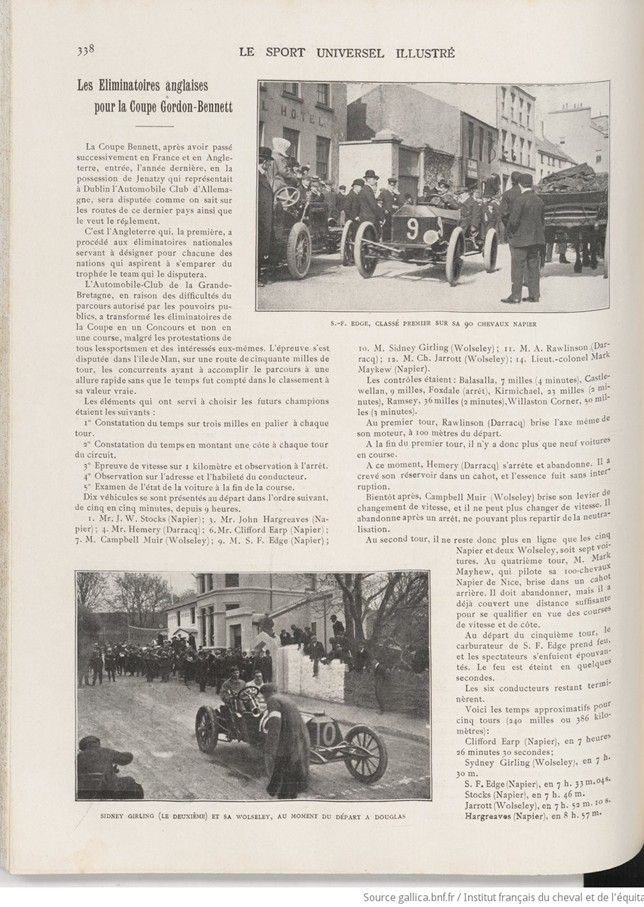
The English Qualifiquation Trials for the Gordon-Bennett Cup
The Bennett Cup, having passed successively through France and England, and having come into the possession last year of Jenatzy, who represented the German Automobile Club in Dublin, will be contested, as is well known, on the roads of the latter country, as required by the regulations.
England was the first to hold its national qualifying rounds to select the team that will compete for the trophy on behalf of each of the nations aspiring to win it.
The Automobile Club of Great Britain, due to the difficulties of the route authorized by the public authorities, transformed the Cup qualifiers into a competition rather than a race, despite the protests of all the competitors and the participants themselves. The event took place on the Isle of Man, on a fifty-mile circuit, with competitors required to complete the course at a fast pace, though the time was not counted toward the final standings.
The criteria used to select the future champions were as follows:
1. Timing over three miles on a flat section at the start of each lap.
2. Timing of the climb up a hill on each lap of the circuit.
3. Speed test over one kilometer and observation while stationary.
4. Observation of the driver’s skill and dexterity.
5. Inspection of the car’s condition at the end of the race.
Ten vehicles lined up at the start in the following order, at five-minute intervals, beginning at 9 a.m.
1. Mr. J. W. Stocks (Napier); 3. Mr. John Hargreaves (Napier); 4. Mr. Hemery (Darracq); 6. Mr. Clifford Earp (Napier); 7. Mr. Campbell Muir (Wolseley); 9. Mr. S. F. Edge (Napier); 10. Mr. Sidney Girling (Wolseley); 11. Mr. A. Rawlinson (Darracq); 12. Mr. Ch. Jarrott (Wolseley); 14. Lt. Col. Mark Maykew (Napier).
The checkpoints were: Balasalla, 7 miles (4 minutes), Castle-Wellan, 9 miles, Foxdale (stop), Kirkmichael, 23 miles (2 minutes), Ramsey, 36 miles (2 minutes), Willaston Corner, 50 miles (3 minutes).
On the first lap, Rawlinson (Darracq) broke the engine crankshaft itself, 100 meters from the start.
By the end of the first lap, there were therefore only nine cars left in the race.
At that moment, Hemery (Darracq) stopped and withdrew. He had punctured his fuel tank on a bump, and gasoline was leaking continuously.
Soon after, Campbell Muir (Wolseley) broke his gearshift lever and could no longer change gears. He retired after a stop, unable to restart from the neutral zone.
By the second lap, only the five Napiers and two Wolseleys remained in the race — seven cars in total. On the fourth lap, Mr. Mark Mayhew, driving his 100-horsepower Napier from Nice, broke his rear suspension on a bump. He had to retire, but he had already covered enough distance to qualify for the speed and hill climb races.
At the start of the fifth lap, S. F. Edge’s carburetor caught fire, and the spectators fled in terror. The fire was extinguished in a few seconds.
The six remaining drivers finished.
Here are the approximate times for five laps (240 miles or 386 kilometers):
Clifford Earp (Napier), in 7 hours 26 minutes 30 seconds;
Sydney Girling (Wolseley), in 7 hours 30 minutes
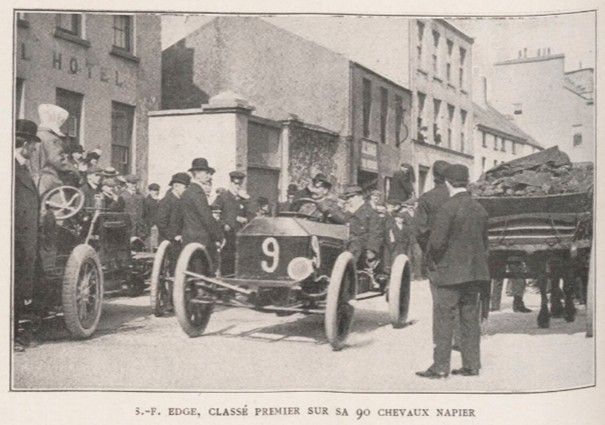
S. F. Edge (Napier), in 7 hours
Stocks (Napier), in 7 hours 46 minutes
Jarrott (Wolseley), in 7 hours 52 minutes 10 seconds
Hargreaves (Napier), in 8 hours 57 minutes.
These times had no bearing on the result, as the committee did not take them into account due to the requirement not to exceed a certain speed.
The cars were stored under the committee’s supervision, and no adjustments or repairs were permitted in the garage prior to the hill climb on the second day.
The time was recorded over half a mile on an average gradient of 7%, the first part of which was 15%.
Each car completed the course three times. Victory went once again to S. F. Edge (Napier), whose car had a superb start. His two closest competitors, as will be seen below, had already finished in the same order behind him the previous day.
1. S. F. Edge (Napier), fastest time 38 sec. 7/5
2. Clifford Earp (Napier), 42 sec. 4/5.
3. Syd. Girling (Wolseley), 44 sec. 1/5.
4. C. Jarrott (Wolseley), 47.2 seconds.
5. Hargreaves (Napier), 50.2 seconds.
6. C. Muir (Wolseley), 50.1 seconds.
7. J. W. Stocks (Napier), 55.1 seconds.
The speed trials held on the third day took place on the Douglas promenade. Each competitor made three runs over one kilometer. As before, S. F. Edge first, followed by Clifford Earp, the two Napier drivers had posted the best times, when a terrible accident deprived the great English marque of its second representative. Clifford Earp’s car’s clutch failed to respond, and he was traveling at nearly 100 kilometers per hour into the dense crowd. Suddenly, the driver slammed on both brakes; in a dramatic spin, the heavy vehicle veered to the right and crashed into a wall along the edge of the road a few meters away.
The accident, it is said, will not result in any fatalities. In any case, it underscores the need for precautions that cannot be overstated.
The times recorded during the first two heats (the third not having been contested due to the accident) yielded the following standings: 1st Edge, 39″; 2nd Earp, 42 s.; 3rd Girling, 44.45 seconds; 4th Jarrott, 45.25 seconds; 5th Rawlinson, 46.35 seconds.
The Committee of the Automobile Club of Great Britain has selected the following to represent it in the cup:
1st S. F. Edge (90 hp, Napier), weight 2,182 lbs.
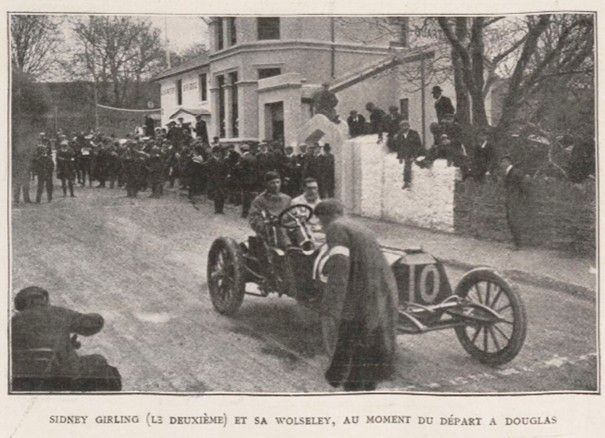
2nd Sidney Girling (80 hp, Wolseley), 2,191 lbs.
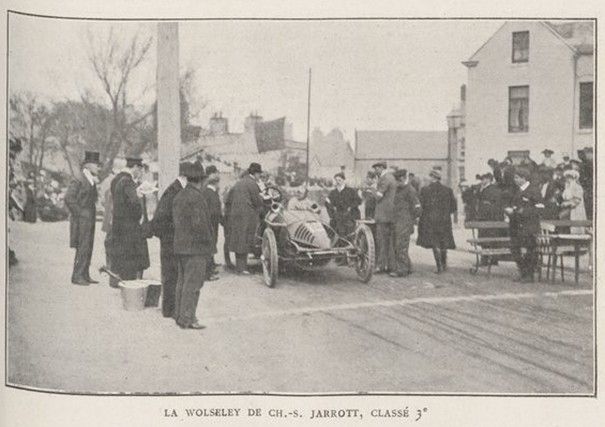
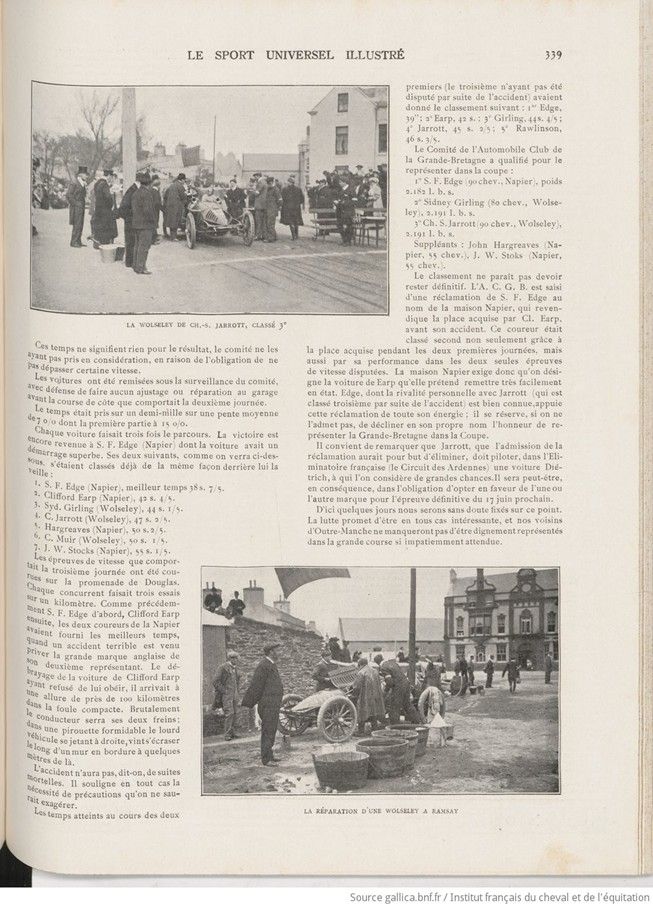
3rd Ch. S. Jarrott (80 hp, Wolseley), 2,191 lbs.
Alternates: John Hargreaves (Napier, 55 hp), J. W. Stoks (Napier, 55 hp).
The standings do not appear likely to remain final. The A.C.G.B. has received a protest from S.F. Edge on behalf of the Napier company, which is claiming the position earned by Cl. Earp prior to his accident. This driver was ranked second not only due to the position he secured during the first two days, but also because of his performance in the only two speed trials held. The Napier stable therefore demands that Earp’s car be designated, which it claims it can easily restore to working order. Edge, whose personal rivalry with Jarrott (who is ranked third following the accident) is well known, supports this claim with all his energy; he reserves the right, if it is not accepted, to decline in his own name the honor of representing Great Britain in the Cup.
It should be noted that Jarrott, whom the acceptance of the claim would aim to eliminate, is set to drive a Diétrich car in the French Qualifier (the Circuit des Ardennes), which is considered to have a strong chance of winning. He may therefore be forced to choose one brand or the other for the final race on June 17.
We will no doubt have a clear answer on this point in a few days.
The competition promises to be interesting in any case, and our neighbors across the Channel will certainly be well represented in the eagerly awaited grand race.
Photos.
SIDNEY GIRLING (SECOND PLACE) AND HIS WOLSELEY, AT THE START IN DOUGLAS
S.-F. EDGE, RANKED FIRST ON HIS 90-HORSEPOWER NAPIER
CH.-S. JARROTT’S WOLSELEY, RANKED 3RD
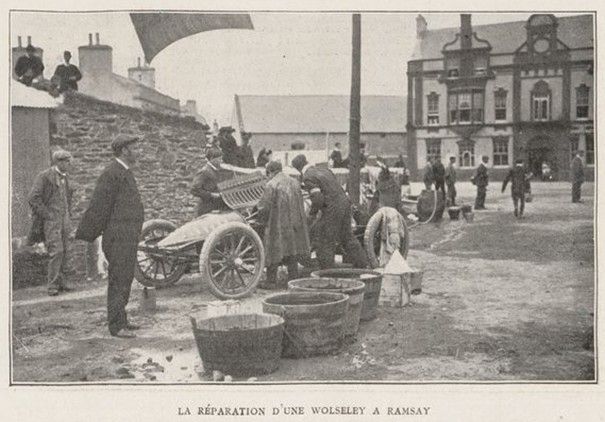
REPAIR OF A WOLSELEY AT RAMSAY