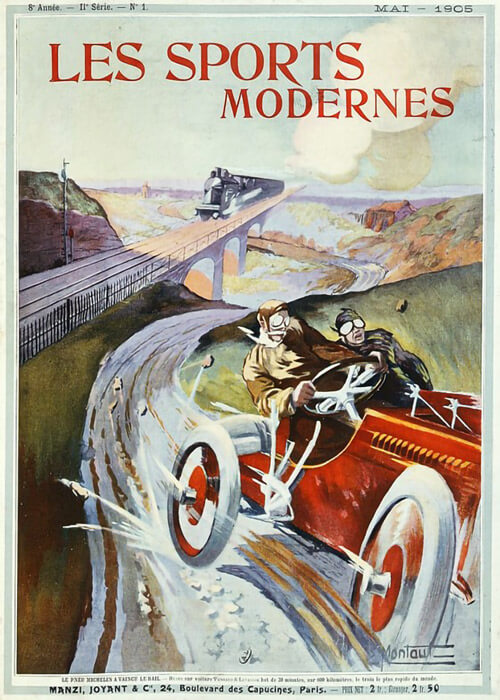
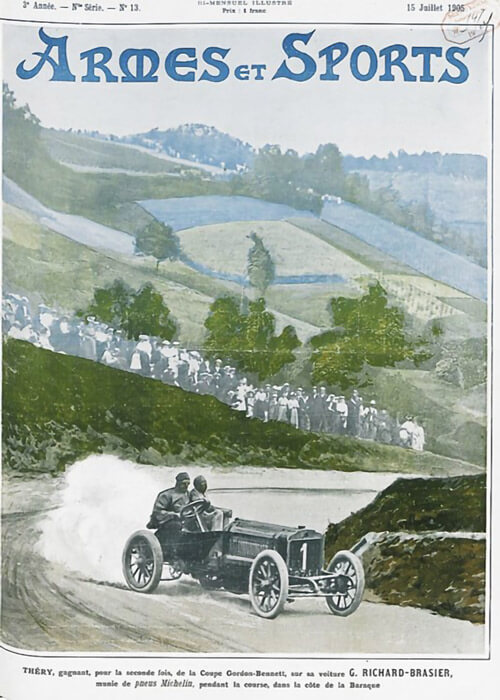
The 1902 Paris-Vienna Race as reported by the magazine “The Automobile and Motor Review”. It bore this name until the beginning of 1903; since then it was named “The Automobile”. This report once more shows that in those days, much more was written on an event than was shown pictorial. So, a large read, indeed. But more, it is as if you were there and kind of participated in the three-days event. First describing the route and its conditions, as well as the genaral rules and brief descriptions of some of the participating cars. Writing on the different stages Paris-Belfort, Belfort-Bregenz, Bregenz-Salzbourg and finally Salzbourg-Vienna. Results of the Paris-Vienna Race, for all five vehicle classes. Incorporating the 1902 Gordon Bennet Cup Race from Paris to Salzbourg, showing that The Gordon Benett Cup was not among the high-popularity events until the catastrophical Paris-Madrid Race of 1903.
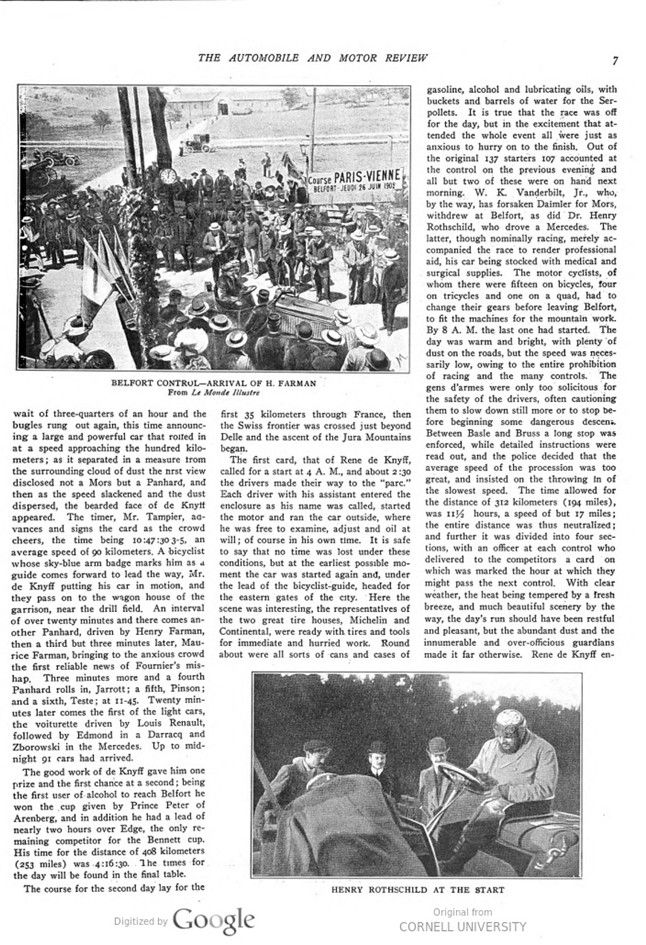
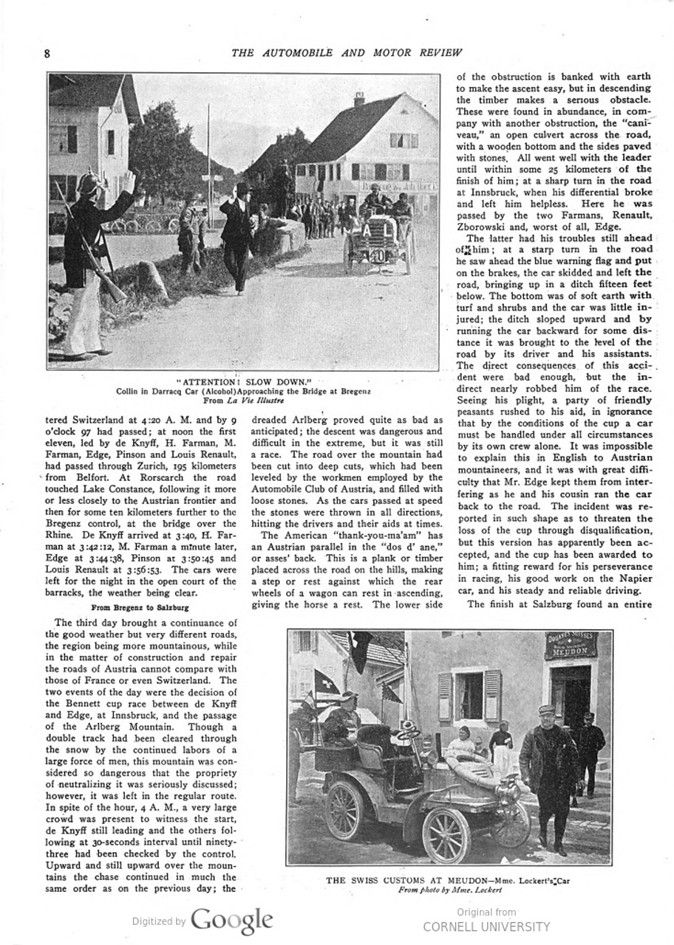
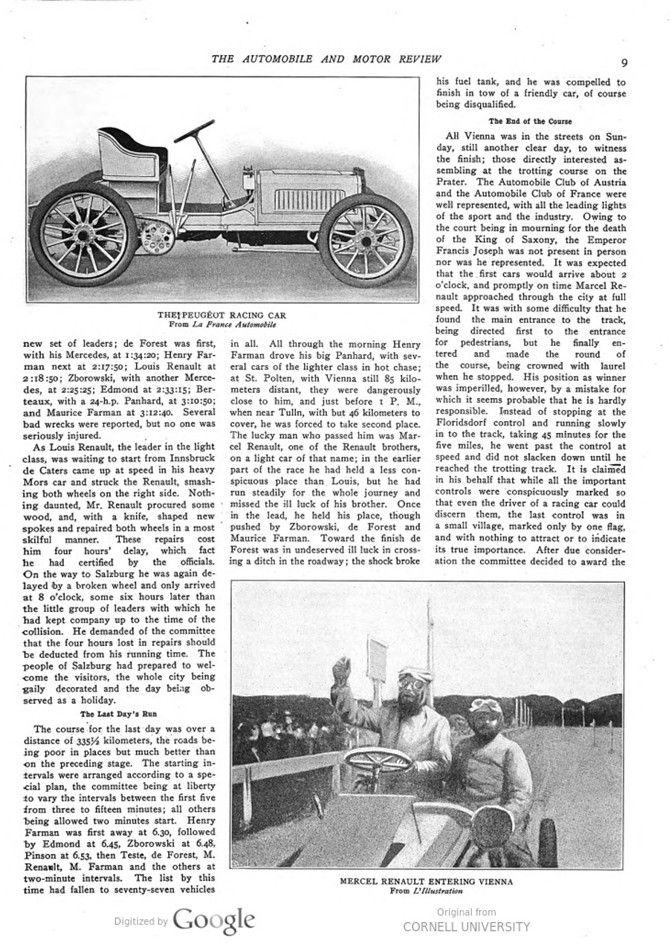
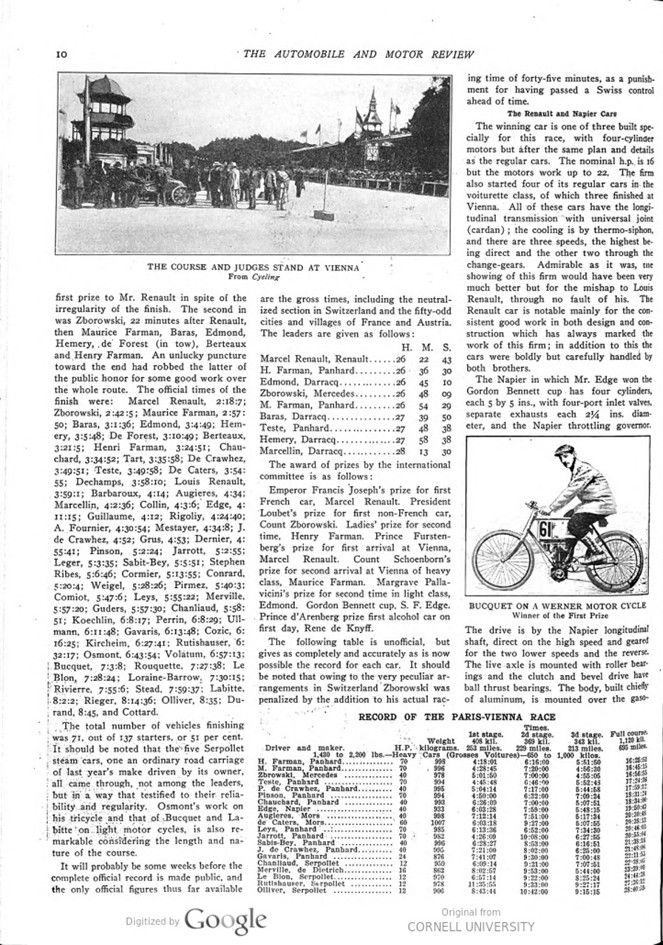

Text and jpegs by courtesy of hathitrust.org www.hathitrust.org, compiled by motorracinghistory.com
The Automobile (and Motor Review), Vol. VII, July 26, 1902
THE PARIS-VIENNA RACE
IT can hardly be said as. yet that motoring has a history; the record of its initial stage consists of a mere list of independent and isolated experiments, separated by long intervals, while its actual development is so much the work of men who are even now only in the prime of life as to make it a matter of the present rather than the past. When the time comes that the now lusty infant has attained the age and dignity at present enjoyed by the locomotive and the steamboat, with a history as long and as interesting as that of either to-day, the name of the French capital will stand out prominently in the early pages. The great races that center about it, Paris- Marseilles, Paris-Lyons, Paris-Bordeaux, Paris-Berlin and Paris-Vienna, will appear not as sporting events of mere passing inter- est, but as milestones in the way of mechanical progress. It is too soon as yet to estimate the true technical value of these events; there is no background, no perspective, and while we may with advantage attempt to deduce useful lessons from them, it is impossible to judge them fairly. Conceding all that is urged against them, it is nevertheless evident that much good has already resulted, and that more may be confidently looked for in the near future, especially if international rivalry shall be more fully developed.
The Paris-Berlin race of last year, a speed contest over good roads, is now very generally accepted as a material factor in the improvement evident this year in the ordinary road car. In preparing for it during the previous winter the many makers represented had before them the problem of producing cars of exceptional speed and endurance-judged by existing standards-without regard to weight. The course was longer than any previously attempted, the speed was certain to be much higher, and a veritable road locomotive was necessary, instead of a mere horseless carriage.
This year the problem assumed a different aspect. The first consideration was the new limit of weight imposed by the Automobile Club of France, 1,000 kilograms or 2,204 lbs. for the heaviest and most powerful vehicles. The total course measured over 900 miles, of which 695 were to be covered at racing speed. The four stages have been well summed up by French writer: The first was a race over good French roads; the second was a tour over bad roads but at slow speed; the third was a course of automobile acrobaties, with a tire test; the fourth was a continuation of the acrobatics, with a test of axles and springs. While some have hastened to proclaim the failure of the most famous makes of the year, it must be remembered that the long route over the mountains was a most severe test, from which seventy-one out of 138 starters came out successful.
From another point of view the race may be summed up as follows: The first day was a grand victory for the Panhard cars, the Mors-winner of last year’s race-meeting with very bad luck. The second and third days brought new laurels to the German Mercedes; the two cars entered-each driven by its amateur owner-made a splendid showing of endurance. The honors for the complete course went to a light car in the second category, the Renault, to the general surprise of experts.
The personnel of the racing division has also changed greatly. The list of winners is made up of new names, Marcel Renault, Henry Farman, Maurice Farman, Zborowski, Edmond and de Forest, while nearly all the best-known racing men failed to get through, Fournier, Girardot, de Knyff, Giraud, Heath and the two Americans, Vanderbilt and Foxhall Keene. all coming to grief.
The Course and Conditions
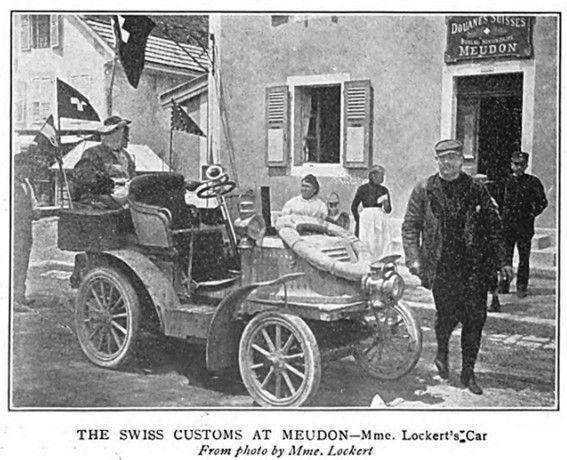
The Paris-Vienna race was planned by the Automobile Club of France, assisted by the Automobile Club of Austria, and the arrangements have been under way for nearly a year. Many difficulties had to be encountered in laying out a suitable course, securing the consent of the two governments, etc.; in fact, until the successful termination of the Alcohol Circuit last month it was uncertain whether the permission of the French Government would be obtained. In addition, for a distance of some 200 miles between the French and Austrian frontiers, it was necessary to pass over foreign territory. either Swiss or German, the former being finally selected. The full program included three separate events: first, a tour, leaving Paris on June 19 and terminating in Vienna on June 28; second, the great race, starting from Paris on June 26 and reaching Vienna on June 29; at Vienna the racers and tourists were to combine for a tour of Bosnia and Herzegovina.
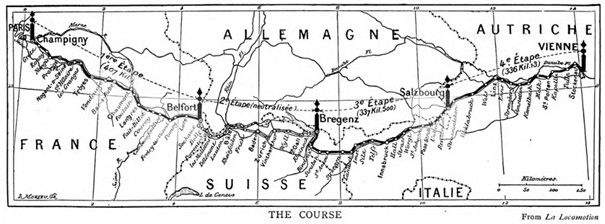
The start of the race was located at Champigny, about twelve miles from the center of Paris, the first day’s stage being to Belfort, on the French frontier, a distance of 408 kilometers. The run of the second day was through Swiss territory, from Belfort to Bregenz, 312 kilometers, this entire distance was “neutralized,” the authorities being opposed to racing. The course of the third day was from Bregenz to Salzburg, 337½ kilometers, first over the Arlberg Mountain and then over a succession of rough and mountainous roads. The final run was still over bad but less dangerous roads, 335½ kilometers to Vienna. The finishing conditions were peculiar. The last regular control was at Floridsdorf, a suburb about 8 kilometers from the center of the city, where each competitor was supposed to stop, his time being taken; then he was allowed 45 minutes in which to cover the five miles through the city to the trotting course on the Prater, making a final round of the course at speed for the benefit of the spectators.
The Gordon Bennett Cup
Auxiliary to the main race was the international contest for the Gordon Bennett cup. This trophy, first offered in 1900, must be run over a course located in the country of the holder, the distance being about 600 kilometers. It was first raced for over the Paris-Lyons course, 566 kilometers, being won by Charron in a 27-h.p. Panhard, the time being 9 hours, 0 minutes 49 seconds. The race of last year was from Paris to Bordeaux, 560 kilometers, covered by Girardot in a 40-h.p. Panhard in 8 hours, 47 minutes 39 seconds. The course for this year was from Paris to Belfort and then to Innsbruck, on the second stage, a total distance of 618 kilometers. The defenders nominated by the Automobile Club of France were Girardot, Fournier and Rene de Knyff; the foreigner contestants being the three English motorists, Montague Grahame White, Herbert Austin and Arthur Callan; all, however, failing to start and S. F. Edge taking a vacant place. The three French cars in this section of the race were painted blue and the English red. They were allotted the first six places at the start.
The General Rules
The first start was made in the order of the entries, except for the Bennett cup men, an interval of two minutes being allowed between each car. The succeeding starts were made in the order of the arrivals on the previous evening, lists being made out as soon as possible by the control agents and posted on the door of the “parc” or enclosure in which all the cars were under watch for the night. On arrival at the last control of the day, which by the way was open until the start on the following morning, an escort mounted on a bicycle led the way to the parc; on entering, the driver and his attendant mechanic at once stopped the motor, disconnected the battery, extinguished the incandescent tube, or in the case of a steam car extinguished the burners and emptied the boiler. It was also permissible to run a little gasoline into the cylinders while they were still warm, but beyond this all repairs, adjustments, oiling, leaving the enclosure at once. On the etc., were rigorously forbidden, the party next morning at the exact moment indicated on the card for their start, the driver and assistant entered the enclosure, and the car was timed as starting. It was supposed to be set in motion instantly, but if after four or five minutes the motor failed to work, the attendants pushed the car outside the enclosure and the driver was at liberty to make repairs and adjustments; the time, however, being counted against him. Under no circumstances was any work, whatever permitted on the car within the official enclosure.
The entire course was marked with flags, yellow signaling an absolute stop, blue calling for slower speed for a dangerous place, or black for the same purpose where no allowance was made for the required reduction of speed. Parti- colored flags, the lower half white and the upper yellow, blue or black, signified that speed might be resumed. Controls were marked by groups of three flags, the two national ensigns and the yellow flag indicating a stop. On arriving at an intermediate city each car stopped at the entering control and the card was signed with the time of arrival and the time at which it was permitted to pass the outgoing control; a bicycle guide then led the way through the town, the car following at a distance of at least 80 to 100 ft. to the next control, where the card was delivered and the car allowed to start at its proper time. Drivers were strictly prohibited from passing a guide. In case two cars arrived at once at a control, one was compelled to keep at least 150 ft. in the rear of the other through the town and to wait until the leader had at least that start on leaving. The various officials were marked by arm badges of different colors. In France and Switzerland, the rule of the road is as in this country, to the right in passing and to the left in overtaking; but in Austria it is the reverse, the competitors being compelled to observe the local law. The neutralizations on the first day amounted to 2 hours 43 minutes.
The long road between the French and Austrian capitals was known to be none of the best, and a number of the racing men covered it in part in advance by way of familiarizing themselves with it. On June 14 Rutishauser, the well-known Serpollet driver, left Paris in one of the firm’s new 6-h.p. cars, followed three days later by Franz Reichel, of Figaro, in a sister vehicle, both going through to. Vienna. They reported the roads as very bad, especially in Switzerland and in the western part of Austria, there being then six feet of snow on the Arlsberg, with men laboring to clear the road for the cars. Apart from the mountainous nature of the roads, the surface was very bad, cut by deep ditches and gullies. Fournier took his new Mors over the French and Swiss portions of the course, W. K. Vanderbilt, Jr., was over the French portion, while de Knyff, Charron and others were also out.
The Eve of the Race
The first preliminary was the entry, made last winter by many, Fournier being first with Gabriel, de Caters and Foxhall Keene after him. This ceremony was only valid when accompanied by a fee of 200 francs ($40). The real work began with the weighing of the cars, on Monday, June 23, at the Automobile Club de France, Place de la Concorde. The results of a year’s hard work by such great firms as the Mors, Panhard, Daimler, Napier, Darracq, Renault, Serpollet and the new Charron, Girardot and Voight, were all on exhibition before an interested audience. With the club officials were the customs officers, playing a very important part, as at the time of weighing each contestant had to pay the customs fees for Switzerland and Austria in bulk, thus avoiding delay on the road. These fees were as follows, according to the weights of the cars: 100 kilograms, 500 francs ($100 for a 62-lb. motorcycle); 200 kilos., 600 francs; 300 kilos., 700 francs; 600 kilos, 1,000 francs, and so on up to 1,400 francs for the limit of weight of 1,000 kilograms. Among other formalities the exhaust was tested for its effect upon the road, in raising dust or injuring the surface. A handful of sawdust was thrown under the exhaust, and the motor was run at varying speeds. If the sawdust was blown violently away the muffler was altered. The extremes were reached in the Mercedes and the Panhards, the former running quietly and regularly at low speed while the latter told audibly of the power within them. The Wolseley car driven by Grahame White had no exhaust and made a terrible noise.
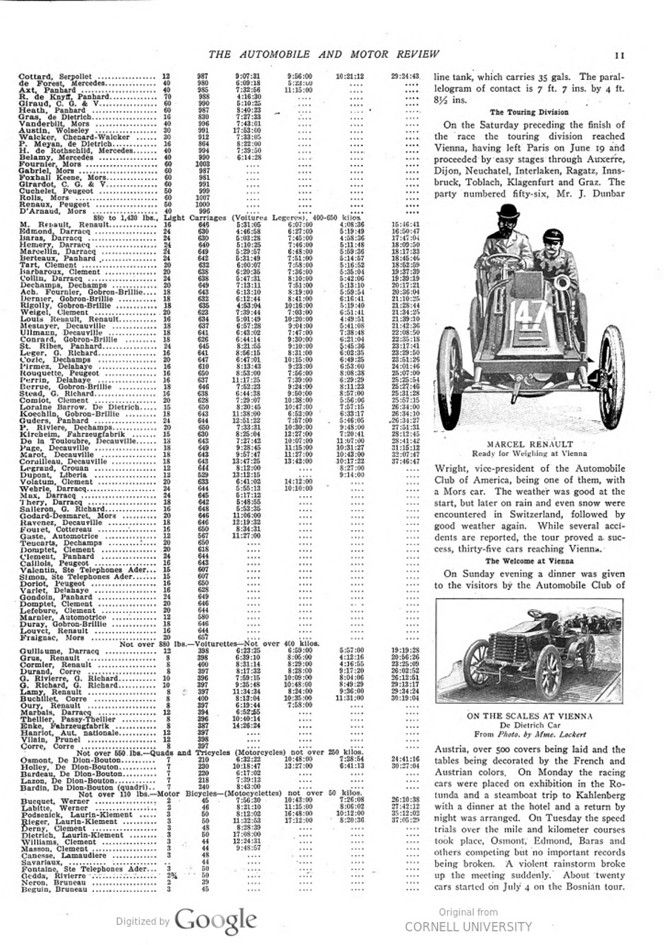
The total entries numbered 218, and of these 146 appeared before the officials at the final weighing. The Start at Champigny Paris was favored with real summer weather, on the day preceding the start, and the warm air and clear brilliant moon- light brought out thousands of spectators who spent the entire night in the neighborhood of Champigny. All through the evening streams of carriages, bicycles, motor cars and foot passengers converged from all directions to the top of the hill where banner stretched across the road announced the starting point. The big and brilliant lamps of the cars flashed in every direction mingled with hundreds of smaller lights on the bicycles, while from the trees were hung alcohol torches. Booths were erected for the sale of refreshments and for the checking of cycles, while big trucks were at hand with supplies of alcohol and petrol. A company of artillery, free to witness the start, came up singing merrily, while the great crowd, estimated at 30,000, was animated by a spirit of fun and good nature. One by one the great new racing cars rushed up the narrow road between the crowd and took their places, each beside a tree on which a placard with its racing number had been posted. The midnight trains from Paris brought out fresh crowds of spectators, who charged over the three miles between the little station at Nogent-Le-Perreux and the start on foot, but few conveyances being obtainable. One of these trains was a special, through to Vienna, carrying many makers, motorists and newspaper men, the charge for the single trip being 250 francs ($50); this party stopped off and climbed the Champigny hill with the rest.
At the Starting Line
According to order of entry Fournier was entitled to the first place in line, but a slight change was made owing to the Bennett cup race. Girardot, the holder of the cup, was given first place, his number of entry being 12; Fournier came next, and then came Edge, No. 45, the English champion, with de Knyff in fourth instead of fifth place. At the last moment the drivers of the three Wolseley cars, powerful racing machines but hurried to completion without proper trial, decided to abandon the course, and Mr. Edge took their place as the national representative. The sparking coils of the English machines had proved defective and it was impossible to replace them with others of British make, as the conditions of the cup required. Mr. Edge also suffered from the same trouble, though it did not rob him of the ultimate victory. Before starting each contestant was given three small flags, the French, the Austrian and one with the number of his car. Every car carried the number in front and on some were the letters A. L., signifying that alcohol was used instead of gasoline.
The sun was just high enough to throw long shadows across the full width of the road, as shown in some of the photos, when the official starter Mr. Huet summoned Girardot to advance to the line. The veteran racer moved his new C. G. V. car forward and rested, with hand on steering wheel and eye on watch as the five minutes ran slowly by, when, at 3.30 exactly, the word “Attention” was given and the red flag dropped, the great machine leaped instantly into life and fairly flew between the row of eager faces that lined the road for miles. Next came Fournier with his new Mors, waiting just two minutes and then starting in hot pursuit. Following him came to the line Mr. Edge. with his amateur mechanic Cecil Edge, on the powerful and formidable Napier with its Dunlop tires; two minutes more and he is off, the big and amiable Rene de Knyff in his 70-h.p. Panhard taking the vacant place at the line and starting after another two minutes. By this time the dust enveloped everything along the road, the songs of the birds were drowned in the chuff-chuff of the motors, and the balmy odors of the summer fields were smothered under the fumes of gasoline and alcohol.
A brief interval of nine minutes and the start was resumed, now in numerical order: 2, Gabriel; 3, de Caters; 4, Foxhall Keene; 6, Maurice Farman; 7, Henry Farman, and so on through the long list. The passengers by the Vienna special left soon after the first cars started, and the great crowd by degrees thinned down through the long interval before 218, the last car, crossed the line at 7.45. The following complete list of starters is worthy of a place as a permanent record:
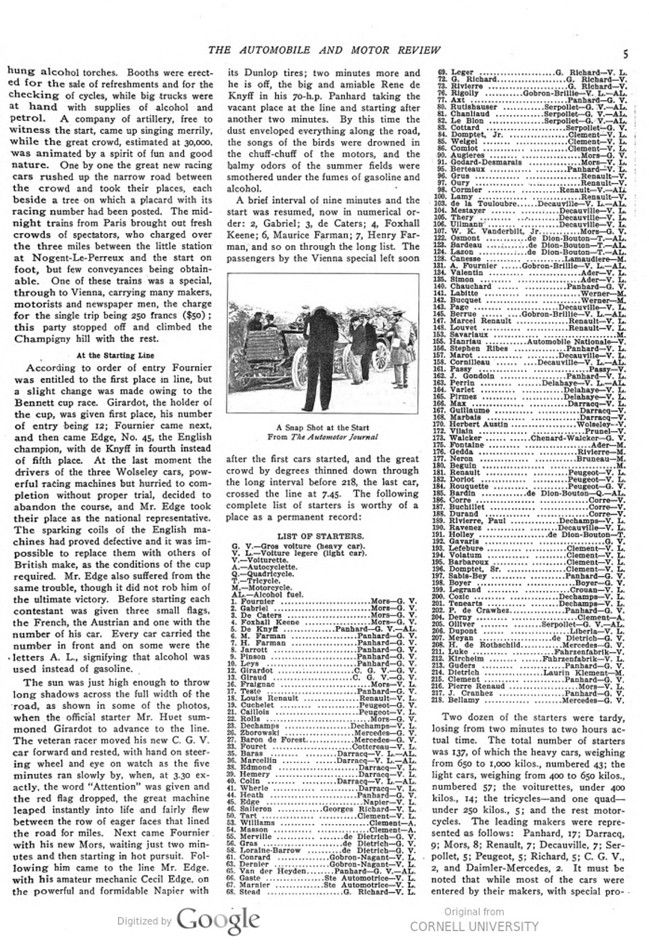
(See “LIST OF STARTERS”)
Two dozen of the starters were tardy, losing from two minutes to two hours actual time. The total number of starters was 137, of which the heavy cars, weighing from 650 to 1,000 kilos., numbered 43; the light cars, weighing from 400 to 650 kilos., numbered 57; the voiturettes, under 400 kilos., 14; the tricycles and one quad – under 250 kilos., 5; and the rest motorcycles. The leading makers were represented as follows: Panhard, 17; Darracq, 9; Mors, 8; Renault, 7; Decauville, 7; Serpollet, 5; Peugeot, 5; Richard, 5; C. G. V., 2, and Daimler-Mercedes, 2. It must be noted that while most of the cars were entered by their makers, with special provisions for repairs by the way as well as mutual assistance on the road, the Daimler factory was not directly interested, and entered no cars, the two Mercedes cars being each entered by its owner, on his own responsibility; the two, Baron de Forest and Count Zborowski, driving themselves, though having little experience in this class of racing. Twenty of the vehicles, including the five Serpollet steamers, used alcohol, all the others running on gasoline.
Charron, though entered, did not start, neither did Stead. Herbert Austin White, of the English trio, after withdrawing from the Bennett cup race, made a start in his regular place in the Vienna race.
On the Road to Belfort
The first day’s run, in clear weather and over good roads, was free from serious accidents, but replete with interesting incidents, many of which will never be told. Fournier soon took the lead, with de Knyff second and Edge third. The mis- haps began before the little village of Gretz, but 17 kilometers from the start, was reached. That seasoned sportsman Foxhall Keene had astonished the spectators in the morning by starting in ordinary dress, without the complicated paraphernalia of racing; he had gone only a dozen kilometers or so, however, before he ran into the gates at a grade crossing and disabled his car, the first bad luck for the Mors. With him in the same trouble was Fraignac, in another Mors, and a little later a third of the same make, that driven by Rolls, was forced to make a quick stop and burst the two right tires, the steering gear failed, and the car struck a tree, being totally disabled.
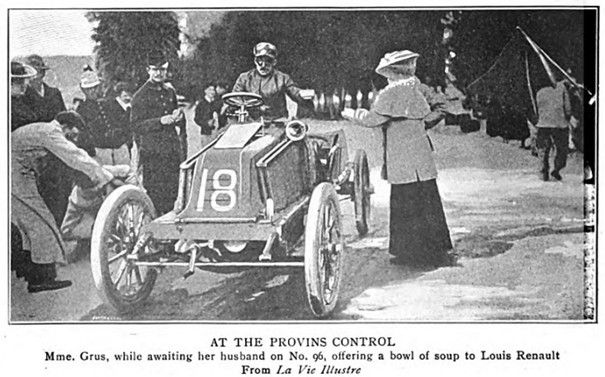
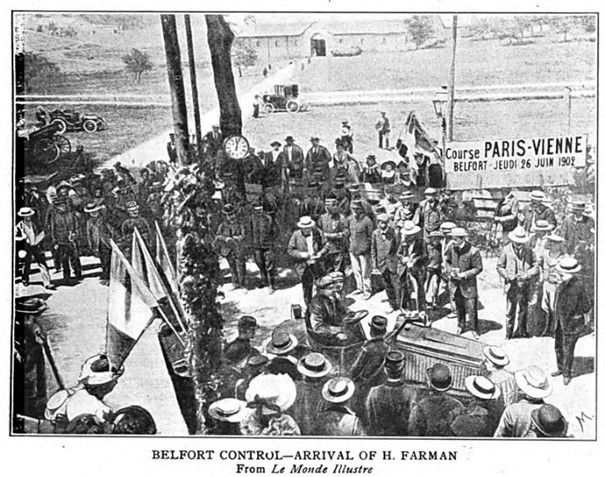
Fournier passed through Provins (75 kilometers) at 4.33, leading de Knyff by II minutes and Edge by 15 minutes; at Bar-sur-Aube (200 kilometers) he was but 4 minutes 10 seconds ahead, with the two Farmans in third and fourth places. The special train at times ran close along the highway and the racing cars were not only in view but actually speeding against the train itself. It was at 8 A. M., near Chaumont, between that place and Frotey-le-Vesoul (see map), that the passengers on the train caught sight of a car running at railroad speed in a cloud of dust. Hardly had they recognized Fournier when his car slowed down, then stopped, and he straightened up in his seat and threw up his hands in a way that signified that he was out of the race, the fourth mishap for the Mors. The break, which is ascribed to one of the gear shafts, was beyond repair, and the winner of Paris-Berlin was compelled to retire. Shortly after the stop, de Knyff rushed past, then came Maurice Farman, who, seeing that Fournier was in serious trouble, made a stop at the loss of three minutes, but resumed the course when he found that the break was beyond all aid. The special train rolled into Belfort at 10 A. M. to find the place in a buzz of excitement, the inhabitants having been out since early dawn, though it was certain that the first car could not arrive before the middle of the morning. The whole town was en fete, the streets filled with gaily dressed crowds and the buildings decorated with flags and streamers. The city authorities had erected a triumphal arch of flowers and banners at the control, which was excellently located. The road from Paris led down a long straight hill, with a row of trees on each side, the timing station being on a slight rise just beyond the foot of the hill; the cars consequently approached at full speed, being visible for a distance, while the up-grade helped them to stop quickly at the control. A big clock was suspended in full view. Every precaution was taken to prevent accidents, three companies of infantry were under arms, stationed at short intervals on each side of the road for a distance of 1,200 meters, while for the nearer half of that distance ropes were stretched from tree to tree, with a sentry with fixed bayonet at every ten meters. No one was allowed within the lines, even Mr. Serpollet, who wished to take a picture, being expelled. For a distance of two kilometers trumpeters were stationed at intervals of one hundred meters, each signaling in turn the sighting of a car.
From about 8 A. M. the crowd expectantly awaited the first comer; at 9 o Clock the bugles sounded and a Mors car approached, the photographers stood ready to shoot and the excitement was intense. As it happened it was Mr. Huillier, the manager of the Mors company, running over the course; he was promptly taken in charge by the officer in command for having broken the rules and trespassed on the course. By degrees the rumor of a mishap to Fournier spread through the crowd, but no details were known. At 10 o’clock the bugles again sounded and again all were on edge, this time over Mr. Deutch, another non-racer who shared the fate of his predecessor. Another impatient wait of three-quarters of an hour and the bugles rung out again, this time announcing a large and powerful car that rolled in at a speed approaching the hundred kilo- meters; as it separated in a measure from the surrounding cloud of dust the first view disclosed not a Mors but a Panhard, and then as the speed slackened and the dust dispersed, the bearded face of de Knyff appeared. The timer, Mr. Tampier, advances and signs the card as the crowd cheers, the time being 10:47:30 3-5, an average speed of 90 kilometers. A bicyclist whose sky-blue arm badge marks him as a guide, comes forward to lead the way, Mr. de Knyff putting his car in motion, and they pass on to the wagon house of the garrison, near the drill field. An interval of over twenty minutes and there comes another Panhard, driven by Henry Farman, then a third but three minutes later, Maurice Farman, bringing to the anxious crowd the first reliable news of Fournier’s mishap. Three minutes more and a fourth Panhard rolls in, Jarrott; a fifth, Pinson; and a sixth, Teste; at 11-45. Twenty minutes later comes the first of the light cars, the voiturette driven by Louis Renault, followed by Edmond in a Darracq and Zborowski in the Mercedes. Up to midnight, 91 cars had arrived.
The good work of de Knyff gave him one prize and the first chance at a second; being the first user of alcohol to reach Belfort he won the cup given by Prince Peter of Arenberg, and in addition he had a lead of nearly two hours over Edge, the only remaining competitor for the Bennett cup. His time for the distance of 408 kilometers (253 miles) was 4:16:30. The times for the day will be found in the final table.
The course for the second day lay for the first 35 kilometers through France, then the Swiss frontier was crossed just beyond Delle and the ascent of the Jura Mountains began.
The first card, that of Rene de Knyff, called for a start at 4 A.M., and about 2:30 the drivers made their way to the “parc.” Each driver with his assistant entered the enclosure as his name was called, started the motor and ran the car outside, where he was free to examine, adjust and oil at will; of course in his own time. It is safe to say that no time was lost under these conditions, but at the earliest possible moment the car was started again and, under the lead of the bicyclist-guide, headed for the eastern gates of the city. Here the scene was interesting, the representatives of the two great tire houses, Michelin and Continental, were ready with tires and tools for immediate and hurried work. Round about were all sorts of cans and cases of gasoline, alcohol and lubricating oils, with buckets and barrels of water for the Serpollets. It is true that the race was off for the day, but in the excitement that attended the whole event all were just as anxious to hurry on to the finish. Out of the original 137 starters 107 accounted at the control on the previous evening and all but two of these were on hand next morning. W. K. Vanderbilt, Jr., who, by the way, has forsaken Daimler for Mors, withdrew at Belfort, as did Dr. Henry Rothschild, who drove a Mercedes. The latter, though nominally racing, merely accompanied the race to render professional aid, his car being stocked with medical and surgical supplies. The motorcyclists, of whom there were fifteen on bicycles, four on tricycles and one on a quad, had to change their gears before leaving Belfort, to fit the machines for the mountain work. By 8 A. M. the last one had started. The day was warm and bright, with plenty of dust on the roads, but the speed was necessarily low, owing to the entire prohibition of racing and the many controls. The gendarmes were only too solicitous for the safety of the drivers, often cautioning them to slow down still more or to stop be- fore beginning some dangerous descents.
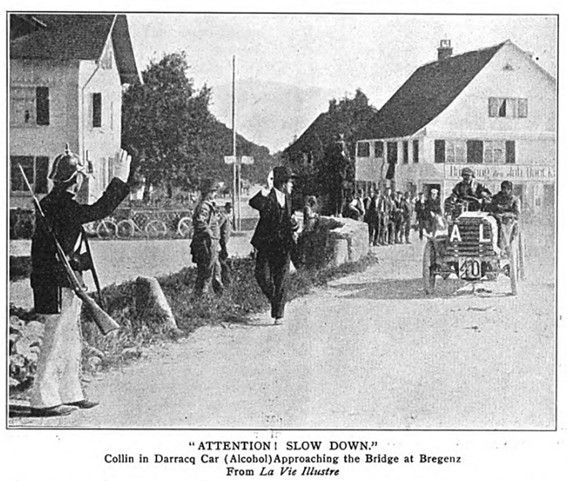
Between Basle and Bruss a long stop was enforced, while detailed instructions were read out, and the police decided that the average speed of the procession was too great, and insisted on the throwing in of the slowest speed. The time allowed for the distance of 312 kilometers (194 miles), was 1112 hours, a speed of but 17 miles; the entire distance was thus neutralized; and further it was divided into four sections, with an officer at each control who delivered to the competitors a card on which was marked the hour at which they might pass the next control. With clear weather, the heat being tempered by a fresh breeze, and much beautiful scenery by the way, the day’s run should have been restful and pleasant, but the abundant dust and the innumerable and over-officious guardians made it far otherwise. Rene de Knyff entered Switzerland at 4:20 A. M. and by 9 o’clock 97 had passed; at noon the first eleven, led by de Knyff, H. Farman, M. Farman, Edge, Pinson and Louis Renault, had passed through Zurich, 195 kilometers from Belfort. At Rorscarch the road touched Lake Constance, following it more or less closely to the Austrian frontier and then for some ten kilometers further to the Bregenz control, at the bridge over the Rhine. De Knyff arrived at 3:40, H. Farman at 3:42:12, M. Farman a minute later, Edge at 3:44:38, Pinson at 3:50:45 and Louis Renault at 3:56:53. The cars were left for the night in the open court of the barracks, the weather being clear.
From Bregenz to Salzburg
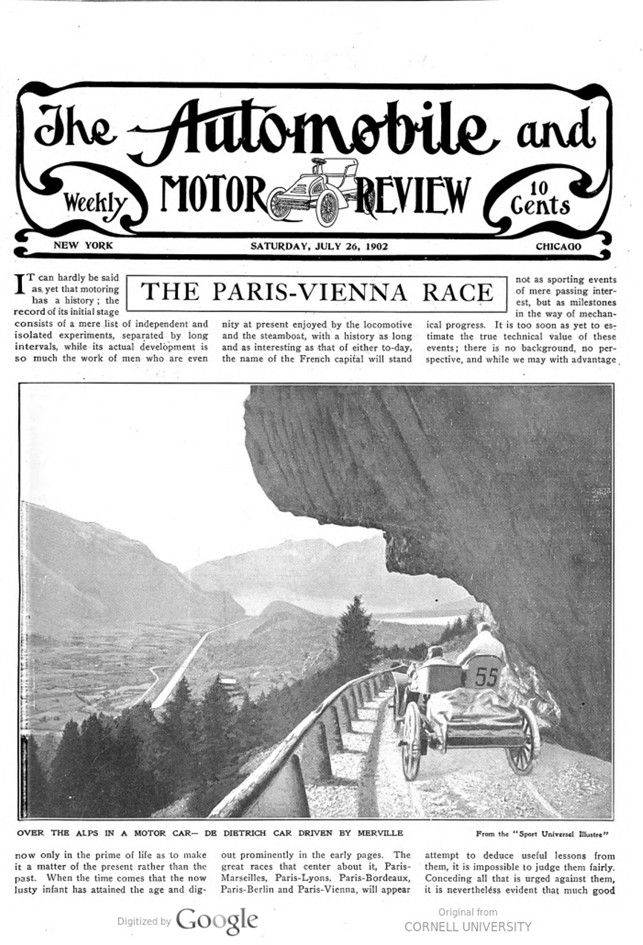
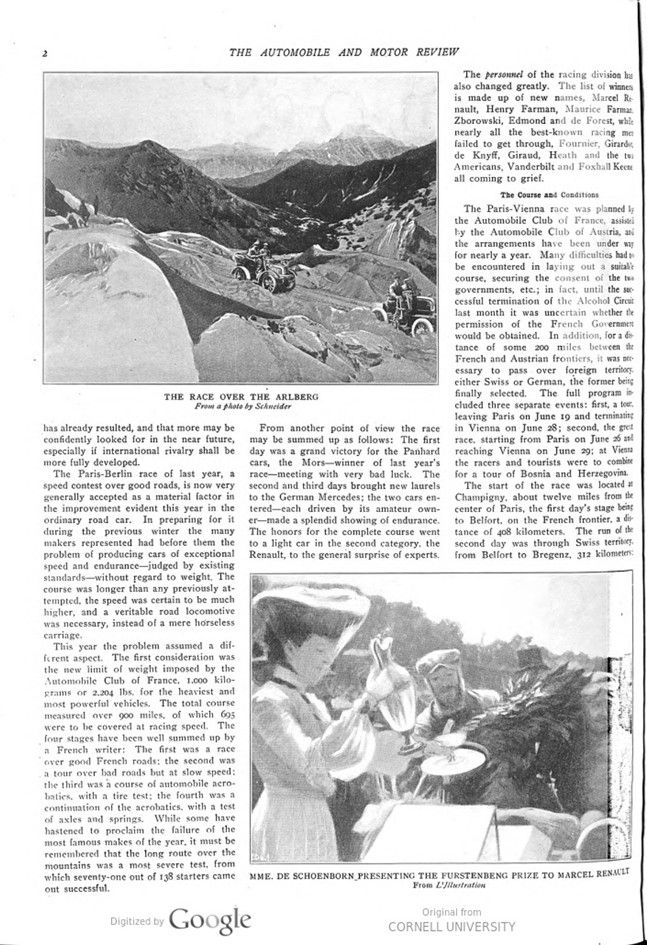
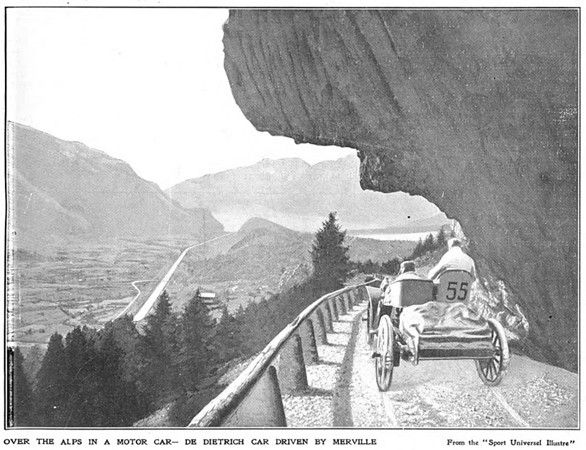
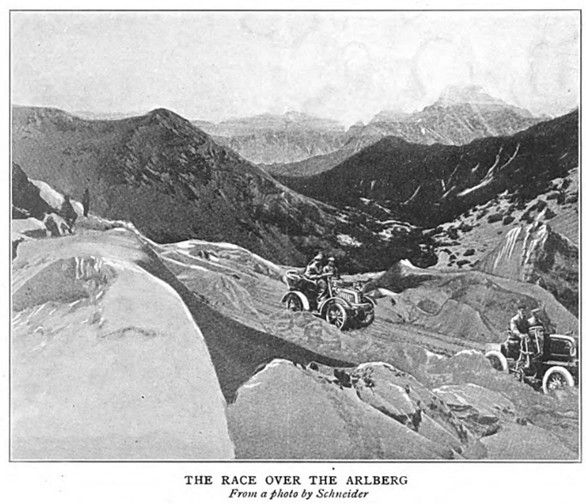
The third day brought a continuance of the good weather but very different roads, the region being more mountainous, while in the matter of construction and repair the roads of Austria cannot compare with those of France or even Switzerland. The two events of the day were the decision of the Bennett cup race between de Knyff and Edge, at Innsbruck, and the passage of the Arlberg Mountain. Though a double track had been cleared through the snow by the continued labors of a large force of men, this mountain was considered so dangerous that the propriety of neutralizing it was seriously discussed; however, it was left in the regular route. In spite of the hour, 4 A. M., a very large crowd was present to witness the start, de Knyff still leading and the others following at 30-seconds interval until ninety-three had been checked by the control. Upward and still upward over the mountains the chase continued in much the same order as on the previous day; the dreaded Arlberg proved quite as bad as anticipated; the descent was dangerous and difficult in the extreme, but it was still a race. The road over the mountain had been cut into deep cuts, which had been leveled by the workmen employed by the Automobile Club of Austria, and filled with loose stones. As the cars passed at speed the stones were thrown in all directions, hitting the drivers and their aids at times.
The American “thank-you-ma’am” has an Austrian parallel in the “dos d’ane,” or asses’ back. This is a plank or timber placed across the road on the hills, making a step or rest against which the rear wheels of a wagon can rest in ascending, giving the horse a rest. The lower side of the obstruction is banked with earth to make the ascent easy, but in descending the timber makes a serious obstacle. These were found in abundance, in company with another obstruction, the “caniveau,” an open culvert across the road, with a wooden bottom and the sides paved with stones, All went well with the leader until within some 25 kilometers of the finish of him; at a sharp turn in the road at Innsbruck, when his differential broke and left him helpless. Here he was passed by the two Farmans, Renault, Zborowski and, worst of all, Edge.
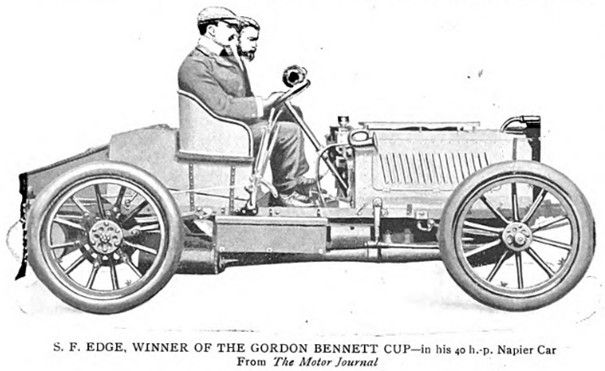
The latter had his troubles still ahead of him; at a sharp turn in the road he saw ahead the blue warning flag and put on the brakes, the car skidded and left the road, bringing up in a ditch fifteen feet below. The bottom was of soft earth with turf and shrubs and the car was little injured; the ditch sloped upward and by running the car backward for some distance it was brought to the level of the road by its driver and his assistants. The direct consequences of this accident were bad enough, but the indirect nearly robbed him of the race. Seeing his plight, a party of friendly peasants rushed to his aid, in ignorance that by the conditions of the cup a car must be handled under all circumstances by its own crew alone. It was impossible to explain this in English to Austrian mountaineers, and it was with great difficulty that Mr. Edge kept them from interfering as he and his cousin ran the car back to the road. The incident was reported in such shape as to threaten the loss of the cup through disqualification, but this version has apparently been accepted, and the cup has been awarded to him; a fitting reward for his perseverance in racing, his good work on the Napier car, and his steady and reliable driving.
The finish at Salzburg found an entire new set of leaders; de Forest was first, with his Mercedes, at 1:34:20; Henry Farman next at 2:17:50; Louis Renault at 2:18:50; Zborowski, with another Merce- des, at 2:25:25; Edmond at 2:33:15; Berteaux, with a 24-h.p. Panhard, at 3:10:50; and Maurice Farman at 3:12:40. Several bad wrecks were reported, but no one was seriously injured. manner.
As Louis Renault, the leader in the light class, was waiting to start from Innsbruck de Caters came up at speed in his heavy Mors car and struck the Renault, smashing both wheels on the right side. Nothing daunted, Mr. Renault procured some wood, and, with a knife, shaped new spokes and repaired both wheels in a most skillful manner. These repairs cost him four hours’ delay, which fact he had certified by the officials. On the way to Salzburg, he was again delayed by a broken wheel and only arrived at 8 o’clock, some six hours later than the little group of leaders with which he had kept company up to the time of the collision. He demanded of the committee that the four hours lost in repairs should be deducted from his running time. The people of Salzburg had prepared to welcome the visitors, the whole city being gaily decorated and the day being observed as a holiday.
The Last Day’s Run
The course for the last day was over a distance of 3352 kilometers, the roads being poor in places but much better than on the preceding stage. The starting intervals were arranged according to a special plan, the committee being at liberty to vary the intervals between the first five from three to fifteen minutes; all others being allowed two minutes start. Henry Farman was first away at 6.30, followed by Edmond at 6.45, Zborowski at 6.48, Pinson at 6.53, then Teste, de Forest, M. Renault, M. Farman and the others at two-minute intervals. The list by this time had fallen to seventy-seven vehicles in all. All through the morning Henry Farman drove his big Panhard, with several cars of the lighter class in hot chase; at St. Polten, with Vienna still 85 kilometers distant, they were dangerously close to him, and just before I P. М., when near Tulln, with but 46 kilometers to cover, he was forced to take second place. The lucky man who passed him was Marcel Renault, one of the Renault brothers, on a light car of that name; in the earlier part of the race he had held a less conspicuous place than Louis, but he had run steadily for the whole journey and missed the ill luck of his brother. Once in the lead, he held his place, though pushed by Zborowski, de Forest and Maurice Farman. Toward the finish, de Forest was in undeserved ill luck in crossing a ditch in the roadway; the shock broke his fuel tank, and he was compelled to finish in tow of a friendly car, of course being disqualified.
The End of the Course
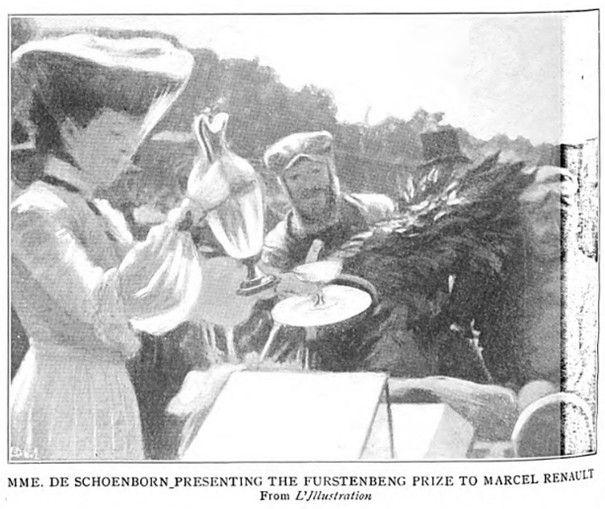
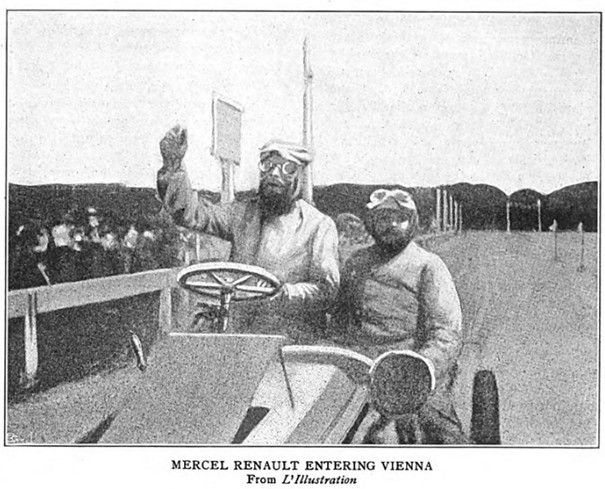
All Vienna was in the streets on Sunday, still another clear day, to witness the finish; those directly interested assembling at the trotting course on the Prater. The Automobile Club of Austria and the Automobile Club of France were well represented, with all the leading lights of the sport and the industry. Owing to the court being in mourning for the death of the King of Saxony, the Emperor Francis Joseph was not present in person nor was he represented. It was expected that the first cars would arrive about 2 o’clock, and promptly on time Marcel Renault approached through the city at full speed. It was with some difficulty that he found the main entrance to the track, being directed first to the entrance for pedestrians, but he finally entered and made the round of the course, being crowned with laurel when he stopped. His position as winner was imperiled, however, by a mistake for which it seems probable that he is hardly responsible. Instead of stopping at the Floridsdorf control and running slowly in to the track, taking 45 minutes for the five miles, he went past the control at speed and did not slacken down until he reached the trotting track. It is claimed in his behalf that while all the important controls were conspicuously marked so that even the driver of a racing car could discern them, the last control was in a small village, marked only by one flag, and with nothing to attract or to indicate its true importance. After due consideration the committee decided to award the first prize to Mr. Renault in spite of the irregularity of the finish. The second in was Zborowski, 22 minutes after Renault, then Maurice Farman, Baras, Edmond, Hemery, de Forest (in tow), Berteaux and Henry Farman. An unlucky puncture toward the end had robbed the latter of the public honor for some good work over the whole route. The official times of the finish were: Marcel Renault, 2:18:7; Zborowski, 2:42:5; Maurice Farman, 2:57: 50; Baras, 3:1:36; Edmond, 3:4:49; Hemery, 3:5:48; De Forest, 3:10:49; Berteaux, 3:21:5; Henri Farman, 3:24:51; Chauchard, 3:34:52; Tart, 3:35:58; De Crawhez, 3:49:51; Teste, 3:49:58; De Caters, 3:54: 55; Dechamps, 3:58:10; Louis Renault, 3:59:1; Barbaroux, 4:14; Augieres, 4:34; Marcellin, 4:2:36; Collin, 4:3:6; Edge, 4: 11:15; Guillaume, 4:12; Rigoliy, 4:24:40; A. Fournier, 4:30:54; Mestayer, 4:34:8; J. de Crawhez, 4:52; Grus, 4:53; Dernier, 4: 55:41; Pinson, 5:2:24; Jarrott, 5:2:55; Leger, 5:3:35; Sabit-Bey, 5:5:51; Stephen Ribes, 5:6:46; Cormier, 5:13:55; Conrard, 5:20:4; Weigel, 5:28:26; Pirmez, 5:40:3; Comiot, 5:47:6; Leys, 5:55:22; Merville, 5:57:20; Guders, 5:57:30; Chanliaud, 5:58: 51; Koechlin, 6:8:17; Perrin, 6:8:29; Ullmann, 6:11:48; Gavaris, 6:13:48; Cozic, 6: 16:25; Kircheim, 6:27:41; Rutishauser, 6: 32:17; Osmont, 6:43:54; Volatum, 6:57:13; Bucquet, 7:3:8; Rouquette, 7:27:38; Le Blon, 7:28:24; Loraine-Barrow. 7:30:15; Rivierre, 7:55:6; Stead, 7:59:37: Labitte, 8:2:2; Rieger, 8:14:36; Olliver, 8:35; Durand, 8:45, and Cottard.
The total number of vehicles finishing was 71, out of 137 starters, or 51 per cent. It should be noted that the five Serpollet steam cars, one an ordinary road carriage of last year’s make driven by its owner, all came through, not among the leaders, but in a way that testified to their reliability and regularity. Osmont’s work on his tricycle and that of Bucquet and Labitte on light motorcycles, is also remarkable considering the length and nature of the course.
It will probably be some weeks before the complete official record is made public, and the only official figures thus far available are the gross times, including the neutralized section in Switzerland and the fifty-odd cities and villages of France and Austria. The leaders are given as follows:
————————————— H. M. S.
Marcel Renault, Renault……. 26 22 43
H. Farman, Panhard………….. 26 36 30
Edmond, Darracq……………… 26 45 10
Zborowski, Mercedes……….. 26 48 09
M. Farman, Panhard………… 26 54 29
Baras, Darracq…………………. 27 39 50
Teste, Panhard…………………. 27 48 38
Hemery, Darracq……………… 27 58 38
Marcellin, Darracq……………. 28 13 30
The award of prizes by the international committee is as follows: Emperor Francis Joseph’s prize for first French car, Marcel Renault. President Loubet’s prize for first non-French car, Count Zborowski. Ladies’ prize for second time, Henry Farman. Prince Furstenberg’s prize for first arrival at Vienna, Marcel Renault. Count Schoenborn’s prize for second arrival at Vienna of heavy class, Maurice Farman. Margrave Pallavicini’s prize for second time in light class, Edmond. Gordon Bennett cup, S. F. Edge. Prince d’Arenberg prize first alcohol car on first day, Rene de Knyff.
The following table is unofficial, but gives as completely and accurately as is now possible the record for each car. It should be noted that owing to the very peculiar arrangements in Switzerland Zborowski was penalized by the addition to his actual racing time of forty-five minutes, as a punishment for having passed a Swiss control ahead of time.

The Renault and Napier Cars
The winning car is one of three built specially for this race, with four-cylinder motors but after the same plan and details as the regular cars. The nominal h.p. is 16 but the motors work up to 22. The firm also started four of its regular cars in the voiturette class, of which three finished at Vienna. All of these cars have the longitudinal transmission with universal joint (cardan); the cooling is by thermo-siphon, and there are three speeds, the highest being direct and the other two through the change-gears. Admirable as it was, the showing of this firm would have been very much better but for the mishap to Louis Renault, through no fault of his. The Renault car is notable mainly for the consistent good work in both design and construction which has always marked the work of this firm; in addition to this the cars were boldly but carefully handled by both brothers.
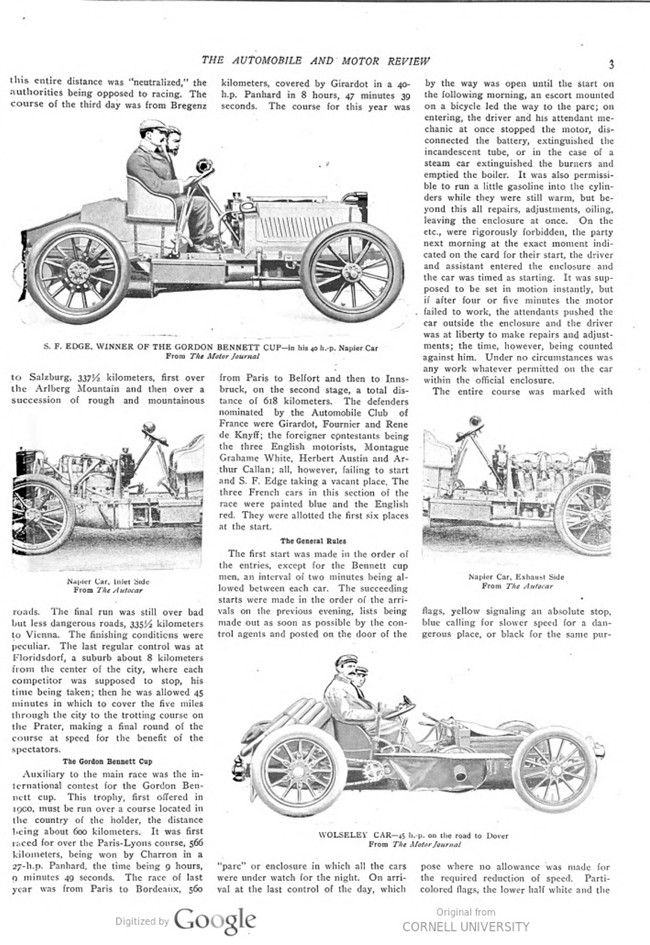
The Napier in which Mr. Edge won the Gordon Bennett cup has four cylinders, each 5 by 5 ins., with four-port inlet valves, separate exhausts each 24 ins. diameter, and the Napier throttling governor. The drive is by the Napier longitudinal shaft, direct on the high speed and geared for the two lower speeds and the reverse. The live axle is mounted with roller bearings and the clutch and bevel drive have ball thrust bearings. The body, built chiefly of aluminum, is mounted over the gasoline tank, which carries 35 gals. The parallelogram of contact is 7 ft. 7 ins. by 4 ft. 8½ ins.
The Touring Division
On the Saturday preceding the finish of the race the touring division reached Vienna, having left Paris on June 19 and proceeded by easy stages through Auxerre, Dijon, Neuchatel, Interlaken, Ragatz, Innsbruck, Toblach, Klagenfurt and Graz. The party numbered fifty-six, Mr. J. Dunbar Wright, vice-president of the Automobile Club of America, being one of them, with a Mors car. The weather was good at the start, but later on, rain and even snow were encountered in Switzerland, followed by good weather again. While several accidents are reported, the tour proved a suc-ess, thirty-five cars reaching Vienna.
The Welcome at Vienna
On Sunday evening a dinner was given to the visitors by the Automobile Club of Austria, over 500 covers being laid and the tables being decorated by the French and Austrian colors. On Monday the racing cars were placed on exhibition in the Rotunda and a steamboat trip to Kahlenberg with a dinner at the hotel and a return by night was arranged. On Tuesday the speed trials over the mile and kilometer courses took place, Osmont, Edmond, Baras and others competing but no important records being broken. A violent rainstorm broke up the meeting suddenly. About twenty cars started on July 4 on the Bosnian tour.
Photos.
Page 1.
#55 OVER THE ALPS IN A MOTOR CAR – DE DIETRICH CAR DRIVEN BY MERVILLE From the “Sport Universel Illustre”
Page 2.
THE RACE OVER THE ARLBERG – From a photo by Schneider
MME. DE SCHOENBORN_PRESENTING THE FURSTENBENG PRIZE TO MARCEL RENAULT – From “L’Illustration”
Page 3.
Napier Car, Inlet Side – From “The Autocar” – Napier Car, Exhaust Side – From “The Autocar”
S. F. EDGE, WINNER OF THE GORDON BENNETT CUP-in his 40 h.p. Napier Car – From “The Motor Journal”
WOLSELEY CAR – 45 h. p. on the road to Dover – From “The Motor Journal”
Page 4.
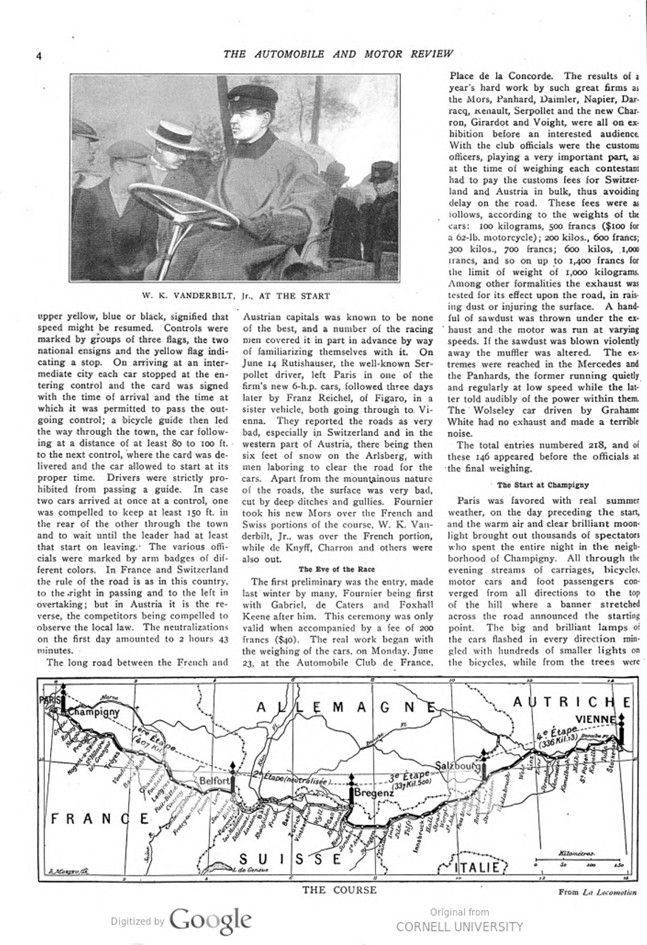
W. K. VANDERBILT, Jr., AT THE START
THE COURSE – 1ere Étape (407 Kil.) Champigny – Belfort | 2e Étape (neutralisée) Belfort – Bregenz | 3e Étape (337 Kil. 500) Bregenz – Salzbourg | 4e Étape (336 Kil.) Salzbourg – Vienne. From “La Locomotion”
Page 5.
A Snap Shot at the Start – From “The Automotor Journal”
LIST OF STARTERS
G. V. – Gros voiture (heavy car) V. L. – Voiture legere (light car)
V. – Voiturette A. – Autocyclette
Q. – Quadricycle T. – Tricycle
M. – Motorcycle AL. – Alcohol fuel
Page 6.
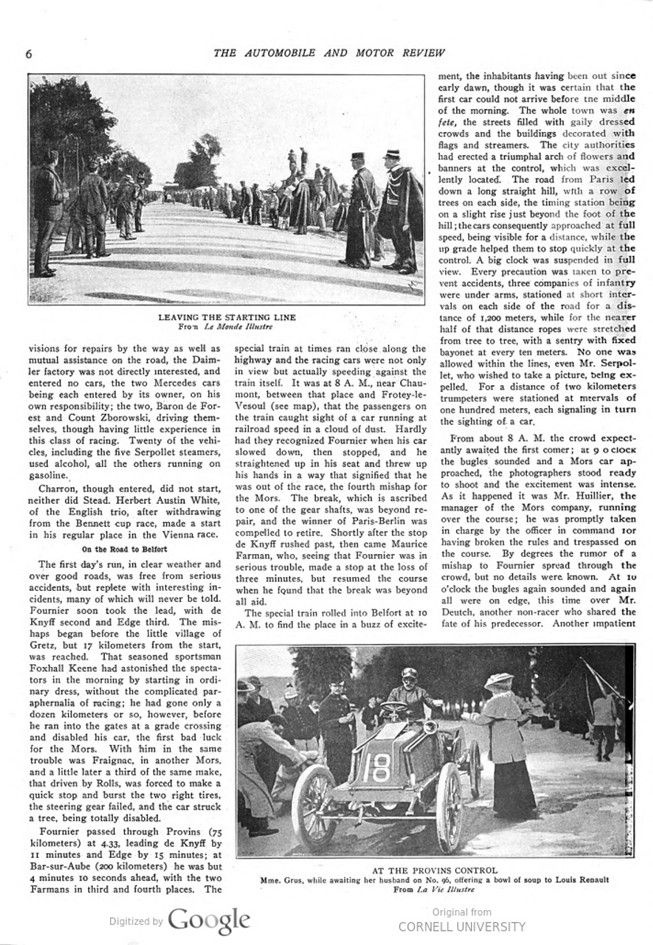
REVIEW LEAVING THE STARTING LINE – From “Le Monde Illustré”
AT THE PROVINS CONTROL – Mme. Grus, while awaiting her husband on No. 96, offering a bowl of soup to Louis Renault – From “La Vie Illustré”
Page 7.
“Course PARIS-VIENNE BELFORT – JEUDI 26 JUIN 1902” – BELFORT CONTROL – ARRIVAL OF H. FARMAN – From “Le Monde Illustré”
HENRY ROTHSCHILD AT THE START
Page 8.
“ATTENTION! SLOW DOWN.” – Collin in Darracq Car (Alcohol) Approaching the Bridge at Bregenz – From “La Vie Illustré”
(DOUANES SUISSES + BURLAL SECONDAIRE MEUDON)
THE SWISS CUSTOMS AT MEUDON – Mme. Lockert’s Car – From photo by Mme. Lockert
Page 9.
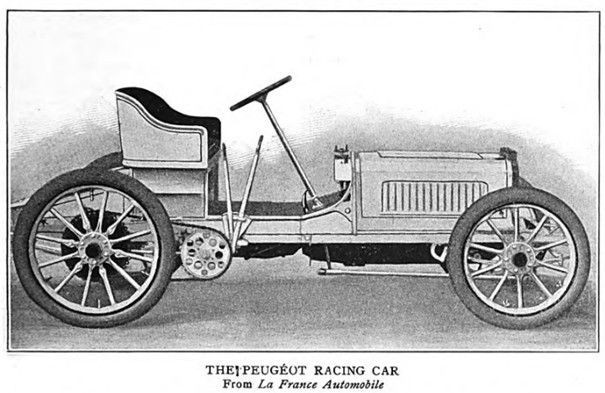
THE PEUGEOT RACING CAR – From “La France Automobile”
MARCEL RENAULT ENTERING VIENNA – From “L’Illustration”
Page 10.
THE COURSE AND JUDGES STAND AT VIENNA – From Cycling
BUCQUET ON A WERNER MOTORCYCLE – Winner of the First Prize
RECORD OF THE PARIS-VIENNA RACE
Page 11.
MARCEL RENAULT – Ready for Weighing at Vienna
ON THE SCALES AT VIENNA De Dietrich Car – From Photo. by Mme. Lockert