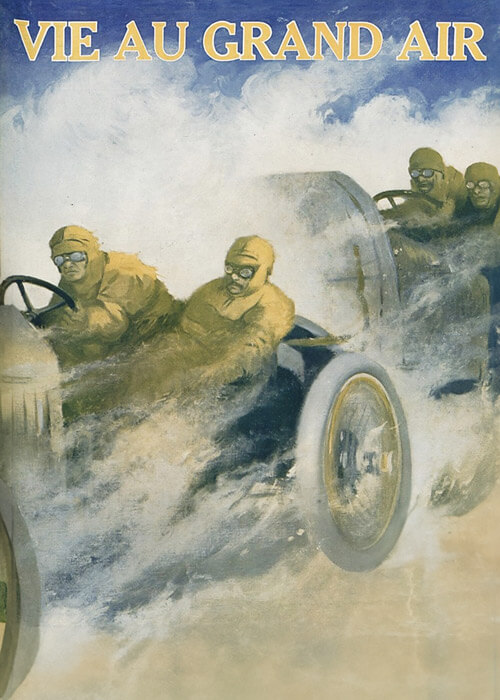
In 1908, the first American Grand Prix was run, for which Savannah, Georgia got the credits. In view of the European automotive industry and hence some magazines, this event really bore quite some interest. In this article of the French magazine La Vie au Grand Air, first the background of European interest is explained.The aim of the A.A.A (American Automobile Assiciation) was to match both the Vanderbilt Cup with the now new Grand Prize as being a boost for the American automotive industry. This one still lagged behind on it’s European counterpart. (A sutuation that would only last till the Great War). In the second part, the excellent condition of the road course as well as the organisation is praised. Throughout, the importance of this Grand Prize for the European automotive industry is stretched, an issue that we’ll encounter in more European magazines. (Translation).

Text and jpegs by courtesy of the Bibliothèque national francais – gallica.bnf.fr; compiled by motorracinghistory.com, Translation by DeepL.com
La Vie au Grand Air – Volume 14, No. 519, August 29, 1908
THE GRAND PRIX OF AMERICA
By C. FAROUX
The Automobile Club of America is organizing a major international race on November 26 at the Savannah Circuit, for which the regulations of the Dieppe Grand Prix will apply — Disappearance of the Vanderbilt Cup, which has been disqualified
The United States has always been a loyal customer of our major automobile brands. Just last year, more than twelve hundred cars of French origin cleared customs in New York, and since these are, almost without exception, luxury cars with an average power of around 35 horsepower and a price tag of 20,000 francs each, it is clear that the Yankees are currently dependent on the French automobile industry for an annual sum of 25 million francs. Add to this the fact that Americans limit their purchases almost exclusively to a dozen of our major brands, and you will easily understand that an international speed race officially organized in America is, from the outset, assured of the active participation of the major European brands.
This is what has made the Vanderbilt Cup a success so far; it is also what will lead to its demise. These two somewhat contradictory statements require clarification.
Discord in America
To fully understand the situation, a brief preamble is necessary. In the United States, as elsewhere, there are several regional automobile clubs: only one of them, considered the representative of the others, was represented at the International Federation of Automobile Clubs, which brings together the sporting leaders of all automobile-producing nations. Thus, for example, the Federation recognizes in Italy only the Automobile Club of Turin, the oldest and most prosperous; likewise, the same Federation recognizes in the United States only the Automobile Club of New York, which is also the oldest and most prosperous.
It is easy to see that this general understanding among the various national sporting authorities can only lead to positive results, not least of which is the unification of racing regulations, achieved last year following the historic Congress in Ostend. Everything went well everywhere, except in America, and due to the fault of the turbulent American Automobile Association.
The American Automobile Association, the A.A.A., — the 3 A’s, as it is called over there — is nothing more than a vast automobile trust cleverly disguised under the innocent sporting guise of an association of automobile clubs, which, by encompassing all local clubs in every state of North America, claimed to act solely to facilitate all matters pertaining to the automobile.
In reality, the A.A.A. aimed only to encircle the clubs throughout the region in order to subsequently impose racing regulations which, if enforced, would have practically barred any European manufacturer from participating in any race on American soil, or would have made it impossible for their cars to hold their own against the shiny American machines. Recall the recent history of the Briarcliff Trophy, where, under the terms of a rule imposed by the A.A.A. in exchange for its subsidy:
“No driver or pilot who is not a citizen of the United States may be admitted to attempt the race.”
The newspapers protested vehemently against this clause, which was ultimately repealed. But the spirit behind this exclusion has persisted in another form in the upcoming Vanderbilt Cup. For, after Ostend, the A.A.A. proclaimed in no uncertain terms: “What need have we of European regulations? We have no need of the Old World, and since the creation of a Grand Prix of Amerca has been decided according to the views of European clubs, let us set up the Vanderbilt Cup against it, which we will provide with rules to our liking.”
That is, according to the liking of the Yankee manufacturers.
In short, this discord will result in two events: one, the Vanderbilt Cup, disqualified everywhere and condemned to having an exclusively national character; the other, the Grand Prix of Savannah, which will have a global impact and which will be, we hope, a fine revenge for the French industry for the defeat suffered at Dieppe. We will therefore focus solely on the Grand Prix of the Automobile Club of America.
The proposed circuit is ideal in terms of layout and surface
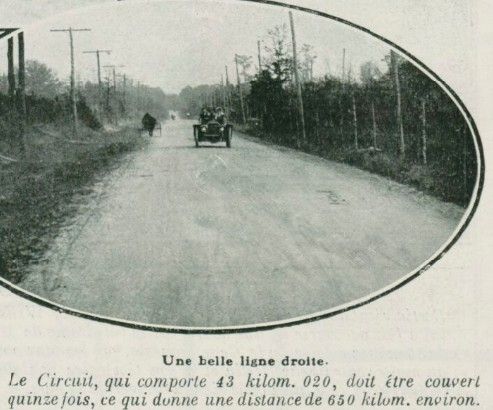
As we have said, the regulations for the A.C.A. Grand Prix are identical to those of the A.C.F. Grand Prix, and it is the cars from Dieppe that will face off in Savannah. The circuit, which is 43.020 kilometers long, must be completed fifteen times, meaning that the competitors will have to cover a total distance of approximately 650 kilometers. The road will be guarded by the military and has, moreover, been prepared with the utmost care for this event, which the Automobile Club of America will hold annually.
As for the organization, it will be simply splendid.
How can we say that, you might ask? Because there is a precedent. On this very same Savannah Circuit, in fact, the Briarcliff Trophy, of which *Vie au Grand Air* published an illustrated report, which saw an Isotta-Fraschini triumph. Incidentally, just ask the major manufacturers in Milan if they’ve had any cause to regret it. Their exports to America have quite simply quadrupled in less than three months.
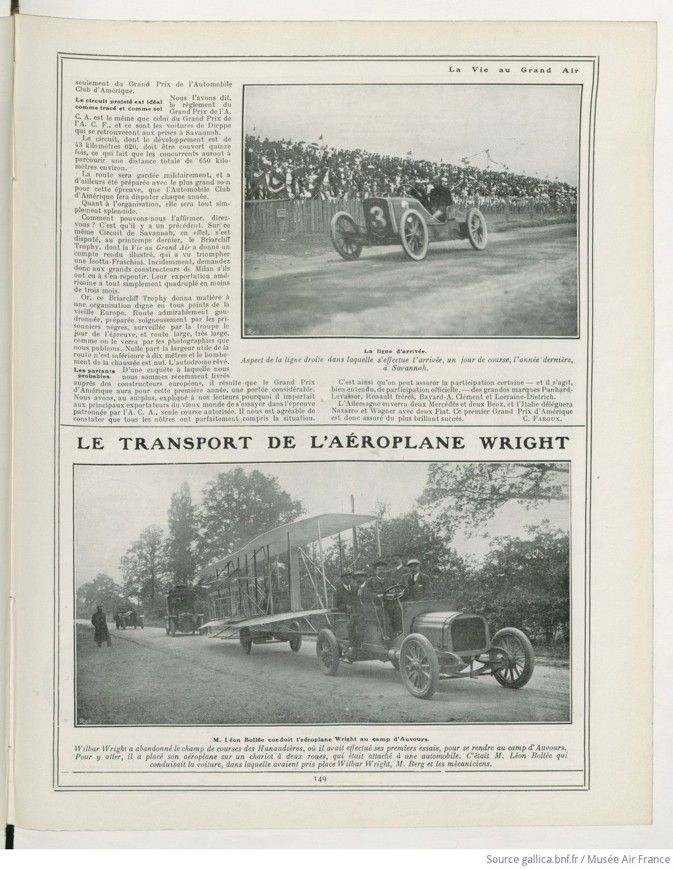
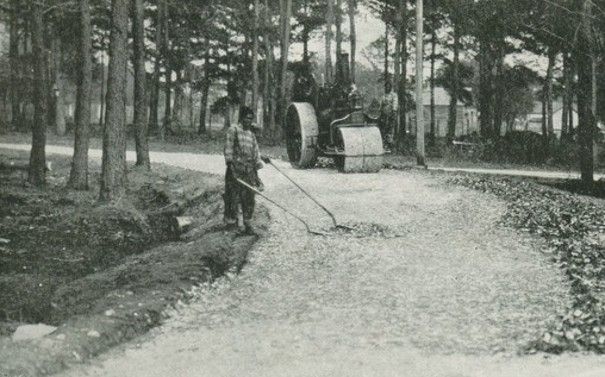
Now, this Briarcliff Trophy provided the basis for an organization worthy in every respect of old Europe. A beautifully paved road, carefully prepared by Black prisoners, supervised by troops on race day, and a wide, very wide road, as can be seen from the photographs we are publishing. Nowhere is the usable width of the road less than ten meters, and the road surface has no camber. The ideal racetrack.
The likely starters.
A survey we recently conducted among European manufacturers indicates that the Grand Prix of America will have considerable significance in this first year.
We have, moreover, explained to our readers why it was important for the major exporters of the Old World to compete in the race sponsored by the A.C.A., the only authorized race. We are pleased to note that all of our own manufacturers have fully understood the situation.
Thus, we can confirm the certain participation — and this is, in fact, official participation — of the major brands Panhard-Levassor, Renault frères, Bayard-A. Clément, and Lorraine-Dietrich.
Germany will send two Mercedes and two Benz, and Italy will send Nazarro and Wagner with two Fiats. This first Grand Prix of America is therefore assured of the greatest success.
C. FAROUX.

Photos.
A dangerous turn. Road repairs have already begun. This turn is being re-paved with stones before the first layer of asphalt is applied.
Circuit Security. The road will be under military guard for the entire duration of the race.
A beautiful straightaway. The Circuit, which is 43.020 km long, must be covered fifteen times, resulting in a distance of approximately 650 km.
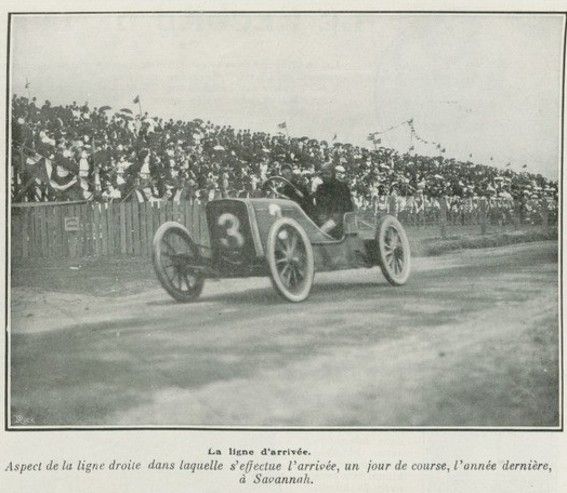
The finish line. View of the straight where the finish takes place, on a race day last year in Savannah.