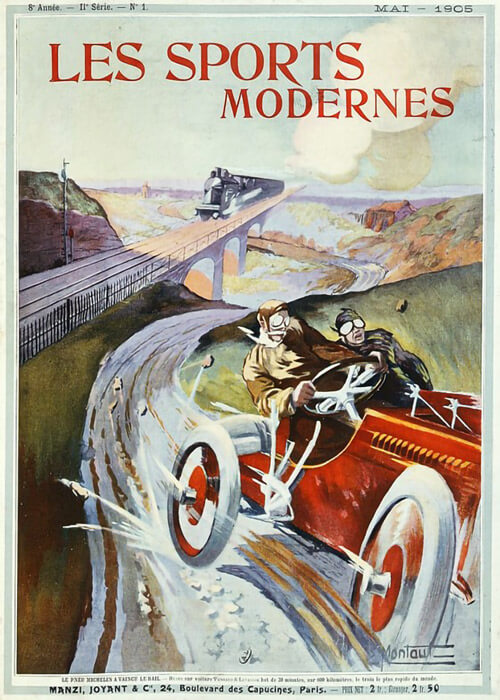
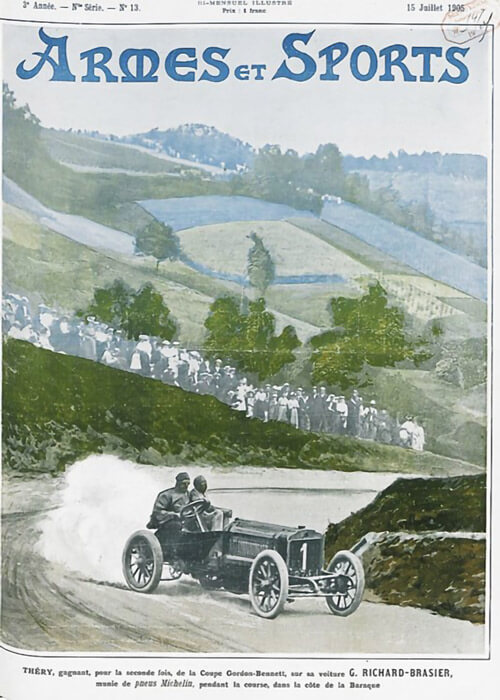
The book of Pierre Souvestre, „Histoire de l’Automobile“ covers very extensively the very first years of the automotive industry up until 1906. The section „La vitesse et sa griserie“ deals with the very first automobile contest in history, not being a race though: the 1894 Concours de Paris-Rouen. In this first part of the book section, not only the introduction to this event, but also the complete list of the 102 registrations is given. After the eliminations, not all participated. (Translation separately).
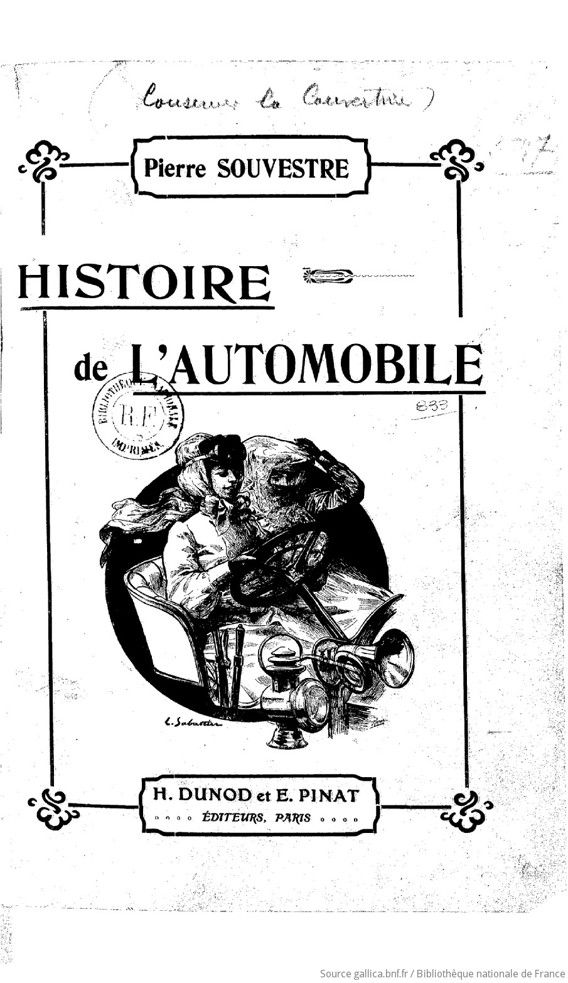
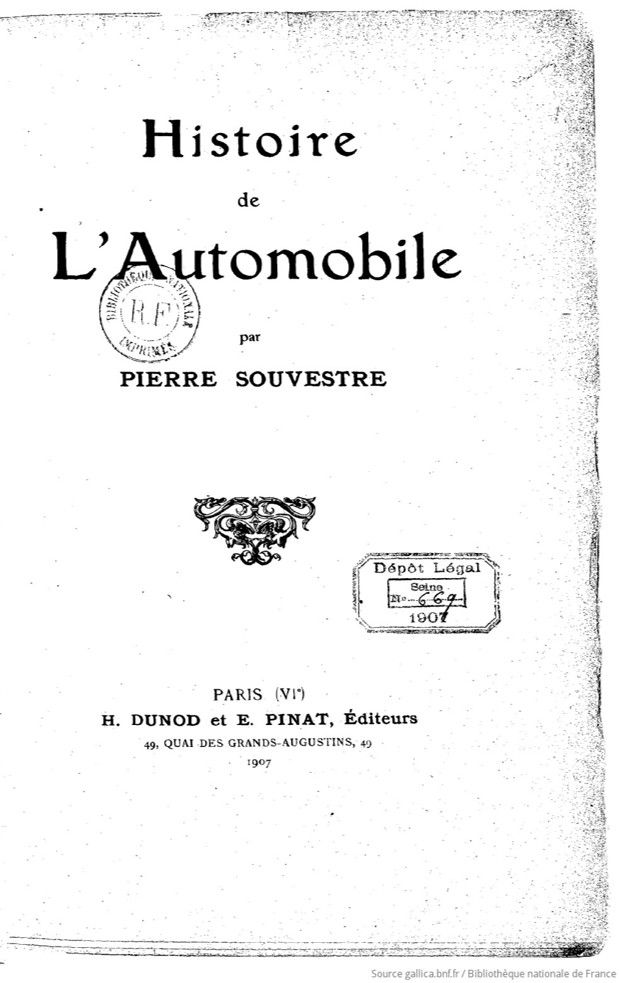
With permission of the Bibliothèque national francais gallica.bnf.fr
Text and photos compiled by motorracinghistory motorracinghistory.com Translation by DeepL deepl.com
Histoire de l’Automobile — Pierre Souvestre, Paris 1907
The Paris-Rouen Contest (1894)
The Direction. — Focus on Speed. — The “Petit Journal” Race. — Jean sans Terre. — The Rules. — Entries. — 102 Entries. — The Elimination/Qualifying Rounds. — Race Day. —On the Road. — Arrival in Rouen. — The Results. — Press Reactions. — A Happy Coincidence! — Baron de Zuylen. — Marinoni.
The Direction. — Toward Speed
The modern automotive industry is now fully established.
However, a serious question arises: in which direction should its activities be steered?
Three key players claim to be holding the newborn at the baptismal font.
The heavy-duty vehicle industry, applied to public transportation or freight transport; mechanical propulsion on waterways; speed. The first — by far the oldest — is of English origin.
It dates back to 1830 and draws on its great forebears Gurney, Hancock, and others, to promise contemporary motoring a future of great economic significance.
The second, highlighted by Daimler’s recent experiments, ensures the mechanical vehicle a peaceful, safe, almost bourgeois existence, if not one capable of upending the balance of the modern world. The third… ah! the third……
Ah! The third, listen carefully: just like in *La Belle Hélène*, it brought nothing but a blank past and a most uncertain future. But it was “speed”, that is to say, exhilaration, ecstasy, a mad struggle, a chivalric tournament, the French spirit, all at once!
It was also, though no one suspected it at the time, the concise, brief, and conclusive formula that, for many years to come, would resolve all problems of competition and rivalry.
In truth, that preference was not openly acknowledged from the start. Over the course of the century, people had seen how routine, a backward-looking mindset, timid bureaucracy, anxious public authorities, a press reluctant to take sides, and an enigmatic public opinion had done considerable harm to this fledgling mode of transportation; to avoid their harmful influence, it was necessary to be cunning and grant speed only an “unofficial” and secondary role.
Thus, to pit motor vehicles against one another, the term “contest” was initially used, a term through which discerning people clearly read the six seductive letters of the word “race.”
The “Petit Journal” Contest. — Jean sans Terre
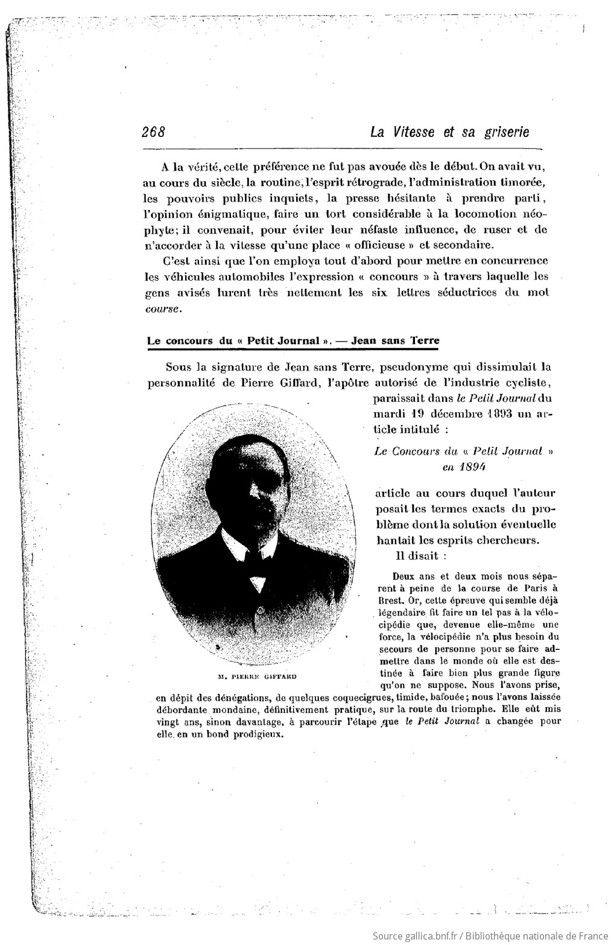
Under the byline Jean sans Terre, a pseudonym concealing the identity of Pierre Giffard, the recognized champion of the cycling industry, an article appeared in the *Petit Journal* on Tuesday, December 19, 1893, titled: The “Petit Journal” Contest in 1894 an article in which the author laid out the exact terms of the problem whose potential solution was on the minds of all who sought it.
He said:
Barely two years and two months separate us from the Paris-Brest race. Yet this event, which already seems legendary, marked such a significant step forward for the bicycle that—having become a force in its own right, it no longer needs anyone’s help to gain acceptance in the world where it is destined to play a far greater role than anyone supposes.
We took it, despite the denials of a few crackpots, when it was timid and scorned; we left it brimming with social appeal, definitively practical, on the path to triumph. It would have taken twenty years, if not more, to cover the distance that *Le Petit Journal* has transformed for it in a single prodigious leap.
Jean sans Terre added: The bicycle is fine for one person, two at most; but what about the other members of the family when Pierre or Paul go for a ride? Don’t they also have a right to their share of happiness and sightseeing?
What thoughts do the practical-minded people of our time have on this subject?
These:
They wonder how, at the end of the nineteenth century, human industry, which in less than a hundred years created steam, gas, electricity, and so many other forms of propulsion, has not yet found a way to do away with horses and replace them with a mechanical means of traction.
Well, it is this problem, this fascinating question of eliminating horses from carriages, that Le Petit Journal wishes to address, in the hope of advancing it by leaps and bounds.
Le Petit Journal’s 1894 competition will therefore be a contest for horse-less, mechanically propelled carriages.
All that remained was to specify the details of the event and its organization.
The Regulations
The very next day, the contest rules were published, as follows:
I. The contest will be international. Self-propelled vehicles from all countries may participate.
II. All types of propulsion systems are permitted: steam, electricity, gas, and petroleum.
III. The vehicles will be judged exclusively by the editorial and administrative staff of *Le Petit Journal*, who will simply consult with as many engineers as necessary.
IV. To be eligible for the competition, vehicles must have at least four seats.
V. There will be no categories based on either the type of engine used or the number of seats.
VI. The first prize in the competition will be awarded strictly to the horseless carriage that meets the following condition: that it be safe, easy for passengers to operate, and not too expensive to operate. In short, the judgment of the individuals delegated for this purpose by Le Petit Journal will be based on safety, convenience, and affordability.
VII. As for the distance to be covered, it will be more or less the same for all vehicles, especially in the first preliminary round. The comparative tests will take place over several days on the routes from Paris to Mantes, Paris to Dreux, Paris to Beauvais, and Paris to Gournay.
Each vehicle, driven by the inventor or his representative, accompanied by at least two members of the jury and a consulting engineer, must complete a 50-kilometer route in three hours for the first preliminary round; to make it clear that these are not high-speed trials, a speed of 16 to 17 kilometers per hour is sufficient for the journey.
No account will be taken of speeds exceeding those specified above.
Once the route has been completed within the allotted time, that is, in three hours, the members of the jury, appointed to award the prizes, will assign ranking points from 1 to 10 to the vehicle in which they made the journey. Only the cars that receive scores of 8, 9, and 10 will advance to the second round. The same will apply to the third round if deemed necessary.
VIII. If the number of vehicles entered in the competition is too large, they will be dispatched to the preliminary rounds on several routes simultaneously; in any case, the routes will be drawn by lot a few days before June 1.
The final round will take place on the route from Paris to Rouen via Saint-Germain, Triel, Meulan, Mantes, Vernon, Gaillon, and Pont-de-l’Arche, covering a distance of 120 kilometers. All aspects of the cars will then be evaluated: speed, stability, fuel economy, and safety.
IX. All types of cars will be admitted; no account will be taken of luxury accessories, that is to say, even the most rudimentary and least expensive model to build will be accepted; provided it runs, that is all we ask. The rest will follow naturally.
X. Entries will be accepted at the Petit Journal starting today, December 20; simply send them to me with a brief description of the vehicle. I should add that an entry fee of ten francs must accompany the registration application. This entry fee will be paid into the Petit Journal’s emergency relief fund. Entry fees will not be refunded.
As one might have guessed, this measure is intended to weed out pranksters who might try to pass themselves off, for free, as accomplished inventors.
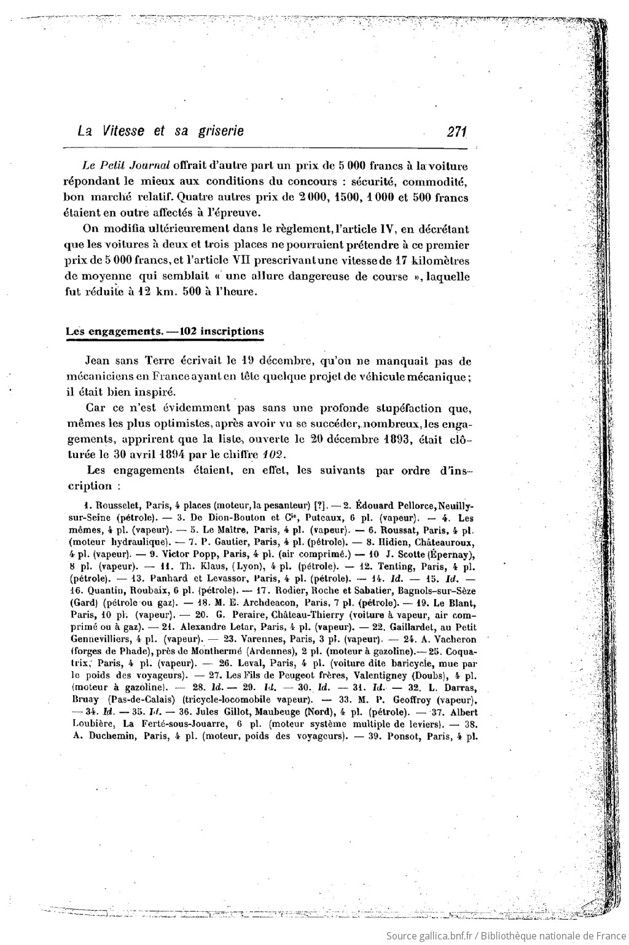
Le Petit Journal also offered a prize of 5,000 francs for the vehicle that best met the contest’s criteria: safety, convenience, and relative affordability. Four additional prizes of 2,000, 1,500, 1,000, and 500 francs were also awarded in the competition.
The rules were subsequently amended: Article IV stipulated that two- and three-seater vehicles would not be eligible for the first prize of 5,000 francs, and Article VII, which had prescribed an average speed of 17 kilometers per hour, a speed deemed “a dangerous racing pace”, was revised to 12.5 kilometers per hour.
Entries. — 102 registrations
Jean sans Terre wrote on December 19 that there was no shortage of engineers in France with plans for some kind of mechanical vehicle in mind; he was quite right.
For it was obviously with profound astonishment that even the most optimistic observers, after seeing a numerous stream of entries, learned that the list, opened on December 20, 1893, was closed on April 30, 1894, with the number 102.
The entries were, in fact, as follows, in order of registration:
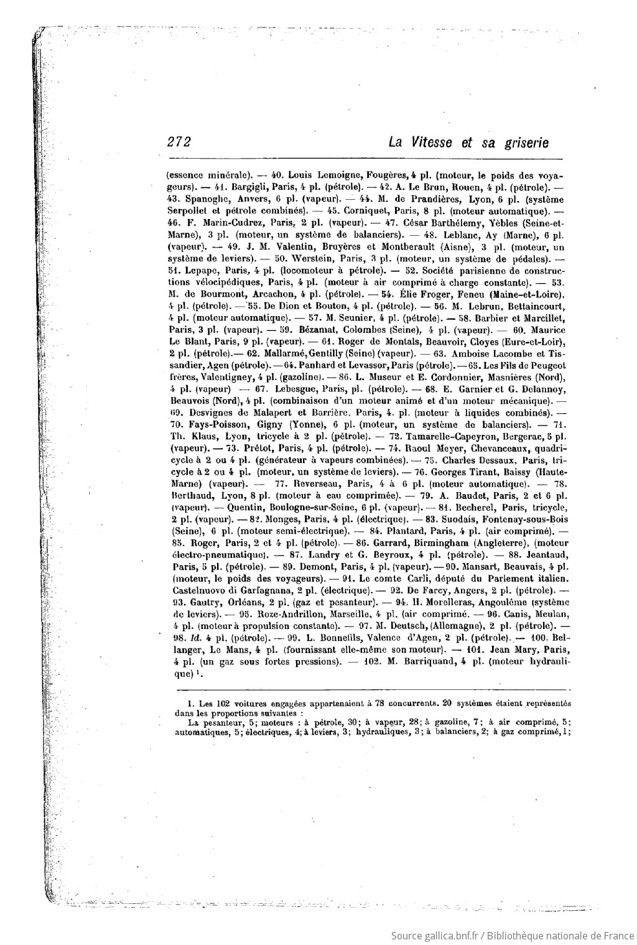
1. Rousselet, Paris, 4-seater (engine, gravity) [?]. — 2. Edouard Pellorce, Neuilly-sur-Seine (gasoline). — 3. De Dion-Bouton & Co., Puteaux, 6-seater (steam). — 4. The same company, 4-seater (steam). — b. Le Maître, Paris, 4-seater (steam). — 6. Roussat, Paris, 4-seater (hydraulic engine). — 7. P. Gautier, Paris, 4-seater (petroleum). — 8. Hidien, Châteauroux, 4-seater (steam). — 9. Victor Popp, Paris, 4-seater (compressed air). — 10. J. Scotte (Épernay), 8-seater (steam). — 11. Th. Klaus (Lyon), 4-seater (gasoline). — 12. Tenting, Paris, 4-seater (gasoline). — 13. Panhard and Levassor, Paris, 4-seater (gasoline). — 14. Ibid. — 15. Ibid. — 16. Quantin, Roubaix, 6-seater (gasoline). — 17. Rodier, Roche, and Sabatier, Bagnols-sur-Cèze (Gard) (petroleum or gas). — 18. M. E. Archdeacon, Paris, 7-seater (petroleum). — 19. Le Blant, Paris, 10-seater (steam). — 20. G. Peraire, Château-Thierry (steam, compressed air, or gas-powered vehicle). — 21. Alexandre Lelar, Paris, 4 seats (steam). — 22. Gaillardet, in Petit Gennevilliers, 4 seats (steam). — 23. Varennes, Paris, 3-seater (steam). — 24. A. Vacheron (Phade Forges), near Monthermé (Ardennes), 2-seater (gasoline engine). — 25. Coquatrix, Paris, 4-seater (steam). — 26. Levai, Paris, 4 pl. (a vehicle known as a “baricycle,” propelled by the weight of the passengers). — 27. Les Fils de Peugeot frères, Valentigney (Doubs), 4 pl. (gasoline engine). — 28. Ibid. — 29. Ibid. — 30. Ibid. — 31. Ibid. — 32. L. Darras, Bruay (Pas-de-Calais) (steam-powered tricycle). — 33. M. P. Geoffroy (steam), — 34. Ibid. — 35. Ibid. — 36. Jules Gillot, Maubeuge (Nord), 4 pl. (petroleum). — 37. Albert Loubière, La Ferté-sous-Jouarre, 6-seater (multiple-lever engine). — 38. A. Duchemin, Paris, 4-seater (engine, passengers’ weight). — 39. Ponsot, Paris, 4-seater (mineral oil). — 40. Louis Lemoigne, Fougères, 4 plates (engine, passenger weight). — 41. Bargigli, Paris, 4 pl. (petroleum). 42. A. Le Brun, Rouen, 4 pl. (petroleum). — 43. Spanoghe, Antwerp, 6 plates (steam). — 44. M. de Prandières, Lyon, 6 pl. (combined Serpollet system and petroleum). — 45. Corniquet, Paris, 8 pl. (automatic engine). — 46. F. Marin-Cudrez, Paris, 2 pl. (steam). — 47. César Barthélémy, Yèbles (Seine-et-Marne), 3 pl. (engine, a system of balance weights). — 48. Leblanc, Ay (Marne), 6 pl. (steam). — 49. J. M. Valentin, Bruyères and Montberault (Aisne), 3-seater (engine, a lever system). — 50. Werstein, Paris, 3-seater (engine, a pedal system). — 51. Lepape, Paris, 4-seater (petroleum-powered locomotive). — 52. Parisian Society for Bicycle Construction, Paris, 4-seater (constant-charge compressed-air engine). — 53. M. de Bourmont, Arcachon, 4-seater (gasoline). — 54. Élie Froger, Feneu (Maine-et-Loire), 4-seater (gasoline). — 55. De Dion and Bouton, 4 pl. (petroleum). — 56. Mr. Lebrun, Bettaincourt, 4 pl. (automatic engine). — 57. Mr. Seunier, 4 pl. (petroleum). — 58. Barbier and Marcillet, Paris, 3 pl. (steam). — 59. Bézamat, Colombes (Seine), 4-seater (steam). — 60. Maurice Le Blant, Paris, 9-seater (steam). — 61. Roger de Montais, Beauvoir, Cloyes (Eure-et-Loir), 2-seater (gasoline). — 62. Mallarmé, Gentilly (Seine) (steam). — 63. Amboise Lacombe and Tissandier, Agen (gasoline). — 64. Panhard and Levassor, Paris (gasoline). — 65. Les Fils de Peugeot frères, Valenligney, 4-seater (gasoline). — 66. L. Museur and E. Cordonnier, Masnières (Nord), 4 pl. (steam) — 67. Lebesgue, Paris, 4 pl. (petroleum). — 68. E. Garnier and G. Delannoy, Beauvois (Nord), 4-cylinder (combination of a live engine and a mechanical engine). — 69. Desvignes de Malapert and Barrière. Paris, 4-seater (combined liquid-fuel engine). — 70. Fays-Poisson, Gigny (Yonne), 6-seater (engine, a system of balance weights). — 71. Th. Klaus, Lyon, 2-seater tricycle (petroleum). — 72. Tamarelle-Capeyron, Bergerac, 5-seater (steam). — 73. Prétot, Paris, 4-seater (petroleum). — 74. Raoul Meyer, Chevanceaux, 2- or 4-seater quadricycle (combined steam generator).
75. Charles Dessaux, Paris, 2- or 4-seater tricycle (engine, lever system). — 76. Georges Tirant, Baissy (Haute-Marne) (steam). — 77. Reverseau, Paris, 4- to 6-seater (automatic engine). — 78. Berthaud, Lyon, 8-seater (compressed water engine). — 79. A. Baudet, Paris, 2- and 6-seaters (steam). — Quentin, Boulogne-sur-Seine, 6-seater (steam). — 81. Becherel, Paris, tricycle, 2-seater (steam). — 82. Monges, Paris, 4-seater (electric). —83. Suodais, Fontenay-sous-Bois (Seine), 6-seater (semi-electric engine). — 84. Plantard, Paris, 4-seater (compressed air). — 85. Roger, Paris, 2- and 4-seater (gasoline). — 86. Garrard, Birmingham (England), (electropneumatic engine). — 87. Landry and G. Beyroux, 4-seater (gasoline). — 88. Jeantaud, Paris, 5-seater (gasoline). — 89. Demont, Paris, 4-seater (steam). — 90. Mansart, Beauvais, 4-seater (engine powered by the weight of the passengers). — 91. Count Carli, member of the Italian Parliament. Castelnuovo di Garfagnana, 2-seater (electric). — 92. De Farcy, Angers, 2 pl. (petroleum). — 93. Gautry, Orléans, 2 plates (gas and gravity). — 94. H. Morelleras, Angoulême (lever system). — 95. Roze-Andrillon, Marseille, 4 plates (compressed air). — 96. Canis, Meulan, 4-seater (constant-propulsion engine). — 97. M. Deutsch, (Germany), 2-seater (gasoline). — 98. Id., 4-seater (gasoline). — 99. L. Bonneills, Valence d’Agen, 2-seater (gasoline). — 100. Bellanger, Le Mans, 4-seater (with its own engine). — 101. Jean Mary, Paris, 4-seater (high-pressure gas). — 102. Mr. Barriquand, 4-seater (hydraulic engine). (1).
————-
1. The 102 cars entered belonged to 78 competitors. Twenty different propulsion systems were represented in the following proportions:
Gravity, 5; engines: petroleum-powered, 30; steam-powered, 28; gasoline-powered, 7; compressed-air-powered, 5; automatic, 5; electric, 4; lever-operated, 3; hydraulic, 3; balance-wheel, 2; compressed gas, 1; mineral oil, 1; combined petroleum, 1; multiple-lever system, 1; pedal, 1; mechanical, 1; combined liquids, 1; combined steam, 1; electropneumatic, 1; gas and gravity, 1; mineral oil, 1; combined petroleum, 1; multiple-lever system, 1; pedal, 1; mechanical, 1; combined fluids, 1; combined steam, 1; electropneumatic, 1; gas and gravity, 1.
————-
The Elimination/Qualifying Rounds
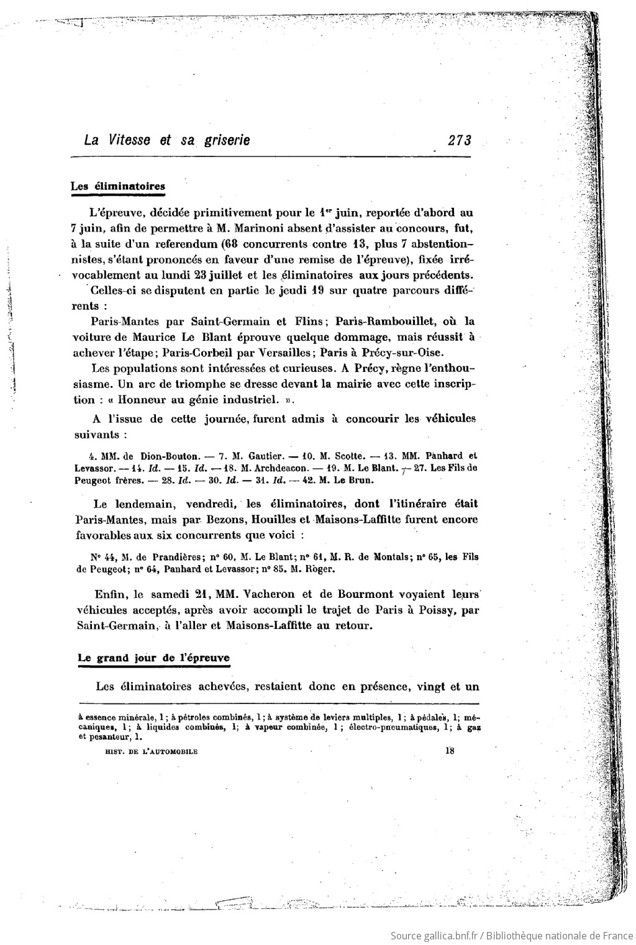
The competition, originally scheduled for June 1, was first postponed to June 7 to allow Mr. Marinoni, who was absent, to attend the competition; however, following a vote (68 competitors in favor of postponing the event, 13 against, and 7 abstentions), the date was irrevocably set for Monday, July 23, with the qualifying rounds to be held on the preceding days.
These were held in part on Thursday, the 19th, on four different routes:
Paris to Mantes via Saint-Germain and Flins; Paris to Rambouillet, where Maurice Le Blant’s car sustained some damage but managed to complete the stage; Paris to Corbeil via Versailles; and Paris to Précy-sur-Oise.
The local populations were interested and curious. In Précy, enthusiasm reigned. A triumphal arch stood in front of City Hall bearing the inscription: “Honor to industrial genius.”
At the end of the day, the following vehicles were admitted to the competition:
4. Messrs. de Dion-Bouton. — 7. Mr. Gautier. — 10. Mr. Scotte. — 13. Messrs. Panhard and Levassor. — 14. Ibid. — 15. Ibid. — 18. Mr. Archdeacon. — 19. Mr. Le Blant. — 27. The Peugeot Brothers. — 28. Ibid. — 30. Ibid. — 31. Ibid. — 42. Mr. Le Brun.
The next day, Friday, the qualifying rounds—whose route was Paris to Mantes, but via Bezons, Houilles, and Maisons-Laffitte—were again favorable to the following six competitors:
No. 44, Mr. de Prandières; No. 60, Mr. Le Blant; No. 61, Mr. R. de Montais; No. 65, the Peugeot Sons; No. 64, Panhard and Levassor; No. 85, Mr. Roger. Finally, on Saturday the 21st, Messrs. Vacheron and de Bourmont had their vehicles accepted after completing the route from Paris to Poissy via Saint-Germain on the outbound leg and via Maisons-Laffitte on the return leg.
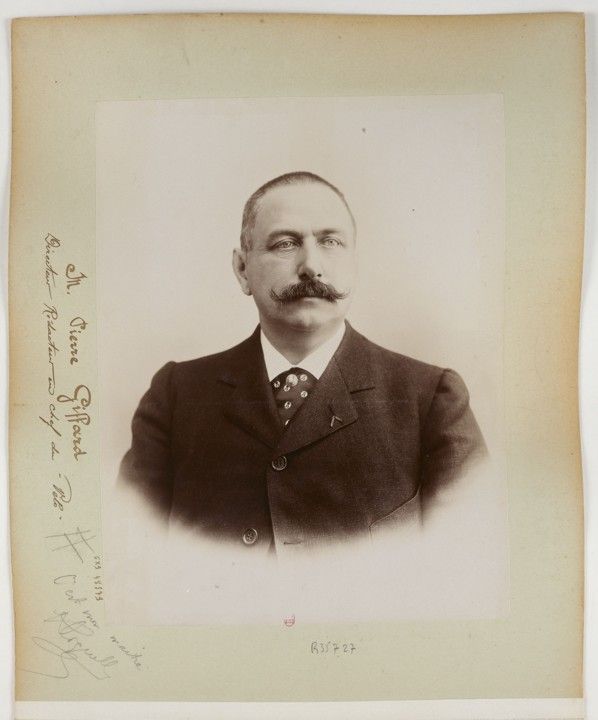
<– Page 269: Pierre Giffard, image of the Collection Jules Beau. Source: Bibliothèque national de France.
Photos.
Page 268. Mr. PIERRE GIFFARD
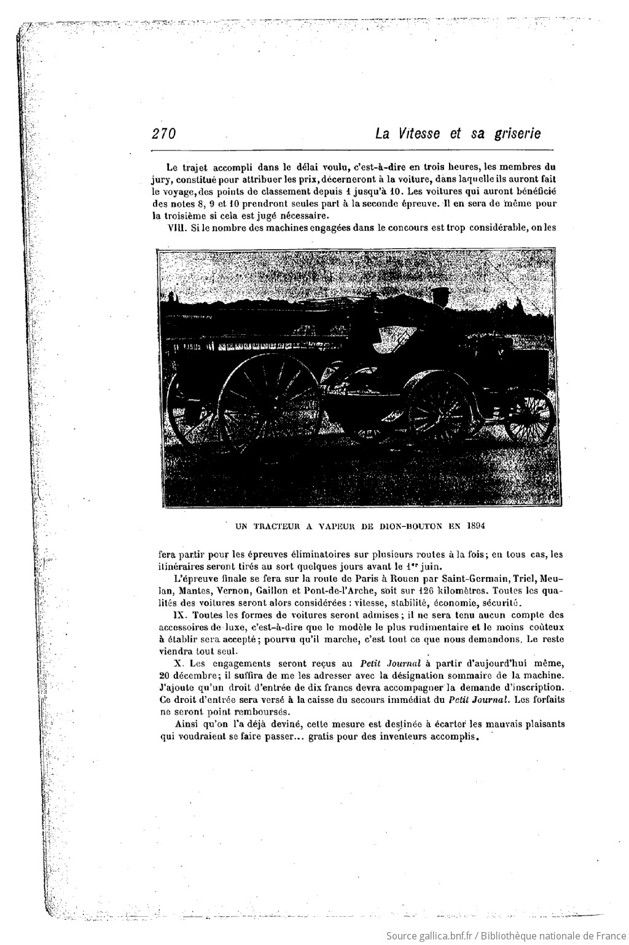
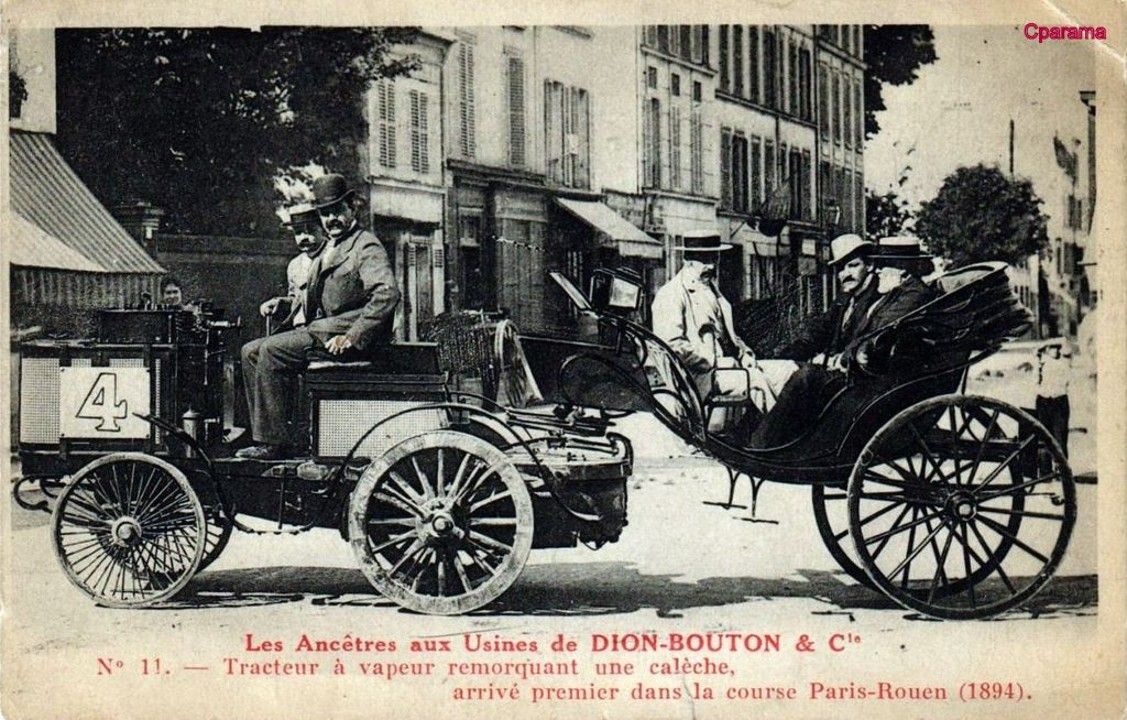
Page 270. A DION-BOUTON STEAM TRACTOR FROM 1894
Page 274: NINE-SEATER BREACK — MAURICE LE BLANT