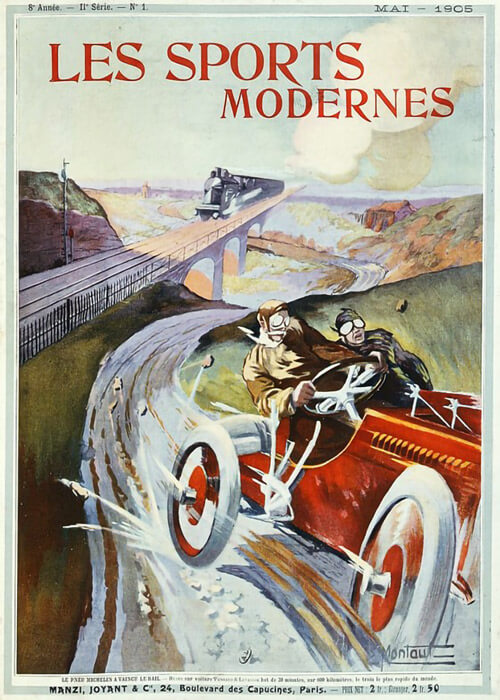
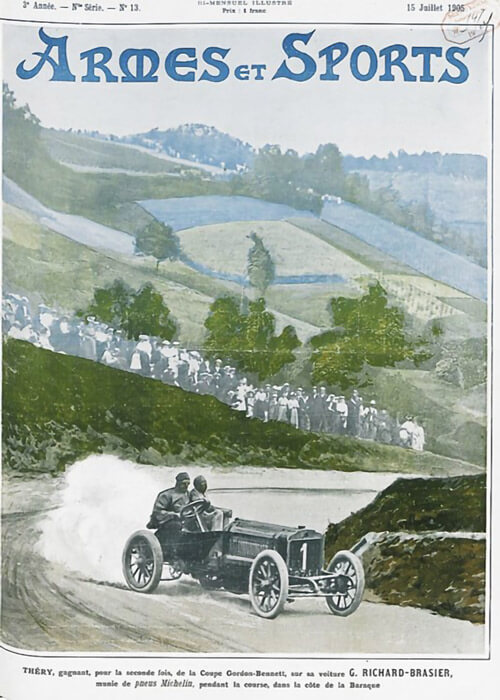
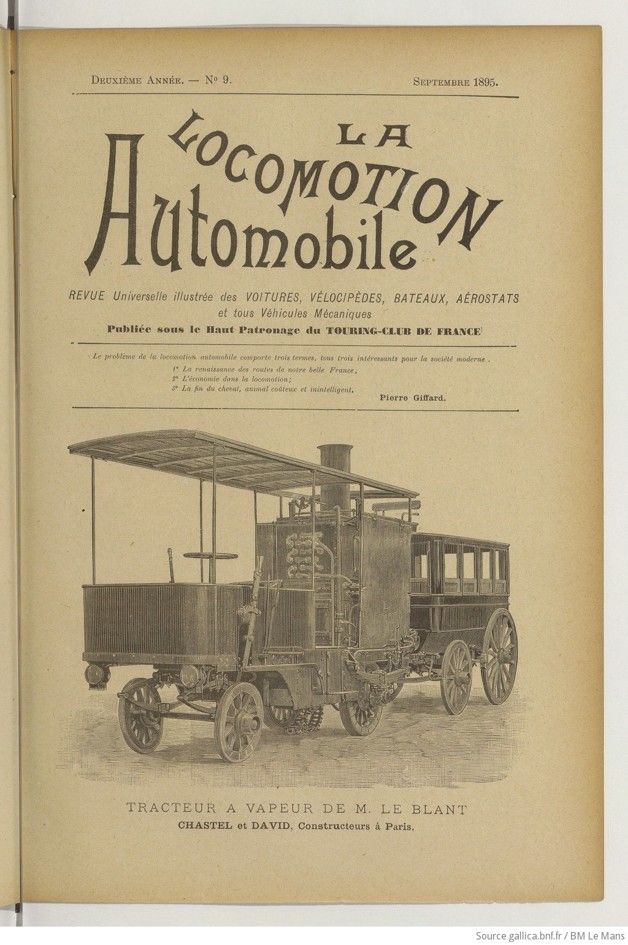
If anyone might have tought that Europe wouldn’t be interested in US motor racing: here’s proof of the contrary. In it’s first active publishing year, the French magazine La Locomotion Automobile publishes in all three reports on the first American motoring race; written by their US correspondant Charles Loved. This first article shows the introduction, the contest rules and some of the participating vehicles. (Translation of original text).
With courtesy of the Bibliothèque national francais gallica.bnf.fr
Text and photos compiled by motorracinghistory; Translation by DeepL deepl.com
La Locomotion Automobile — 2nd Year, No. 9, September 1895, pages 204-208
Automobiles in America – THE “TIMES-HERALD“ RACE in Chicago
REGULATIONS
Our American correspondent writes:
Your articles titled “Automobile Transportation in 1895” and “Automobile Transportation in 1896,” which appeared consecutively in your last two issues, have sparked great interest on this side of the Atlantic, where we are preparing to follow the trend set by France in the field of automobiles.
Before the rules for the race you are preparing for 1896 are finalized, the results of the Times-Herald race will be known. I will send them to you, as I believe your readers will be curious to compare them with those of the Paris-Bordeaux-Paris race and, later, with those of your upcoming competition.
In the meantime, here are a few details that may be of interest to you.
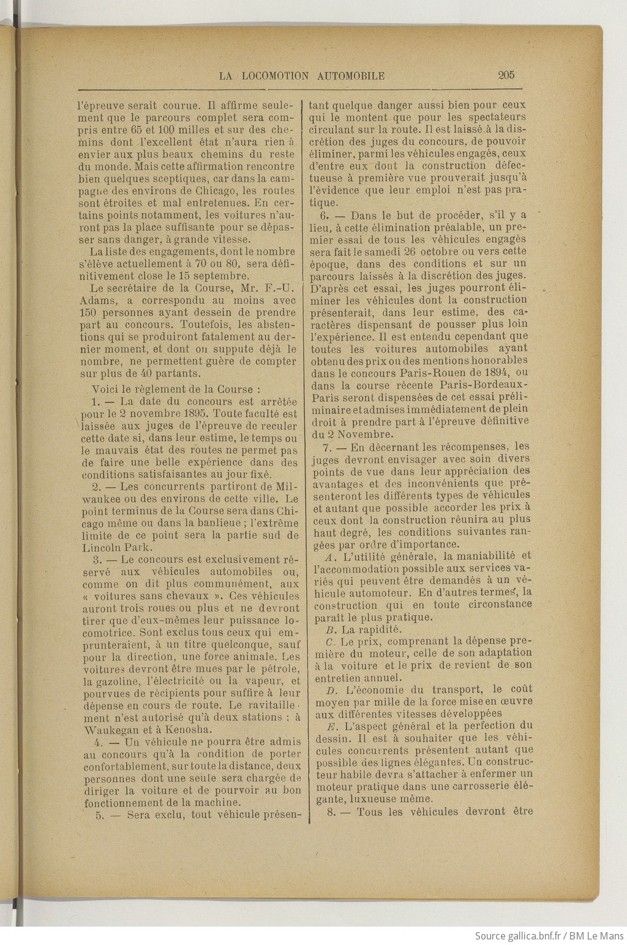
The automobile race organized by the Times-Herald will take place in Chicago on November 2. Preparations for this magnificent sporting event are proceeding with great enthusiasm. The Times-Herald has not yet announced the route on which the race will be run. It states only that the total distance will be between 65 and 100 miles and that the roads will be in such excellent condition as to rival the finest roads anywhere in the world. However, this claim has met with some skepticism, as the roads in the countryside around Chicago are narrow and poorly maintained. In certain spots, in particular, cars will not have enough room to safely pass one another at high speeds.
The entry list, which currently stands at 70 or 80 entries, will be definitively closed on September 15.
The race secretary, Mr. F. U. Adams, has corresponded with at least 150 people intending to take part in the competition. However, the last-minute withdrawals that are bound to occur,and whose number is already being estimated, make it unlikely that there will be more than 40 starters.
Here are the race rules:
1. — The date of the race is set for November 2, 1895. The race judges have full discretion to postpone this date if, in their judgment, the weather or poor road conditions do not permit a successful race under satisfactory conditions on the scheduled day.
2. — Competitors will depart from Milwaukee or the vicinity of that city. The finish line of the race will be in Chicago itself or in the suburbs; the southernmost boundary of this area will be the southern part of Lincoln Park.
3. — The competition is exclusively reserved for motor vehicles or, as they are more commonly called, “horseless carriages.” These vehicles must have three or more wheels and must derive their propulsive power solely from their own means. Any vehicle that relies, in any capacity, except for steering, on animal power is excluded. The cars must be powered by petroleum, gasoline, electricity, or steam, and must be equipped with fuel tanks sufficient to meet their consumption needs along the route. Refueling is permitted at only two stations: in Waukegan and Kenosha.
4. — A vehicle may be admitted to the competition only on the condition that it can comfortably carry, over the entire distance, two people, only one of whom will be responsible for steering the vehicle and ensuring the proper functioning of the engine.
5. — Any vehicle posing a danger to either its occupants or to spectators on the road will be excluded. It is left to the discretion of the race judges to eliminate, from among the entered vehicles, those whose construction is, at first glance, so defective as to clearly demonstrate that their use is impractical.
6. — In order to carry out this preliminary elimination, if necessary, an initial test of all entered vehicles will be conducted on Saturday, October 26, or around that time, under conditions and on a course determined at the discretion of the judges. Based on this test, the judges may eliminate vehicles whose construction, in their estimation, exhibits characteristics that preclude further testing. It is understood, however, that all automobiles that received prizes or honorable mentions in the 1894 Paris-Rouen competition, or in the recent Paris-Bordeaux-Paris race, will be exempt from this preliminary test and automatically admitted to participate in the final event on November 2.
7. — In awarding the prizes, the judges must carefully consider various factors in their assessment of the advantages and disadvantages presented by the different types of vehicles and, as far as possible, award the prizes to those whose construction best meets the following criteria, listed in order of importance.
A. General utility, maneuverability, and adaptability to the various services that may be required of a self-propelled vehicle. In other words, the design that appears most practical under all circumstances.
B. Speed.
C. Cost, including the initial expense of the engine, the cost of adapting it to the vehicle, and the annual maintenance cost.
D. Fuel efficiency, defined as the average cost per thousand of the power expended at the various speeds achieved.
E. Overall appearance and design excellence. It is hoped that the competing vehicles will feature elegant lines as much as possible. A skilled manufacturer should strive to incorporate a practical engine into an elegant, even luxurious, body.
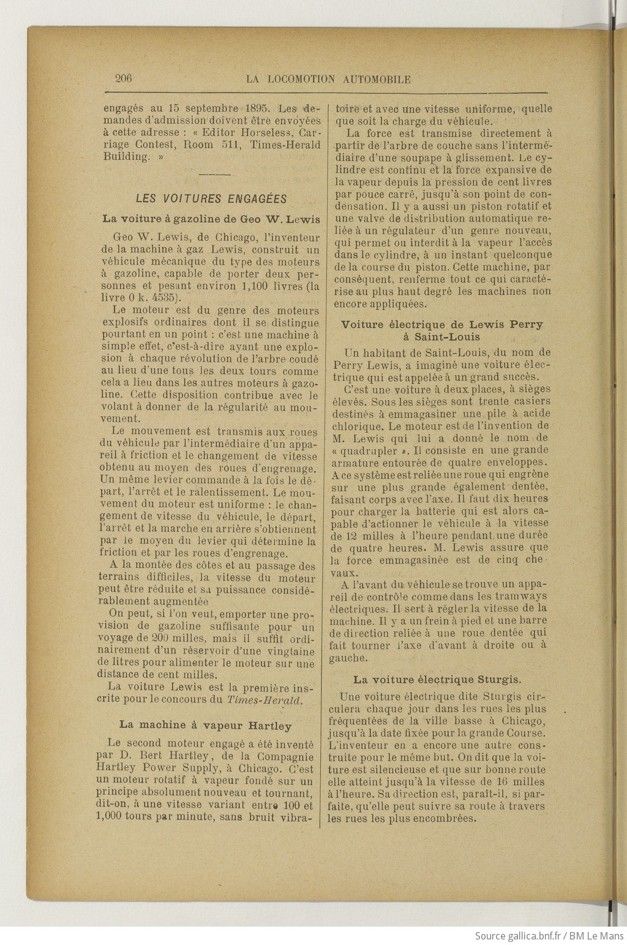
8. — All vehicles must be entered by September 15, 1895. Applications for admission must be sent to the following address: “Editor, Horseless Carriage Contest, Room 511, Times-Herald Building.”
THE ENTRANT VEHICLES
Geo W. Lewis’s Gasoline-Powered Car.
Geo W. Lewis of Chicago, the inventor of the Lewis gas engine, has built a gasoline-powered vehicle capable of carrying two people and weighing approximately 1,100 pounds (1 pound = 0.4535 kg).
The engine is of the same type as ordinary internal combustion engines, though it differs in one respect: it is a single-acting engine, meaning it produces one explosion per revolution of the crankshaft rather than one every two revolutions, as is the case with other gasoline engines. This design, together with the flywheel, helps ensure smooth operation.
Motion is transmitted to the vehicle’s wheels via a friction mechanism, and gear changes are achieved by means of gear wheels. A single lever controls starting, stopping, and deceleration. The engine’s operation is uniform: changing the vehicle’s speed, starting, stopping, and reversing are achieved by means of the lever that controls friction and by the gear wheels.
When climbing hills or traversing difficult terrain, the engine’s speed can be reduced and its power considerably increased. If desired, one can carry enough gasoline for a 200-mile trip, but a tank holding about twenty liters is usually sufficient to power the engine for a distance of one hundred miles.
The Lewis car is the first to be entered in the Times-Herald competition.
The Hartley Steam Engine.
The second engine entered was invented by D. Bert Hartley of the Hartley Power Supply Company in Chicago. It is a rotary steam engine based on an entirely new principle and, it is said, rotates at a speed ranging from 100 to 1,000 revolutions per minute, without vibratory noise and at a uniform speed, regardless of the vehicle’s load.
Power is transmitted directly from the crankshaft without the use of a slide valve. The cylinder is continuous, and the steam expands from a pressure of 100 pounds per square inch to its condensation point. There is also a rotary piston and an automatic distribution valve connected to a new type of regulator, which allows or prevents steam from entering the cylinder at any point during the piston’s stroke. This machine, therefore, embodies all the characteristics that best define machines not yet in use.
Lewis Perry’s Electric Car in St. Louis.
A St. Louis resident named Perry Lewis has designed an electric car that is destined for great success.
It is a two-seater with high seats. Beneath the seats are thirty compartments designed to hold a hydrochloric acid battery. The motor is an invention of Mr. Lewis, who named it the “quadrupler.” It consists of a large armature surrounded by four casings. Connected to this system is a gear that meshes with a larger, similarly toothed gear, which is integral with the axle.
It takes ten hours to charge the battery, which is then capable of powering the vehicle at a speed of 12 miles per hour for a period of four hours. Mr. Lewis claims that the stored power is five horsepower.
At the front of the vehicle is a control panel similar to those found in electric streetcars. It is used to regulate the vehicle’s speed. There is a foot brake and a steering bar connected to a gear that turns the front axle to the right or left.
The Sturgis electric car.
An electric car known as the Sturgis will run daily on the busiest streets of Chicago’s Lower City until the date set for the big race. The inventor has had yet another one built for the same purpose. It is said that the car is silent and that, on a good road, it can reach speeds of up to 16 miles per hour. Its steering is, apparently, so precise that it can navigate its way through even the most congested streets.
The Camden Automobile.
Chas. S. Caffrey Co., the well-known coachbuilders of Camden (N.J.), are building two electric cars that are receiving high praise. These cars cost between 700 and 800 dollars each. The storage batteries that provide the power are said to be capable of propelling the vehicles a distance of 500 miles without recharging, at a cost of 65 cents per 50 miles. A top speed of 17 miles per hour is guaranteed.
There are two approaches to powering the vehicle: one involves the mechanic, the other the electrician. Power can be transmitted to the wheels in two different ways: mechanically or electrically.
In both cases, the battery will be located at the rear of the vehicle. The front wheels are the largest; the rear wheels are used for steering. They are designed to turn a very tight circle, with the axles suspended and the steering mechanism arranged for this purpose. Ball bearings will be used throughout the vehicle. Power will be generated at the front of the car, where a speed regulator and a speedometer will also be located, displaying the speed and allowing the driver to adjust it. The steering wheel or bar will be on the right-hand side, and the steering can be controlled from the front.
In the first configuration, the engine will be located between the wheels, at roughly equal distances from each of them. A similar wheel will be placed next to the large front wheels, and an endless chain connecting the two will provide traction. This is a simple application of the principle commonly used in bicycles. Two identical devices will be mounted on each side, effectively constituting two engines.
In the other traction system, the inventor departs completely from conventional methods, but he believes this new approach will achieve a higher speed than the system described above. The engine will be positioned further back on the car’s body. The large front wheels will have two tires mounted side by side, leaving a circular groove between them along the entire circumference. The small drive wheel will be connected to them by a thick friction belt, designed so that part of the belt fits into the groove to prevent slippage. This belt will encircle the outer rim of the large wheels, which, as a result, will not touch the ground.
The car will be designed to carry two people, but thanks to a special attachment system, a seat for two additional passengers can be secured to the rear in five minutes. When this seat is in place, the vehicle becomes a full-fledged car.
The Caffrey Company intends to complete this vehicle in time to participate in the Times-Herald race.
The Trenton Automobile.
Phineas Quinn, a car manufacturer from Trenton (N.J.), is building an automobile that he will soon test. It is a three-seat open-top car. The engine is not mounted on the car’s body but on a rolling chassis, resulting in smoother operation. Power is transmitted to the rear wheels.
Mr. Quinn hopes to complete his project within a month and, if the tests are satisfactory, to establish an operating company.
Emperor Wilhelm’s Automobile.
The report that the Benz Motor Company, of 10 Wall Street, New York, intends to enter a car in the Times-Herald race is incorrect. The Benz Motor Wagon Company is the oldest of the automobile companies. Hundreds of vehicles have rolled out of its workshops, some of which have been sold to the far corners of the world. The best known is the one built for the Emperor of Germany, in which its royal owner is said to have traveled 15 miles in 85 minutes.
The Bowman Gasoline Car.
The Geo W. Bowman Motor Car Company has just been incorporated in Denver, Colo., to exploit the patent and manufacture the Bowman gasoline-powered car.
The engine weighs 275 pounds (275 × 0.4535 kg) and consumes one gallon (4.54 L) per horsepower for ten hours of operation.
Mr. Bowman recently made the trip from Denver to Chicago in three days; the cost was $5.10.
These latest details were drawn in part by our American correspondent from the interesting publication *The Maker and Dealer*, published in New York by our distinguished colleague E. P. Ingersoll. This magazine, which has devoted extensive coverage to the *Times-Herald* Race, is at the forefront of this new sport in America, just as *La Locomotion Automobile* is in Europe.
Charles Loved.