Introduction on the title is on it’s way. (Translation included at the end). (Translation separately).
With permission of the Bibliothèque national francais gallica.bnf.fr
Text and photos compiled by motorracinghistory. Translation by DeepL deepl.com
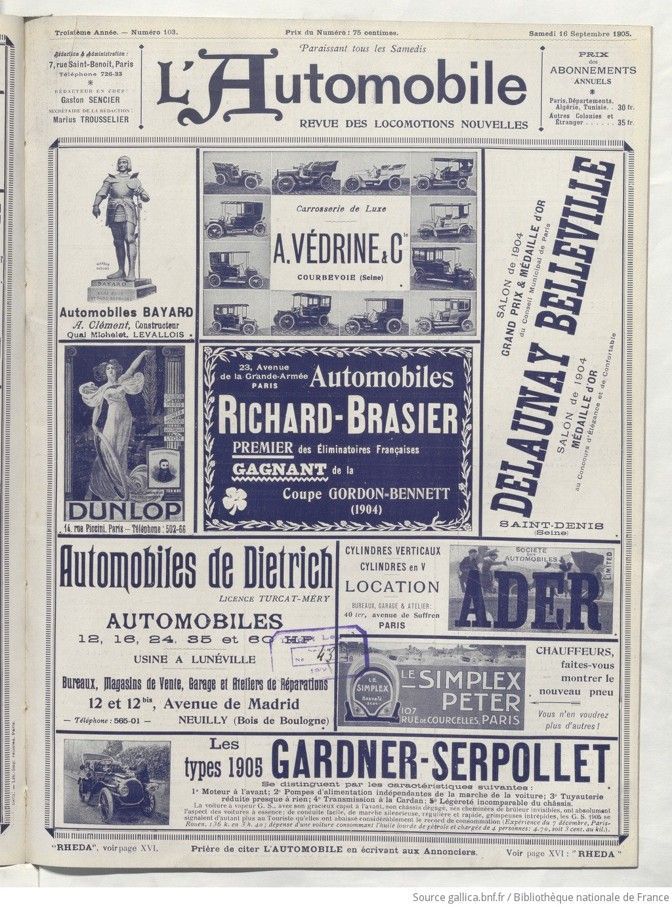
L’Automobile — 3rd Year, No. 103, September 16 1905
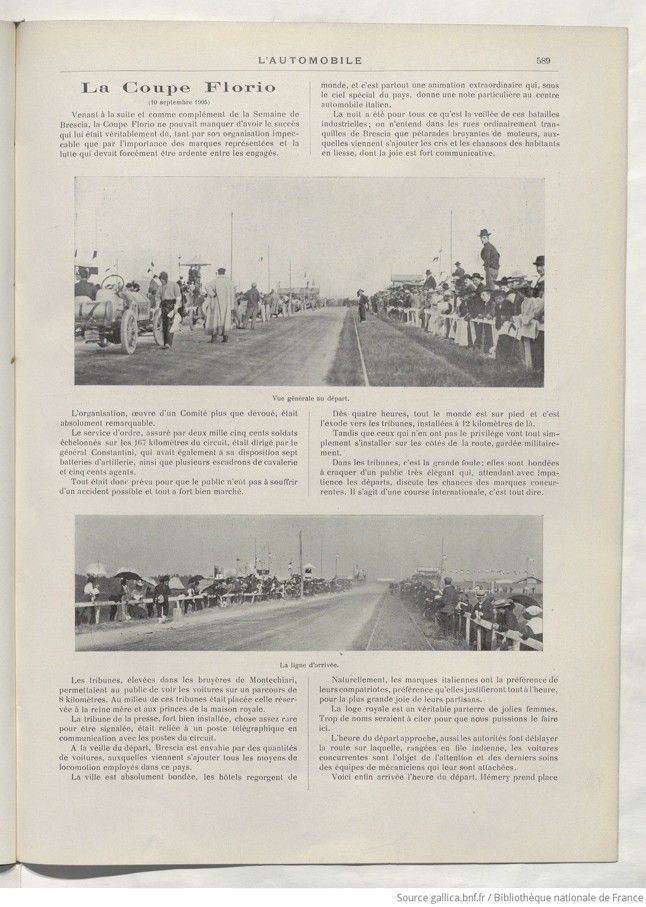
The Florio Cup (September 10, 1905)
Following on from and complementing Brescia Week, the Florio Cup was bound to enjoy the success it truly deserved, thanks both to its impeccable organization and to the prominence of the brands represented, as well as the competition among the entrants, which was bound to be fierce.
The organization, the work of a highly dedicated committee, was absolutely remarkable.
Security, provided by 2,500 soldiers stationed along the 167-kilometer circuit, was led by General Constantini, who also had at his disposal seven artillery batteries, as well as several cavalry squadrons and 500 officers.
Everything had therefore been planned to ensure that the public would not suffer from any potential accidents, and everything went very smoothly.
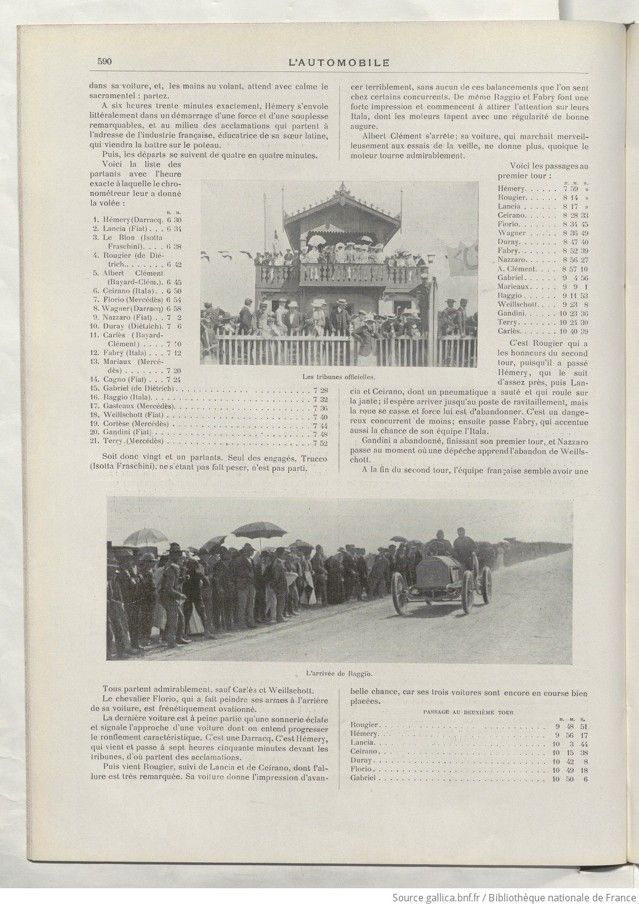
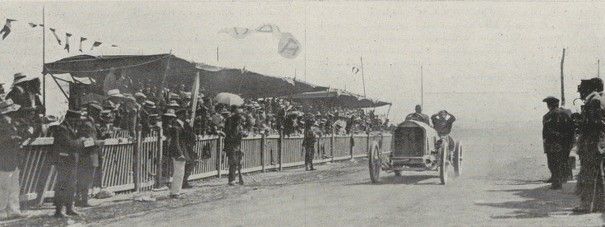
The grandstands, erected among the heather of Montechiari, allowed the public to view the cars over an 8-kilometer stretch of the course. In the center of these grandstands was the one reserved for the Queen Mother and the princes of the royal family.
The press grandstand, very well set up—a rarity worth noting—was connected to a telegraph station in communication with stations along the circuit.
On the eve of the start, Brescia was flooded with a sea of flags, to which were added all the modes of transportation used in this country.
The city is absolutely packed, the hotels are overflowing with people, and everywhere there is an extraordinary bustle which, under the region’s distinctive sky, lends a special atmosphere to the Italian auto capital.
The night was for everyone what the eve of these industrial battles is; all that can be heard in the usually quiet streets of Brescia is the loud roar of engines, accompanied by the shouts and songs of jubilant residents, whose joy is highly contagious.
By four o’clock, everyone is up and the exodus begins toward the grandstands, set up 12 kilometers away. Meanwhile, those who do not have that privilege simply settle in along the sides of the road, which is guarded by the military.
The grandstands are packed to the brim with a very elegant crowd, who, eagerly awaiting the start, discuss the chances of the competing brands. This is an international race—that says it all.
Naturally, the Italian brands are the favorites among their compatriots—a preference they will soon prove worthy of, much to the delight of their supporters. The royal box is a veritable gathering of beautiful women. There are too many names to mention here.
The starting time is approaching, so the authorities are clearing the road where, lined up in single file, the competing cars are the focus of attention and receiving final preparations from their respective teams of mechanics.
At last, the starting time has arrived. Hémery takes his place behind the wheel and, with his hands on the steering wheel, calmly awaits the customary command: “Go.”
At exactly 6:30, Hémery literally takes off with a start of remarkable power and agility, amid cheers directed at French industry—the mentor of its Latin counterpart, which will go on to beat it to the finish line. Then, the starts follow one after another at four-minute intervals. Here is the list of starters with the exact time at which the timekeeper gave them the go-ahead: H. M.
1. Hémery (Darracq). 6 30
2. Lancia (Fiat). 6 34
3. Le Blon (Isotta Fraschini). 6 38
4. Rougier (de Diétrich). 6 42
5. Albert Clément (Bayard-Clém.). 6 45
6. Ceirano (Itala). 6 50
7. Florio (Mercedes) 6 54
8. Wagner (Darracq) 6 58
9. Nazzaro (Fiat). 7 2
10. Duray (Diétrich). 7 6
11. Carlès (Bayard-Clément). 7 10
12. Fabry (Itala). 7 12
13. Mariaux (Mercedes). 7 20
14. Cagno (Fiat). 7 24
15. Gabriel (de Dietrich). 7 28
16. Raggio (Itala). 7 32
17. Gasteaux (Mercedes). 7 36
18. Weillschott (Fiat). 7 40
19. Cortese (Mercedes). 7 44
20. Gandini (Fiat). 7 48
21. Terry (Mercedes). 7 52
That makes twenty-one entrants. Of the registered drivers, only Trucco (Isotta Fraschini), who did not weigh in, did not start. All got off to a splendid start, except for Carlès and Weillschott.
Chevalier Florio, who had his coat of arms painted on the back of his car, was greeted with a frenzied ovation.
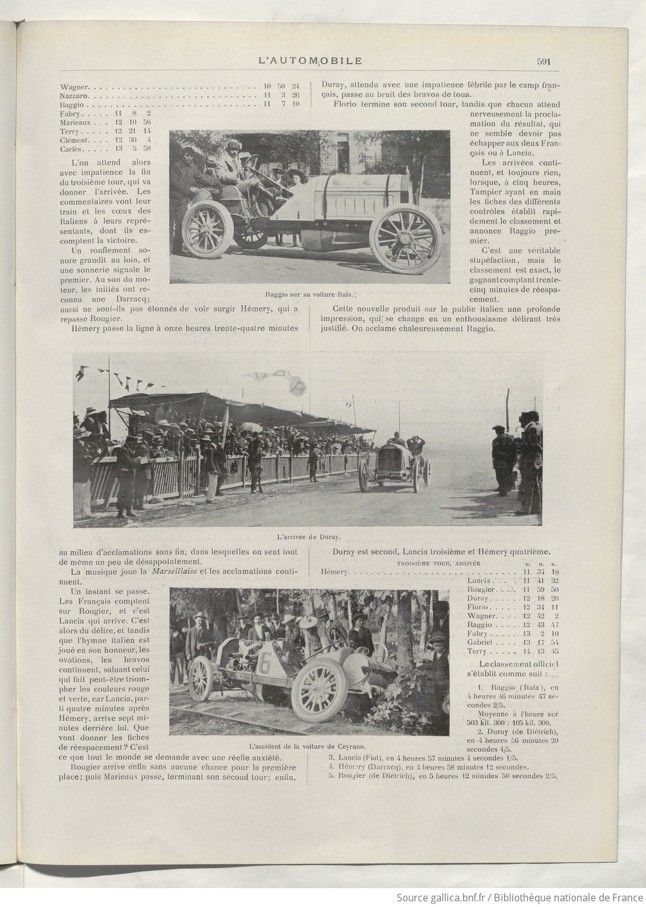
No sooner had the last car left than a bell rang out, signaling the approach of a car whose characteristic rumble could be heard growing louder. It was a Darracq. It was Hémery, who arrived and passed in front of the grandstands at 7:50, drawing cheers from the crowd.
Next comes Rougier, followed by Lancia and Ceirano, whose pace is highly noted. Its vehicle gives the impression of moving forward with tremendous speed, without any of the swaying motion evident in some of the competitors’ cars. Likewise, Raggio and Fabry make a strong impression and begin to draw attention to their Italas, whose engines are running with a reassuringly steady rhythm.
Albert Clément comes to a stop; his car, which had performed wonderfully during the previous day’s practice runs, is no longer moving, even though the engine is running admirably.
Here are the times for the first lap: H. M.
Hémery. 7 59
Rougier. 8 14
Lancia. 8 17
Ceirano. 8 28 33
Florio. 8 34 45
Wagner. 8 36 49
Duray. 8 47 40
Fabry. 8 52 39
Nazzaro. 8 56 27
A. Clément. 8 57 10
Gabriel. 9 4 56
Marieaux. 9 9 1
Raggio. 9 11 53
Weillschott. 9 23 8
Gandini. 10 23 36
Terry. 10 24 30
Carlès. 10 40 39
Rougier takes the lead in the second lap, having passed Hémery—who is following him quite closely—then Lancia and Ceirano, whose tire has blown out and who is driving on the rim; he hopes to make it to the pit stop, but the wheel breaks, forcing him to retire. That’s one less dangerous competitor; next comes Fabry, who also boosts his team’s chances—the Itala.
Gandini has retired at the end of his first lap, and Nazzaro passes just as a dispatch announces Weillschott’s retirement.
At the end of the second lap, the French team seems to have a good chance, as its three cars are still in the race and well-positioned.
ENTERING THE SECOND LAP – H. M. S.
Rougier. 9 48 51
Hemery. 9 56 17
Lancia. 10 3 44
Ceirano. 10 15 38
Duray. 10 42 10
Florio. 10 49 18
Gabriel. 10 50 6
Wagner. 10 50 24
Nazzaro. 11 3 26
Raggio. 11 7 10
Fabry. 11 8 2
Marieaux. 12 10 56
Terry. 12 21 14
Clément. 12 30 4
Carles. 13 5 58
Everyone is eagerly awaiting the end of the third lap, which will mark the finish. The commentary flows steadily, along with the Italians’ cheers for their representatives, whom they expect to win.
A loud roar grows in the distance, and a bell signals the first car. From the sound of the engine, the insiders recognized a Darracq; so they were not surprised to see Hémery surge ahead, having overtaken Rougier.
Hémery crosses the finish line at 11:34 a.m. amid endless cheers, in which one can nevertheless sense a hint of disappointment.
The band plays the Marseillaise, and the cheers continue.
A moment passes. The French are counting on Rougier, but it is Lancia who arrives. The crowd goes wild, and as the Italian national anthem plays in his honor, the ovations and bravos continue, hailing the man who may yet bring triumph to the red and green colors, for Lancia—who started four minutes after Hémery—arrives seven minutes behind him. What will the timing sheets show? That is what everyone is wondering with genuine anxiety.
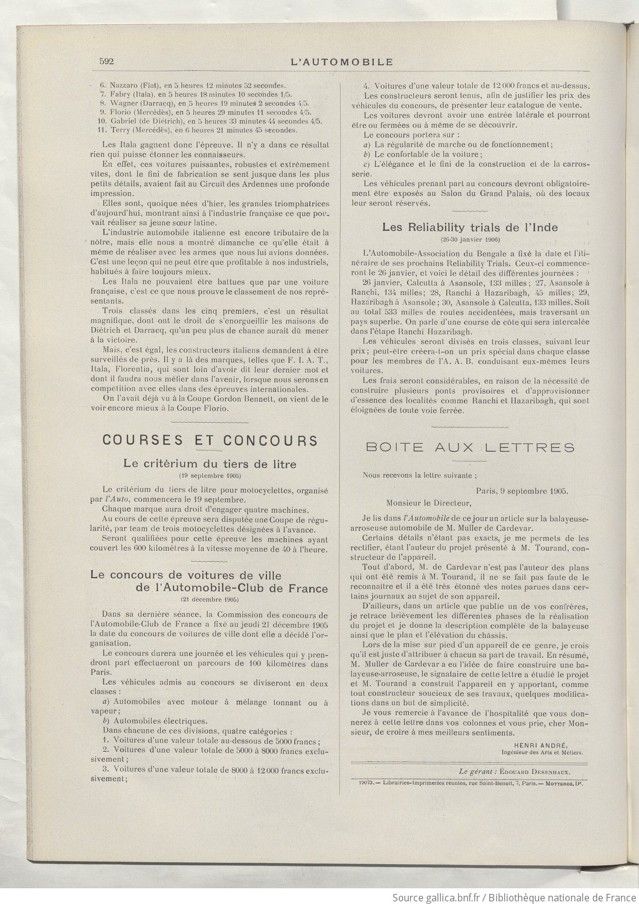
Rougier finally arrives with no chance of first place; then Marieaux crosses the line, finishing his second lap; finally, Duray—awaited with feverish impatience by the French contingent—crosses the line to the sound of everyone’s cheers.
Florio finishes his second lap, while everyone nervously awaits the announcement of the results, which seem unlikely to go to anyone other than the two Frenchmen or Lancia.
The finishers continue to arrive, and still nothing, when, at five o’clock, Tampier—with the time sheets from the various checkpoints in hand—quickly establishes the standings and announces Raggio as first.
It is a state of utter astonishment, but the standings are correct; the winner has a lead of thirty-five minutes.
This news made a profound impression on the Italian public, which turned into a well-deserved frenzy of enthusiasm. Raggio was warmly cheered.
Duray was second, Lancia third, and Hémery fourth.
THIRD LAP, FINISH – H. M. S.
Hémery. 11 31 18
Lancia. 11 41 32
Rougier. 11 59 50
Duray. 12 18 20
Florio. 12 34 11
Wagner. 12 42
Raggio. 12 43 47
Fabry. 13 2 10
Gabriel. 13 17 51
Terry. 14 13 45
The official standings are as follows:
1. Raggio (Itala), in 4 hours, 46 minutes, 47.2 seconds.
Average speed over 503.300 kilometers: 105.300 kilometers per hour.
2. Duray (de Dietrich), in 4 hours, 56 minutes, 20.4 seconds.
3. Lancia (Fial), in 4 hours, 57 minutes, 4.1 seconds.
4. Hémery (Darracq), in 4 hours, 58 minutes, 12 seconds.
5. Rougier (de Dietrich), in 5 hours, 12 minutes, 50.2 seconds.
6. Nazzaro (Fiat), in 5 hours, 12 minutes, and 52 seconds.
7. Fabry (Itala), in 5 hours, 18 minutes, and 10.1 seconds.
8. Wagner (Darracq), in 5 hours, 19 minutes, and 2.4 seconds.
9. Florio (Mercedes), in 5 hours, 29 minutes, 11.4 seconds.
10. Gabriel (de Dietrich), in 5 hours, 33 minutes, 44.4 seconds.
11. Terry (Mercedes), in 6 hours, 21 minutes, 45 seconds.
The Italas thus won the race. There is nothing about this result that should surprise connoisseurs.
Indeed, these powerful, sturdy, and extremely fast cars, whose craftsmanship is evident down to the smallest details, had made a profound impression at the Circuit des Ardennes.
Although they are relatively new, they are today’s great triumphs, thus showing the French automotive industry what its young Latin counterpart is capable of achieving.
The Italian automotive industry is still dependent on ours, but on Sunday it showed us what it was capable of achieving with the tools we had given it. This is a lesson that can only benefit our manufacturers, who are accustomed to constantly improving.
The Italas could only be beaten by a French car, as the standings of our representatives prove.
Three cars in the top five is a magnificent result, one of which the Diétrich and Darracq companies have every right to be proud—a result that, with just a little more luck, should have led to victory.
But in any case, the Italian manufacturers must be watched closely. There are brands such as F.I.A.T., Itala, and Florentia that are far from having said their last word and that we will need to be wary of in the future, when we compete against them in international races.
We had already seen this at the Gordon Bennett Cup, and we’ve just seen it even more clearly at the Florio Cup.
Photos.
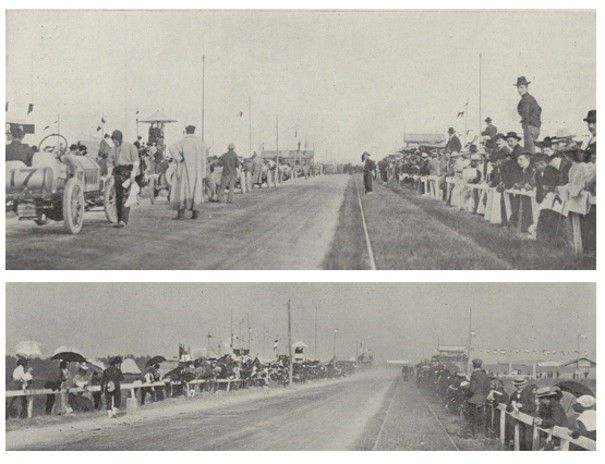
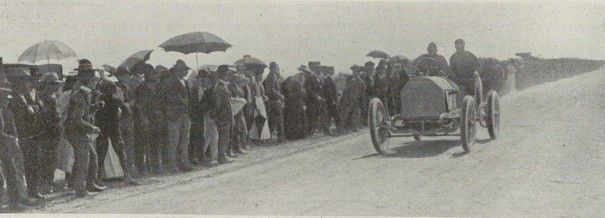
Page 589: General view at the start. – The finish line.
Page 590: The official grandstands. – Raggio’s finish.
Page 591: Raggio in his Itala car. – Duray’s finish. – The accident involving Ceyrano’s car.