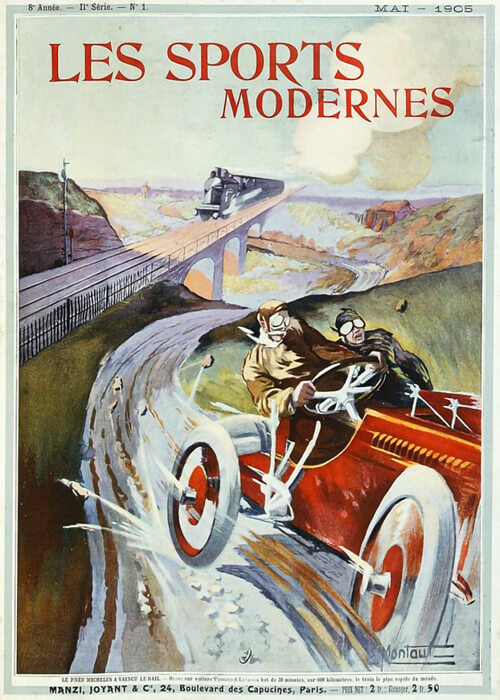
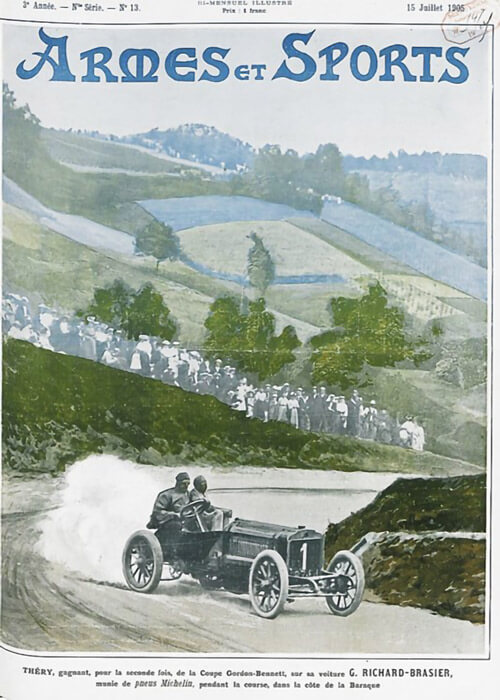
In the magazine “Ars et Labor”, Mario Morasso gives a recall of that year’s Targa Florio race through the Sicilian landscape. He more draws an artistical picture of that race by words and in the usual and typical way of a novelist who really is enthusiastic about the new automobile technique and the new kind of sport that comes along with it. (Translation included at the end.) * The author, essayist and literary pioneer of Futurism, Mario Morasso in 1907 published a book “Il nuovo aspetto meccanico del mondo” (The new mechanical view on the world) in which he comments the psychlogical and social changes of mankind following the introduction of the automobile.



With permission of Storia Memoria di Bologna storiadememoriadibologna.it
ext and fotos compiled by motorracinghistory, translation by Deepl deepl.com
Ars et Labor — 1908
LA CORSA DELLA “TARGA FLORIO,, IN SICILIA – Mario Morasso
FOTOGRAFIE DI MARIO MORASSO
Quando il cav. Vincenzo Florio, or fanno tre anni, ha pensato di istituire la “Targa Florio” scegliendo per pista la strada che da Termini Imerese per Caltavuturo e le Petralie scende a Campofelice, ha non solo avuto una felice idea sportiva, ma anche una deliziosa idea artistica.
Lo sportsman è stato in questa occasione ispirato dall’artista, e la “Targa Florio”, infatti merita il nome della più bella corsa dell’annata. Ed è bella tanto pei luoghi dove si svolge, negli ammirevoli paesaggi dai ricordi insigni che essa attraversa, quanto nel suo stesso svolgimento, nella sua azione continuamente battagliera.
Poiché la “Targa” richiede dai suoi concorrenti qualche cosa di più della consueta abilità dei corridori di automobile. Non è sufficiente saper correre veloce per vincere la “Targa”. Bisogna avere una maestria speciale e uno speciale ardimento, bisogna avere la disinvolta passione del rischio, lo slancio che sa tutto osare e la fermezza e la precisione che mai non fallano. E la corsa, quindi, procede dall’inizio alla fine con un gesto sempre rinnovato e sempre alacre di lotta contro il paese sempre diverso, che oppone visioni pittoresche incomparabili e difficoltà sempre nuove all’impavida conquista umana.
Una tale bellezza della gara si è in quest’anno accresciuta per la profonda drammaticità dei suoi episodi. La battaglia del 18 maggio è divenuta tanto più attraente in quanto più aspramente ed accanitamente è stata combattuta fino all’ultimo. L’esito non è stato deciso fino da principio, al contrario ci tenne sospesi nell’ansia fino in fondo. Pareva che nessuno dei combattenti volesse cedere. È stato quello che si dice un eroico scontro fino all’ultimo sangue. Dopo sette ore di gara gli atleti contendevano con l’ardore iniziale. Non si sono veduti mai campioni più forti, più indomabili, più accesi di emulazione, più ostinati, più addestrati e più capaci di vincere. La vittoria non sapeva a chi accordare la sua preferenza.
Era naturale, del resto, i campioni si chiamavano Nazzaro Lancia, Minoia Trucco, Raggio, Ceirano e i loro ordegni da corsa portavano queste tre marche gloriose, Fiat, Isotta-Fraschini, Spa. La Fiat, la decana e l’invitta del 1907, l’Isotta-Fraschini, la trionfatrice del 1908, la Spa, la sicura promessa dell’avvenire. Il torneo si è aperto con inusato favore davanti a una elegante e grandiosa assemblea di dame e di pubblico, schierata fra il mare turchino e i monti solenni che saranno per ben tre volte superati dagli instancabili contendenti.
Dopo il primo assalto, quando già dovrebbero rivelarsi le prime supremazie e le prime stanchezze, quando dovrebbe essersi già operato un certo distanziamento fra gli implacabili rivali, noi assistiamo invece al magnifico spettacolo di ben cinque concorrenti che si trovano sullo stesso grado di classifica, che non hanno perduto un pollice di terreno.
È semplicemente meraviglioso. Dopo 150 chilometri di corsa, attraverso monti e valli, attraverso il più dirupato e acrobatico degli itinerari, vi sono state ben cinque macchine che, come se si fossero date convegno, sono arrivate con una inverosimile precisione, camminando a una velocità media di circa 60 chilometri all’ora, in un tratto di tempo non superiore ai 30 secondi. Due Fiat, una Isotta-Fraschini, due Spa hanno compiuta questa straordinaria impresa.
E la hanno quasi rinnovata al secondo giro, dopo cinque ore di marcia, dopo 300 chilometri di percorso, quando ancora le due Fiat di Lancia e di Nazzaro, la Spa di Ceirano e l’Isotta-Fraschini di Trucco si sono ritrovate nuovamente nella stessa possibilità di essere prime.
La corsa si è decisa nella prima metà del terzo giro. Lancia che ha commesso l’errore di non fermarsi ai rifornimenti a rinnovare i suoi pneumatici, deve cambiarli ad uno ad uno per la strada perdendo oltre 14 minuti. Nazzaro che sa di poter acquistare i due minuti che ha di ritardo, si spinge a un’andatura vertiginosa, e in un virage spezza il pivot di una ruota. Ceirano perde qualche minuto per assistere il suo collega Raggio, mentre Trucco cammina con una stupefacente regolarità e con un impeto irresistibile verso la meta e verso la vittoria.
Li abbiamo applauditi tutti i tre forti e vittoriosi campioni del volante, Trucco-Lancia-Ceirano, e le tre impareggiabili macchine, l’Isotta-Fraschini 1.°, la Fiat 2.°, la Spa 3.°, poiché tutte e tre onorano l’industria italiana che le ha costruite.
Erano invero possenti e magnifiche le macchine preparate dai nostri costruttori per la corsa della “Targa”. Non che si trattasse di macchine eccezionali, di mostri fatti unicamente per la velocità, ma le nostre fabbriche principali hanno saputo trarre con un costante perfezionamento un tale profitto dai loro modelli comuni da turismo da renderli capaci di prodezze sbalorditive. Alcune delle macchine della “Targa”, come le Spa, non erano che dei tipi ordinari come quelli consegnati alla clientela, con qualche modificazione e ritocco in vista della corsa. Ebbene questi motori dal tipo 28-40 HP, con 130 mm. di alesaggio davano un rendimento di oltre 70 HP e potevano imprimere una velocità in piano alla vettura di 120 chilometri all’ora. In quella strada montuosa del circuito la Fiat di Nazzaro, la Spa di Raggio, hanno per un giro tenuto una media di 60 chilometri all’ora, l’Isotta-Fraschini di Trucco ha durante tutta la corsa, per 7 ore 49′ e 25″ marciato con una media di oltre 57 chilometri all’ora!
MARIO MORASSO.
Immagini.
Pagina 478.
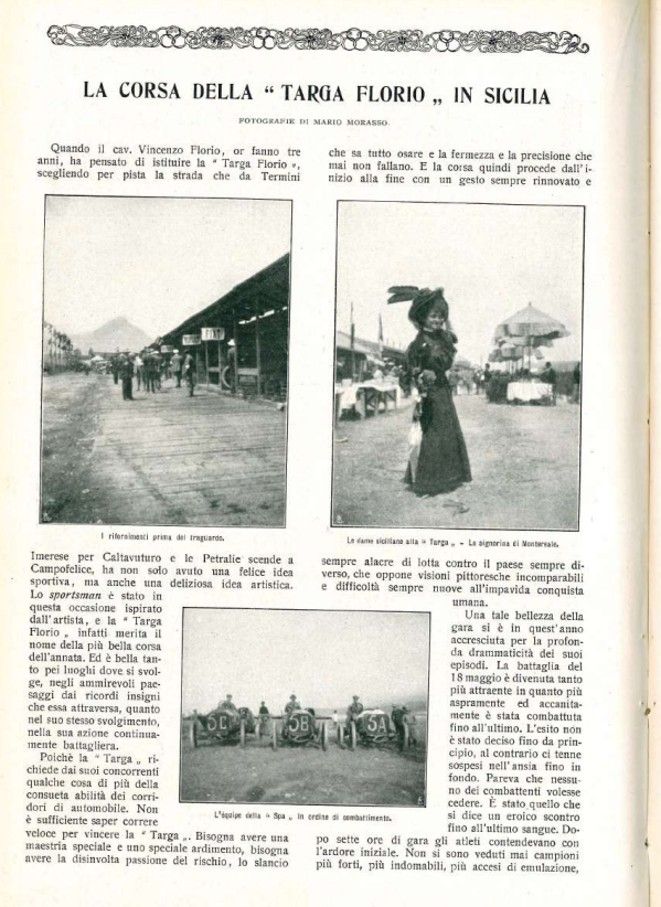
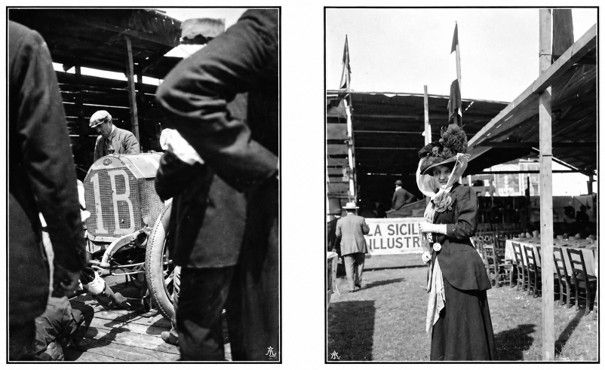
I rifornimenti prima del traguardo.
Le dame siciliane alla u Targa – La signorina di Montereale.
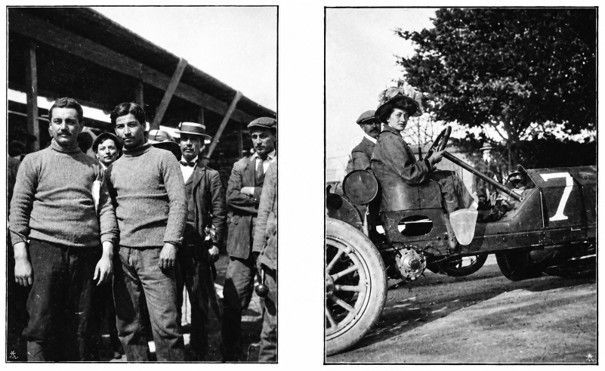
L’équipe della Spa „ in ordine di combattimento.
Pagina 479.
La colonia milanese alla “Targa”.
Fra un giro e l’altro, un momento che non è certo di sosta.
Nazzaro sorveglia il cambio dei pneumatici dopa il secondo giro.
In mancanza di concorrenti la Francia ha mandato delle graziose spettatrici.
Pagina 480.
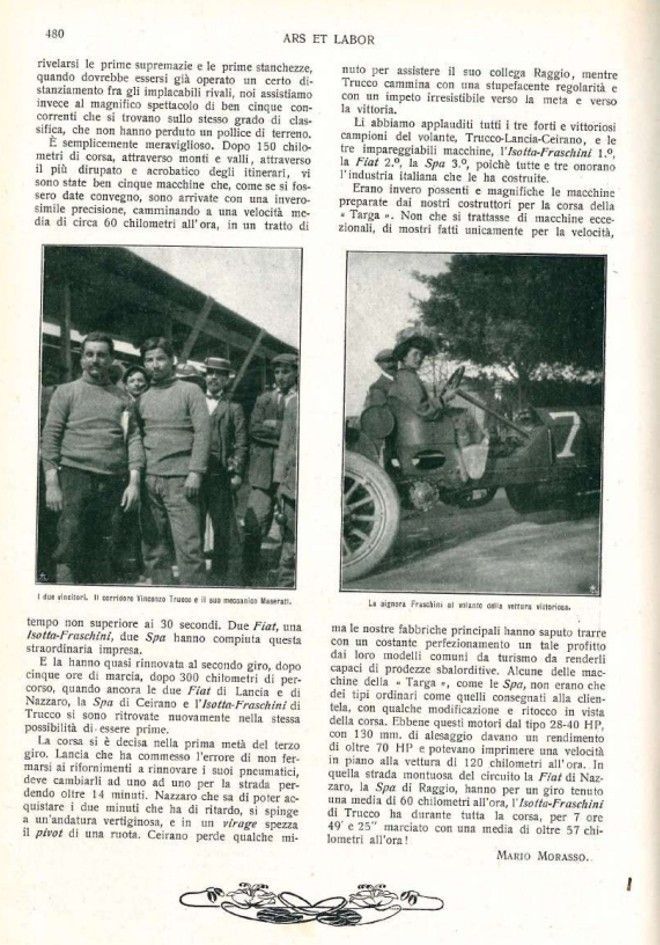
I due vincitori. Il corridore Vincenzo Trucco e il suo meccanico Maserati.
La signora Fraschini al volante della vettura vittoriosa.
Translation by DeepL deepl.com
Ars et Labor — 1908
THE “TARGA FLORIO” RACE IN SICILY
PHOTOGRAPHS BY MARIO MORASSO.
When Cav. Vincenzo Florio, three years ago now, decided to establish the “Targa Florio”—choosing as the racecourse the road that runs from Termini Imerese through Caltavuturo and Le Petralie down to Campofelice—he not only had a brilliant sporting idea but also a delightful artistic one.
On this occasion, the sportsman was inspired by the artist, and the “Targa Florio” truly deserves to be called the most beautiful race of the year. It is beautiful both for the places where it takes place—the admirable landscapes steeped in illustrious history that it traverses—and for the race itself, with its ceaselessly competitive spirit.
For the “Targa” demands something more from its competitors than the usual skill of race car drivers. It is not enough to know how to drive fast to win the “Targa.” One must possess special skill and special daring; one must have a carefree passion for risk, the drive to dare anything, and the steadfastness and precision that never fail. And so the race proceeds from start to finish with a constantly renewed and relentless struggle against the ever-changing countryside, which presents incomparable picturesque vistas and ever-new challenges to fearless human conquest.
The beauty of this race has been heightened this year by the profound drama of its events. The battle on May 18 became all the more compelling precisely because it was fought so fiercely and relentlessly right up to the very end. The outcome was not decided from the start; on the contrary, it kept us in suspense until the very end. It seemed that none of the competitors was willing to give in. It was what one might call a heroic clash fought to the bitter end. After seven hours of racing, the athletes were still competing with the same initial fervor. Never have we seen champions stronger, more indomitable, more fiercely competitive, more tenacious, better trained, or more capable of winning. Victory could not decide whom to favor.
It was only natural, after all: the champions were Nazzaro Lancia, Minoia Trucco, Raggio, and Ceirano, and their race cars bore these three glorious brands—Fiat, Isotta-Fraschini, and Spa. Fiat, the veteran and undefeated champion of 1907; Isotta-Fraschini, the triumphant champion of 1908; and Spa, the sure promise of the future. The race got off to an unusually promising start before an elegant and grand gathering of ladies and spectators, lined up between the azure sea and the majestic mountains that the tireless contenders would cross no fewer than three times.
After the first leg—when the first signs of dominance and fatigue should already be apparent, and when a certain gap should have already opened up between the relentless rivals—we instead witness the magnificent spectacle of no fewer than five competitors tied for the lead, none having lost an inch of ground.
It is simply marvelous. After 150 kilometers of racing, through mountains and valleys, along the most rugged and acrobatic of routes, there were no fewer than five cars that—as if they had arranged to meet—arrived with incredible precision, traveling at an average speed of about 60 kilometers per hour, within a span of no more than 30 seconds. Two Fiats, one Isotta-Fraschini, and two Spas accomplished this extraordinary feat.
And they nearly repeated it on the second lap, after five hours of driving and 300 kilometers of racing, when once again the two Fiats driven by Lancia and Nazzaro, Ceirano’s Spa, and Trucco’s Isotta-Fraschini found themselves in the same position to take the lead.
The race was decided in the first half of the third lap. Lancia, who had made the mistake of not stopping at the refueling stations to change his tires, had to change them one by one on the road, losing over 14 minutes. Nazzaro, knowing he could make up the two-minute deficit, pushed at a breakneck pace, only to snap a wheel pivot in a virage. Ceirano lost a few minutes assisting his colleague Raggio, while Trucco cruised with astonishing consistency and irresistible momentum toward the finish line and victory.
We applauded all three—the strong and victorious champions behind the wheel, Trucco, Lancia, and Ceirano—and the three incomparable cars: the Isotta-Fraschini in 1st place, the Fiat in 2nd, and the Spa in 3rd, for all three bring honor to the Italian industry that built them.
The cars prepared by our manufacturers for the “Targa” race were indeed powerful and magnificent. Not that they were exceptional machines—monsters built solely for speed—but our leading manufacturers have been able, through constant refinement, to derive such performance from their standard touring models as to make them capable of astonishing feats. Some of the “Targa” cars, such as the Spas, were nothing more than ordinary models like those delivered to customers, with a few modifications and tweaks made in preparation for the race. Well, these 28-40 HP engines, with a 130 mm bore, delivered over 70 HP and could propel the car to a speed of 120 kilometers per hour on flat ground. On that mountainous stretch of the circuit, Nazzaro’s Fiat and Raggio’s Spa maintained an average speed of 60 kilometers per hour for one lap, while Trucco’s Isotta-Fraschini maintained an average speed of over 57 kilometers per hour throughout the entire race, which lasted 7 hours, 49 minutes, and 25 seconds!
MARIO MORASSO.
Photos.
Paga 478.
Refueling before the finish line.
The Sicilian ladies at the Targa—the young lady from Montereale.
The Spa team in “battle formation.”
Page 479.
The Milanese contingent at the “Targa.”
Between laps, a moment that’s certainly not one of rest.
Nazzaro supervises the tire change after the second lap.
In the absence of competitors, France sent some charming female spectators.
Page 480.
The two winners. Racer Vincenzo Trucco and his Maserati mechanic.
Mrs. Fraschini at the wheel of the winning car