This 1903 Paris-Madrid report of The Automobile, titled “Pen Pictures of the Paris-Madrid” talks about a “helter-skelter flight”, which thus really was. Expressions like “Laxity of Policing”, “Criminal Carelessness” and “Precautions not observed” say it all, with a relveiving “Injured improving” in the final part of the report. It covers many aspects of this catastophical race. It lasted only one day and that was more than enough!
Text and photos with courtesy of hathitrust.org hathitrust.org, compiled by motorracingistory.com
The Automobile – Vol. 9. June 13, 1903.
Pen Pictures of the Paris-Madrid.
Analysis of the Performances of Contestants – Net Times and Average Speed – Comparative Showing Made by Various Makes of Machines with France in the Lead.
FROM SPECIAL REPORTS BY EDWARD KENEALY.
PARIS, May 27. – Like a veritable race unto death was the helter-skelter flight of the 227 contestants in the Paris-Madrid, in all styles and sizes of automobiles and motorcycles, through swirling, blinding clouds of dust from Versailles to Bordeaux on that fatal Sunday, May 24. Drivers declare that it was like flying at top speed through a thick London fog. Behind them, to the right of them and to the left of them they could constantly hear the raucous blasts of horns, but in the thick dust it was impossible to see what was before them or at their side. From the very start of the accident, misadventure and tragedy befell the cars and their drivers. It is the universal belief that no such wild flight of such a large number of heterogeneous machines, starting at such short intervals, can ever occur again.
In the two hours and five minutes between 3.45 A. M., when Jarrott started first in his Mors, and 5.50 A. M., 138 large cars started, many of them with engines of 70- and some of 100-horsepower. In the next twenty-five minutes thirty-six light cars were sent away, and in the remaining thirty-five minutes, ending at 6.50, no less than fifty-three motorcycles of 2½ and 3½ horsepower shot out, with a blind trust in Providence, into the unknown dangers besetting the 342½ miles of badly policed roadway to Bordeaux. Two hundred and twenty-seven power vehicles scattered along less than 180 miles of common highway, thundering and rattling along at all rates of speed from almost 100 miles an hour in some phenomenal cases to the slower speeds of the motor bicycles.
LAXITY OF POLICING.
With an absolutely clear course, such a marvelous procession of cars, passing and repassing one another and roiling up a continuous cloud of dust, would have made the race dangerous in the extreme, but, added to the dangers arising from these causes and the natural peril of negotiating the awkward turns in a course that is adapted to no greater speed than thirty to forty miles in the hour, was a multiplication of unanticipated dangers imposed through an almost criminally inadequate and negligent policing of the course. “Under the circumstances of the road, it is a wonder more accidents did not happen,” says Gabriel, winner of the first stage. “The small force of police and officials were absolutely helpless to restrain the crowds. The racing men were more alarmed for the safety of the rash crowds, who stood straight in the road ahead of the onrushing cars, than for their own. They did not seem to realize that the cars were making faster time than the Paris-Calais Rapide, the quickest train in Europe. Half-a-dozen troopers and a dozen gendarmes were supposed to keep 2,000 to 3,000 utterly rash persons off the route.” Gabriel thinks nearly all the accidents are attributable to the carelessly kept route.
EXAMPLES OF CRIMINAL CARELESSNESS.
Here is an illustration of what absolute lack of protection the contestants were accorded on the occasion of the greatest race the world has ever known. A special train was sent from Vendome toward Paris to accommodate the people who had gone as far as Vendome to see the flyers on the road to Bordeaux. The watchman at the gates on the railroad near Choisy-le-Roi, not having been notified of the dispatching of the train, had not closed the gates when the train arrived. As the train reached the crossing, a large automobile, occupied by the owner and his mechanician, approached. Seeing the gates open, they were about to cross the tracks, when they noticed the oncoming train. Fortunately, the automobile, which was not in the contest, was going slowly, but it could not be stopped in time to avoid a collision, so the occupants jumped out and allowed it to go on. The train, running at full speed, struck the machine, smashing it to pieces, and some flying parts hit the mechanic of the motor car and inflicted serious injuries.
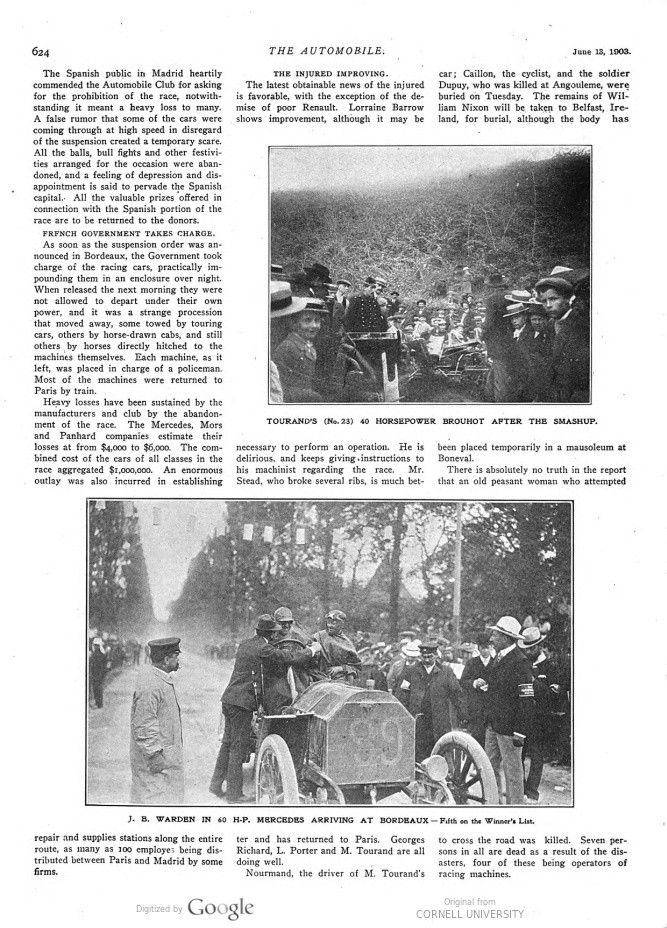
Another, and far more lamentable case, that throws a vivid light on the conditions that contributed to the causes of the day’s fatalities and injuries, was the disaster met by the Frenchman Tourand, in his 40-horsepower Brouhot car. When leaving the control at Angouleme, and while rushing along at great speed, he was suddenly confronted by a child of seven years which started to cross the road. A soldier bravely sprang out to save the child and was struck violently by the machine. The soldier was killed almost instantly, and his rifle was flung fifty feet away. The impact caused the car to swerve, and, still moving rapidly, it struck a tree. Both the operator and his assistant were thrown out, M. Tourand receiving serious spinal injuries, and his chauffeur, Norveau, being killed outright. As the car swerved and plunged to the side of the road it ran over another soldier, who was so badly hurt that he died twenty minutes later. A spectator was also knocked over and less badly injured. Curiously, the child, for which three lives were sacrificed, escaped entirely unhurt.
PRECAUTIONS NOT OBSERVED.
M. Combes, Minister of the Interior for France, who, upon hearing the reports of the disasters of the first day, promptly countermanded his authorization of the race, complained that the conditions and precautions that he laid down were not ob- served, and blamed the Automobile Club and the prefects of police of the districts within their jurisdiction for not making use of the available troops and the volunteer bicyclists and for permitting large crowds to gather at dangerous points. It had been arranged that buglers were to be posted at intervals of 200 yards along the course to sound a warning whenever a racing car approached, and gendarmes and wood rangers were to keep all vehicles, pedestrians and domestic animals off the course, while the crossroads were to be guarded very carefully. The Automobile Club guaranteed to pay all the expenses of guarding the course, but it was not kept clear. There was nobody to see that the grade railroad crossings were kept open and safe, and the contestants drove into the gates, or, in attempting to avoid them, capsized in the ditch. Non-contesting motorists and bicyclists were permitted to drive on the road almost without restriction, although pedestrians and drivers of animals were kept off.
No endeavor was made to control the crowds on the eight-kilometer stretch out of Chartres, although there were several hundred automobiles scattered along it, and the course was lined with some thousands of spectators, mostly peasants and people who were only slightly familiar with automobiles. A regiment of infantry and some gendarmes patrolled the road from Chartres to a narrow bridge at the foot of a hill at the outskirts, and, although pedestrians were not allowed to cross the bridge, but were compelled to pass under it through the stream below, ordinary automobiles and motor bicyclists went unrestricted over it. Such advantage was taken of this that one of the racing machines had to be stopped short while a man in an outside car slowly drove over the bridge. Near Chartres any stray scorcher who felt inclined simply tacked on behind the motor bicycles in the contest and took pace for his own amusement.
ARRIVALS AT BORDEAUX.
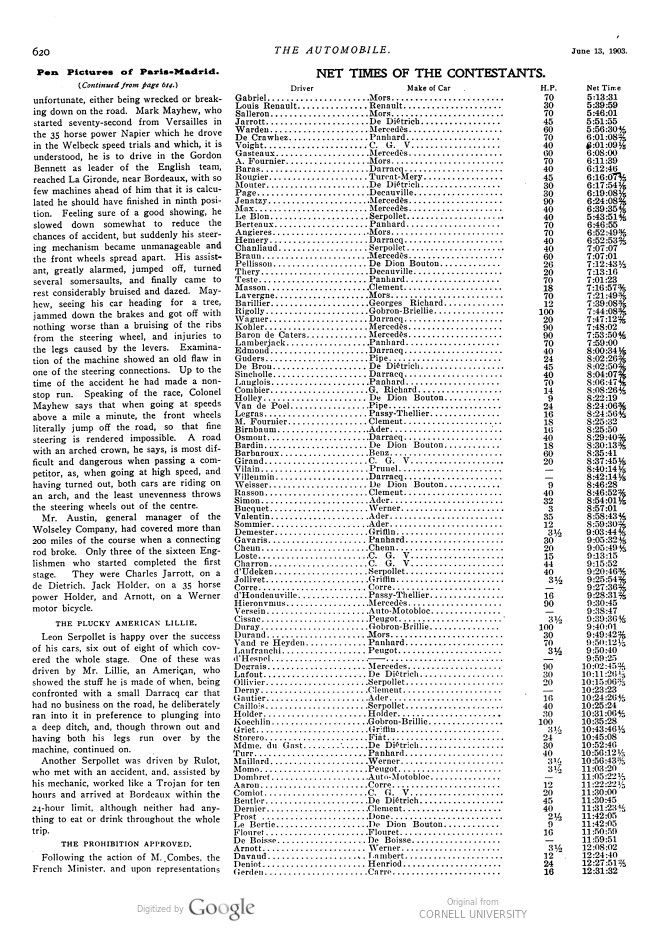
Louis Renault, who started third from Versailles at 3.47 A. M. in a 30 horsepower Renault, was the first arrival at the last control, about five miles from the centre of Bordeaux. He dashed up, loaded with dust, at 12.14.45, having passed Charles Jarrott and Rene de Knyff on the road. It was fifteen minutes before the next competitor whirled up in a hurricane of dust. This was seen to be Jarrott, who started first. Then followed a long straining through field glasses as the waiters watched for the arrival of the third contestant. After more than half an hour of expectance, he sped in, and when he was recognized as Gabriel, and a hasty consultation of the order of start showed that he had passed eighty-one cars on the road, a wild burst of enthusiasm hailed him as the probable winner of the day’s run. Then the racers began arriving faster, and by 2 o’clock thirteen cars had shown up.
Wise precautions had been taken to protect the road at the Bordeaux control, where, for a space of 200 or 300 yards, a barrier had been erected and soldiers with bayonets fixed kept the crowd back. Photographers and friends of the drivers, however, exhibited the utmost indifference in venturing on the road as the machines whizzed down the hill to the finish at from sixty to seventy miles an hour, but by great good fortune all the operators succeeded in slowing down their cars to almost a walk within the last few yards, so that no accidents occurred. But so reckless did the people become, that the soldiers were finally obliged to charge into the crowd to force the people back.
On arrival, Louis Renault could give the anxious inquirers no news of the other racing men he had passed. “A motorist traveling at sixty to seventy miles an hour does not notice other cars,” he said. When Jarrott drove up he was as calm and fresh physically as if he had driven only from a nearby village, while his English assistant was beaming with pleasure, as this was the first great race he had taken part in.
THE ACCIDENT TO RENAULT.
Shortly after the arrival of the first contestants at Bordeaux the news of the disasters along the way began coming in. When Louis Renault heard of the accident in which his brother Marcel was reported to have lost his life, he at once abandoned the race, left orders that all Renault cars be withdrawn, and drove back to Couhé, where Marcel lay in the hospital. Although the reported death was untrue at the time, it eventually has had to be confirmed, as Marcel Renault has since succumbed to the injuries received when, in trying to avoid closed gates at Chartres, he turned his car into a ditch and collided with a tree. The story of the accident is told in the following graphic words by M. Seret, who drove a Renault No. 113:
“Coming from the village of Couhé at fifty miles an hour at a sharp turn over a bridge spanning a river, I saw one of our cars overturned and a wheel smashed. M. Marcel’s friends standing round told me he had dashed full speed round the double and very sharp corner, despite the fact that it was signalled dangerous by a sentinel waving a red flag. The car skidded and ran off the road, the wheel caught in a piece of drainpipe on the pavement, the car turned right around, a wheel was smashed, and the vehicle went full tilt for a tree, against which M. Marcel was hurled with great violence.”
In connection with this accident, a most sportsmanlike action was performed by Maurice Farman, who, coming upon Renault lying unconscious by the roadside, threw away his chances of winning, and, going to his assistance, carried the injured man in his car to Couhé-Verac, where surgical aid was secured.
TERRY’S REMARKABLE ACCIDENT.
Incidental to the remarkable accident that happened to the American, Terry, driving a 60 horsepower Mercedes, No. 290, it is stated that his chauffeur had strapped himself to the car. If this is so, he was an exception, for, notwithstanding the reports to the contrary, this is an unusual thing to do, as the risks are considered far too great. Terry’s accident was one of the most curious of the day. At Coignieres the intrepid driver tried to pass Porter, in a Wolseley, on his left, but Porter also turned to the left, and to avoid a collision Terry ran his wheels against the flint pavement. The tire on the front wheel burst with a sound like a Maxim gun, but the car went on like a bullet, shooting in front of Porter’s car. Following the bursting of the tire, the left wheel broke, and although the engine was thrown out of gear, the machine traveled along the street sideways at a speed of more than sixty miles an hour. The breaking of the wheel split the gasoline tank, and the inflammable stuff caught fire, either from heated bearings or sparks from the road set up by the sliding friction. With the flames shooting up around him, Terry sat like a statue, petrified by the suddenness of the occurrence and the strain on his nerves. His machinist recalled him to his senses just in time to prevent him being burned alive. The car was reduced to ashes, as were also two trees standing by the roadside, which the machine brought up against. Porter miraculously escaped collision with Terry’s machine, but later met a more serious accident himself near Chartres, resulting in the overturning and burning of his own car and the death of his machinist, Nixon, while he was seriously burned himself.
WHY VANDERBILT WITHDREW.
W. K. Vanderbilt, Jr., says that although he quit the contest ostensibly because of a puncture, he could have easily replaced the tire with another, and in reality quit because of the bad management of the race. At the start at Versailles much needless official trouble was made because he did not have the necessary outfit of control papers, while all along the route the course was obstructed by spectators. Vanderbilt returned to Paris with Baron de Forest, who also had a punctured tire, but who fully shared the American’s views as to the great dangers and lack of proper official precautions.
Henri Fournier, who started in a 70 horsepower Mors, and hoped to reach Bordeaux in five hours, was also obliged to give up the race at Chartres. He had been one of the chief favorites.
THE UNFORTUNATE ENGLISHMEN.
Of the twenty-five Englishmen who entered, sixteen started. Those who drove English machines were in Napier and Wolseley cars and on Humber, Ormonde, Werner and Rex motor bicycles. All of the Napier and Wolseley racing machines were unfortunate, either being wrecked or breaking down on the road. Mark Mayhew, who started seventy-second from Versailles in the 35 horse power Napier which he drove in the Welbeck speed trials and which, it is understood, he is to drive in the Gordon Bennett as leader of the English team, reached La Gironde, near Bordeaux, with so few machines ahead of him that it is calculated he should have finished in ninth position. Feeling sure of a good showing, he slowed down somewhat to reduce the chances of accident, but suddenly his steering mechanism became unmanageable, and the front wheels spread apart. His assistant, greatly alarmed, jumped off, turned several somersaults, and finally came to rest considerably bruised and dazed. Mayhew, seeing his car heading for a tree, jammed down the brakes and got off with nothing worse than a bruising of the ribs from the steering wheel, and injuries to the legs caused by the levers. Examination of the machine showed an old flaw in one of the steering connections. Up to the time of the accident, he had made a non-stop run. Speaking of the race, Colonel Mayhew says that when going at speeds above a mile a minute, the front wheels literally jump off the road, so that fine steering is rendered impossible. A road with an arched crown, he says, is most difficult and dangerous when passing a competitor, as, when going at high speed, and having turned out, both cars are riding on an arch, and the least unevenness throws the steering wheels out of the centre.
Mr. Austin, general manager of the Wolseley Company, had covered more than 200 miles of the course when a connecting rod broke. Only three of the sixteen Englishmen who started completed the first They were Charles Jarrott, on a stage. de Dietrich, Jack Holder, on a 35 horse power Holder, and Arnott, on a Werner motor bicycle.
THE PLUCKY AMERICAN LILLIE.
Leon Serpollet is happy over the success of his cars, six out of eight of which covered the whole stage. One of these was driven by Mr. Lillie, an American, who showed the stuff he is made of when, being confronted with a small Darracq car that had no business on the road, he deliberately ran into it in preference to plunging into a deep ditch, and, though thrown out and having both his legs run over by the machine, continued on.
Another Serpollet was driven by Rulot, who met with an accident, and assisted by his mechanic, worked like a Trojan for ten hours and arrived at Bordeaux within the 24-hour limit, although neither had anything to eat or drink throughout the whole trip.
THE PROHIBITION APPROVED.
Following the action of M. Combes, the French Minister, and upon representations from France, the Spanish Government prohibited the extension of the contest into Spanish territory, but later permission was telegraphed for the racers to proceed to Madrid as tourists. It was generally felt by the contestants and the officials of the race that it would be safe to continue, as the number of contestants had been greatly reduced, and the news of the accidents of the first day had been published broadcast, so that the course would have been better protected and the people more cautious about crossing and using the road. The authorities were inexorable, however, and so the racers returned to Paris, few of them caring to go on to Madrid at the legal speed permitted the tourist section. Others of the racing-contingent were heartily in accord with the authorities. Charles Jarrott was among there. “I am positively of the opinion,” he says, “that the decision to prohibit the Paris-Madrid race was a wise one. There were too many cars in the race, and the speeds were too great. Enormous motors and light frames prove nothing commercially. Racing under the present regulations will never be allowed again in France. I consider that new rules should be framed at once, limiting the size of the motor with a fixed minimum weight. The drivers in future races should be carefully picked, and the entries limited to a reasonable number.”
The Spanish public in Madrid heartily commended the Automobile Club for asking for the prohibition of the race, notwithstanding it meant a heavy loss to many. A false rumor that some of the cars were coming through at high speed in disregard of the suspension created a temporary scare. All the balls, bull fights and other festivities arranged for the occasion were abandoned, and a feeling of depression and disappointment is said to pervade the Spanish capital. All the valuable prizes offered in connection with the Spanish portion of the race are to be returned to the donors.
FRENCH GOVERNMENT TAKES CHARGE.
As soon as the suspension order was announced in Bordeaux, the Government took charge of the racing cars, practically impounding them in an enclosure overnight. When released the next morning they were not allowed to depart under their own power, and it was a strange procession that moved away, some towed by touring cars, others by horse-drawn cabs, and still others by horses directly hitched to the machines themselves. Each machine, as it left, was placed in charge of a policeman. Most of the machines were returned to Paris by train.
Heavy losses have been sustained by the manufacturers and club by the abandonment of the race. The Mercedes, Mors and Panhard companies estimate their losses at from $4,000 to $6,000. The combined cost of the cars of all classes in the race aggregated $1,000,000. An enormous outlay was also incurred in establishing repair and supplies stations along the entire route, as many as 100 employes being distributed between Paris and Madrid by some firms.
THE INJURED IMPROVING.
The latest obtainable news of the injured is favorable, with the exception of the demise of poor Renault. Lorraine Barrow shows improvement, although it may be necessary to perform an operation. He is delirious, and keeps giving instructions to his machinist regarding the race. Mr. Stead, who broke several ribs, is much better and has returned to Paris. Georges Richard, L. Porter and M. Tourand are all doing well.
Nourmand, the driver of M. Tourand’s car; Caillon, the cyclist, and the soldier Dupuy, who was killed at Angouleme, were buried on Tuesday. The remains of William Nixon will be taken to Belfast, Ireland, for burial, although the body has been placed temporarily in a mausoleum at Boneval.
There is absolutely no truth in the report that an old peasant woman who attempted to cross the road was killed. Seven persons in all are dead as a result of the disasters, four of these being operators of racing machines.
Photos.
Page 611.
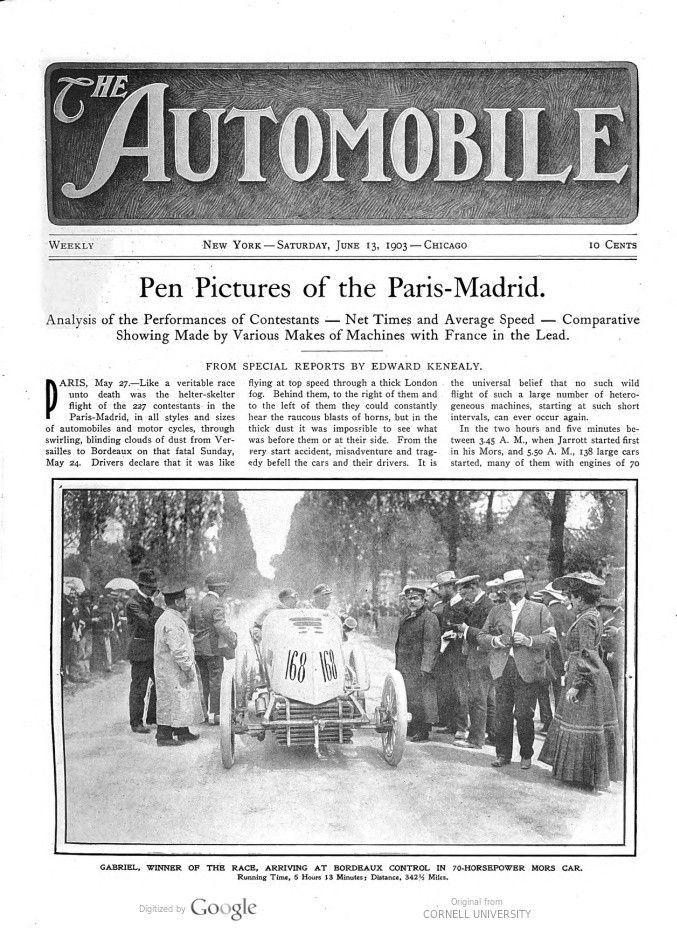
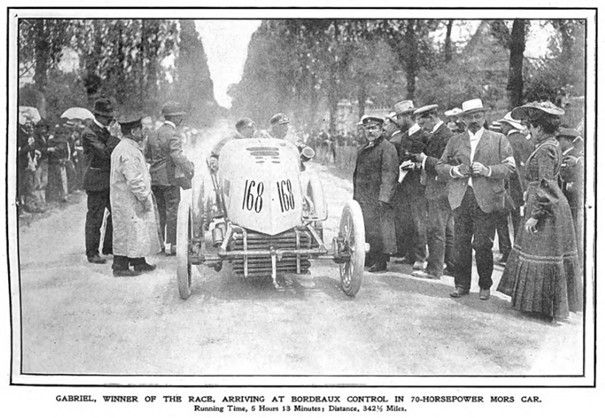
GABRIEL, WINNER OF THE RACE, ARRIVING AT BORDEAUX CONTROL IN 70-HORSEPOWER MORS CAR. Running Time, 5 Hours 13 Minutes; Distance, 342½ Miles. #168.
Page 612.
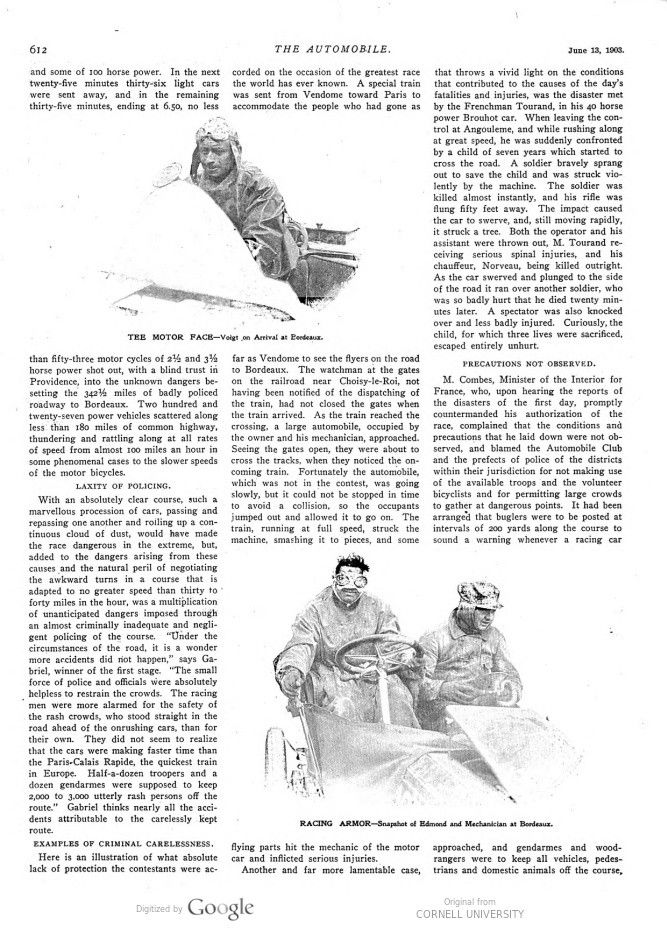
THE MOTOR FACE – Voigt on Arrival at Bordeaux.
RACING ARMOR – Snapshot of Edmond and Mechanician at Bordeaux.
Page 613.
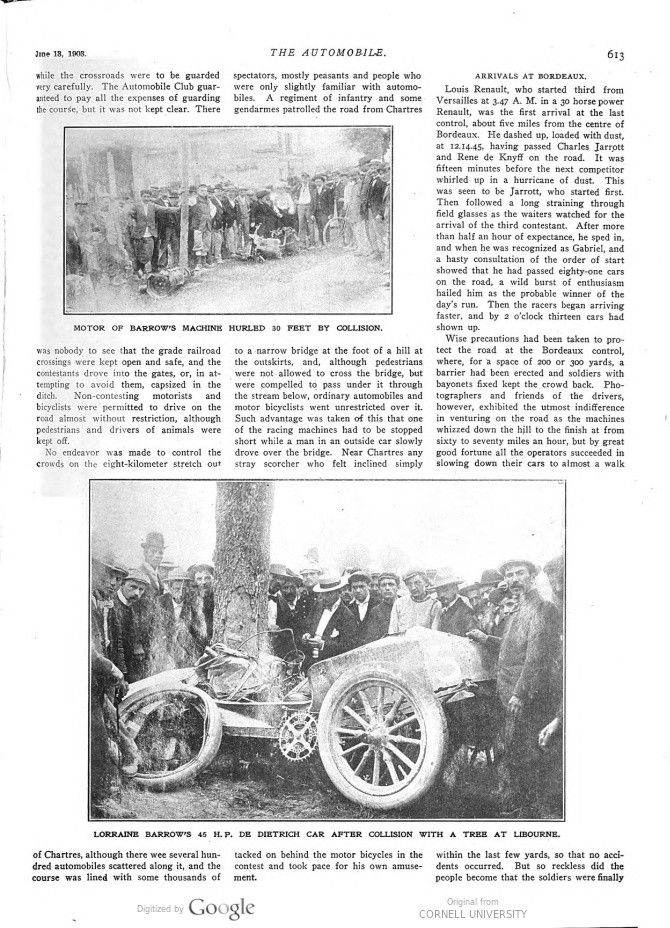
MOTOR OF BARROW’S MACHINE HURLED 30 FEET BY COLLISION.
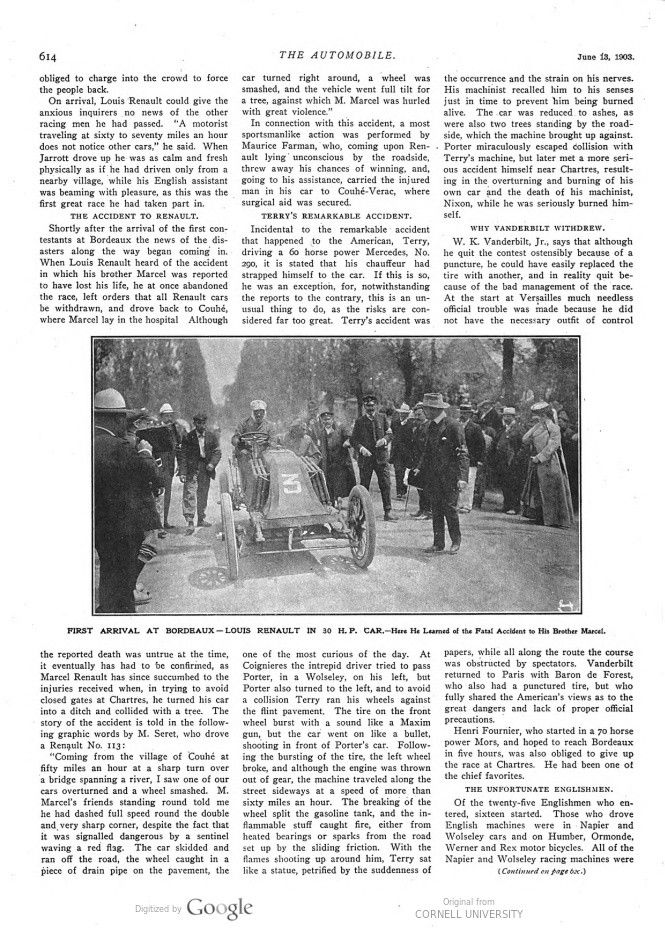
LORRAINE BARROW’S 45 H. P. DE DIETRICH CAR AFTER COLLISION WITH A TREE AT LIBOURNE.
Page 614.
FIRST ARRIVAL AT BORDEAUX – LOUIS RENAULT IN 30 H. P. CAR. – Here He Learned of the Fatal Accident to His Brother Marcel.
Page 615 – 620.
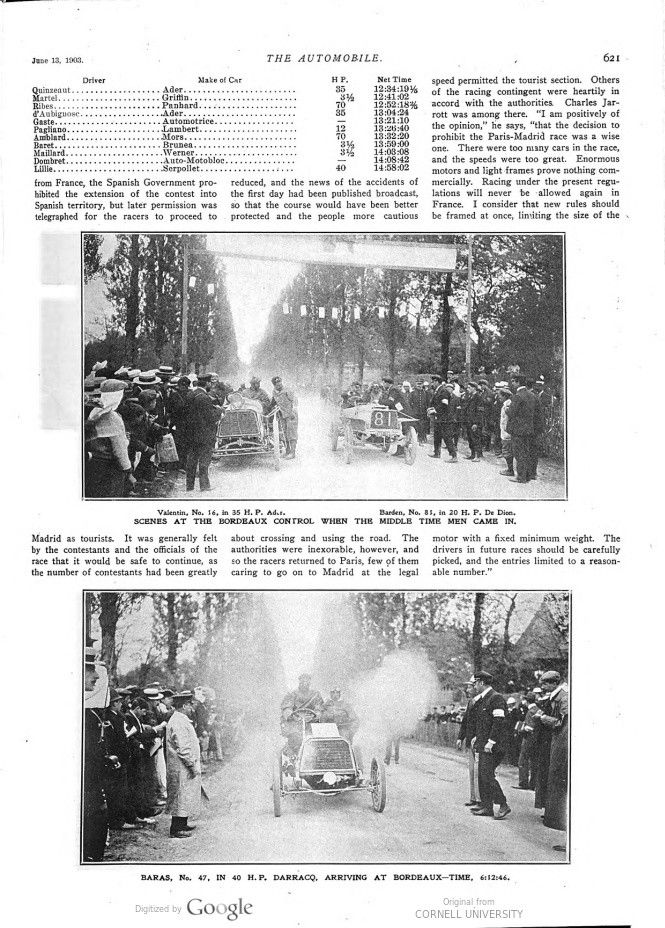
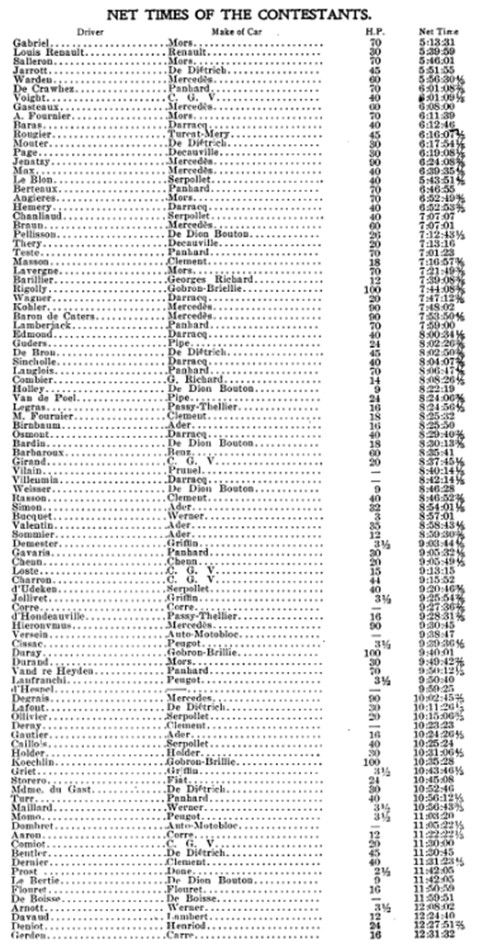
Table: NET TIMES OF THE CONTESTANTS.
Driver – Make of Car – H.P. – Net Time
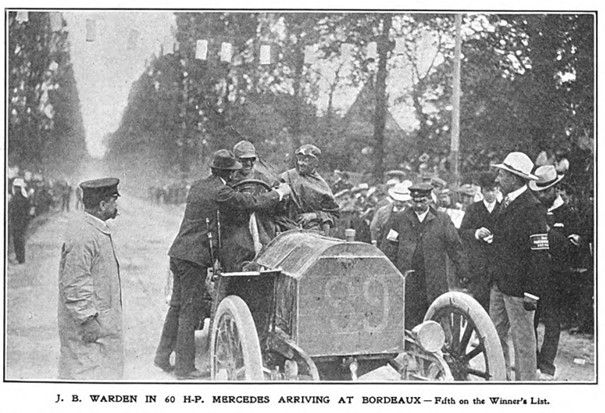
Gabriel – Louis Renault – Salleron – Jarrott – Warden – De Crawhez – Voight – Gasteaux – A. Fournier – Baras – Teste – Masson – Lavergne – Barillier – Rigolly – Wagner – Kohler – Lamberjack.
Page 621.
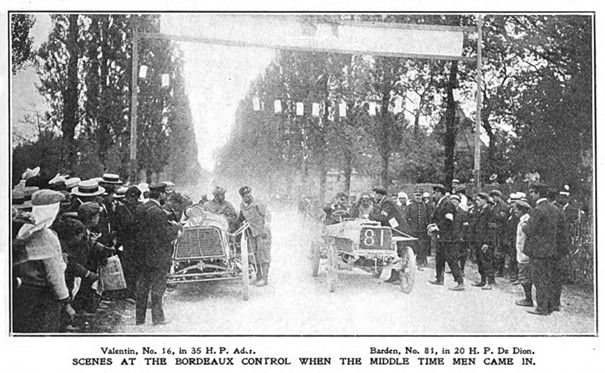
SCENES AT THE BORDEAUX CONTROL WHEN THE MIDDLE TIME MEN CAME IN.
Valentin, No. 16, in 35 H.P. Ader. – Barden, No. 81, in 20 H.P. De Dion.
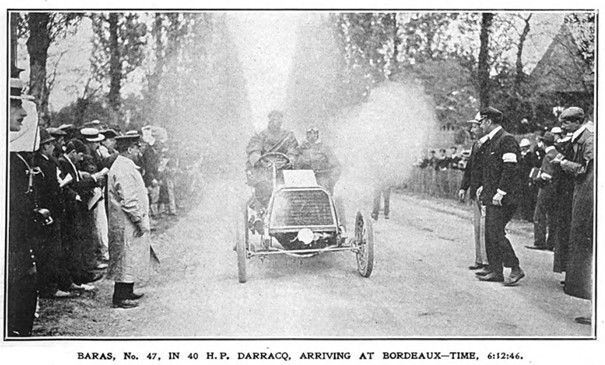
BARAS, No. 47, IN 40 H.P. DARRACQ, ARRIVING AT BORDEAUX – TIME, 6:12:46.
Page 622-623.
Table: Speeds in Racing Class.
AVERAGE SPEEDS OF FASTEST COMPETITORS. PARIS TO BORDEAUX, 343 MILES.
Class 1 – Cars weighing up to 1,000 kilos (2,206 163).
Class 2-Cars up to 650 kilos (1434 lbs.).
Class 3 – Voiturettes up to 400 kilos (8822 lbs.).
Class 4 – Motor Cycles up to 50 kilos (110 lbs).
Table: PERFORMANCES OF THE BIG CARS. PARIS TO BORDEAUX, 343 MILES.
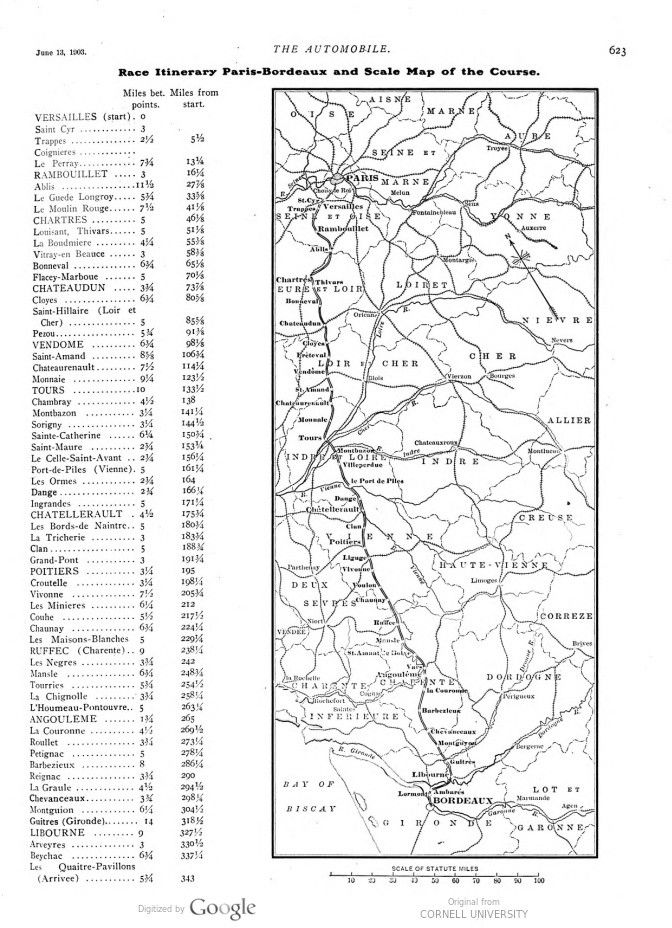
Race Itinerary Paris-Bordeaux and Scale Map of the Course. (Miles bet. points – Miles from start.)
Page 624.
TOURAND’S (No.23) 40 HORSEPOWER BROUHOT AFTER THE SMASHUP.
J. B. WARDEN IN 60 H.P. MERCEDES ARRIVING AT BORDEAUX – Fifth on the Winner’s List.