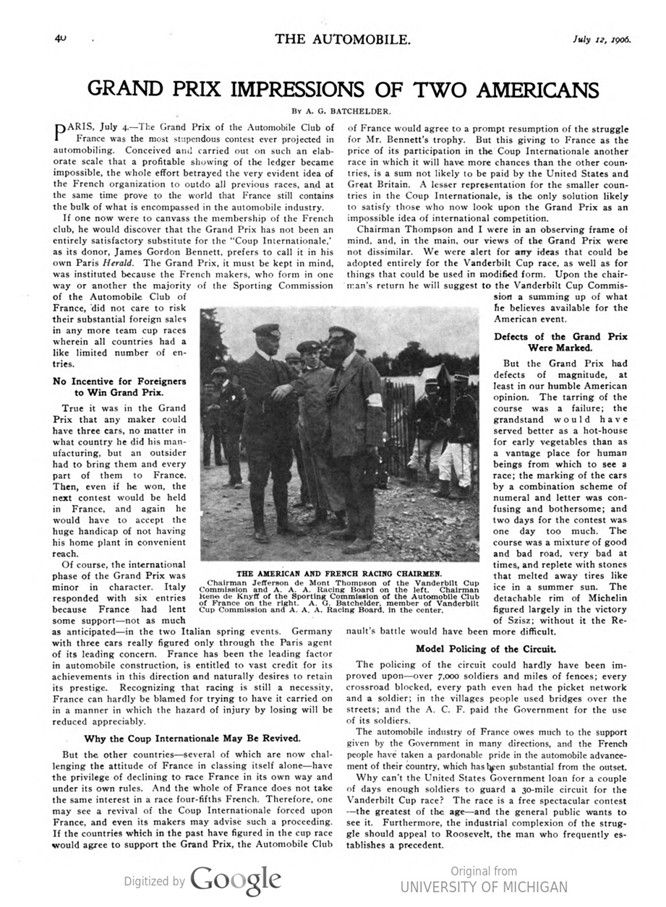
This article is from the hand of Mr. Batchelder; no one less than the well-known starter and referee of the Vanderbilt Cup races, a member of the Vanderbilt Cup Commission and a member of the American A. A. A. Racing Board. A real critical impression is given, not only on the Grand Prix race itself, but surely also on the background of the transition from Gordon Bennett Cup races into the Grand Prix races. Especially with quite some humor on, for instance, the grandstands are referred, but also some recommandations for American motorracing events are summed up.
Text and jpegs by courtesy of hathitrust.org www.hathitrust.org, compiled by motorracinghistory.com
The Automobile, Vol. XV, July 12, 1906
GRAND PRIX IMPRESSIONS OF TWO AMERICANS
By A. G. BATCHELDER.
PARIS, July 4 – The Grand Prix of the Automobile Club of France was the most stupendous contest ever projected in automobiling. Conceived and carried out on such an elaborate scale that a profitable showing of the ledger became impossible, the whole effort betrayed the very evident idea of the French organization to outdo all previous races, and at the same time prove to the world that France still contains the bulk of what is encompassed in the automobile industry.
If one now were to canvass the membership of the French club, he would discover that the Grand Prix has not been, an entirely satisfactory substitute for the “Coup Internationale,’ as its donor, James Gordon Bennett, prefers to call it in his own Paris Herald. The Grand Prix, it must be kept in mind, was instituted because the French makers, who form in one way or another the majority of the Sporting Commission of the Automobile Club of France, did not care to risk their substantial foreign sales in any more team cup races wherein all countries had a like limited number of entries.
No Incentive for Foreigners to Win Grand Prix.
True it was in the Grand Prix that any maker could have three cars, no matter in what country he did his manufacturing, but an outsider had to bring them and every part of them to France. Then, even if he won, the next contest would be held in France, and again he would have to accept the huge handicap of not having his home plant in convenient reach.
Of course, the international phase of the Grand Prix was minor in character. Italy responded with six entries because France had lent some support – not as much as anticipated – in the two Italian spring events. Germany with three cars really figured only through the Paris agent of its leading concern. France has been the leading factor in automobile construction, is entitled to vast credit for its achievements in this direction and naturally desires to retain its prestige. Recognizing that racing is still a necessity, France can hardly be blamed for trying to have it carried on in a manner in which the hazard of injury by losing will be reduced appreciably.
Why the Coup Internationale May Be Revived.
But the other countries – several of which are now challenging the attitude of France in classing itself alone – have the privilege of declining to race France in its own way and under its own rules. And the whole of France does not take the same interest in a race four-fifths French. Therefore, one may see a revival of the Coup Internationale forced upon France, and even its makers may advise such a proceeding. If the countries which in the past have figured in the cup race would agree to support the Grand Prix, the Automobile Club of France would agree to a prompt resumption of the struggle for Mr. Bennett’s trophy. But this giving to France as the price of its participation in the Coup Internationale another race in which it will have more chances than the other countries, is a sum not likely to be paid by the United States and Great Britain. A lesser representation for the smaller countries in the Coup Internationale, is the only solution likely to satisfy those who now look upon the Grand Prix as an impossible idea of international competition.
Chairman Thompson and I were in an observing frame of mind, and, in the main, our views of the Grand Prix were not dissimilar. We were alert for any ideas that could be adopted entirely for the Vanderbilt Cup race, as well as for things that could be used in modified form. Upon the chairman’s return he will suggest to the Vanderbilt Cup Commission a summing up of what he believes available for the American event.
Defects of the Grand Prix Were Marked.
But the Grand Prix had defects of magnitude, at least in our humble American opinion. The tarring of the course was a failure; the grandstand would have served better as a hot-house for early vegetables than as a vantage place for human beings from which to see a race; the marking of the cars by a combination scheme of numeral and letter was confusing and bothersome; and two days for the contest was one day too much. The course was a mixture of good and bad road, very bad at times, and replete with stones that melted away tires like ice in a summer sun. The detachable rim of Michelin figured largely in the victory of Szisz; without it the Renault’s battle would have been more difficult.
Model Policing of the Circuit.
The policing of the circuit could hardly have been improved upon – over 7,000 soldiers and miles of fences; every crossroad blocked, every path even had the picket network and a soldier; in the villages people used bridges over the streets; and the A. C. F. paid the Government for the use of its soldiers.
The automobile industry of France owes much to the support given by the Government in many directions, and the French people have taken a pardonable pride in the automobile advancement of their country, which has been substantial from the outset. Why can’t the United States Government loan for a couple of days enough soldiers to guard a 30-mile circuit for the Vanderbilt Cup race? The race is a free spectacular contest – the greatest of the age – and the general public wants to see it. Furthermore, the industrial complexion of the struggle should appeal to Roosevelt, the man who frequently establishes a precedent.
Photo: THE AMERICAN AND FRENCH RACING CHAIRMEN.
Chairman Jefferson de Mont Thompson of the Vanderbilt Cup Commission and A. A. A. Racing Board on the left. Chairman René de Knyff of the Sporting Commission of the Automobile Club of France on the right. A. G. Batchelder, member of Vanderbilt Cup Commission and A. A. A. Racing Board, in the center.