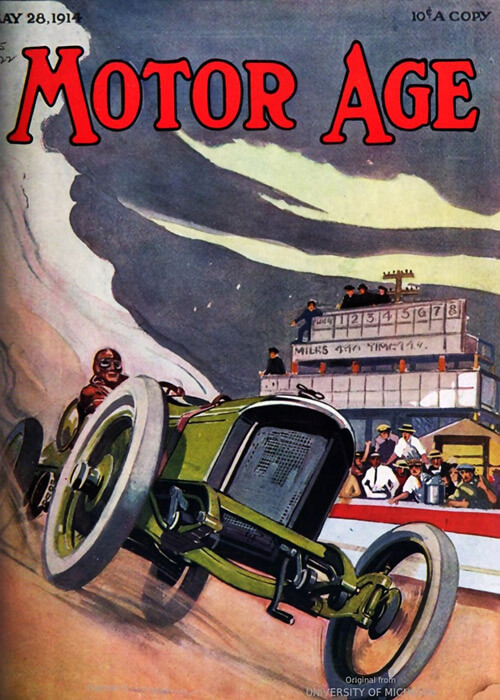
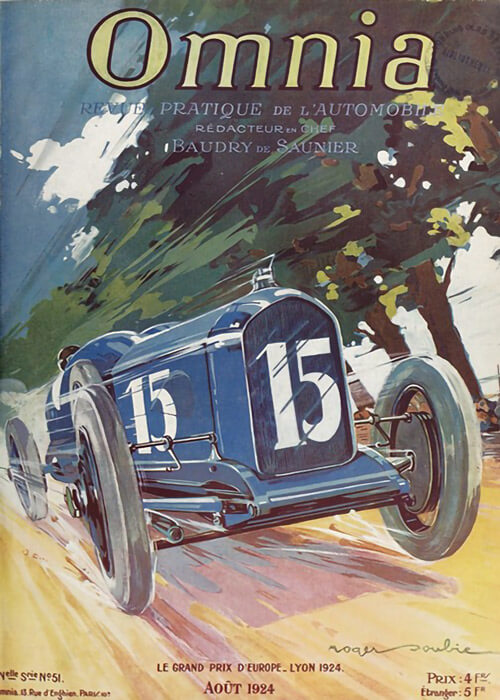
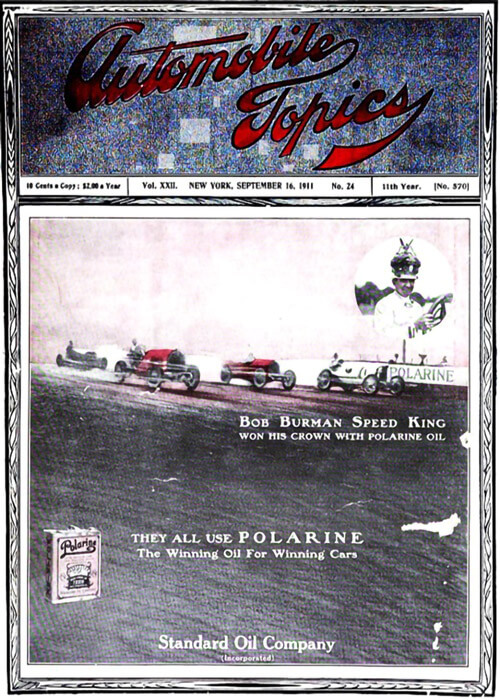
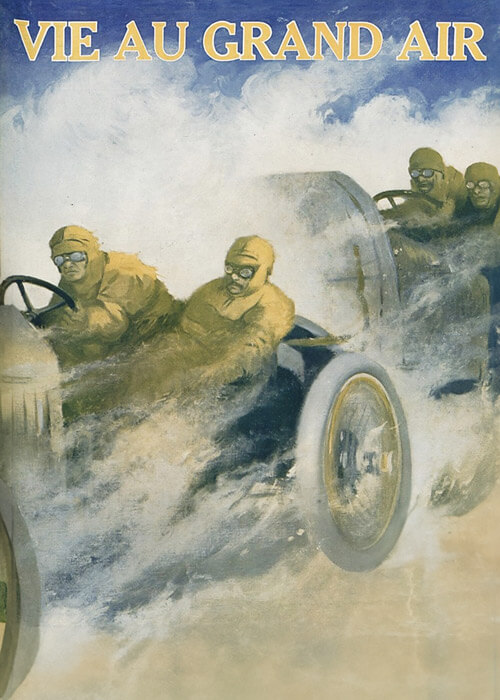
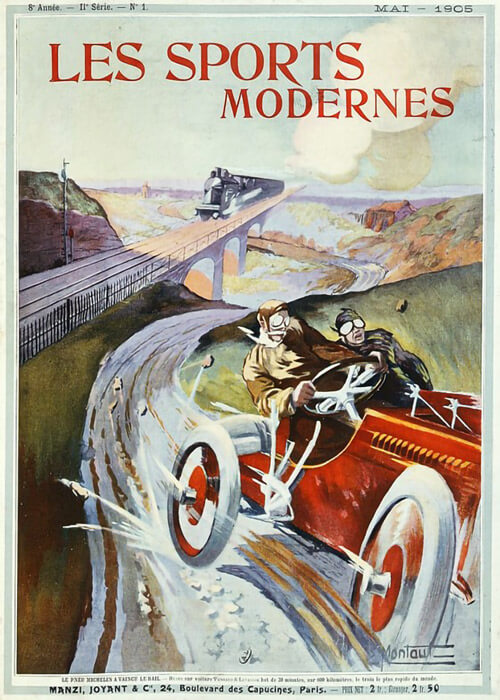
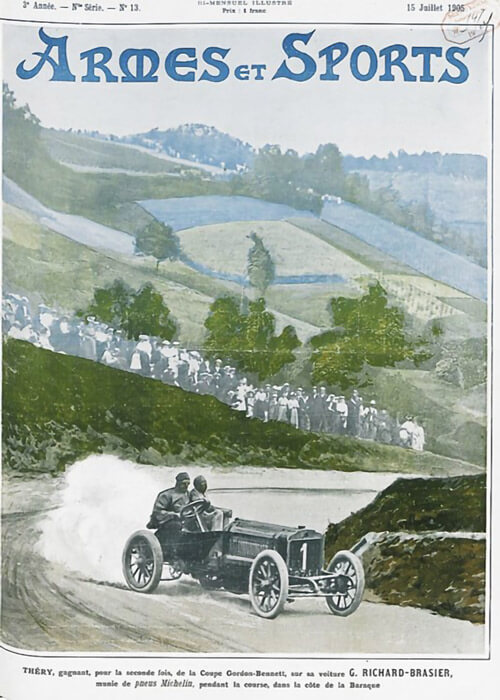
For some reason or another, the Automobile Club of America A.C.A decided to map the Gordon Bennett Cup rules somewhere in 1905; the last year that the GB Cup was to take place! Why the ACA would do that, at such a late extent (the final year of that race event), I donno! But at least, here’s a fine survey of the rules themselves. Interesting: these 24 rules coincide with the 24 ones in Le Vélo end November. By end October, the count was 22; amendments increased the final count up to these 25.
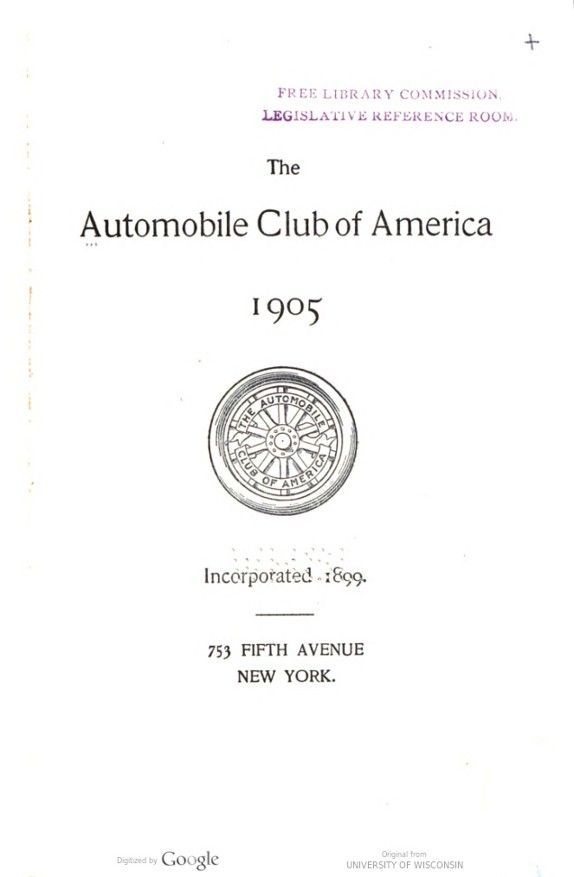
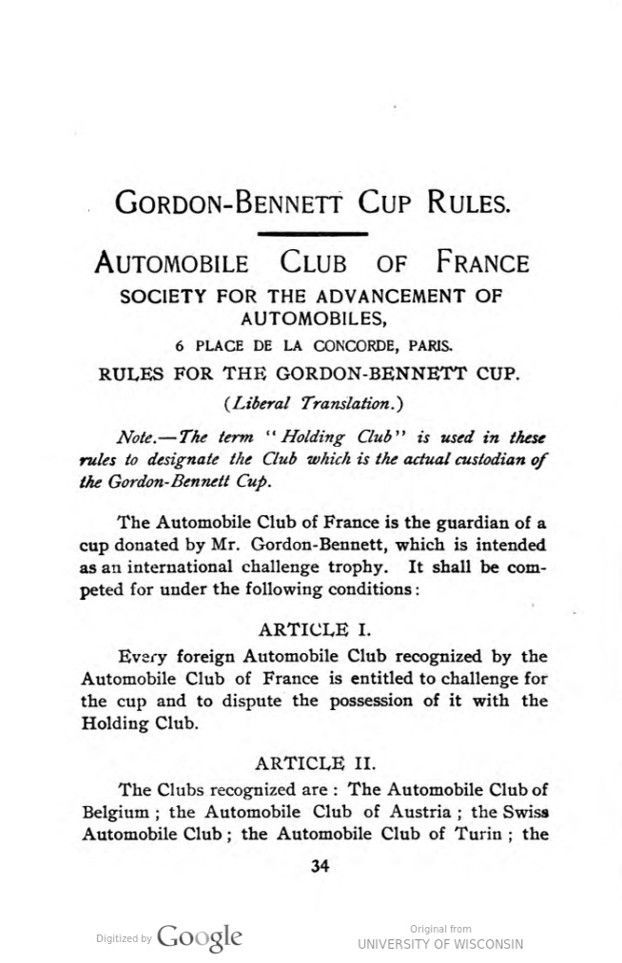
Text and photos with courtesy of hathitrust hathitrust.org, compiled by motorracingistory.com.
The Automobile Club of America 1905. Incorporated 1899.
753 FIFTH AVENUE NEW YORK. (FREE LIBRARY COMMISSION, LEGISLATIVE REFERENCE ROOM.)
GORDON-BENNETT CUP RULES.
AUTOMOBILE CLUB OF FRANCE
SOCIETY FOR THE ADVANCEMENT OF AUTOMOBILES,
6 PLACE DE LA CONCORDE, PARIS.
RULES FOR THE GORDON-BENNETT CUP. (Liberal Translation.) Page 34 – 41.
Note. – The term „Holding Club“ is used in these rules to designate the Club which is the actual custodian of the Gordon-Bennett Cup.
The Automobile Club of France is the guardian of a cup donated by Mr. Gordon-Bennett, which is intended as an international challenge trophy. It shall be competed for under the following conditions:
ARTICLE I.
Every foreign Automobile Club recognized by the Automobile Club of France is entitled to challenge for the cup and to dispute the possession of it with the Holding Club.
ARTICLE II.
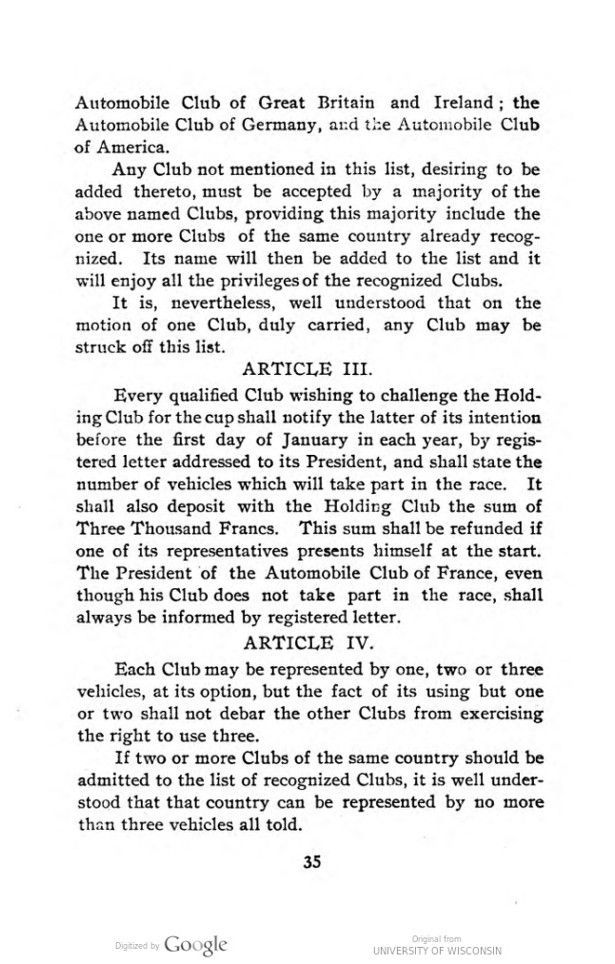
The Clubs recognized are: The Automobile Club of Belgium; the Automobile Club of Austria; the Swiss Automobile Club; the Automobile Club of Turin; the Automobile Club of Great Britain and Ireland; the Automobile Club of Germany, and the Automobile Club of America.
Any Club not mentioned in this list, desiring to be added thereto, must be accepted by a majority of the above named Clubs, providing this majority include the one or more Clubs of the same country already recognized. Its name will then be added to the list and it will enjoy all the privileges of the recognized Clubs.
It is, nevertheless, well understood that on the motion of one Club, duly carried, any Club may be struck off this list.
ARTICLE III.
Every qualified Club wishing to challenge the Holding Club for the cup shall notify the latter of its intention before the first day of January in each year, by registered letter addressed to its President, and shall state the number of vehicles which will take part in the race. It shall also deposit with the Holding Club the sum of Three Thousand Francs. This sum shall be refunded if one of its representatives presents himself at the start. The President of the Automobile Club of France, even though his Club does not take part in the race, shall always be informed by registered letter.
ARTICLE IV.
Each Club may be represented by one, two or three vehicles, at its option, but the fact of its using but one or two shall not debar the other Clubs from exercising the right to use three.
If two or more Clubs of the same country should be admitted to the list of recognized Clubs, it is well under- stood that that country can be represented by no more than three vehicles all told.
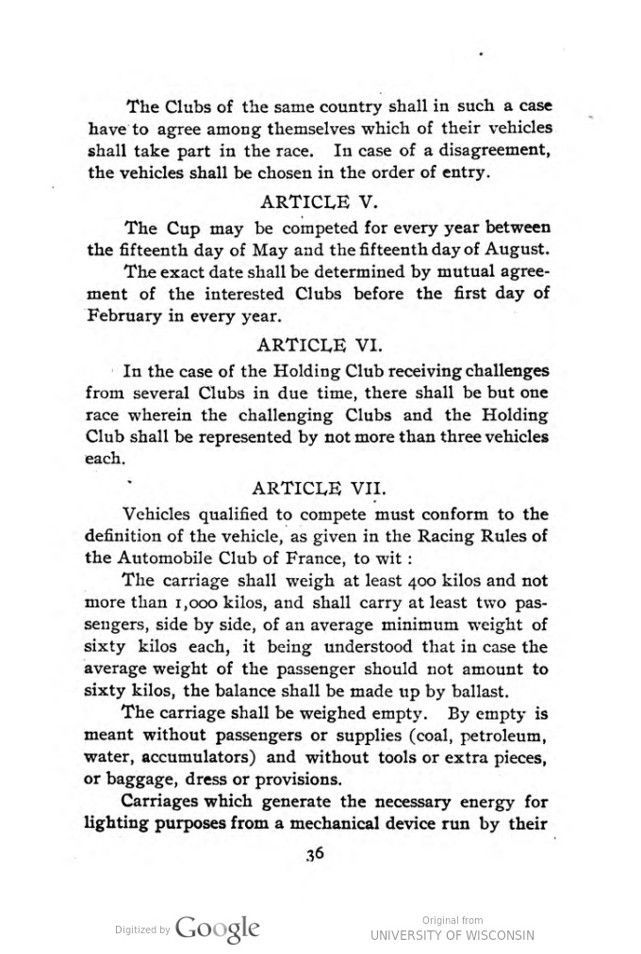
The Clubs of the same country shall in such a case have to agree among themselves which of their vehicles shall take part in the race. In case of a disagreement, the vehicles shall be chosen in the order of entry.
ARTICLE V.
The Cup may be competed for every year between the fifteenth day of May and the fifteenth day of August. The exact date shall be determined by mutual agreement of the interested Clubs before the first day of February in every year.
ARTICLE VI.
In the case of the Holding Club receiving challenges from several Clubs in due time, there shall be but one race wherein the challenging Clubs and the Holding Club shall be represented by not more than three vehicles each.
ARTICLE VII.
Vehicles qualified to compete must conform to the definition of the vehicle, as given in the Racing Rules of the Automobile Club of France, to wit:
The carriage shall weigh at least 400 kilos and not more than 1,000 kilos, and shall carry at least two passengers, side by side, of an average minimum weight of sixty kilos each, it being understood that in case the average weight of the passenger should not amount to sixty kilos, the balance shall be made up by ballast.
The carriage shall be weighed empty. By empty is meant without passengers or supplies (coal, petroleum, water, accumulators) and without tools or extra pieces, or baggage, dress or provisions.
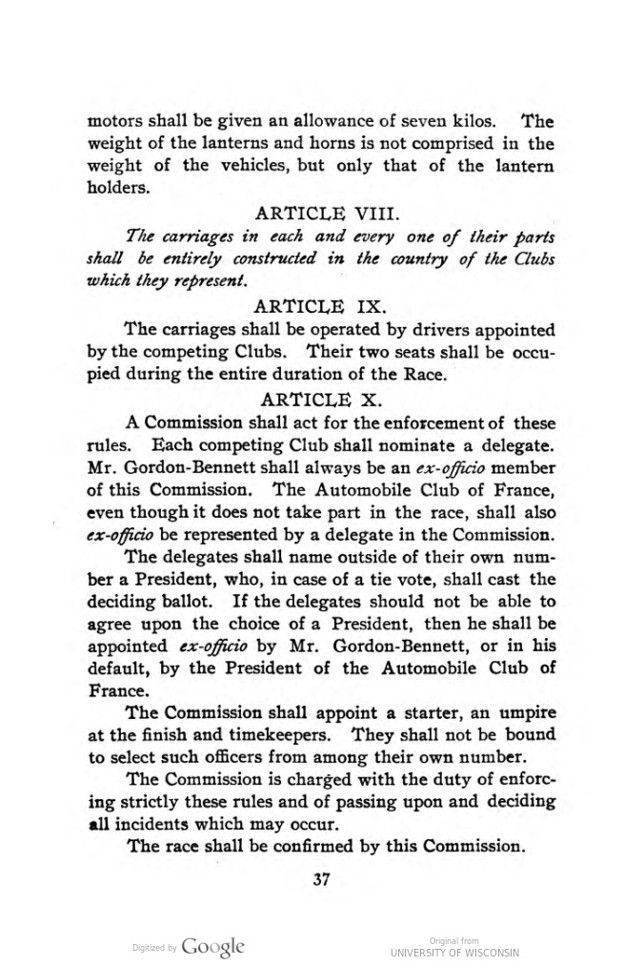
Carriages which generate the necessary energy for lighting purposes from a mechanical device run by their motors shall be given an allowance of seven kilos. The weight of the lanterns and horns is not comprised in the weight of the vehicles, but only that of the lantern holders.
ARTICLE VIII.
The carriages in each and every one of their parts shall be entirely constructed in the country of the Clubs which they represent.
ARTICLE IX.
The carriages shall be operated by drivers appointed by the competing Clubs. Their two seats shall be occupied during the entire duration of the Race.
ARTICLE X.
A Commission shall act for the enforcement of these rules. Each competing Club shall nominate a delegate. Mr. Gordon-Bennett shall always be an ex-officio member of this Commission. The Automobile Club of France, even though it does not take part in the race, shall also ex-officio be represented by a delegate in the Commission.
The delegates shall name outside of their own number a President, who, in case of a tie vote, shall cast the deciding ballot. If the delegates should not be able to agree upon the choice of a President, then he shall be appointed ex-officio by Mr. Gordon-Bennett, or in his default, by the President of the Automobile Club of France.
The Commission shall appoint a starter, an umpire at the finish and timekeepers. They shall not be bound to select such officers from among their own number.
The Commission is charged with the duty of enforcing strictly these rules and of passing upon and deciding all incidents which may occur.
The race shall be confirmed by this Commission.
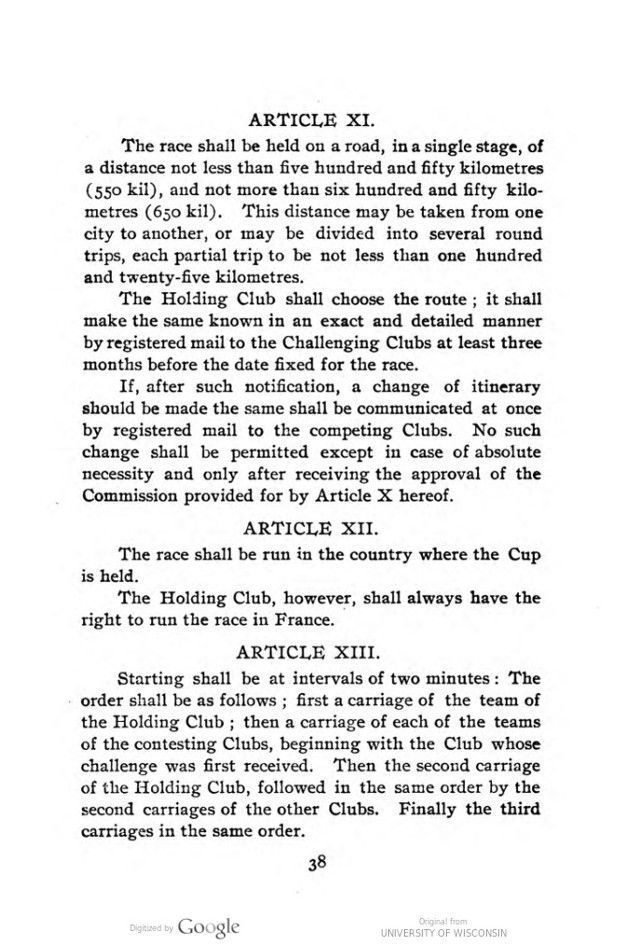
ARTICLE XI.
The race shall be held on a road, in a single stage, of a distance not less than five hundred and fifty kilometres (550 kil), and not more than six hundred and fifty kilometres (650 kil). This distance may be taken from one city to another, or may be divided into several round trips, each partial trip to be not less than one hundred and twenty-five kilometres.
The Holding Club shall choose the route; it shall make the same known in an exact and detailed manner by registered mail to the Challenging Clubs at least three months before the date fixed for the race.
If, after such notification, a change of itinerary should be made the same shall be communicated at once by registered mail to the competing Clubs. No such change shall be permitted except in case of absolute necessity and only after receiving the approval of the Commission provided for by Article X hereof.
ARTICLE XII.
The race shall be run in the country where the Cup is held.
The Holding Club, however, shall always have the right to run the race in France.
ARTICLE XIII.
Starting shall be at intervals of two minutes: The order shall be as follows; first a carriage of the team of the Holding Club; then a carriage of each of the teams of the contesting Clubs, beginning with the Club whose challenge was first received. Then the second carriage of the Holding Club, followed in the same order by the second carriages of the other Clubs. Finally the third carriages in the same order.
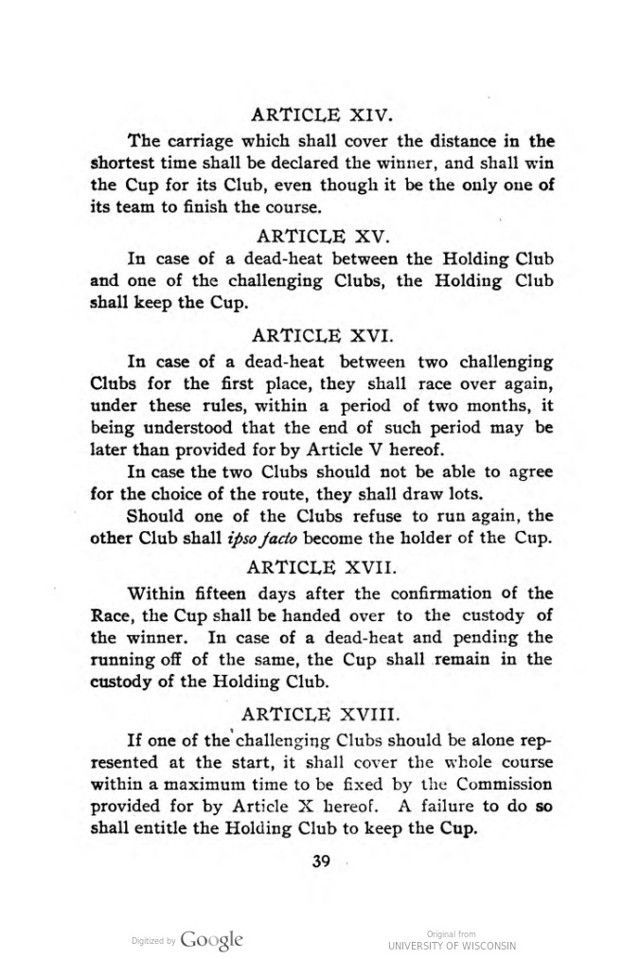
ARTICLE XIV.
The carriage which shall cover the distance in the shortest time shall be declared the winner, and shall win the Cup for its Club, even though it be the only one of its team to finish the course.
ARTICLE XV.
In case of a dead-heat between the Holding Club and one of the challenging Clubs, the Holding Club shall keep the Cup.
ARTICLE XVI.
In case of a dead-heat between two challenging Clubs for the first place, they shall race over again, under these rules, within a period of two months, it being understood that the end of such period may be later than provided for by Article V hereof.
In case the two Clubs should not be able to agree for the choice of the route, they shall draw lots.
Should one of the Clubs refuse to run again, the other Club shall ipso facto become the holder of the Cup.
ARTICLE XVII.
Within fifteen days after the confirmation of the Race, the Cup shall be handed over to the custody of the winner. In case of a dead-heat and pending the running off of the same, the Cup shall remain in the custody of the Holding Club.
ARTICLE XVIII.
If one of the challenging Clubs should be alone rep- resented at the start, it shall cover the whole course within a maximum time to be fixed by the Commission provided for by Article X hereof. A failure to do so shall entitle the Holding Club to keep the Cup.
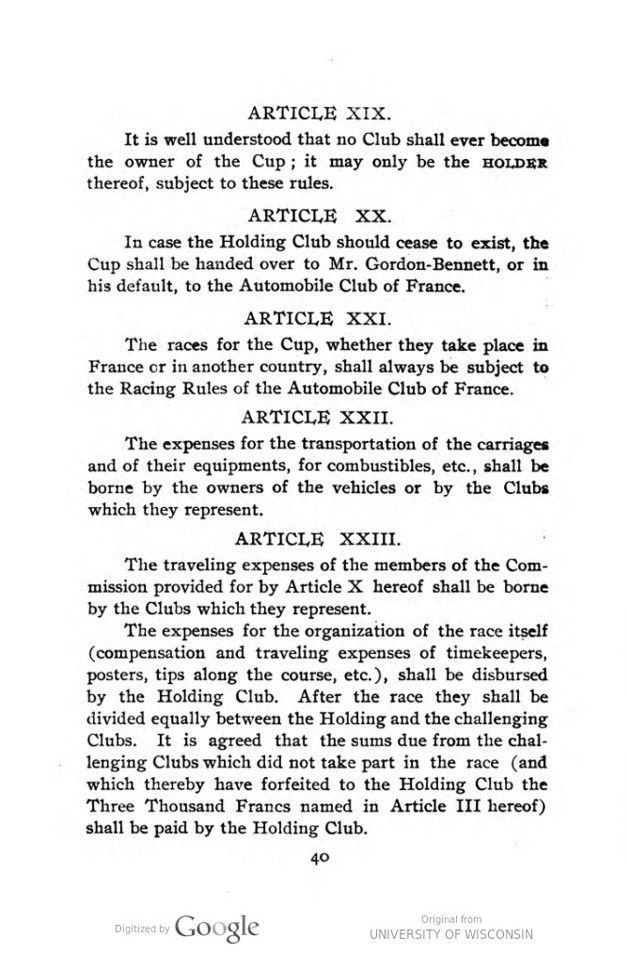
ARTICLE XIX.
It is well understood that no Club shall ever become the owner of the Cup; it may only be the HOLDER thereof, subject to these rules.
ARTICLE XX.
In case the Holding Club should cease to exist, the Cup shall be handed over to Mr. Gordon-Bennett, or in his default, to the Automobile Club of France.
ARTICLE XXI.
The races for the Cup, whether they take place in France or in another country, shall always be subject to the Racing Rules of the Automobile Club of France.
ARTICLE XXII.
The expenses for the transportation of the carriages and of their equipments, for combustibles, etc., shall be borne by the owners of the vehicles or by the Clubs which they represent.
ARTICLE XXIII.
The traveling expenses of the members of the Com- mission provided for by Article X hereof shall be borne by the Clubs which they represent.
The expenses for the organization of the race itself (compensation and traveling expenses of timekeepers, posters, tips along the course, etc.), shall be disbursed by the Holding Club. After the race they shall be divided equally between the Holding and the challenging Clubs. It is agreed that the sums due from the challenging Clubs which did not take part in the race (and which thereby have forfeited to the Holding Club the Three Thousand Francs named in Article III hereof) shall be paid by the Holding Club.
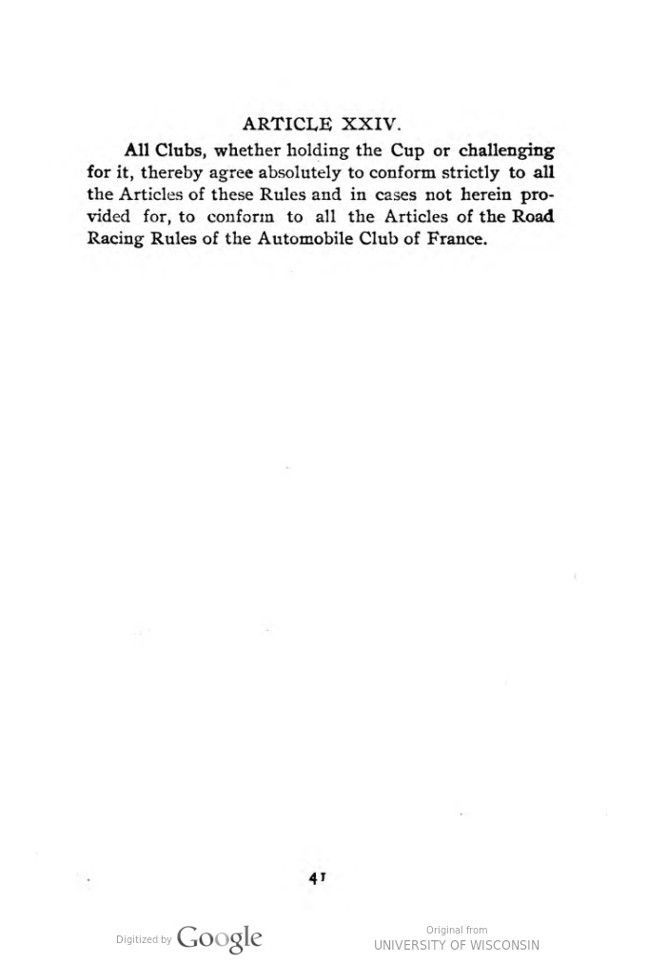
ARTICLE XXIV.
All Clubs, whether holding the Cup or challenging for it, thereby agree absolutely to conform strictly to all the Articles of these Rules and in cases not herein pro- vided for, to conform to all the Articles of the Road Racing Rules of the Automobile Club of France.