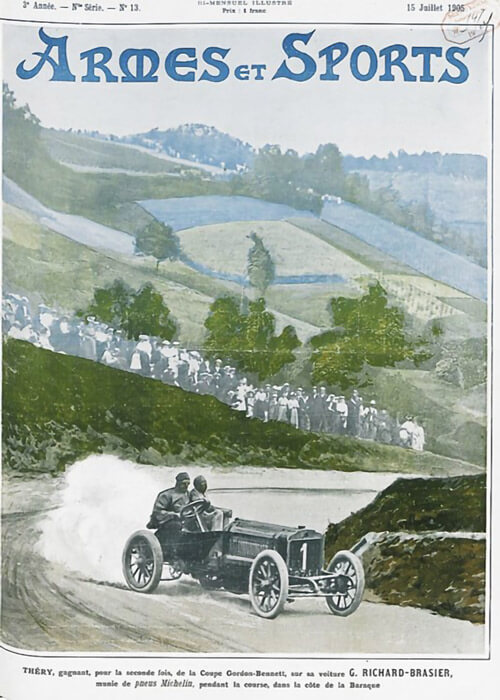
Front Wheel Drive Pre-war in historical view
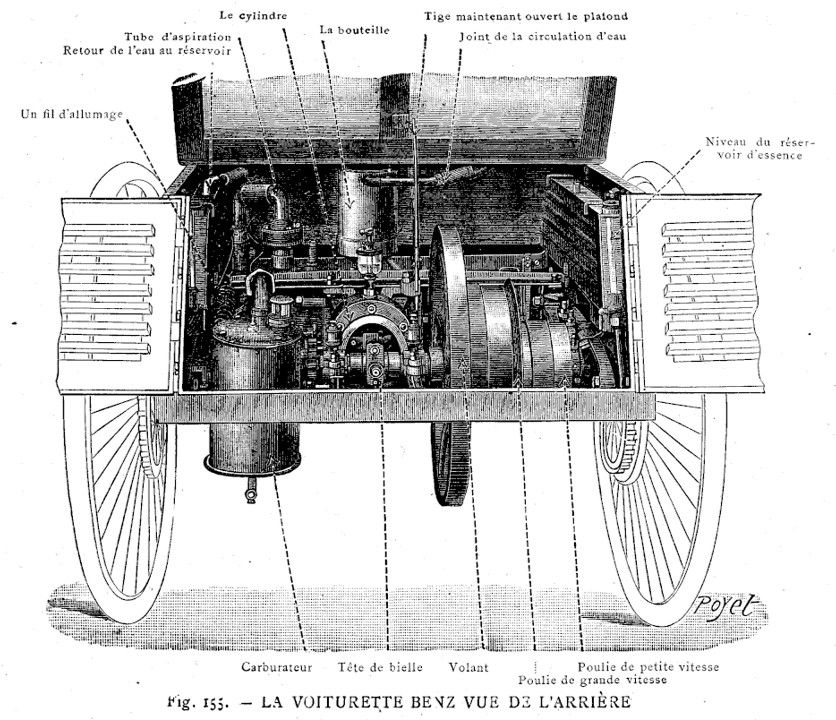
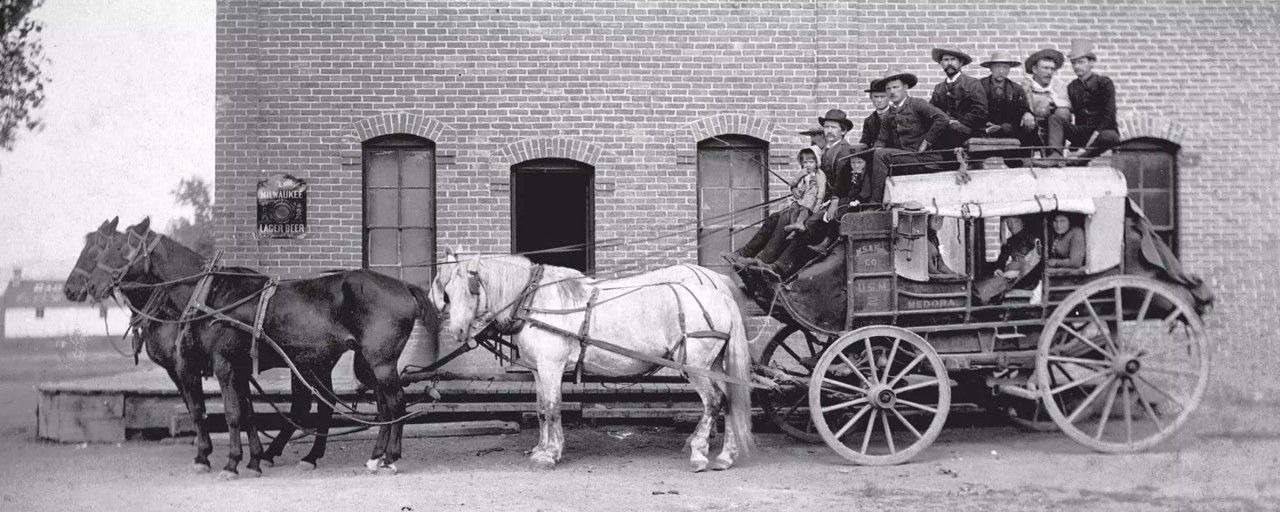
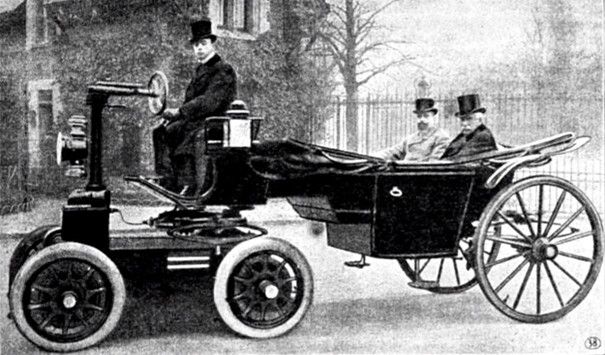
Since the onset of mechanically driven vehicles or the „sans-chevaux“, we can observe that in most cases, the propulsive vehicle power was attached to the vehicle’s rear, as shown here left. This is a sketch of the very first Benz carriages of 1899 and pictured in the book „L’Automobile, Théorie et Pratique, traité élémentaire de locomotion a moteur mécanique“ by Baudry de Saunier. For me however, a rear engined carriage in those early days of motoring, could be considered in the least as „a bit odd“. Why? For centuries, people were used to carts or carriages being pulled by a horse, or even an ox, a donkey or an onager. And these living sources of motive power were positioned in FRONT of a carriage, so as to PULL it. Why then, should that change, simply with the introduction of combustion or steam engines, or even electric motors? I would assume, that purely from a cultural point of view or even a psychological side, this lay-out would be the basis for new, engine powered vehicles, as shown here.

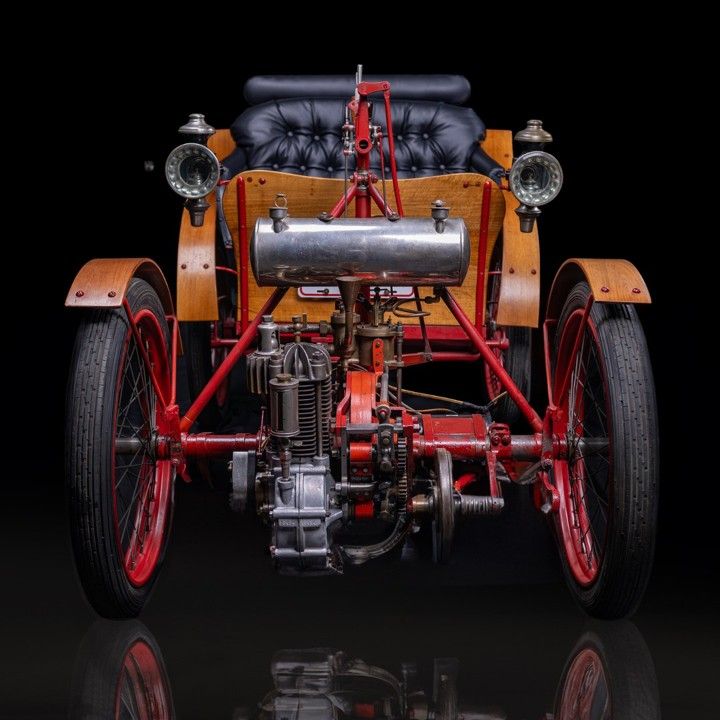
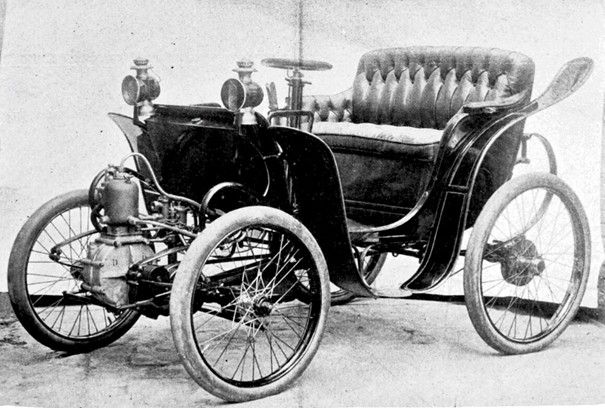
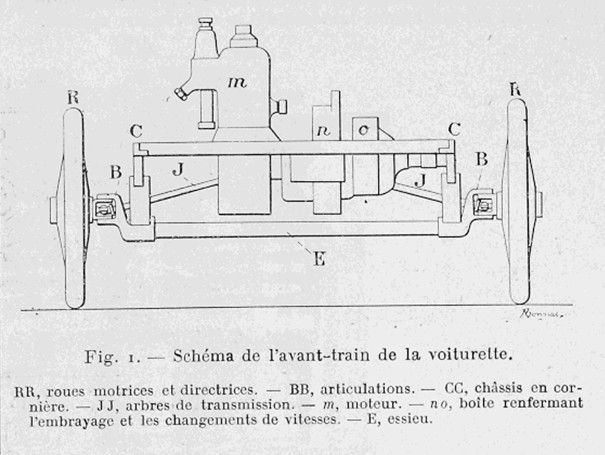
But that’s only part of the story. Although some of the first sans-cheveauxs were indeed designed that way, they were not in a great number. Steering AND driving front wheels at the same time, then indeed seemed to pose realistic technical problems. To avoid this, most of the pre-war vehicles were rear-wheel drives and front engined. But still, some tried to follow the all-known system; and these will be discussed here briefly. Meet some (not all) of the first front-wheel drive vehicles.
Starting in 1877 with the George Selden’s Motor Wagon. His first patent should have been filed already in 1879, (the vehicle being partly built around 1877) but it only remained as a patent. A replica was built in 1905. The front wheel drive was realized by an improved 3-cylinder Brayton engine, horizontally and transversely mounted, combined with the transmission and front axle (was there a differential?) assembled on a front bogie, pivoting by a tiller or a steering wheel. The patent for his Motor Wagon was granted November 1895.
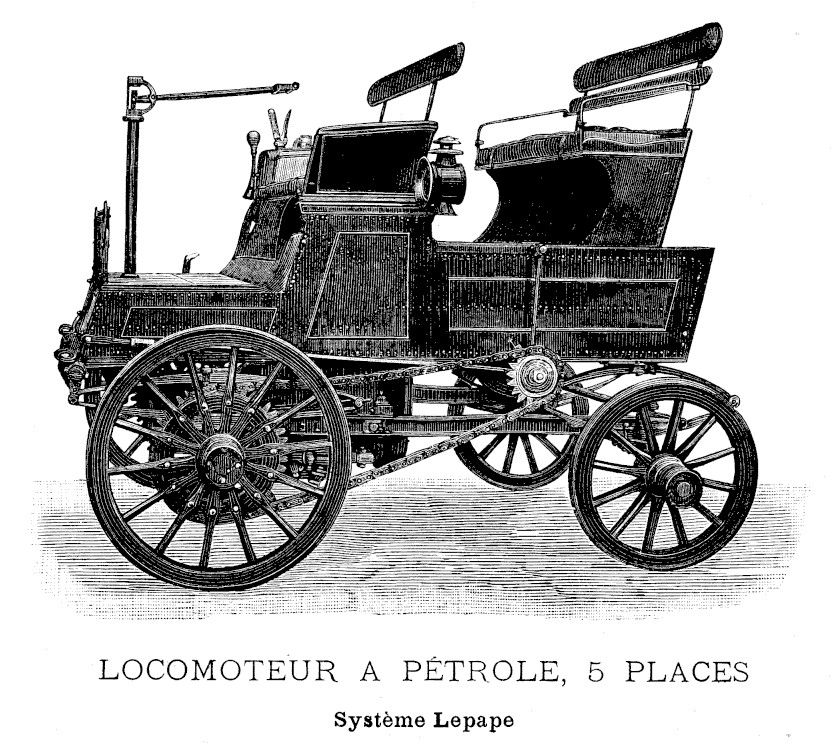
1895 is the earliest date I could find for the French to present a front-wheel drive voiture. That was the so called Locomoteur of Hippolyte Lepape. He himself was, one could say, the type of engineer who is more interested in new ideas than in normal production. The engine’s torque was transmitted via a continuously variable friction drive with chains to the front wheels. The rear wheels were steered.
In 1896, he came up with a new variant; although in smaller dimensions, but again with front-wheel drive, rear-wheel steering and a continuously variable friction drive.
In 1898, the very first attempts on an Austrian front wheel drive vehicle were taken by the brothers Carl, Franz and Heinrich Gräf in the „Gräf-Front“ vehicle. Patented in 1900, the front-wheel drive consisted of a one-cylinder De-Dion engine and a rigid but steering front axle. The frontwheel driveline was equipped with a single universal joint per wheel. It seems however, that the universal joints posed such a problem, that they turned to conventional drives of those days: front engined, rear-wheel driven vehicles. They were backed in 1902 in a financial way by Wilhelm Stift, leading to the new Vienna based company Gräf & Stift, being succesfull until 1971. Today, a replica of that car is exhibited in the National Museum in Vienna.
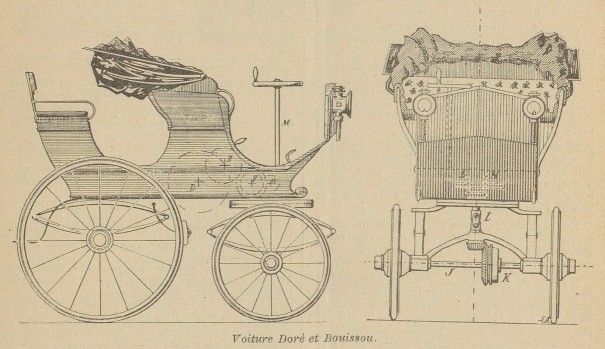
In 1898, the French Doré and Bouisson vehicles were equipped with a front-wheel unit or bogey, that could be rotated by a vertical bevel gear stage, so as to rotate around the pinion axle. A horizontal 3-cylinder engine and a 2-stage transmission drove the rigid front axle. Reverse gear was achieved, not by gear change, but by rotating the drive unit by 180°, making the vehicle drive backward. Simple and effective idea, although I don’t know if that vehicle really came into manufacture.
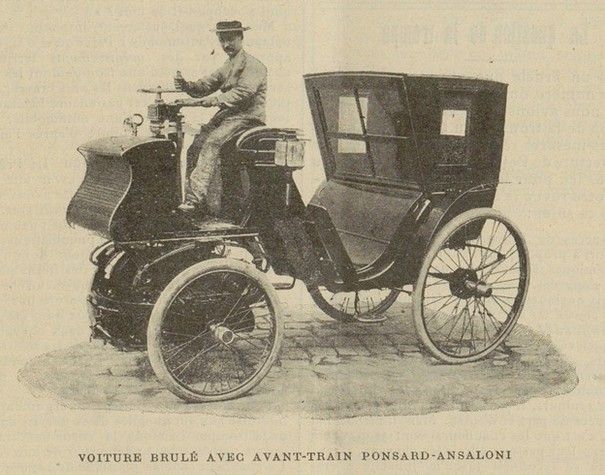
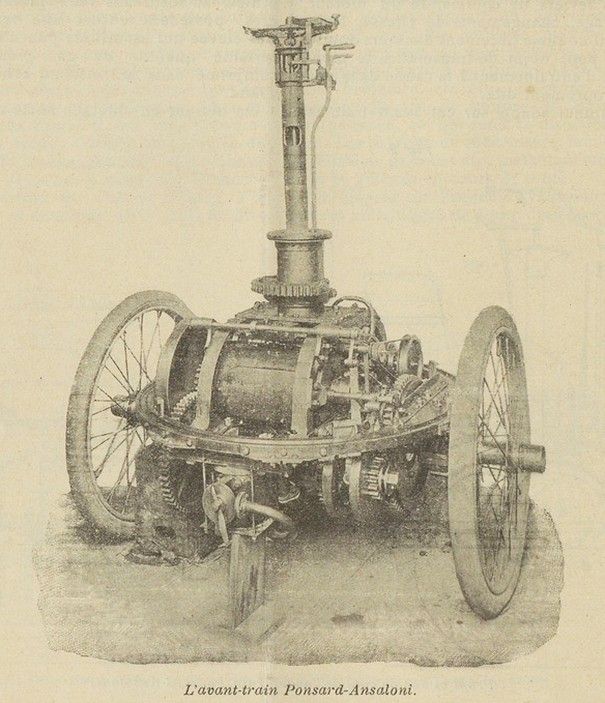
Also in 1898, another French car, the „Brûlé et “avant-train” Ponsard-Ansaloni and Roser-Mazurier engine. This vehicle was equipped with a front-wheel unit, composing of engine, 2-speed transmission and rigid axle. This unit or bogey was attached to the vehicle’s front side by a large horizontal axial bearing, around which it could rotate or swivel to ensure steering.
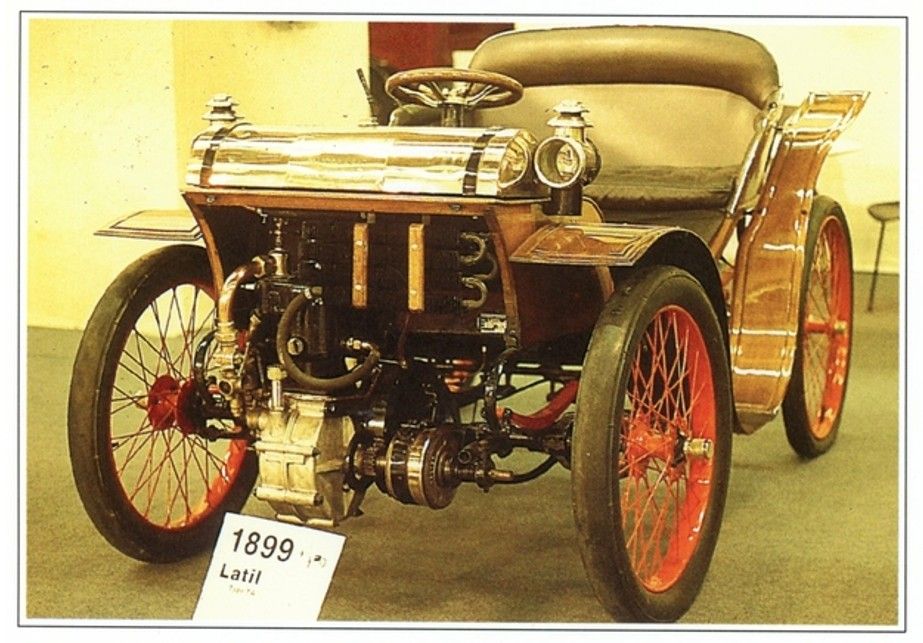
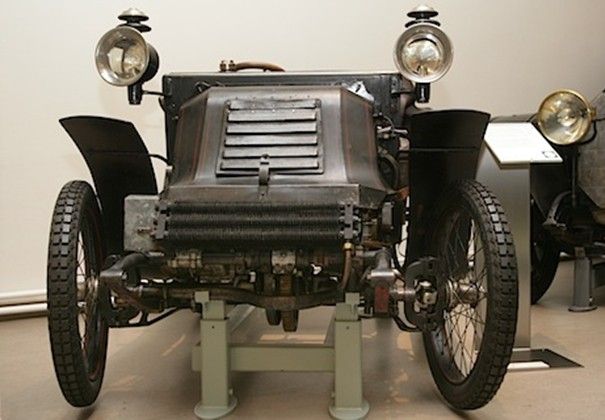
In 1899, the French Latil company presented a voiturette with a rigid, but steering front axle and universal joints, a one-cylinder engine with transmisison. I don’t know if a differential was assembled. I have hardly any information on that car, but a replica stands in the Berliet museum in Lyon..
In 1899, the „La Société Parisienne“ presented the voiturette „Victoria Combination“. This front-wheel drive vehicle was equipped with a front sided frame, pivoting around the steering wheel / tiller. In this frame were assembled, a one-cylinder De Dion engine, a two-speed transmision and a ridig front axle. This voiturerre should heve been produced in a quantity of more than 400 and it should have participated in two French contests.
In 1902, the French „Roulleau & Pilât voiture à avant-train moteur“ was quite extensively described in La Vie automobile. The car was equipped with a rigid and steering front axle, a one-cylinder engine and a three-speed transmission with bevel gear drive. From transmission to wheels, both sides are equipped with each two cardan joints, connected by a propshaft. The joints give me the impression of being similar to the about 20 years later invented Tracta joints. The whole vehicle driveline is more like nowaday’s conventional front-wheel drives!
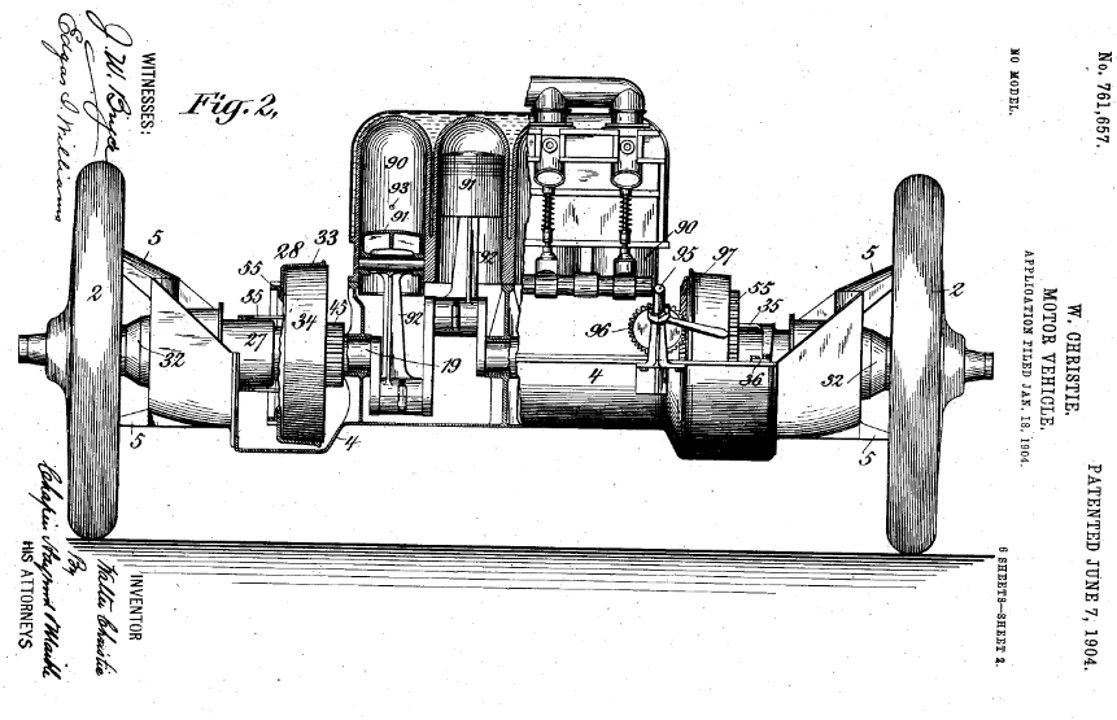
In 1904, a patent, titled „Motor Vehicle“, was granted to John Walter Christie of the USA. A front positioned transverse 4-cylinder engine, driving directly both front wheels. The engine crankshaft was coupled to each wheel by double-universal joints. There was no gearbox and no differential; only a slip clutch on both sides to accomodate for different wheel speeds. Although the car drove „like hell“ it finally wasn’t a success.
Up to 1909, the Christie cars were updated with a new driveline, such as front engine offset to wheel shaft, with a two-speed transmission and differential. But finally, these designs didn’t live up to their expectations.
Up to 1909, the Christie cars were updated with a new driveline, such as front engine offset to wheel shaft, with a two-speed transmission and differential. But finally, these designs didn’t live up to their expectations.
Principally, three systems of early front-wheel drive can be considered. There’s 1: the “avant-train” or front-drive + steer unit. Engine, clutch, transmission and wheel drive are altogether assembled on a steerable front unit. Examples are the Selden Motor Wagon, the Doré & Buisson voiture, the Brulé avant-train as well as the Victoria Combination. All these designs disappeared after some time. Then there’s 2: front-wheel drive + rear-wheel steering. Both vehicles of Lepape and the Pennington Raft were examples of this type. Again, these too weren’t up to a long living. The type 3: front-wheel drive with rigid, steering axle. The Gräf Front, The Roulleau & Pilat as well as the different Christie vehicles were of this type. But although these wouldn’t be there anymore in the postwar era, that type finally found a well-established position next to the all-conquering rear-wheel drives.
After about 1911, it grew silent on the front-wheel drive side. Steering + Driving front wheels at the same time indeed seemed to be hard to handle. Until some 15 years later, after the first world war, front-wheel drives gained more and more succes. When enough experience on new technologies of mechanised propulsion was gathered and manufacturing techniques were improved to such a state, that application of front wheel drives came into consideration. Constant Velocity joints then would play a major role in the devopment of front-wheel drives.
Specific articles on these vehicles can be found under „Front-Wheel Drive Pre-war“.