It is the end of November 1899 and the year slowly slitters into its finale. By that time, very late in view of next year’s event timing, the Automobile Club de France publishes the Gordon Bennett Rules. That is one of the reasons, why the ACF was under a lot of criticism. Could they have purposely waited to publish them that late?
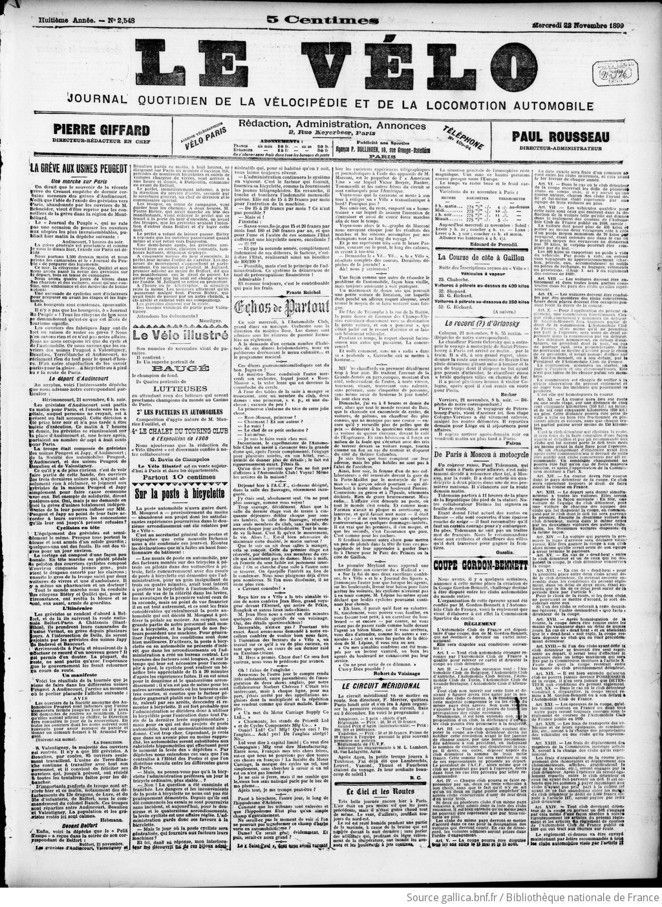
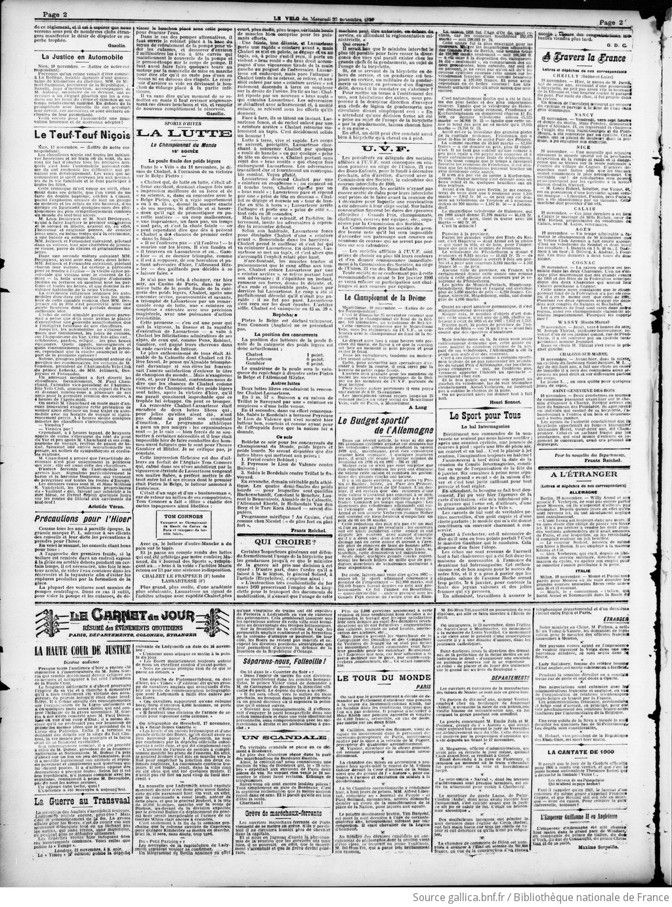
With permission of the Bibliothèque national francais gallica.bnf.fr
Text and fotos compiled by motorracinghistory; Translation by DeepL deepL.com
LE VÉLO — Daily Journal of Cycling and Automobile Transportation — 8th Year, No. 2,548, Wednesday November 22, 1899
GORDON-BENNETT CUP
A few weeks ago, we announced in this very column the creation of the Gordon-Bennett Cup, a challenge race to be contested by automobile clubs from around the world.
Since Mr. Gordon-Bennett entrusted the organization of this event to the Automobile Club de France, here are the rules that the club’s Sports Commission has just drawn up for this purpose.
RULES
The Automobile Club of France is the custodian of a trophy, a gift from Mr. Gordon-Bennett, which is intended to become an international challenge cup.
It will be contested under the following conditions:
Art. I. — Any foreign automobile club recognized by the Automobile Club of France is eligible to accept this challenge and compete for the trophy against the holding club.
Art. II — The recognized clubs are: the Automobile Club of Belgium, the Automobile Club of Austria, the Automobile Club of Switzerland, the Automobile Club of Turin, the Automobile Club of Great Britain, and the Automobile Club of Germany.
Any club not included on this list that wishes to be added must be approved by a majority of the clubs listed above, provided that this majority includes the club or clubs from the same country that have already been approved. Its name will be added to the list, and it will enjoy all the privileges of recognized clubs.
Nevertheless, it is understood that, upon the proposal of one club, the expulsion of another club may be decided by a majority vote.
Art. III. — Any qualified club wishing to compete for the cup against the defending club must notify the latter of this decision before January 1 of each year, by registered letter addressed to its president, indicating the number of cars that will compete for the cup. It must also deposit the sum of three thousand francs with the cup-holding club. This sum will be refunded if one of its representatives appears at the starting line. The president of the A.C.F. must, in any case, be notified by certified mail, even if the club does not participate in the event.
Art. IV. — Each club may be represented by one, two, or three vehicles of its choice; the fact that only one or two are on the starting line shall not prevent the other competing clubs from exercising their right to field three.
If two or more clubs from the same country are admitted to the list of recognized clubs, it is understood that a single country may be represented by no more than three cars.
In this case, the clubs from the same country must agree on which cars will race. In the event of a disagreement, the cars admitted will be selected in the order of entry.
Art. V. — The cup may be contested annually between May 15 and August 15. The exact date shall be set by mutual agreement among the interested clubs, and this must be done before February 1 of each year.
Art. VI. — In the event that the club holding the cup receives challenges from several clubs in a timely manner, there shall be only a single race, with each club that has challenged it—and the cup-holding club itself—represented by a team of no more than three cars.
Art. VII. — Vehicles eligible for this competition are those that meet the specifications for the car as set forth in the racing regulations of the Automobile Club de France published in 1899, namely:
The car must weigh more than 400 kilograms and carry at least two passengers seated side by side, with a minimum average weight of 70 kilograms per passenger, it being understood that if the average weight of the passengers does not total 70 kilograms, the shortfall may be made up with ballast.
The 400 kilograms refer to the vehicle’s curb weight. Curb weight is defined as the weight without passengers, supplies (coal, petroleum, water, batteries), tools or spare parts, or luggage, clothing, or provisions. (Chap. 1, Art. 9 of the 1899 racing regulations).
Art. VIII. – The cars must be built entirely, in all their parts, in the countries of the clubs they represent.
Art. IX. – The cars must be driven by members of the competing clubs.
Both seats must be occupied for the entire duration of the race.
Art. X. – A commission shall be established to enforce these regulations. Each competing club shall appoint a delegate to the commission. Mr. Gordon-Bennett shall always be an ex officio member of the commission. The Automobile Club de France, even if it does not participate in the event, shall also be represented ex officio on the commission by a delegate.
The delegates shall appoint, from among those other than themselves, a chairperson whose vote shall be decisive in the event of a tie. If they are unable to agree on the choice of this chairperson, he or she shall be appointed ex officio by Mr. Gordon-Bennett, or, in his absence, by the President of the Automobile Club de France.
The committee shall appoint a starter, a finish-line judge, and timekeepers. It is not required to select them from among its members.
The committee is responsible for ensuring strict compliance with these regulations and for adjudicating any incidents that may occur.
It shall certify the race.
Art. XI. — The race will take place on public roads in a single stage, covering a distance of at least five hundred fifty kilometers (550 km) and no more than six hundred fifty kilometers (650 km). This distance may be measured from city to city or divided into several round trips, provided that each segment is at least 150 kilometers long.
The host club shall choose the route; it shall be required to provide an exact and detailed description of the route by registered mail to the clubs that have issued the challenge at least three months before the date set for the event.
If a change in the route occurs after this notification, it must be immediately communicated to the competing clubs by registered mail. Such a change may only be made in cases of absolute force majeure, and only after approval by the Commission established in Art. X.
Art. XII. — The race must be held in the country holding the cup. However, that club shall always have the right to hold the race in France.
Art. XIII. — The start will be given simultaneously to all cars. They shall be lined up as follows: At the front, one car from the defending club’s team, followed by one car from each of the teams of the clubs challenging for the cup, beginning with the club whose challenge was received first. Next, the second car from the defending club, followed in the same order by the second cars from the other clubs. Finally, the third cars arranged in the same manner.
Art. XIV. — The car that crosses the finish line first shall be declared the winner. It shall win the cup for its club even if it is the only car from that team to have completed the course.
Art. XV. — In the event of a “dead heat” between the defending club and one of the clubs challenging for the cup, the defending club shall retain the cup.
Art. XVI — In the event of a “dead-heat” for first place between two clubs that have challenged the holding club, they must compete again under the terms of these rules within two months, provided that the end of this period may extend beyond the timeframe set forth in Article V.
If the two clubs cannot agree on the route, the matter shall be decided by lot. If one of the clubs refuses to participate in this second race, the other shall become the “ipso facto” holder of the cup.
Art. XVII. — After the race has been officially certified, the cup must be presented to the winner within fifteen days. In the event of a “dead heat” and pending the resolution of the “dead heat,” the cup shall remain with the club that previously held it.
Art. XVIII — If one of the clubs that challenged the current holder is the only one to start the race, it shall be required to complete the course within a maximum time limit to be set by the Commission established under Article X. Failing this, the cup shall remain with the club that previously held it.
Art. XIX. — It is understood that no club may ever become the OWNER of the cup; it shall only ever be the HOLDER thereof under the terms of these regulations.
Art. XX. — In the event that the holding club ceases to exist, the cup shall be returned to Mr. Gordon-Bennett or, in his absence, to the Automobile Club de France.
Art. XXI. — The Cup races, whether held in France or in any other country, shall always be conducted in accordance with the racing regulations of the Automobile Club de France published in 1899.
Art. XXII. — The costs of transporting the vehicles and their crews, fuel, etc., shall be borne by the owners of the vehicles or the clubs they represent.
Art. XXIII. — Travel expenses for members of the Commission established under Article X shall be borne by the clubs they represent.
Expenses for organizing the race itself (fees and travel for timekeepers, posters, rewards along the route, etc.) shall be incurred by the host club. After the event, these costs will be divided equally between the host club and those clubs that issued a challenge. It is understood that the amounts payable by clubs that did not participate in the race (and thus forfeited the 3,000-franc penalty stipulated in Article III to the host club) will be paid by the said host club.
Art. XXIV. — Any club that becomes the holder of the cup or issues a challenge thereby undertakes, in an absolute manner, to strictly adhere to the articles of these regulations and the articles of the Automobile Club de France’s racing regulations published in 1899 that pertain to road races.
The above regulations will now be sent by certified mail to all automobile clubs referred to in Article II of these regulations, and it is to be hoped that we will soon see many foreign clubs express a desire to compete for this superb trophy.
Gazolin.