In 1904 already, Walter Christie filed his first patent on a front wheel drive. It was a very unusual arrangement indeed, especially for those days, as it combined front wheel drive with transverse placed front engine, directly positioned on the front axle. In the 1904 patent, the engine crankshaft was in-line with the front wheel axis. Later designs show an off-line position of the engine to the wheel axis., coupled by a transmission. And both wheels – mind you: font wheels simply need steering function – coupled to the drive shafts by universal joints. In all, a combination of relatively newly developed automotive parts in a very original arrangement. And that for 1904! The first real revolutionary front-wheel drive; I couldn’t find an earlier one.

Text and jpegs by courtesy of hathitrust.org www.hathitrust.org, compiled by motorracinghistory.com
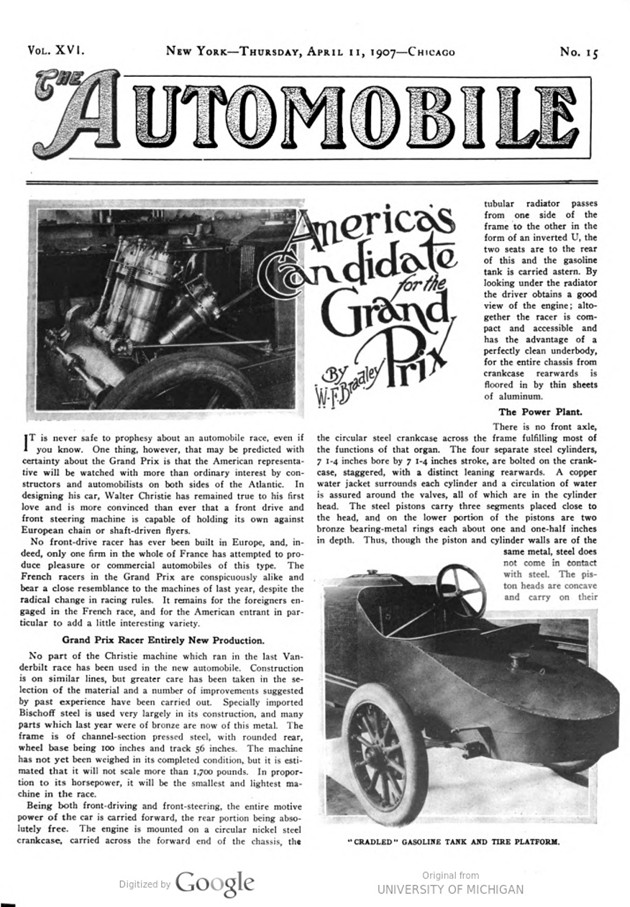
The Automobile, Vol. XVI (16), No. 15, April 11, 1907
Americas Candidate for the Grand Prix
By W. F. Bradley
IT is never safe to prophesy about an automobile race, even if you know. One thing, however, that may be predicted with certainty about the Grand Prix is that the American representative will be watched with more than ordinary interest by constructors and automobilists on both sides of the Atlantic. In designing his car, Walter Christie has remained true to his first love and is more convinced than ever that a front drive and front steering machine is capable of holding its own against European chain or shaft-driven flyers.
No front-drive racer has ever been built in Europe, and, indeed, only one firm in the whole of France has attempted to produce pleasure or commercial automobiles of this type. The French racers in the Grand Prix are conspicuously alike and bear a close resemblance to the machines of last year, despite the radical change in racing rules. It remains for the foreigners engaged in the French race, and for the American entrant in particular to add a little interesting variety.
Grand Prix Racer Entirely New Production.
No part of the Christie machine which ran in the last Vanderbilt race has been used in the new automobile. Construction is on similar lines, but greater care has been taken in the selection of the material and a number of improvements suggested by past experience have been carried out. Specially imported Bischoff steel is used very largely in its construction, and many parts which last year were of bronze are now of this metal. The frame is of channel-section pressed steel, with rounded rear, wheel base being 100 inches and track 56 inches. The machine has not yet been weighed in its completed condition, but it is estimated that it will not scale more than 1,700 pounds. In proportion to its horsepower, it will be the smallest and lightest machine in the race.
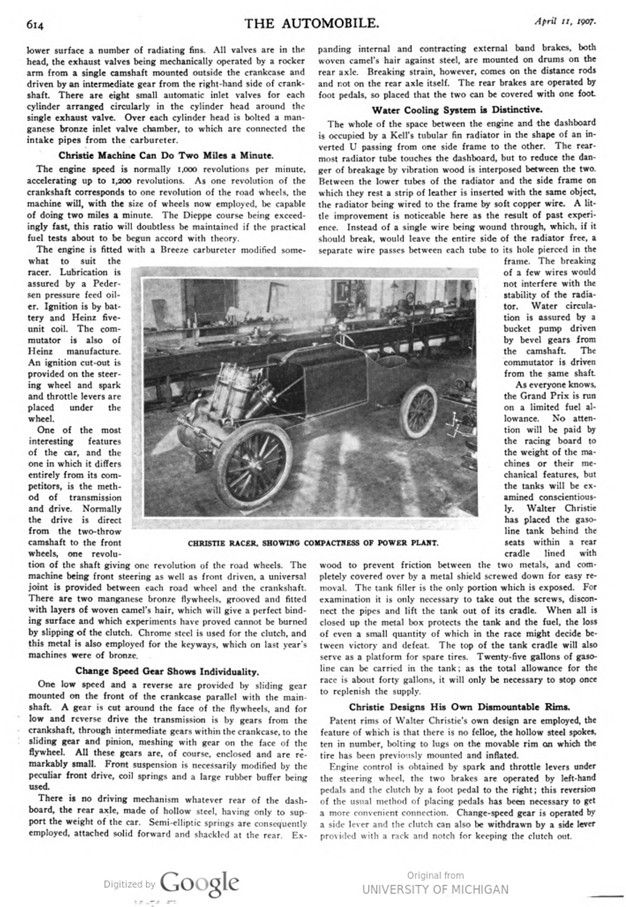
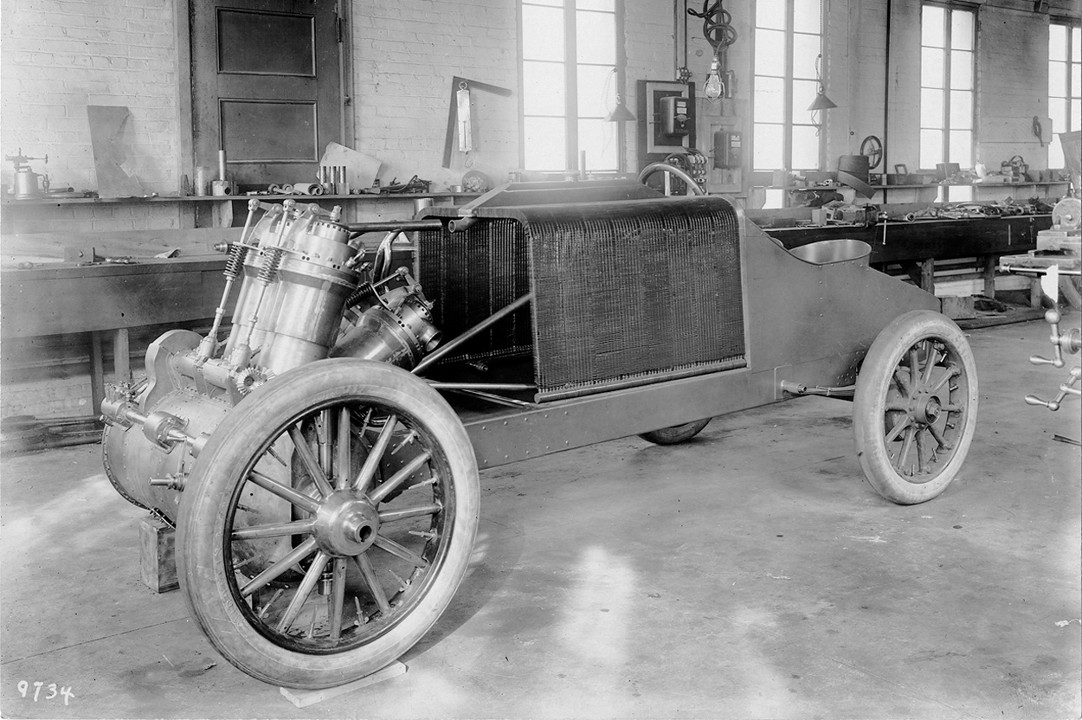
Being both front-driving and front-steering, the entire motive power of the car is carried forward, the rear portion being absolutely free. The engine is mounted on a circular nickel steel crankcase, carried across the forward end of the chassis, the for the tubular radiator passes from one side of the frame to the other in the form of an inverted U, the two seats are to the rear of this and the gasoline tank is carried astern. By looking under the radiator the driver obtains a good view of the engine; altogether the racer is compact and accessible and has the advantage of a perfectly clean underbody, for the entire chassis from crankcase rearwards is floored in by thin sheets of aluminum.
The Power Plant.
There is no front axle, the circular steel crankcase across the frame fulfilling most of the functions of that organ. The four separate steel cylinders, 7 1-4 inches bore by 7 1-4 inches stroke, are bolted on the crankcase, staggered, with a distinct leaning rearward. A copper water jacket surrounds each cylinder, and a circulation of water is assured around the valves, all of which are in the cylinder head. The steel pistons carry three segments placed close to the head, and on the lower portion of the pistons are two bronze bearing-metal rings each about one and one-half inches in depth. Thus, though the piston and cylinder walls are of the same metal, steel does not come in contact with steel. The piston heads are concave and carry on their lower surface a number of radiating fins. All valves are in the head, the exhaust valves being mechanically operated by a rocker arm from a single camshaft mounted outside the crankcase and driven by an intermediate gear from the right-hand side of crankshaft. There are eight small automatic inlet valves for each cylinder arranged circularly in the cylinder head around the single exhaust valve. Over each cylinder head is bolted a manganese bronze inlet valve chamber, to which are connected the intake pipes from the carbureter.
Christie Machine Can Do Two Miles a Minute.
The engine speed is normally 1,000 revolutions per minute, accelerating up to 1,200 revolutions. As one revolution of the crankshaft corresponds to one revolution of the road wheels, the machine will, with the size of wheels now employed, be capable of doing two miles a minute. The Dieppe course being exceedingly fast, this ratio will doubtless be maintained if the practical fuel tests about to be begun accord with theory.
The engine is fitted with a Breeze carbureter modified somewhat to suit the racer. Lubrication is assured by a Pedersen pressure feed oiler. Ignition is by battery and Heinz five- unit coil. The commutator is also of Heinz manufacture. An ignition cut-out is provided on the steering wheel and spark and throttle levers are placed under the wheel.
One of the most interesting features of the car, and the one in which it differs entirely from its competitors, is the method of transmission and drive. Normally the drive is direct from the two-throw camshaft to the front wheels, one revolution of the shaft giving one revolution of the road wheels. The machine being front steering as well as front driven, a universal joint is provided between each road wheel and the crankshaft. There are two manganese bronze flywheels, grooved and fitted with layers of woven camel’s hair, which will give a perfect binding surface, and which experiments have proved cannot be burned by slipping of the clutch. Chrome steel is used for the clutch, and this metal is also employed for the keyways, which on last year’s machines were of bronze.
Change Speed Gear Shows Individuality.
One low speed and a reverse are provided by sliding gear mounted on the front of the crankcase parallel with the main shaft. A gear is cut around the face of the flywheels, and for low and reverse drive the transmission is by gears from the crankshaft, through intermediate gears within the crankcase, to the sliding gear and pinion, meshing with gear on the face of the flywheel. All these gears are, of course, enclosed and are remarkably small. Front suspension is necessarily modified by the peculiar front drive, coil springs and a large rubber buffer being used.
There is no driving mechanism whatever rear of the dashboard, the rear axle, made of hollow steel, having only to support the weight of the car. Semi-elliptic springs are consequently employed, attached solid forward and shackled at the rear. Expanding internal and contracting external band brakes, both woven camel’s hair against steel, are mounted on drums on the rear axle. Breaking strain, however, comes on the distance rods and not on the rear axle itself. The rear brakes are operated by foot pedals, so placed that the two can be covered with one foot.
Water Cooling System is Distinctive.
The whole of the space between the engine and the dashboard is occupied by a Kell’s tubular fin radiator in the shape of an inverted U passing from one side frame to the other. The rear-most radiator tube touches the dashboard, but to reduce the danger of breakage by vibration wood is interposed between the two. Between the lower tubes of the radiator and the side frame on which they rest a strip of leather is inserted with the same object, the radiator being wired to the frame by soft copper wire. A little improvement is noticeable here as the result of past experience. Instead of a single wire being wound through, which, if it should break, would leave the entire side of the radiator free, a separate wire passes between each tube to its hole pierced in the frame. The breaking of a few wires would not interfere with the stability of the radiator. Water circulation is assured by a bucket pump driven by bevel gears from the camshaft. The commutator is driven from the same shaft.
As everyone knows, the Grand Prix is run on a limited fuel allowance. No attention will be paid by the racing board to the weight of the machines or their mechanical features, but the tanks will be examined conscientiously. Walter Christie has placed the gasoline tank behind the seats within a rear cradle lined with wood to prevent friction between the two metals and completely covered over by a metal shield screwed down for easy removal. The tank filler is the only portion which is exposed. For examination it is only necessary to take out the screws, disconnect the pipes and lift the tank out of its cradle. When all is closed up the metal box protects the tank and the fuel, the loss of even a small quantity of which in the race might decide be- tween victory and defeat. The top of the tank cradle will also serve as a platform for spare tires. Twenty-five gallons of gasoline can be carried in the tank; as the total allowance for the race is about forty gallons, it will only be necessary to stop once to replenish the supply.
Christie Designs His Own Dismountable Rims.
Patent rims of Walter Christie’s own design are employed, the feature of which is that there is no felloe, the hollow steel spokes, ten in number, bolting to lugs on the movable rim on which the tire has been previously mounted and inflated.
Engine control is obtained by spark and throttle levers under the steering wheel, the two brakes are operated by left-hand pedals and the clutch by a foot pedal to the right; this reversion of the usual method of placing pedals has been necessary to get a more convenient connection. Change-speed gear is operated by a side lever and the clutch can also be withdrawn by a side lever provided with a rack and notch for keeping the clutch out.
Photo captions.
Page 613 – 614. „CRADLED“ GASOLINE TANK AND TIRE PLATFORM – CHRISTIE RACER, SHOWING COMPACTNESS OF POWER PLANT.