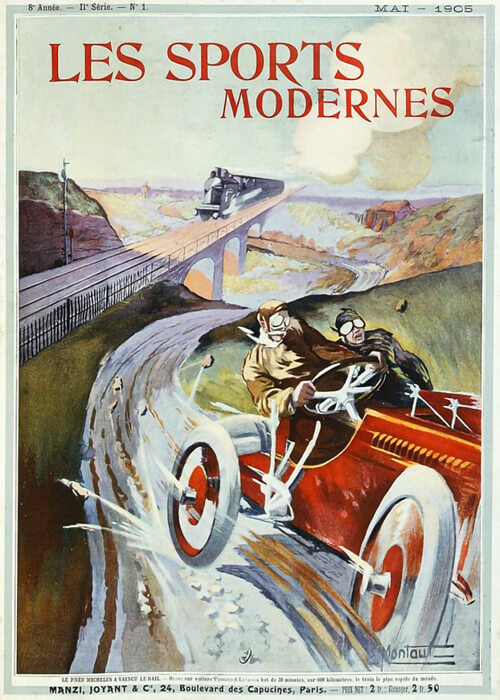
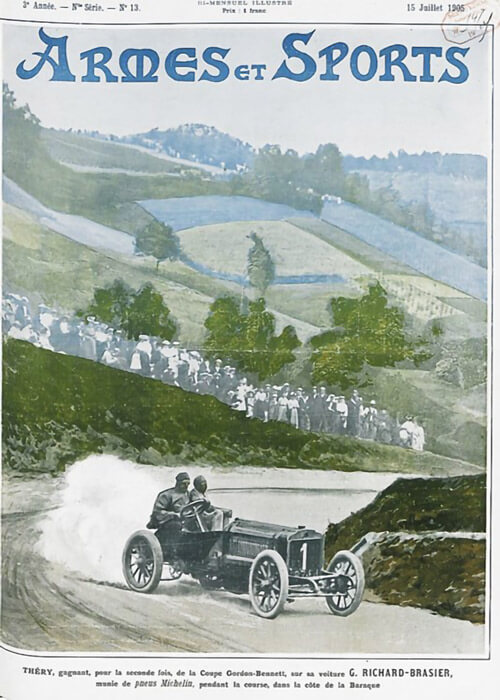
In this article in “Les Sports modernes” on the first Targa Florio in 1906, the journalist Frantz Reichel more or less shows his admiration to Cavaliere Florio, who organised this race series at enormous costs, financed from his own wealth. Count Florio is hailed for promoting Italian sport and their automotive industry. For America, his respect is also shown. But for France’s wealthy men and women, not much respect or gratitude remains in view of heir utterly meager sponsoring. Here is shown, how much motorracing and automobile industry are intertwined, at least in those days. Although finally, a short summary on the race itself is given, the main focus is directed on the generosity of Count Florio himself.



With permission of the Bibliothèque national francais gallica.bnf.fr
Text and photos compiled by motorracinghistory, Translation by DeepL deepl.com
Les Sports modernes (Modern Sports) — 9e Year, 11th Serie, June 1906
The Targa Florio
In France, we lack patrons; in this regard—as in a few others that I see no need to discuss at the moment—America is far better off than we are. It does, it is true, have a few billionaires for whom the opportunity to make a spectacular donation of several million to a city, a university, or a committee—in the service of a philanthropic cause or the triumph of a new idea—is a true godsend: it is a salutary bloodletting for those who suffer from an excess of gold. There are indeed in France some handsome fortunes—plump, even imposing—that yield respectable incomes—millions upon millions—but whether out of selfishness, indifference, timidity, or some other motive, the holders of these colossal incomes do not know how to put them to generous and beneficial use through grand and magnificent gestures. Americans have a sense of the enormous, even the grandiose, and while their actions are often tinged with a touch of ostentation, they give in a way that is useful and beneficial. We in France do not know how to give; we are unhappily stingy; those who do give do so in a manner that is too calculated, as if they were seeking in the act more an excuse for their colossal fortune than the satisfaction of accomplishing noble deeds. And that is why they give poorly.
We do not even know how to be generous in the pursuit of our pleasures; the sports that arouse such ardent and sincere passions in those who practice them have never, in France, led their followers to make even the slightest sacrifice: for years and years, athletics and physical education—whose role, if rationally incorporated into university curricula, can be so significant for the future of national peoples, both morally and materially—have been calling for patrons; indeed, what am I saying—a single patron; but to no avail; ever since its founding in 1888, the Union of French Athletic Sports Societies has been fighting for the sacred cause of *mens sana in corpore sano* with a meager budget of a few thousand-franc notes, scraped together penny by penny from the multitude of its members. When it happens—and anything can happen—that a merchant dealing in pharmaceuticals, hair-removal paste, or athletic accessories, who, incidentally, finds the matter to be a lucrative and rewarding form of advertising, donates to the Federation a sum of one hundred francs, or a work of art valued at twenty-five francs, the committees meet and solemnly express their immense gratitude to the grocer, the shrewd merchant who, in one fell swoop and at little cost, is hailed as a “generous patron.”
Take the automotive industry, for example; here is an industry that, in just a few years, has built colossal fortunes; through a fortunate turn of events—more than for any other reason—certain individuals—now established as industrial geniuses—have amassed millions upon millions. Well, Well, among this crowd of upstarts, not a single one has yet been found to have—as an American surely would have—toward the industry that enriched him a powerfully generous gesture in a surge of sincere gratitude.
It is not, however, that we lack good examples. Without crossing the Atlantic, we can find them right here on our good old European continent. In fact, they come to us from a Latin country, and the one who provides them is a young man—a brilliant young Italian gentleman, Cavaliere Florio—who is immensely and intelligently wealthy. Cavaliere Florio is a patron of the arts, and he is one for the greater good of his country, splendid Italy, and his native land, divine Sicily.
Automobilism and ballooning had a number of more substantial patrons in France, especially ballooning, which enjoyed a year of dizzying prosperity in 1901; Mr. Henry Deutsch (of Meurthe) established a prize of 100,000 francs (which, incidentally, cost him 125,000) to be awarded to the first person to travel by airship, using only the vessel’s own power, from Saint-Cloud to the Eiffel Tower and back in less than thirty minutes.
One hundred thousand francs! Mr. Henry Deutsch’s gesture caused a scandal; people were alarmed, and they were on the verge of calling him a madman—he who, with a stroke of his pen, had just rendered an incomparable service to science through the competition he was about to spark, and had significantly advanced the solution to the perplexing and fascinating problem of conquering the skies.
Mr. Deutsch’s example was, is, and will remain unique: this is a cause for concern, for while the role of patron is not within the reach of every wallet, in France it is also not within the reach of every temperament; here, one needs a certain boldness to confront public opinion with a generous gesture; the courage to risk one’s fortune is not given to all millionaires.

gallica.bnf.fr, modified by AI

If, in just three short years of creative activity and boundless ambition—justified by its success—the Italian automobile industry has experienced the remarkable growth that makes it our industry’s most formidable rival, it can be said that its prodigious, frenzied, dizzying, and triumphant momentum is due, in large part, to the wise generosity of Cavaliere Vincenzo Florio.
No sacrifice is too great for him in the service of his country’s prosperity; his gestures are grand and elegant, and the grandeur with which he performs them cuts short any petty insinuations.
Just as France had owed the rise of its automotive industry to racing, so too must the fledgling Italian industry look to racing for its own; but beyond the Alps, drivers were scarce, and specialized clubs either did not exist or were few and far between; thus, it was not from them that one could expect valuable and fruitful support. And yet action was necessary to enable Northern Italy—in the throes of an admirable industrial renaissance—to capitalize on its efforts and make up the ground it had lost to other nations.
The major races needed to give the automotive industry the momentum and activity necessary for its development—the excitement it needed to gain and inspire confidence, and to attract the world’s attention—were created by Cavaliere Florino, who single-handedly organized them.
His first initiative was the Brescia circuit, which will be held for the fourth time this year. Won in 1903 and 1904 by the French industry, and in 1905 by the Italian industry, this race—which is on its way to becoming one of the most important classic events in motorsports—has been wonderfully beneficial for Italy, since through it the Italian industry has, in three or four years, rapidly risen to the level of the most renowned manufacturers, the highest-ranked in the world.
Chevalier Florio has just completed his work by endowing the industry—of which he is the tireless benefactor—and his native land, the paradisiacal Sicily, with a new major race whose twists and turns have captured the world’s attention: the Targa Florio, which was held on Sunday, May 6, through the magnificently flower-filled and fragrant countryside bathed in the warm caress of a dazzling sun at the foot of the colossal Mount Etna.
You are no doubt aware of the cost of organizing an automobile race; it is exorbitantly expensive, and to put the figure into perspective—it bears noting—here is an example: the last Gordon-Bennett Cup, held in Auvergne, ran up a total bill of approximately three hundred thousand francs. There is no reason why the bill should be any lower beyond our borders, and you can well imagine what the two races that Count Florio created to better serve his country must cost him. They cost him all the more because the Brescia circuit and the Targa Florio are interspersed with various nautical races, some held on Lake Garda, others at sea, along the enchanting coastlines that lend their infinite and capricious grace to the pure and prodigious blue of the voluptuous Mediterranean.
Thus, it is at least 400,000 francs that Chevalier Florio, in a generous act of wise patriotism, devotes each year to the interests of a sport and an industry of which he is the impressive patron. What a lesson and what an example for our French millionaires! Consider, in fact, that to ensure the Targa Florio is an even greater success in 1907 than in 1906, and to spur the international competition from which all industrial progress springs, the Chevalier decided, following the conclusion of the race that has just ended, to award 104,000 francs in cash prizes for the next one. Forty thousand francs for the winner! Thirty thousand francs for the winning team.
Rich, very rich, formidably rich—he draws his gold by the armful and ingeniously lavishes it on grand initiatives. And must we not admire this young man who is—and this is the only thing that matters to him—twenty-five years old and who has truly endowed his country with an industry whose rapid rise has astonished the entire world? Slender, supple, elegant, with a dark complexion, black eyes, and a touch of sadness in his expression, he is gentle yet energetic. The success he seeks, he has achieved; he has just proven it with the Targa Florio.


gallica.bnf.fr, modified by AI
Three weeks before the scheduled race date, it seemed impossible to pull off; there was a lack of entries; only two Italian brands had registered; the French automotive industry had stayed away: it was a fiasco. Chevalier Florio therefore set to work; within eight days, he had secured entries from twenty-three cars, all of which would have been at the starting line had the strikes in Genoa not held up the competitors—who were expected in Palermo—in the port’s congested docks.
The Targa was a resounding success; seven brands competed over the 444-kilometer course, leaving those who were privileged to witness it with dazzling memories of festivities, luxury, and splendor. The Targa featured not race cars, but touring cars; benefiting from surprisingly cheap labor, Italy was able—at the same price point (there were two vehicle categories, one at 15,000 francs and one at 20,000 francs)—to pit cars with greater power against our representatives and thus secure the triumphant standings, which were as follows: 1st Cagno (Italy), in 9 hrs. 22 min. — 2nd Graziani (Italy), in 10 hrs. 5 min. — 3rd Bablot (France), in 10 hrs. 20 min. 7 sec. — 4th Rigal (Italy), — 5th De Caters (Italy). — 6th Leblon (France). The first French vehicle, a Berliet, came in third.
This latest victory for Italian industry should serve as a salutary warning to French manufacturers: they have reason to fear fierce competition from beyond the Alps. More daring, more “American” than we are—which we certainly are not—in their ventures, the Italians will outpace us thanks, once again, to a labor force that is as inexpensive in their country as it is burdensome in ours. We will not be able to withstand a price war once Italian industry, fully equipped, begins to produce on an intensive scale


Already, huge factories are rising from the ground in their homeland, where crowds of workers will refine the steel and assemble the parts, finished with meticulous care; Tireless, ambitious, and determined to make any sacrifice necessary to succeed, the executives of the major Italian brands are already promising, for 1907, to offer the public—at the same price as today’s four-cylinder models—six-cylinder cars whose smoothness and quiet operation make them the ideal vehicles…
Take note, French automakers! And if you want to get a true sense of the immense effort of the Italian industry, go to the Milan exhibition, where it is on full display in all its power and impressive splendor, its luxury and magnificence overshadowing the French automotive section—which, though abundant, is rather sparsely set up.
FRANTZ REICHEL.
Photos.
Page 10. THE TARGA FLORIO. — PARI-MUTUEL BETTING IN TERMINI — THE GRANDSTANDS IN TERMINI. — WAITING FOR THE WINNER (Photo by Branger.)
Page 11. THE TARGA FLORIO. — AFTER THE RACE, THE WINNER, CAGNO, SHARES HIS IMPRESSIONS WITH CHIAVELIER FLORIO, FOUNDER OF THE EVENT
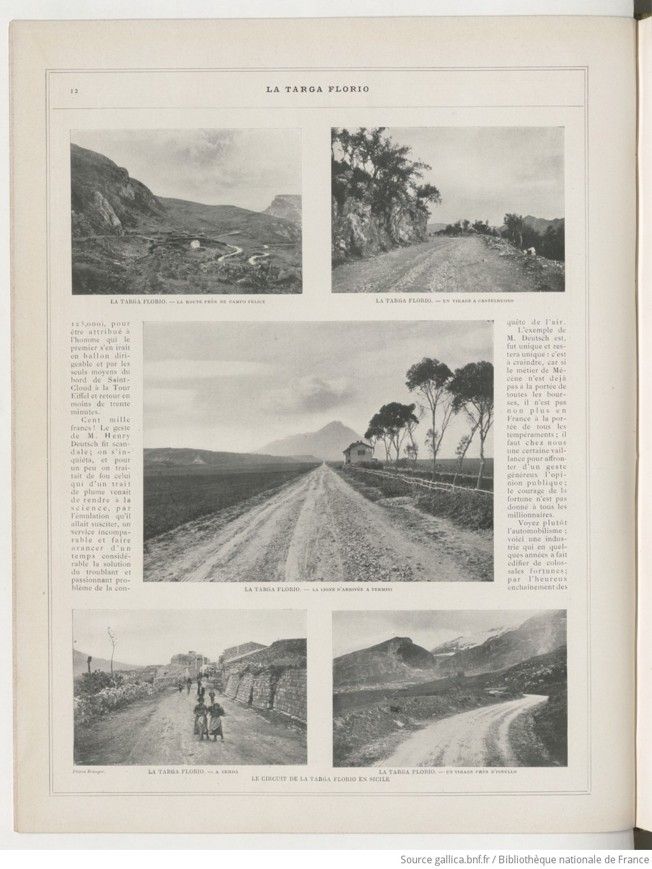
Page 12. THE TARGA FLORIO CIRCUIT IN SICILY THE TARGA FLORIO. — THE. ROAD NEAR CAMPO FELICE — THE TARGA FLORIO. — A TURN AT CASTELBUONO — THE FINISH LINE AT TERMINI — AT CERDA — A TURN NEAR ISNELLO (Photos by Branger.)
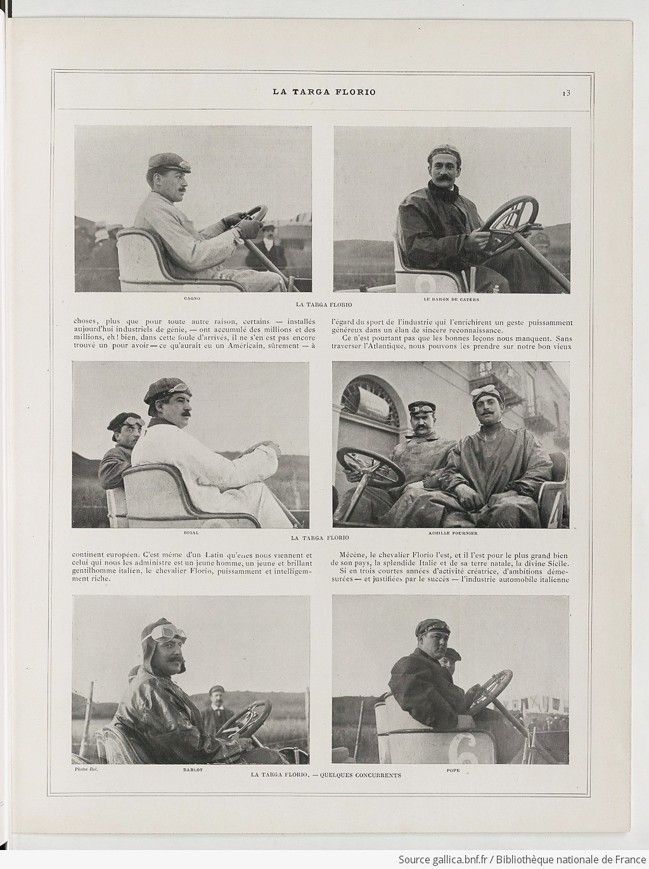
Page 13. THE TARGA FLORIO. — SOME COMPETITORS. CAGNO — THE BARON DE CATERS — RIGAL — ACHILLE FOURNIER — BABLOT — POPE (Photos by Rol.)
Page 14. THE TARGA FLORIO — CAGNO, THE WINNER, WAVING TO THE CHEERING CROWD AT TERMINI STATION (Photo by Rol.)