If anyone might have tought that Europe wouldn’t be interested in US motor racing: here’s proof of the contrary. In it’s first active publishing year, the French magazine La Locomotion Automobile publishes in all three reports on the first American motoring race; written by their US correspondant Charles Loved. This second article shows that preliminary trials were planned fo October 26 and the race, as previously, was planned for November 2. The first US application of pneumatic tyres in this Times-Herald race is mentioned too. Interesting is the information exchange between US and French automotive magazines. (Translation of original text).
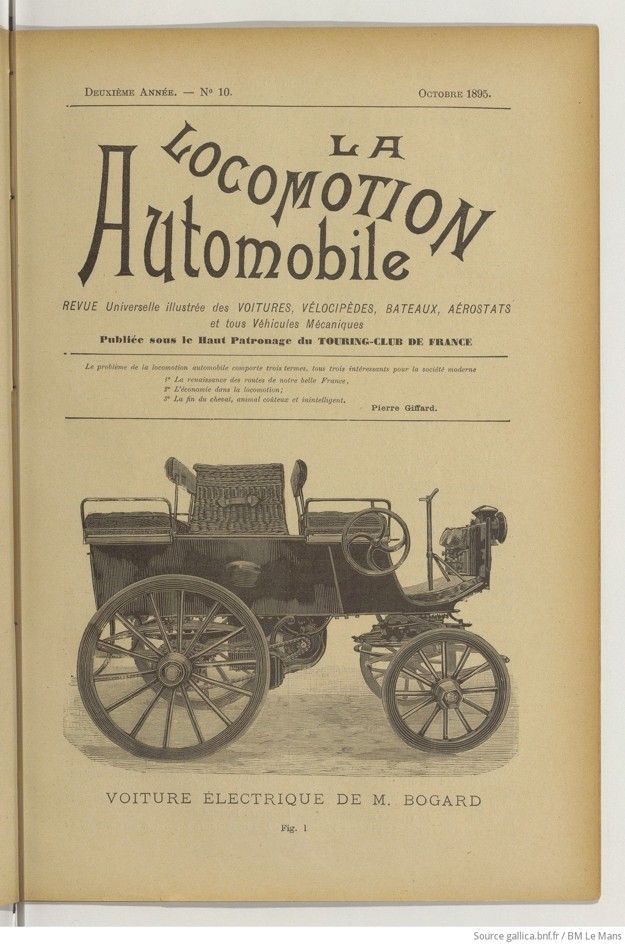
With courtesy of the Bibliothèque national francais gallica.bnf.fr
Text and photos compiled by motorracinghistory; Translation by DeepL deepl.com
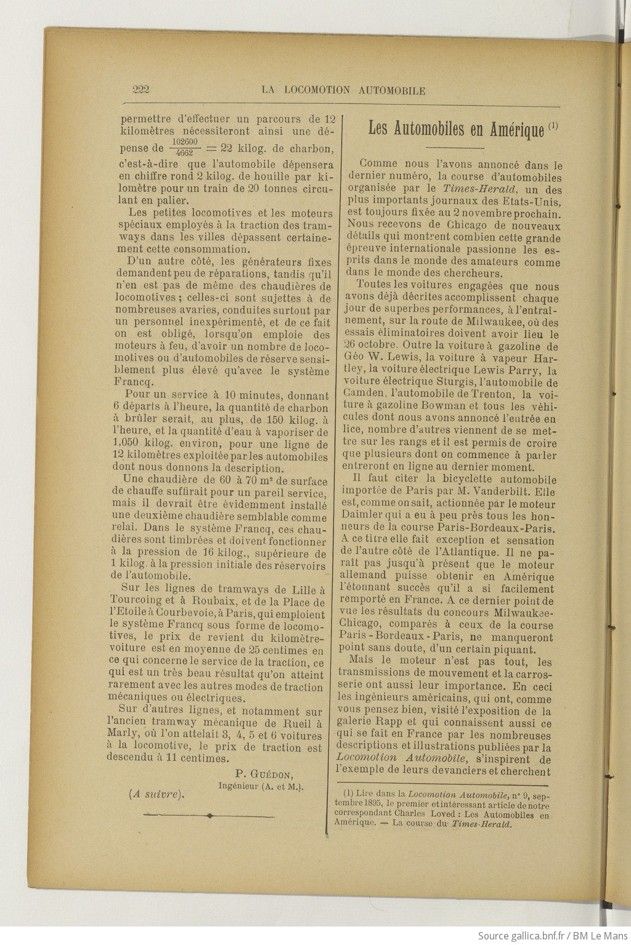
La Locomotion Automobile — 2nd Year, No. 20, October 1895, pages 222-224
Automobiles in America (1)
As we announced in the last issue, the automobile race organized by the Times-Herald, one of the leading newspapers in the United States, is still scheduled for November 2. We have received new details from Chicago that show just how much excitement this major international event is generating among both enthusiasts and researchers.
All the entered cars that we have already described are achieving superb results every day during practice on the Milwaukee road, where qualifying rounds are scheduled to take place on October 26. In addition to Geo W. Lewis’s gasoline-powered car, the Hartley steam car, the Lewis Parry electric car, the Sturgis electric car, the Camden automobile, the Trenton automobile, the Bowman gasoline-powered car, and all the vehicles whose entry we have previously announced, many others have just entered the fray, and it is reasonable to believe that several others now being discussed will join the race at the last minute.
We must mention the motorized bicycle imported from Paris by Mr. Vanderbilt. It is, as is well known, powered by the Daimler engine, which won nearly every honor in the Paris-Bordeaux-Paris race. As such, it stands out as an exception and is causing a sensation on the other side of the Atlantic. So far, it does not appear that the German engine can achieve in America the astonishing success it so easily secured in France. From this perspective, the results of the Milwaukee-Chicago race, when compared to those of the Paris-Bordeaux-Paris race, will undoubtedly provide a certain degree of intrigue.
(1) See the first and interesting article by our correspondent Charles Loved in Locomotion Automobile, No. 9, September 1895: “Automobiles in America” — “The Times-Herald Race.”
But the engine isn’t everything; the drivetrain and the body are also important. In this regard, American engineers — who, as you can imagine, have visited the exhibition at the Rapp Gallery and are also familiar with French innovations through the numerous descriptions and illustrations published by Locomotion Automobile — draw inspiration from the example set by their predecessors and seek to emulate the most perfect examples they have presented to the public. They noted in particular that the cars with rubber-tired wheels were in perfect condition after the race, despite the severe test to which they had been subjected. In the Times-Herald competition, almost all the wheels will have rubber tires. These tires are made of a highly elastic compound that adheres to the rim and is held in place by the tension of a strong band of pure rubber. Years of experience have shown that these tires can withstand, without tearing, total distances of up to 30,000 and 40,000 kilometers.
They have not forgotten, either, that a car equipped with pneumatic tires completed the race without a single accident, despite weighing 800 kilograms. Pneumatic tires for cars, even very heavy ones, are quite common in America: a major coachbuilder, the “Columbia Pneumatic Wagon Wheel Co.,” has just reorganized to manufacture and market pneumatic tires on a large scale, a venture whose success is assured. They generally have a diameter roughly double that of bicycle wheels and a strength proportional to the load they must bear.
An examination of the various vehicle components upon their return from the Paris-Bordeaux-Paris race has once again highlighted this curious fact: in gear-driven power transmissions, the teeth wear down fairly quickly without this spontaneous wear impairing the machine’s proper functioning. Building on this observation, American manufacturers have given the teeth of their gears an elongated shape, and it is reported that the results are excellent: the operation is more uniform, the teeth mesh precisely like the gears of a watch, the force is distributed more evenly across the contacting surfaces, and the risk of breakage is significantly reduced. Finally, experiments conducted with the utmost care have established that the coefficient of friction is lower for pointed teeth than for square teeth.
The same spirit of observation has led manufacturers to combine in their vehicles these qualities that are truly contradictory only in appearance: strength, lightness, and power. To this end, they have meticulously studied every detail of the car and reduced its weight as much as possible. Certain parts that do not require high strength, such as the taillights, are made of aluminum. This reduces the traction required when climbing hills.
What will give the Times-Herald race a new character is (something that was missing from the Paris-Bordeaux-Paris race) the presence of a large number of electric cars. There will be even more of them than was initially expected, and it is on them that interest is particularly focused. Could one deny them a chance of success in a country where everything runs on electricity, where the marvelous modern fairy reigns supreme in all branches of science and industry? If automobile manufacturers see their hopes dashed, they will at least have the consolation of knowing that the public’s expectations will be dashed as well.
It must be said, however, that every type of car has its ardent supporters, and that steam, oil, and electricity have their rival interests represented by roughly equal numbers of vehicles. Their chances seem to be evenly balanced. So, as one might expect, bets are being placed, for in America, nothing happens without a bet. “Betting,” along with the dollar, especially in sports, is the lifeblood of progress. You in Europe are not sufficiently convinced of this truth.
There will likely be surprises, and we may have to reckon with the underdog lurking in some corner. It would be reckless of us to venture any predictions before the preliminary trials on October 26 and even before the final races on November 2.
The best we can do is wait patiently for the results and present them to the readers of Locomotion Automobile as soon as they are known.
We cannot, however, fail to mention that these results are already eagerly anticipated. In various industrial centers across the United States, major companies are being formed to manufacture and market certain types of automobiles. For some of these, the investment is said to amount to several hundred thousand dollars.
French manufacturers have, until now, been at the forefront of the great automotive movement they created. But it is not enough to simply conceive of ideas; one must also refine them to the utmost and, above all, bring the invention to market. If they are not careful, they will have to compete—under conditions that may be unequal—with the massive capital of American industry. The contest is now underway in the public eye between American and French manufacturers. The latter, it is true, aside from their indisputable experience and personal merit, have two strong assets on their side: the continued existence of the Paris-Bordeaux-Paris Race Committee, which is poised to ensure their resounding future successes, and the support of that prodigious sports association, the Touring-Club, which, from France—its center of operations—extends its influence throughout the rest of the world and will always provide them with the best and most widespread publicity.
I would add, if the editors of *La Locomotion Automobile* would allow me, that this specialized magazine, so highly regarded even abroad, has given French manufacturers the surest proof of its dedication:
“Its aim,” it stated in the lead article of its first issue, “is to bring to light, through publicity and illustration, all the discoveries that will enrich the field of automobile transportation; to stimulate the efforts of researchers; to encourage all those of good will; and to support, to the best of its ability, the work of progress. ” (1 = See Locomotion Automobile, December 1894.)
It has not failed to live up to its mission, and the page, to cite just one example, where, in the wake of the June 1895 race, it published the highly artistic illustration of the nine cars that emerged victorious from that monumental event, stands as a true monument in the history of modern sport, erected to the glory of French automobile transportation.
However, your engineers would be wrong to ignore what is happening outside their own sphere and to overlook Article 6 of the Times Herald race report, which states that: all automobiles that won prizes or honorable mentions in the 1894 Paris-Rouen race, or in the recent Paris-Bordeaux-Paris race, will be exempt from the qualifying trials on October 26 and immediately admitted, by right, to take part in the final race on November 2.
Charles Loved.