In four separate and small articles, the complete route of the world’s first auto race was published in La Locomotion Automobile. The four separate sections are meticously described, whitnessing thereby how carefully the preparations were made by the organisers. (Translation of original text).
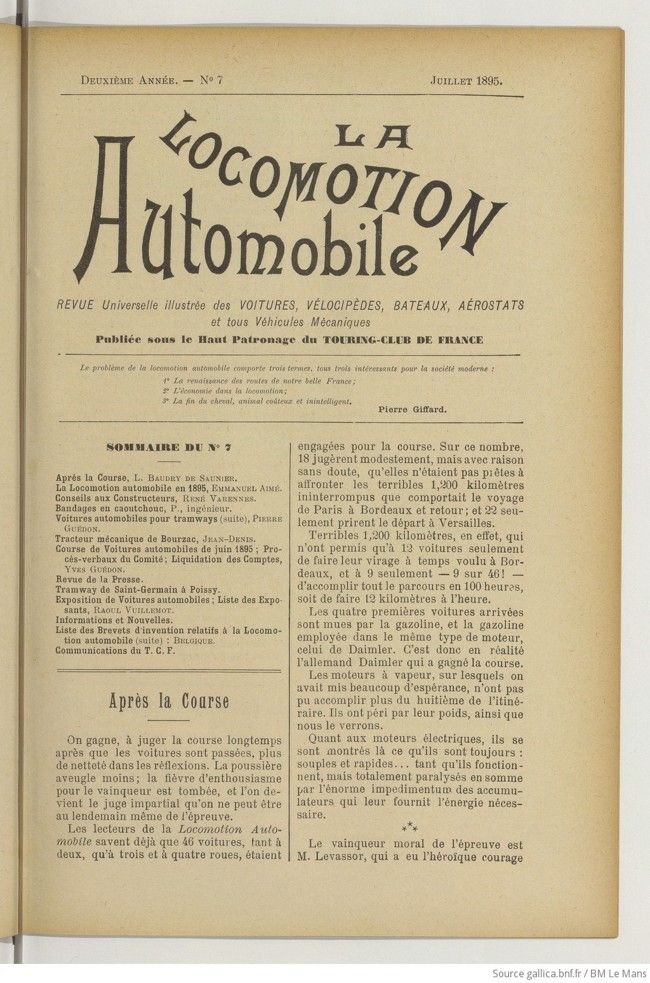
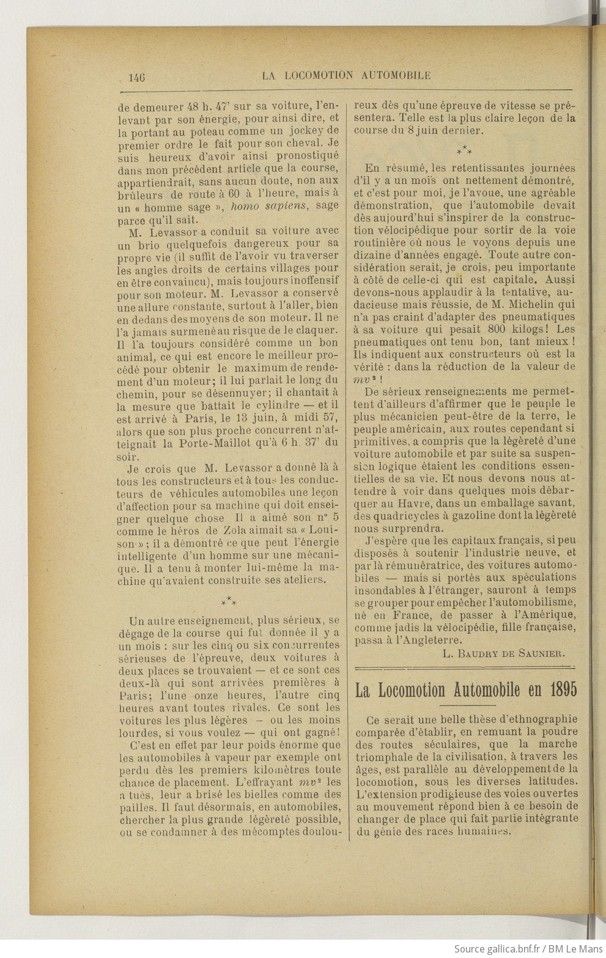
With courtesy of the Bibliothèque national francais gallica.bnf.fr and the Conservatoire numérique des Arts et Métiers (Cnum) – https://cnum.cnam.fr
Text and photos compiled by motorracinghistory motorracinghistory.com Translation by DeepL.com deepl.com
La Locomotion Automobile — 2e Année, No. 7, juillet 1895, pages 145-146 + 148-149
After the Race
When assessing the race long after the cars have passed, one’s thoughts become clearer. The dust is less blinding; the feverish enthusiasm for the winner has subsided, and one becomes the impartial judge that one cannot be even the day after the race.
Readers of La Locomotion Automobile already know that 46 cars — including two-, three-, and four-wheeled models — were entered in the race. Of this number, 18 modestly, but undoubtedly with good reason, judged that they were not up to the task of tackling the grueling 1,200 uninterrupted kilometers that comprised the round trip from Paris to Bordeaux; and only 22 took the starting line in Versailles.
A grueling 1,200 kilometers, indeed, which allowed only 12 cars to turn around in Bordeaux at the appointed time, and only 9 — 9 out of 46! — to complete the entire route in 100 hours, or at a pace of 12 kilometers per hour.
The first four cars to arrive were powered by gasoline, and the gasoline used in the same type of engine — the Daimler engine. So, in reality, it was the German Daimler that won the race.
The steam engines, in which so much hope had been placed, were unable to cover more than one-eighth of the route. They were undone by their weight, as we shall see.
As for the electric motors, they proved to be what they always are: smooth and fast… as long as they’re running, but ultimately completely hampered by the enormous burden of the batteries that supply them with the necessary energy.
***
The moral victor of the race is Mr. Levassor, who had the heroic courage to remain in his car for 48 hours and 47 minutes, propelling it forward with his energy, so to speak, and guiding it to the finish line just as a first-rate jockey does for his horse. I am pleased to have predicted in my previous article that the race would undoubtedly belong not to the speed demons racing at 60 per hour, but to a “wise man,” homo sapiens — wise because he knows.
Mr. Levassor drove his car with a flair that was at times dangerous to his own life (one need only have seen him navigate the right-angle turns in certain villages to be convinced of this), but always harmless to his engine. Mr. Levassor maintained a steady pace, especially on the way there, well within his engine’s capabilities. He never overworked it at the risk of breaking it down. He always treated it like a good animal—which is still the best way to get the most out of an engine; he would talk to it along the way to stave off boredom; he sang in time with the cylinder’s beat — and he arrived in Paris on June 13 at 12:57 p.m., while his closest competitor did not reach the Porte-Maillot until 6:37 p.m.
I believe that Mr. Levassor has thereby given all automobile manufacturers and drivers a lesson in affection for their machines that has something to teach us. He loved his No. 5 just as Zola’s hero loved his “Louison”; he demonstrated what a man’s intelligent energy can achieve with a machine. He insisted on driving the car himself that his workshops had built.
***
Another, more serious lesson emerges from the race held a month ago: among the five or six serious contenders in the event, there were two two-seater cars — and it was these two that finished first in Paris; one eleven hours ahead, the other five hours ahead of all rivals. It was the lightest cars — or the least heavy, if you will — that won!
Indeed, it was precisely because of their enormous weight that steam-powered automobiles, for example, lost any chance of moving forward within the first few kilometers. The terrifying mu2 destroyed them, snapping their connecting rods like straws. From now on, when it comes to automobiles, we must strive for the greatest possible lightness, or face painful disappointments whenever a speed race arises. That is the clearest lesson from the race on June 8.
***
In summary, the sensational events of a month ago clearly demonstrated — and I must admit, this is a welcome demonstration to me — that the automobile must, starting today, draw inspiration from bicycle design to break free from the rut in which we have seen it stuck for the past decade or so. Any other consideration would, I believe, be of little importance compared to this one, which is of paramount importance. We must therefore applaud the bold but successful attempt by Mr. Michelin, who was not afraid to adapt tires to his car, which weighed 800 kilograms! The tires held up—and thank goodness for that! They show manufacturers where the truth lies: in reducing the value of mv *!
Moreover, reliable information allows me to assert that perhaps the most mechanically inclined people on earth — the American people, despite their primitive roads — have understood that the lightness of an automobile and, consequently, its logical suspension are essential to its performance. And we can expect to see gasoline-powered four-wheelers arrive in Le Havre in a few months, expertly packaged, whose lightness will surprise us.
I hope that French capital, so reluctant to support the new — and therefore profitable — automobile industry, yet so inclined toward unfathomable speculations abroad, will be able to band together in time to prevent the automobile, born in France, from passing to America, just as the velocipede, a French invention, once passed to England.
L. Baudry de Saunier.
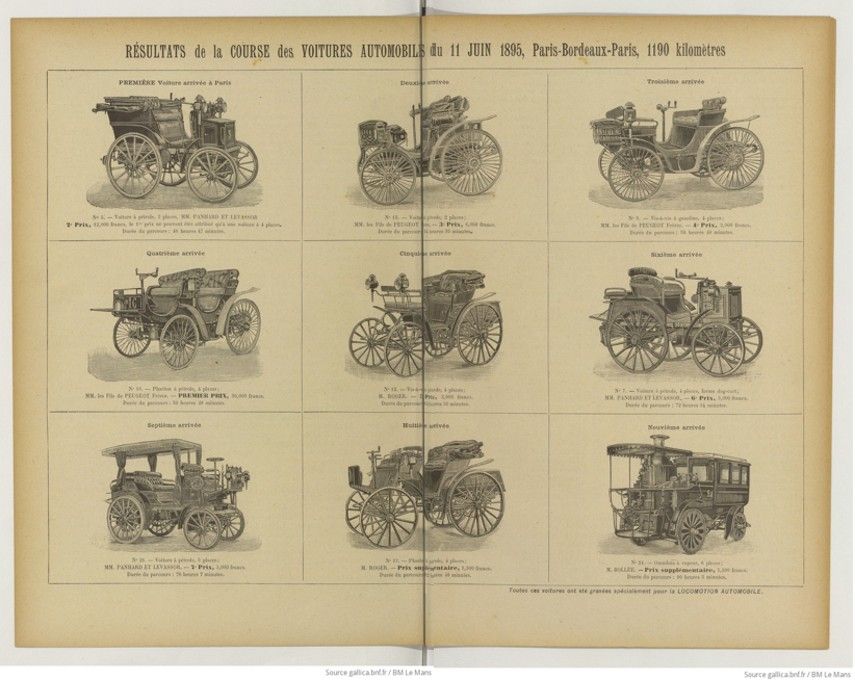
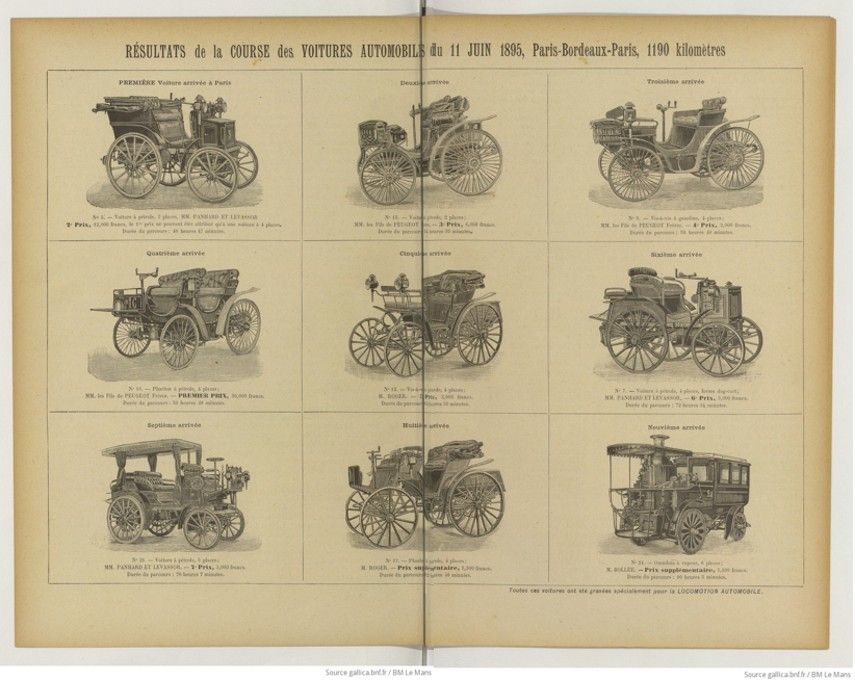
RESULTS of the AUTOMOBILE RACE on JUNE 11, 1895, Paris-Bordeaux-Paris, 1,190 kilometers
FIRST Car to Arrive in Paris
No. 5. — Gasoline-powered car, 2-seater, Messrs. PANHARD AND LEVASSOR. 2nd Prize, 12,000 francs, as the 1st Prize could only be awarded to a 4-seater car. Time taken: 48 hours, 47 minutes.
Second to finish
No. 15. — Gasoline-powered car, 2-seater; Messrs. the Sons of PEUGEOT Frères. — 3rd Prize, 6,000 francs. Time taken: 54 hours 35 minutes.
Third to finish
No. 8. — Gasoline-powered vis-à-vis, 4-seater; the Sons of PEUGEOT Frères. — 4th Prize, 3,000 francs. Time taken: 59 hours 49 minutes.
Fourth to finish
No. 16. — Gasoline-powered phaeton, 4-seater; the Sons of PEUGEOT Frères. — FIRST PRIZE, 30,000 francs. Duration of the race: 59 hours 48 minutes.
Fifth to finish
No. 12. — Petrol-powered vis-à-vis, 4-seater; Mr. ROGER. — 5th Prize, 3,000 francs. Duration of the race: 64 hours 30 minutes.
Sixth to finish
No. 7. — Gasoline-powered car, 4-seater, dog-cart style; Messrs. PANHARD AND LEVASSOR. — 6th Prize, 3,000 francs. Race time: 72 hours 14 minutes.
Seventh to finish
No. 28. — Gasoline-powered car, 5-seater; Messrs. PANHARD AND LEVASSOR. — ? Prize: 3,000 francs. Duration of the race: 78 hours, 7 minutes.
Eighth to finish
No. 13. — Gasoline-powered phaeton, 4-seater; Mr. ROGER. — Supplementary prize: 1,500 francs. Duration of the race: 82 hours, 48 minutes.
Ninth to finish
No. 24. — Steam-powered omnibus, 6-seater; Mr. BOLLÉE. — Supplementary prize: 1,500 francs. Travel time: 90 hours, 3 minutes.
All these vehicles were specially engraved for LOCOMOTION AUTOMOBILE