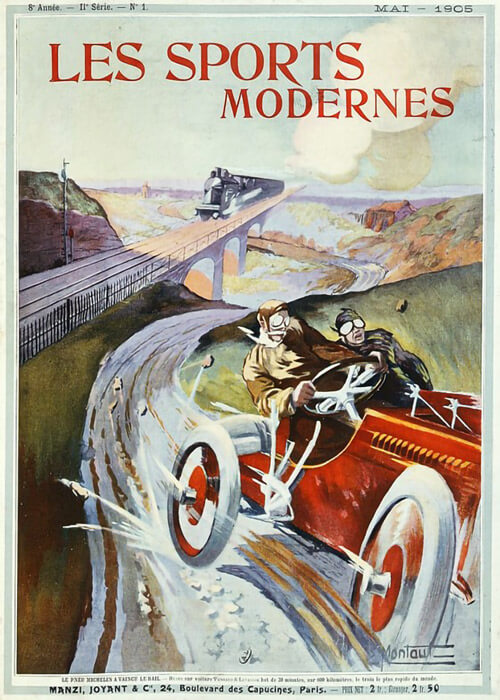
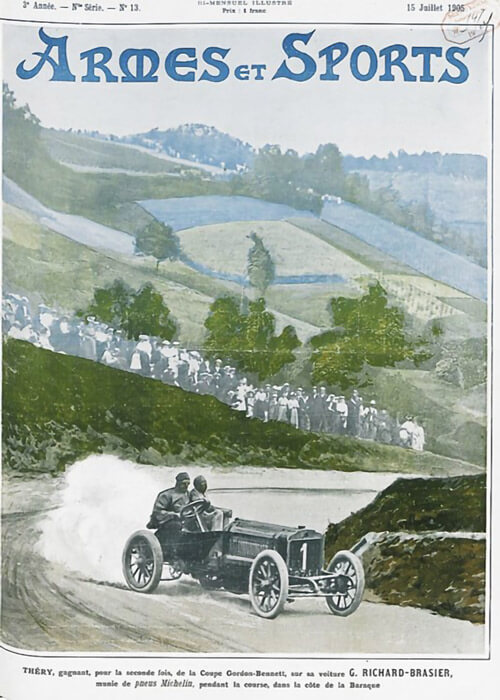
Introduction on the title is on it’s way.
With permission of hathitrust hathitrust.org == Text and fotos compiled by motorracinghistory motorracinghistory.com
THE AUTOMOBILE — Volume XXVII 27, No. 15, October 10, 1912, pages 711, 745 – 747
Work Done at the Pits
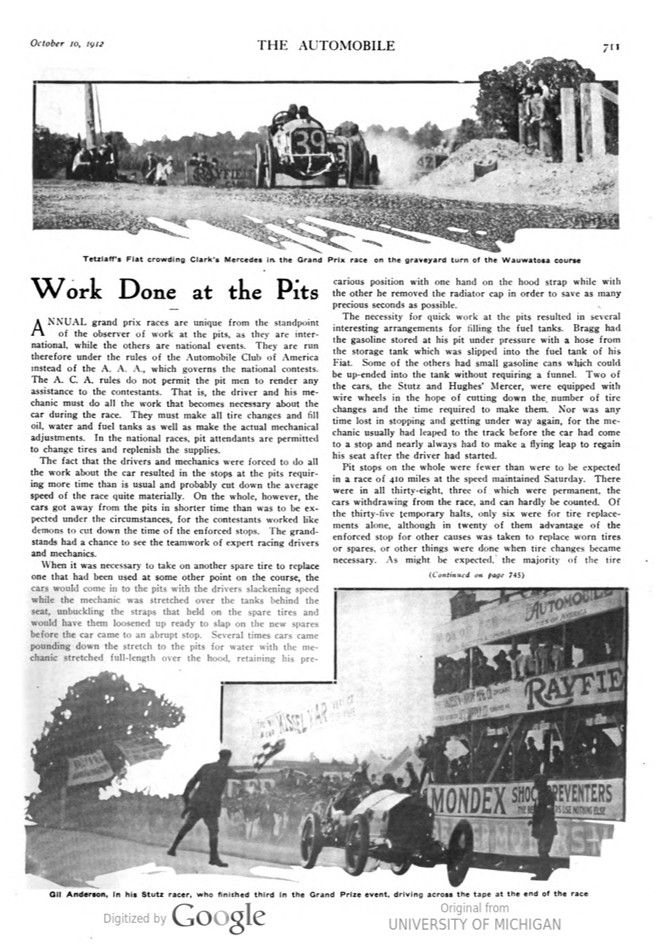
ANNUAL grand prix races are unique from the standpoint of the observer of work at the pits, as they are international, while the others are national events. They are run therefore under the rules of the Automobile Club of America instead of the A. A. A., which governs the national contests. The A. C. A. rules do not permit the pit men to render any assistance to the contestants. That is, the driver and his mechanic must do all the work that becomes necessary about the car during the race. They must make all tire changes and fill oil, water and fuel tanks as well as make the actual mechanical adjustments. In the national races, pit attendants are permitted to change tires and replenish the supplies.
The fact that the drivers and mechanics were forced to do all the work about the car resulted in the stops at the pits requiring more time than is usual and probably cut down the average speed of the race quite materially. On the whole, however, the cars got away from the pits in shorter time than was to be expected under the circumstances, for the contestants worked like demons to cut down the time of the enforced stops. The grandstands had a chance to see the teamwork of expert racing drivers and mechanics.
When it was necessary to take on another spare tire to replace one that had been used at some other point on the course, the cars would come in to the pits with the drivers slackening speed while the mechanic was stretched over the tanks behind the seat, unbuckling the straps that held on the spare tires and would have them loosened up ready to slap on the new spares before the car came to an abrupt stop. Several times cars came pounding down the stretch to the pits for water with the mechanic stretched full-length over the hood, retaining his precarious position with one hand on the hood strap while with the other he removed the radiator cap in order to save as many precious seconds as possible.
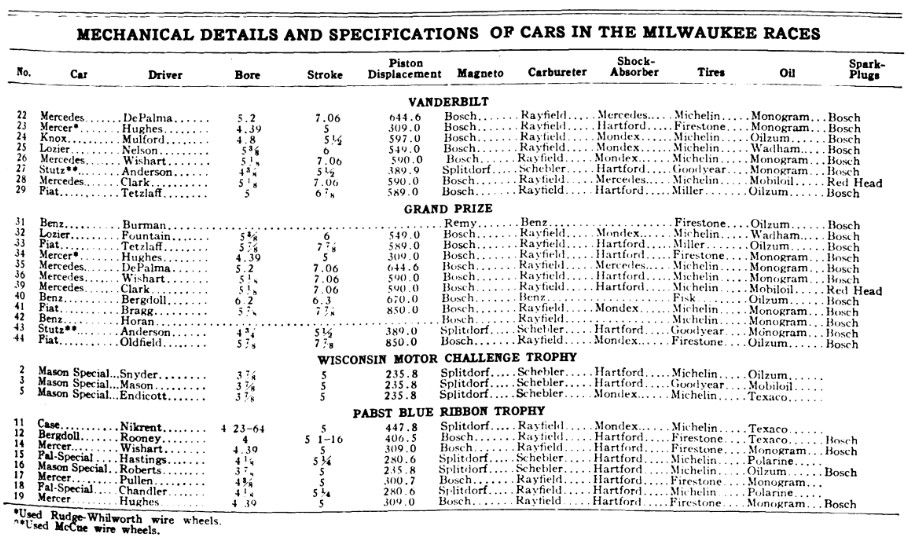
The necessity for quick work at the pits resulted in several interesting arrangements for filling the fuel tanks. Bragg had the gasoline stored at his pit under pressure with a hose from the storage tank which was slipped into the fuel tank of his Fiat. Some of the others had small gasoline cans which could be up-ended into the tank without requiring a funnel. Two of the cars, the Stutz and Hughes’ Mercer, were equipped with wire wheels in the hope of cutting down the number of tire changes and the time required to make them. Nor was any time lost in stopping and getting under way again, for the m chanic usually had leaped to the track before the car had come to a stop and nearly always had to make a flying leap to regain his seat after the driver had started.
Pit stops on the whole were fewer than were to be expected in a race of 410 miles at the speed maintained Saturday. There were in all thirty-eight, three of which were permanent, the cars withdrawing from the race, and can hardly be counted. Of the thirty-five temporary halts, only six were for tire replacements alone, although in twenty of them advantage of the enforced stop for other causes was taken to replace worn tires or spares, or other things were done when tire changes became necessary. As might be expected, the majority of the tire (Continued on page 745) (Continued from page 711) – changes were on the right rear wheel which has the hardest service. Refilling fuel, oil and water tanks were responsible for more stops than any other cause, and mechanical difficulties were comparatively few, necessitating only ten stops altogether, three of which put the cars out permanently.
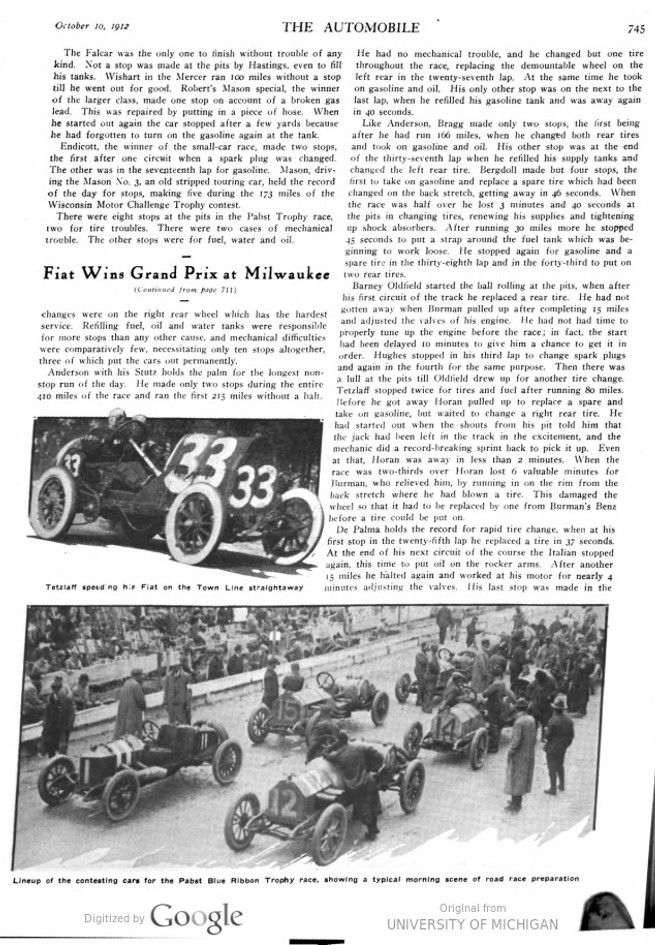
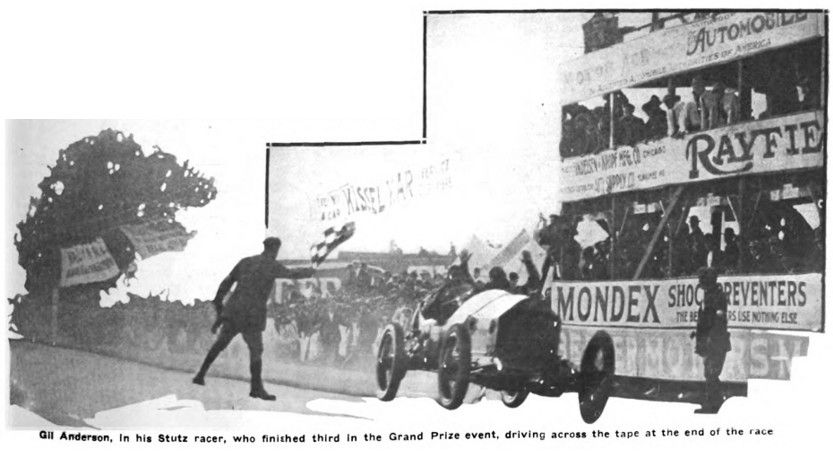
Anderson with his Stutz holds the palm for the longest non-stop run of the day. He made only two stops during the entire 410 miles of the race and ran the first 215 miles without a halt. He had no mechanical trouble, and he changed but one tire throughout the race, replacing the demountable wheel on the left rear in the twenty-seventh lap. At the same time he took on gasoline and oil. His only other stop was on the next to the last lap, when he refilled his gasoline tank and was away again in 40 seconds.
Like Anderson, Bragg made only two stops, the first being after he had run 166 miles, when he changed both rear tires and took on gasoline and oil. His other stop was at the end of the thirty-seventh lap when he refilled his supply tanks and changed the left rear tire. Bergdoll made but four stops, the first to take on gasoline and replace a spare tire which had been changed on the back stretch, getting away in 46 seconds. When the race was half over he lost 3 minutes and 40 seconds at the pits in changing tires, renewing his supplies and tightening up shock absorbers. After running 30 miles more he stopped 45 seconds to put a strap around the fuel tank which was beginning to work loose. He stopped again for gasoline and a spare tire in the thirty-eighth lap and in the forty-third to put on Fiat Wins Grand Prix at Milwaukee two rear tires.
Barney Oldfield started the ball rolling at the pits, when after his first circuit of the track he replaced a rear tire. He had not gotten away when Burman pulled up after completing 15 miles and adjusted the valves of his engine. He had not had time to properly tune up the engine before the race; in fact, the start had been delayed 10 minutes to give him a chance to get it in order. Hughes stopped in his third lap to change spark plugs and again in the fourth for the same purpose. Then there was a lull at the pits till Oldfield drew up for another tire change.
Tetzlaff stopped twice for tires and fuel after running 80 miles. Before he got away Horan pulled up to replace a spare and take on gasoline, but waited to change a right rear tire. He had started out when the shouts from his pit told him that the jack had been left in the track in the excitement, and the mechanic did a record-breaking sprint back to pick it up. Even at that, Horan was away in less than 2 minutes. When the race was two-thirds over Horan lost 6 valuable minutes for Burman, who relieved him, by running in on the rim from the back stretch where he had blown a tire. This damaged the wheel so that it had to be replaced by one from Burman’s Benz before a tire could be put on.
De Palma holds the record for rapid tire change, when at his first stop in the twenty-fifth lap he replaced a tire in 37 seconds. At the end of his next circuit of the course the Italian stopped again, this time to put oil on the rocker arms. After another 15 miles he halted again and worked at his motor for nearly 4 minutes adjusting the valves. His last stop was made in the thirty-seventh lap when he changed a tire and took on water. The record of Clark’s Mercedes is nearly as good as that of the Stutz. Clark made but two stops, the first one being after running 190 miles, when he took on gasoline and oil. His second and last stop occurred in the thirty-fifth circuit of the course, when he lost over 10 minutes in repairing a leak in the water cooling system. Clark was the most fortunate so far as tire troubles were concerned, as he did not change a tire throughout the race.
Bob Burman, in Benz 31, was the first to get away, followed by Fountain in a Lozier. Fountain is a Milwaukee pilot, and he drove the same car which Nelson, its owner and entrant, drove in the Vanderbilt Cup race of Wednesday. Next came Teddy Tetzlaff, demon driver of them all, at the wheel of Fiat 33. He was trailed by Hughie Hughes in the sturdy Mercer. The ill-fated De Palma was off 30 seconds later in his Mercedes 35. Spencer Wishart, who drove a Mercer in the Pabst race of Friday, was in command of another Mercedes, entry number 36. Clark was next off in Mercedes 39. Bergdoll, at the wheel of the immense Benz 40, followed. After him was Bragg, Fiat 41, who had withdrawn from the race following Bruce-Brown’s death, but who was persuaded at the last minute to compete. Benz 42, which was scheduled to be driven by Joe Dawson, winner at Indianapolis in June, was sent away by Horan instead. Gil Anderson in the Stutz, which looked small beside the immense foreign machines, got the word next, and finally came Oldfield in Fiat 44. Although a favorite with the crowd, no one expected Barney to go the distance. He has never finished a road race before. More than that, he finished in the money.
Tetzlaff took the lead in the first lap, with Bragg second and Bergdoll third. Wishart and De Palma were in fourth and fifth places, respectively, while the others came around in the following order: Burman, Hughes, Horan, Anderson, Fountain, Clark and Oldfield. The latter would no doubt have shown up better on this first circuit had he not been delayed by tire trouble. This was the first stop at the pits, but the crowd spurred the veteran driver on.
The second lap saw only two shiftings of positions among the cars in the rear position. Wishart took Bergdoll’s place in third position, while Hughes overtook Burman, forcing the latter into seventh position, and putting Hughes in sixth. All this time Tetzlaff was driving in his terrific slam-bang style, much the same as he did in the Vanderbilt race of Wednesday. After completing his second lap, Burman stopped at the pit with engine trouble, the same trouble, by the way, which delayed the start of the race for 10 minutes. In his third lap Burman was permanently out of the race, his big Benz having succumbed to a broken piston.
Burman out, Anderson came from ninth into seventh place. Hughes, who had to stop at his pit on his third lap to change a spark plug, went back to last place at the end of the third. The shift brought Clark up to tenth, Oldfield having passed him. Fountain was running now in eighth place, while Horan became sixth. The leaders retained the same position which they had held during the second lap.
The third was Wishart’s last lap; in the fourth his motor was disabled by a broken crankshaft, a break which prohibits quick repair. Bergdoll now became third, while De Palma moved up to fourth place. Horan succeeded to fifth place, Anderson to sixth, Fountain to seventh, Oldfield to eighth, Clark to ninth and Hughes to tenth. Tetzlaff, way in the lead, was reeling off the miles at a lively clip. Bragg was a good second.
The fifth saw no changes in the positions of the leaders, the only difference in the ten contenders being that both Anderson and Fountain passed Horan. Hughes, running last, came to the pit again in the fifth lap with more spark plug trouble.
In the sixth lap Clark passed Oldfield, who was obliged to stop to replace a right rear tire. The veteran driver made quick work of the change, but he did not regain his lost ground until the ninth lap. There was no other change in the line-up in the sixth lap, Tetzlaff still leading by a good margin and hotly pursued by Bragg, Bergdoll and De Palma.
It was in the seventh lap that De Palma snatched third place from Bergdoll, who stopped for fuel and an extra supply of tires to replace those used on the backstretch. This wait put Bergdoll into sixth place, Fountain and Anderson passing him as well as De Palma. Tetzlaff and Bragg were still running first and second, respectively.
The eighth lap brought out no differences in the line-up, while in the ninth the only position change was in Oldfield’s taking eighth place from Clark. In this lap Fountain went through the straw bales on the Fond Du Lac road turn, but he was soon on the road again, no one having been hurt, and the car apparently none the worse for the mishap.
In the eleventh Tetzlaff made his first stop at the pit, thus giving his lead to Bragg, who was running nicely, and whose car had performed so far without a hitch. Tetzlaff changed a right rear tire and was soon away again in pursuit of Bragg. In this lap Horan, who had been running seventh, passed Anderson, Bergdoll and Fountain and took fourth position momentarily, only to drop back on the following round. The Stutz car then took fifth place, Bergdoll sixth and Fountain seventh. Bragg retained the lead over Tetzlaff from the eleventh through the fourteenth lap, closely pursued by the former. All this time De Palma was running third, and Anderson, except for the thirteenth lap, when he was momentarily nosed out by Bergdoll, was in fourth position. In the fourteenth lap Bergdoll blew a tire on the backstretch at station 4 and the delay put the Benz entry into seventh position, both Oldfield and Fountain passing it. Hughes was still worrying along in last place.
The fourteenth lap was Tetzlaff’s fastest and also the fastest lap ever covered over the Wauwatosa course, he making the circuit in 6 minutes 7 seconds, at the average speed of 77.2 miles an hour. This hitting it up gave Teddy the lead again, which he held through the next lap, Bragg running consistently and but a few seconds behind. On lap seventeen Tetzlaff made a pit stop which cost him 2 minutes and 22 seconds, and put Bragg in the lead.
At the end of the seventeenth lap the cars stood Bragg, Tetzlaff, De Palma, Anderson, Bergdoll, Fountain, Oldfield, Clark, Horan. The Mercer car 34, Hughie Hughes, went out for good in this lap, leaving only nine cars still running. Hughes’ car was disabled by a broken gasoline line. Two laps previous to his withdrawal, Hughes’ car threw a wheel at station 7, but controlled the car, keeping it on the road. Another wheel was substituted, his car being equipped with the wire type. Bragg averaged 67.5 miles an hour for the seventeen laps.
Through the twentieth lap nothing of note took place, although on the next round Bragg lost his lead, which he had held from the seventeenth lap. He was obliged to stop for gasoline and he changed both rear tires at the same time, losing in all 2 minutes. De Palma and Tetzlaff were both so close that they passed Bragg while he was stopped, putting the Cincinnati driver into third place, Tetzlaff into the lead again and De Palma second. Tetzlaff was also forced to change a rear tire, so that, in the twenty-second circuit, De Palma was leading, with Tetzlaff second and Bragg still third. The other cars maintained practically their same positions in the nineteenth, twentieth, twenty-first and twenty-second laps. De Palma, then leading, had averaged 72 miles an hour for twenty-two laps.
De Palma retained the lead through the twenty-fourth lap, with Tetzlaff second, Bragg third, Bergdoll fourth, Anderson fifth, Oldfield sixth, Clark seventh and Horan eighth. But in the next lap Tetzlaff succeeded in nosing De Palma out of first position, while the positions of the rest of the cars remained the same. De Palma had been forced to stop at the pit to change the left front tire and to take on water and gasoline. His pit stop consumed 2 minutes and 9 seconds. More delay at the pit on the twenty-sixth lap allowed Bragg to take second position from De Palma, while Tetzlaff was still in the lead. No change in the positions of the other cars took place in the twenty-sixth lap, nor in the next four laps.
In the thirty-first lap it was seen that something was wrong with Tetzlaff, who, since he had regained the premier position, had been going at a lively pace. Finally the car was seen coming down the track at a slow pace, and it was found that he was out of the race with a broken radius rod, practically repeating his performance of Wednesday in the Vanderbilt Cup race.
Bragg succeeded to first place again, De Palma second, Bergdoll third, Anderson fourth, Oldfield fifth, Clark sixth and Horan seventh. The rest of the race for first place was simply a struggle between Bragg and De Palma, Bragg with the newer car having the best of the argument. Bergdoll was third up to the forty-third lap, although there was plenty of excitement for the crowd in the closeness between this car and Anderson’s Stutz, which was the only American remaining in the battle.
Through the fifty-first lap Bragg was leading De Palma by over 2 minutes, while Anderson was third, Bergdoll fourth and Oldfield fifth. In the last lap, after De Palma had gone into the ditch, second position went to Bergdoll and third to Anderson. Burman was driving for Horan up to the forty-eighth lap when the car was flagged by the officials.
Photos.
Page 711. Tetzlaff’s Fiat crowding Clark’s Mercedes in the Grand Prix race on the graveyard turn of the Wauwatosa course – Gil Anderson, in his Stutz racer, who finished third in the Grand Prize event, driving across the tape at the end of the race
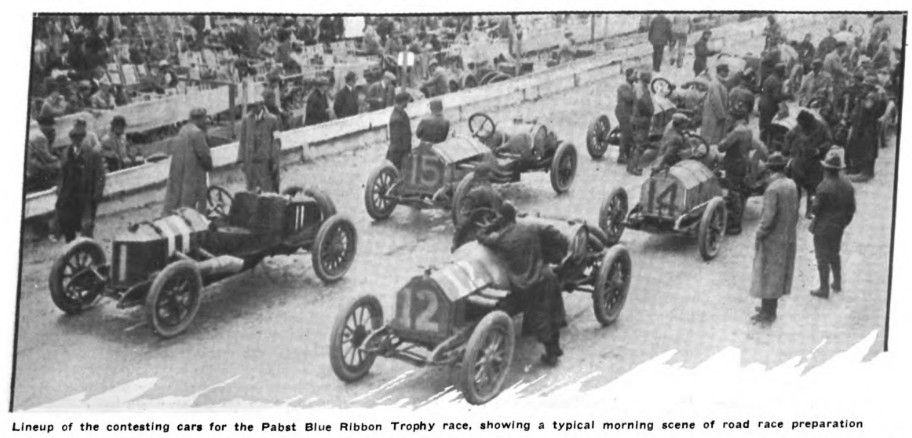
Page 745. Tetzlaff speeding his Fiat on the Town Line straightaway – Lineup of the contesting cars for the Pabst Blue Ribbon Trophy race, showing a typical morning scene of road race preparation
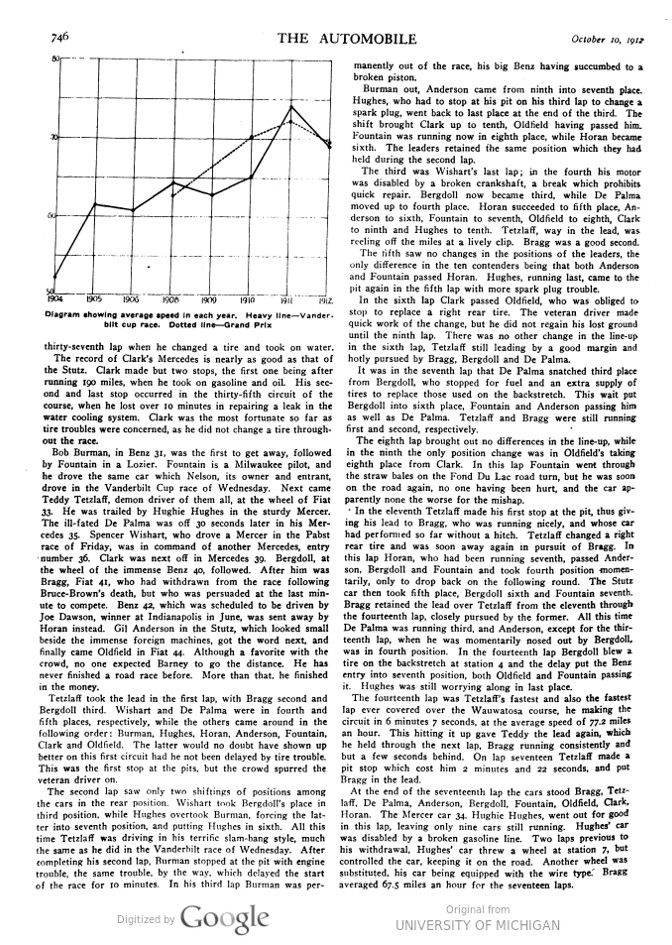
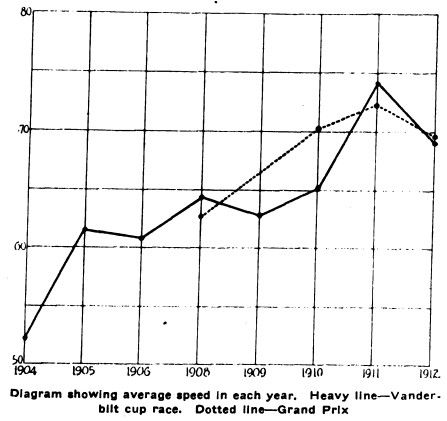
Page 746. Diagram showing average speed in each year. Heavy line – Vanderbilt cup race. Dotted line – Grand Prix
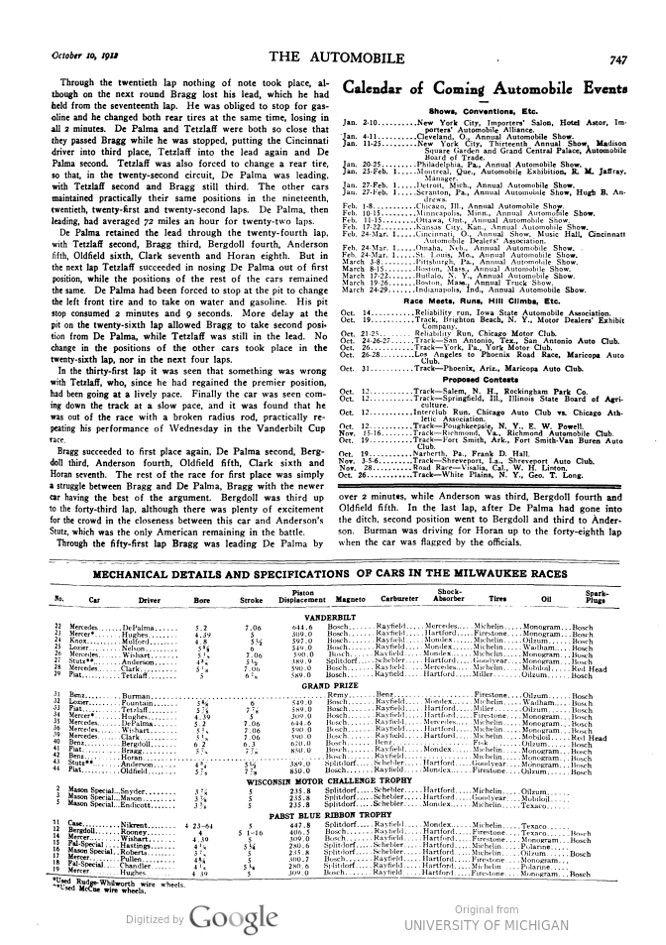
Page 747. MECHANICAL DETAILS AND SPECIFICATIONS OF CARS IN THE MILWAUKEE RACES