Introduction on the title is on it’s way.
With permission of hathitrust hathitrust.org == Text and fotos compiled by motorracinghistory motorracinghistory.com
THE AUTOMOBILE — Volume XXVII 27, No. 15, October 10, 1912, pages 707 – 710
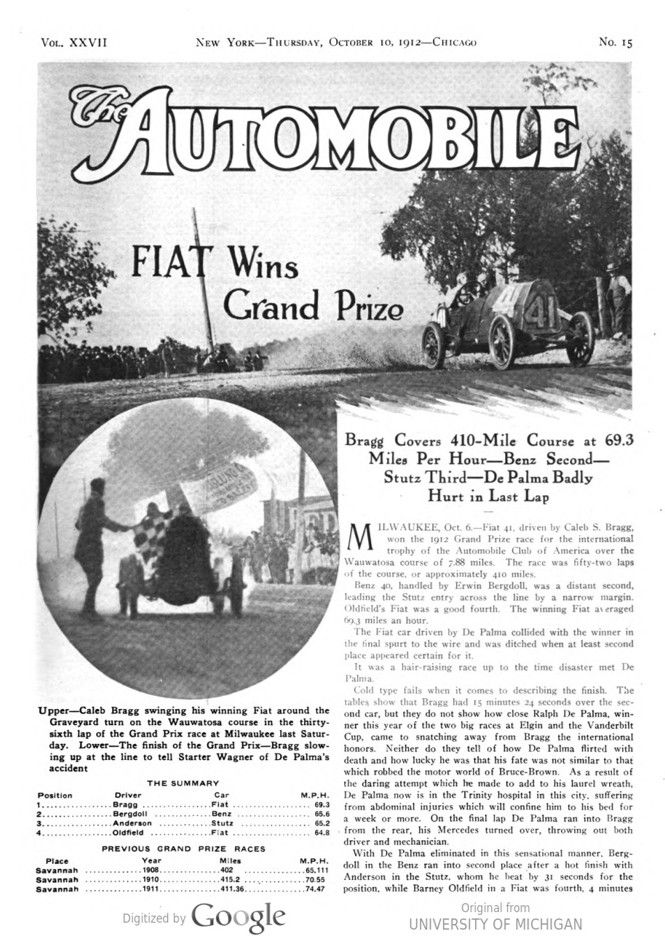
FIAT Wins Grand Prize
Bragg Covers 410-Mile Course at 69.3 Miles Per Hour – Benz Second – Stutz Third – De Palma Badly Hurt in Last Lap
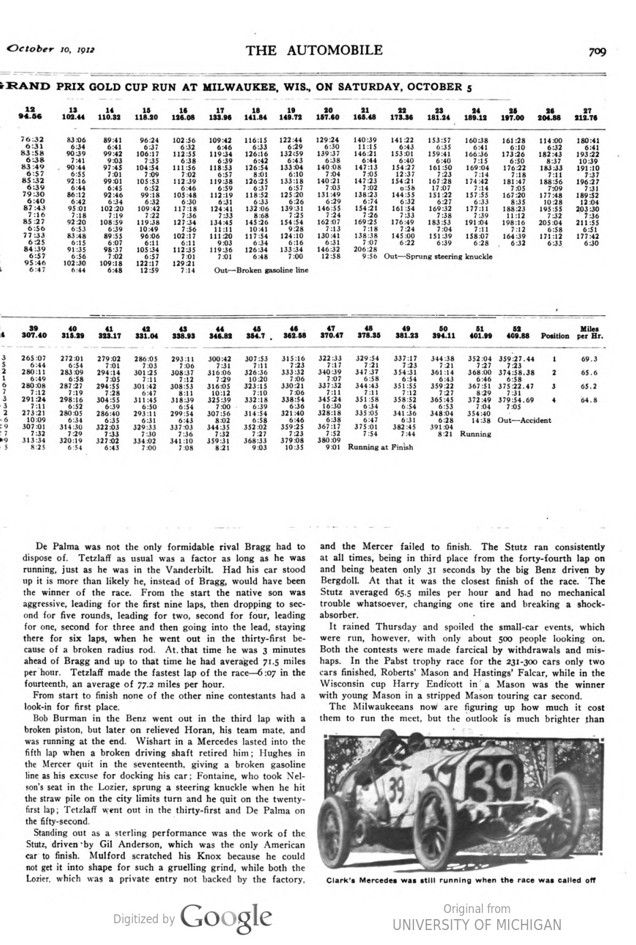
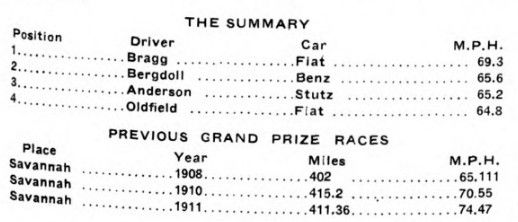
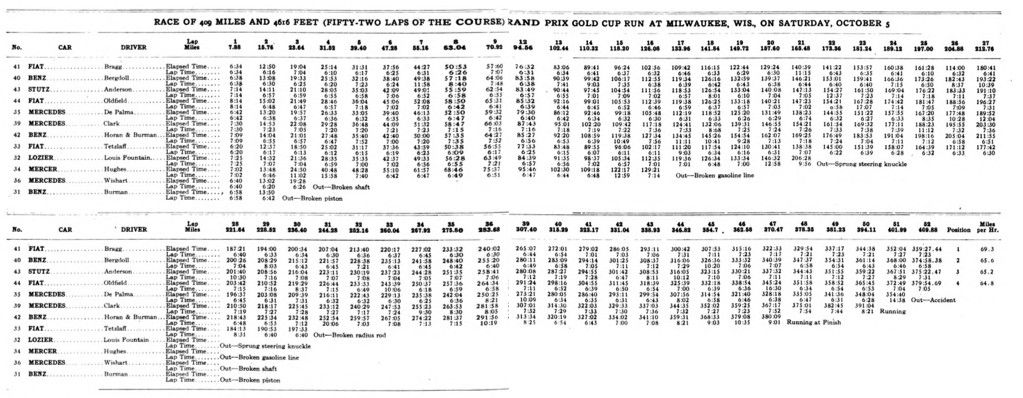
MILWAUKEE, Oct. 6. – Fiat 41, driven by Caleb S. Bragg, won the 1912 Grand Prize race for the international trophy of the Automobile Club of America over the Wauwatosa course of 7.88 miles. The race was fifty-two laps of the course, or approximately 410 miles.
Benz 40, handled by Erwin Bergdoll, was a distant second, leading the Stutz entry across the line by a narrow margin. Oldfield’s Fiat was a good fourth. The winning Fiat averaged 69.3 miles an hour.
The Fiat car driven by De Palma collided with the winner in the final spurt to the wire and was ditched when at least second place appeared certain for it. It was a hair-raising race up to the time disaster met De Palma.
Cold type fails when it comes to describing the finish. The tables show that Bragg had 15 minutes 24 seconds over the second car, but they do not show how close Ralph De Palma, winner this year of the two big races at Elgin and the Vanderbilt Cup, came to snatching away from Bragg the international honors. Neither do they tell of how De Palma flirted with death and how lucky he was that his fate was not similar to that which robbed the motor world of Bruce-Brown. As a result of the daring attempt which he made to add to his laurel wreath, De Palma now is in the Trinity hospital in this city, suffering from abdominal injuries which will confine him to his bed for a week or more. On the final lap De Palma ran into Bragg from the rear, his Mercedes turned over, throwing out both driver and mechanician.
With De Palma eliminated in this sensational manner, Bergdoll in the Benz ran into second place after a hot finish with Anderson in the Stutz, whom he beat by 31 seconds for the position, while Barney Oldfield in a Fiat was fourth, 4 minutes 32 seconds back of Anderson. Clark in a Mercedes and Burman driving Horan’s Benz were still running when the race was called off because of the crowd refusing to be held in check any longer. Twelve cars in all started in the race, but half of them were eliminated for one reason or another.
But it was the Bragg-De Palma struggle that stirred the crowd of 150,000 to a frenzy, and the accident at the eleventh hour undoubtedly robbed the motoring public of the greatest finish that ever had been put up in a grand prix race. Bragg always had been a factor in the race, never being worse than third and having led the field from the thirty-first lap when Tetzlaff went to the side lines for keeps. De Palma had been plugging along grimly, fifth and sixth at the start, then going up to third, then second and finally leading in the twenty-second, twenty-third and twenty-fourth laps, then dropping to third for four laps when Tetzlaff and Bragg were battling, and finally becoming runner-up to Bragg when Tetzlaff went out. It was a plucky battle that De Palma put up, for while Bragg had all the earmarks of a winner, the Italian never relinquished his efforts to catch him.
With four laps to go, De Palma was 4 minutes 19 seconds to the bad. He made a lap in 6:28 to Bragg’s 7:21 and cut the margin to 3 minutes 26 seconds. The fiftieth lap was made in 6:36 by De Palma and 7:26 by Bragg and the gap was reduced to 2 minutes 36 seconds, when Starter Wagner waved his green flag for both of them. De Palma was chasing his rival with deadly intensity, and upon reciving a signal from his pit to „beat it“ he stepped on the throttle and had the accelerator flat with the boards when he swung into the North Fond Du Lac road. He rushed up on the Fiat with great leaps and bounds and at station II he caught his rival. But it was necessary for him to do more than catch him-he had to pass him and beat him to the tape by the margin that Bragg had over him at the start, De Palma being 35 and Bragg 41.
Then came the thriller that spoiled the finish. There are con- flicting stories as to just how this occurred. De Palma was trying to pass, and some say that just as he crept up to the rear wheel of the Fiat, Bragg swung over a trifle and the gray Mer- cedes ran into the rear of the red car. The Mercedes turned turtle and both De Palma and his mechanic, Tom Alley, were hurled to the roadside. The collision failed to disturb Bragg, who continued on his way, a certain winner now.
At the grandstand the 10.000 occupants of the seats were awaiting the finish and there was a dead silence when Bragg drove up slowly, came to a stop at the tape and whispered to Starter Wagner, telling him of the accident.
De Palma was not the only formidable rival Bragg had to dispose of. Tetzlaff as usual was a factor as long as he was running, just as he was in the Vanderbilt. Had his car stood up it is more than likely he, instead of Bragg, would have been the winner of the race. From the start the native son was aggressive, leading for the first nine laps, then dropping to second for five rounds, leading for two, second for four, leading for one, second for three and then going into the lead, staying there for six laps, when he went out in the thirty-first because of a broken radius rod. At. that time he was 3 minutes ahead of Bragg and up to that time he had averaged 71.5 miles per hour. Tetzlaff made the fastest lap of the race – 6:07 in the fourteenth, an average of 77.2 miles per hour.
From start to finish none of the other nine contestants had a look-in for first place. Bob Burman in the Benz went out in the third lap with a broken piston, but later on relieved Horan, his team mate, and was running at the end. Wishart in a Mercedes lasted into the fifth lap when a broken driving shaft retired him; Hughes in the Mercer quit in the seventeenth, giving a broken gasoline line as his excuse for docking his car; Fontaine, who took Nelson’s seat in the Lozier, sprung a steering knuckle when he hit the straw pile on the city limits turn and he quit on the twenty- first lap; Tetzlaff went out in the thirty-first and De Palma on the fifty-second.
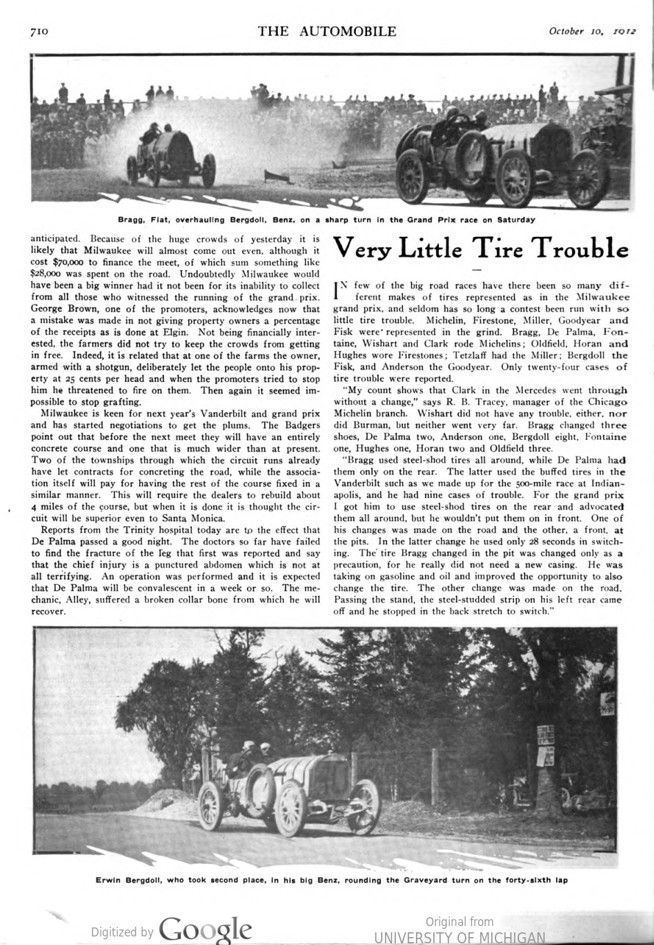
Standing out as a sterling performance was the work of the Stutz, driven by Gil Anderson, which was the only American car to finish. Mulford scratched his Knox because he could not get it into shape for such a gruelling grind, while both the Lozier, which was a private entry not backed by the factory, and the Mercer failed to finish. The Stutz ran consistently at all times, being in third place from the forty-fourth lap on and being beaten only 31 seconds by the big Benz driven by Bergdoll. At that it was the closest finish of the race. The Stutz averaged 65.5 miles per hour and had no mechanical trouble whatsoever, changing one tire and breaking a shock-absorber.
It rained Thursday and spoiled the small-car events, which were run, however, with only about 500 people looking on. Both the contests were made farcical by withdrawals and mishaps. In the Pabst trophy race for the 231-300 cars only two cars finished, Roberts‘ Mason and Hastings‘ Falcar, while in the Wisconsin cup Harry Endicott in a Mason was the winner with young Mason in a stripped Mason touring car second.
The Milwaukeeans now are figuring up how much it cost them to run the meet, but the outlook is much brighter than anticipated. Because of the huge crowds of yesterday it is likely that Milwaukee will almost come out even, although it cost $70,000 to finance the meet, of which sum something like $28,000 was spent on the road. Undoubtedly Milwaukee would have been a big winner had it not been for its inability to collect from all those who witnessed the running of the grand prix. George Brown, one of the promoters, acknowledges now that a mistake was made in not giving property owners a percentage of the receipts as is done at Elgin. Not being financially interested, the farmers did not try to keep the crowds from getting in free. Indeed, it is related that at one of the farms the owner, armed with a shotgun, deliberately let the people onto his property at 25 cents per head and when the promoters tried to stop him he threatened to fire on them. Then again it seemed im- possible to stop grafting.
Milwaukee is keen for next year’s Vanderbilt and grand prix and has started negotiations to get the plums. The Badgers point out that before the next meet they will have an entirely concrete course and one that is much wider than at present. Two of the townships through which the circuit runs already have let contracts for concreting the road, while the association itself will pay for having the rest of the course fixed in a similar manner. This will require the dealers to rebuild about 4 miles of the course, but when it is done it is thought the circuit will be superior even to Santa Monica.
Reports from the Trinity hospital today are to the effect that De Palma passed a good night. The doctors so far have failed to find the fracture of the leg that first was reported and say that the chief injury is a punctured abdomen which is not at all terrifying. An operation was performed and it is expected that De Palma will be convalescent in a week or so. The mechanic, Alley, suffered a broken collar bone from which he will recover.
Very Little Tire Trouble
IN few of the big road races have there been so many different makes of tires represented as in the Milwaukee grand prix, and seldom has so long a contest been run with so little tire trouble. Michelin, Firestone, Miller, Goodyear and Fisk were represented in the grind. Bragg, De Palma, Fontaine, Wishart and Clark rode Michelins; Oldfield, Horan and Hughes wore Firestones; Tetzlaff had the Miller; Bergdoll the Fisk, and Anderson the Goodyear. Only twenty-four cases of tire trouble were reported.
„My count shows that Clark in the Mercedes went through without a change,“ says R. B. Tracey, manager of the Chicago Michelin branch. Wishart did not have any trouble, either, nor did Burman, but neither went very far. Bragg changed three shoes, De Palma two, Anderson one, Bergdoll eight, Fontaine one, Hughes one, Horan two and Oldfield three.
„Bragg used steel-shod tires all around, while De Palma had them only on the rear. The latter used the buffed tires in the Vanderbilt such as we made up for the 500-mile race at Indianapolis, and he had nine cases of trouble. For the grand prix I got him to use steel-shod tires on the rear and advocated them all around, but he wouldn’t put them on in front. One of his changes was made on the road and the other, a front, at the pits. In the latter change he used only 28 seconds in switching. The tire Bragg changed in the pit was changed only as a precaution, for he really did not need a new casing. He was taking on gasoline and oil and improved the opportunity to also change the tire. The other change was made on the road. Passing the stand, the steel-studded strip on his left rear came off and he stopped in the back stretch to switch.“
Photos.
Page 707.
Upper – Caleb Bragg swinging his winning Fiat around the Graveyard turn on the Wauwatosa course in the thirty-sixth lap of the Grand Prix race at Milwaukee last Saturday.
Lower – The finish of the Grand Prix-Bragg slowing up at the line to tell Starter Wagner of De Palma’s accident
Page 708 -709.
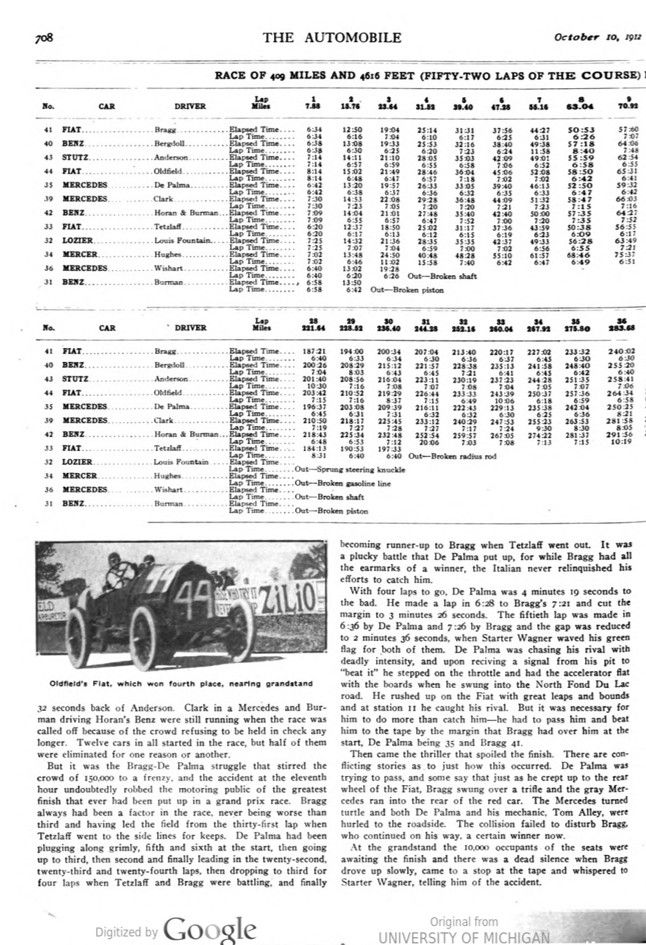
RACE OF 409 MILES AND 4616 FEET (FIFTY-TWO LAPS OF THE COURSE) FOR THE GRAND PRIX GOLD CUP RUN AT MILWAUKEE, WIS., ON SATURDAY, OCTOBER 5
Oldfield’s Fiat, which won fourth place, nearing grandstand – Clark’s Mercedes was still running when the race was called off
Page 710.
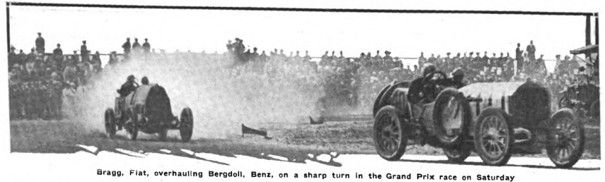
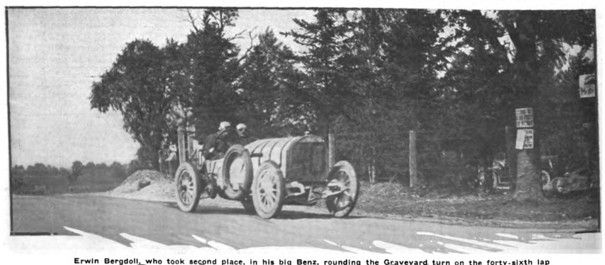
Bragg, Fiat, overhauling Bergdoll, Benz, on a sharp turn in the Grand Prix race on Saturday – Erwin Bergdoll, who took second place, in his big Benz, rounding the Graveyard turn on the forty-sixth lap