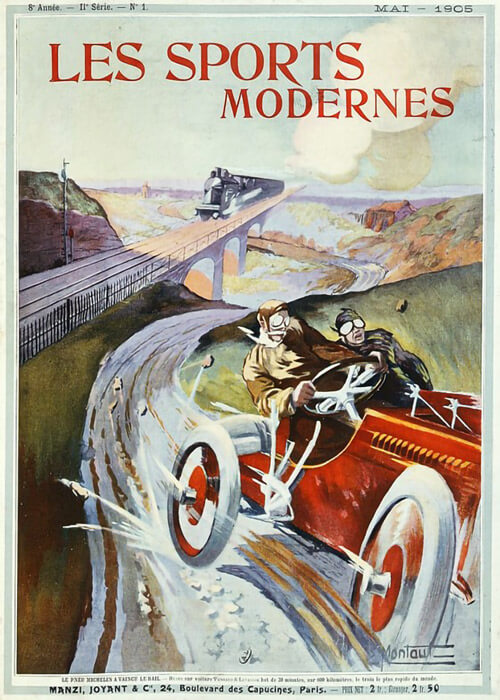
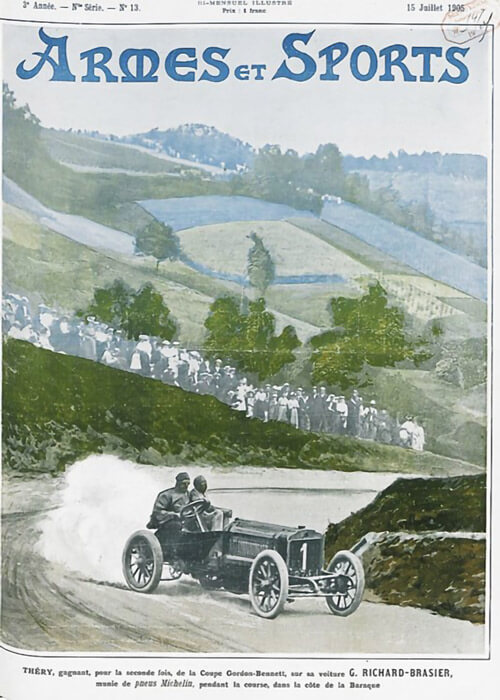
Winning both the Grand Prize and the Vanderbilt Cup race within just about a week, was not very common. especially since Dario (Darius) Resta was not well-known at that time. The Italy-born, British citizen now became not only well-known, but many admired his driving abilities. Such was also written in this report. Some three months later, he finished second in the Indianapolis 500 Sweepstakes, after a late pitstop for changing tires.
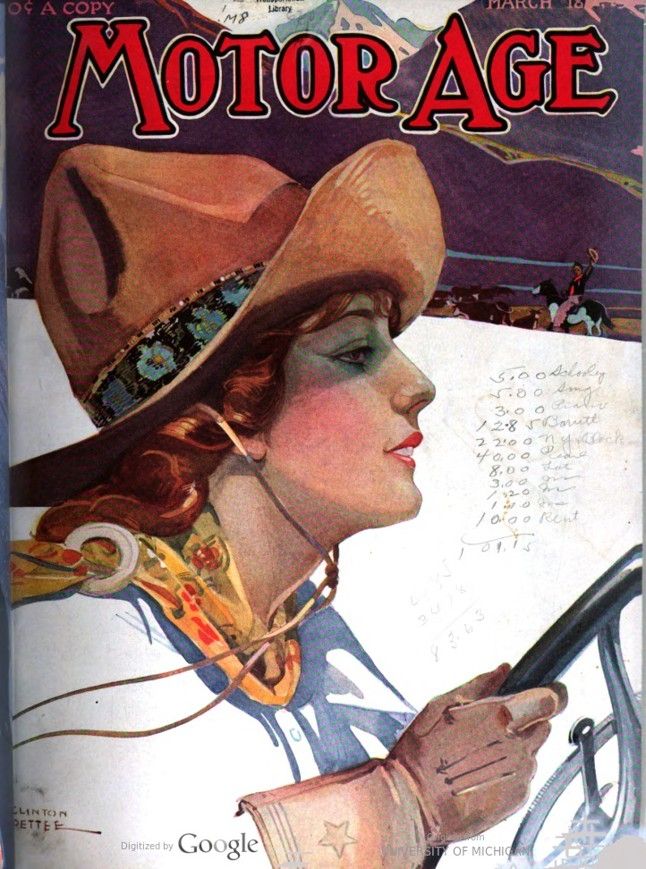
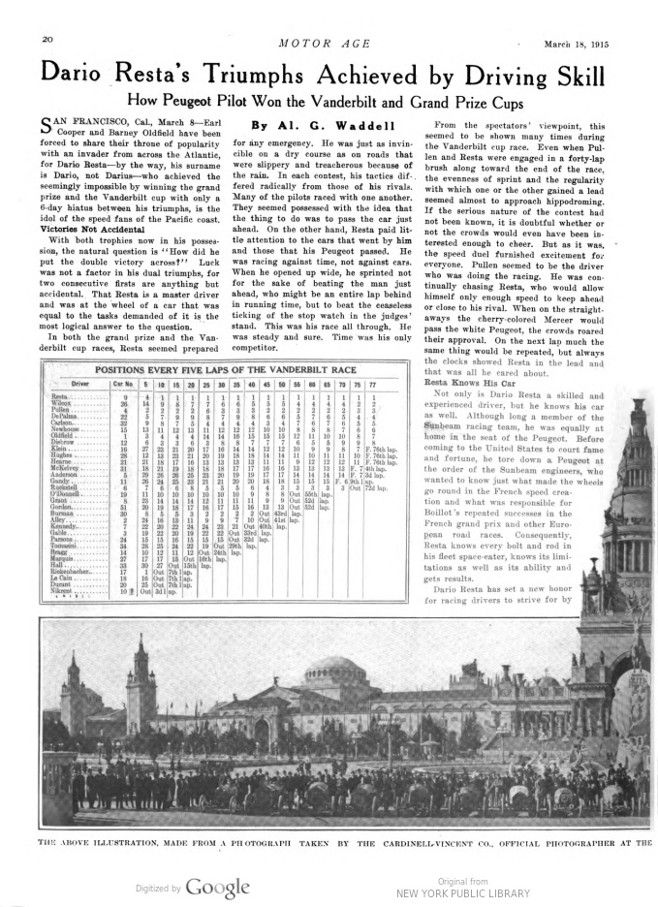
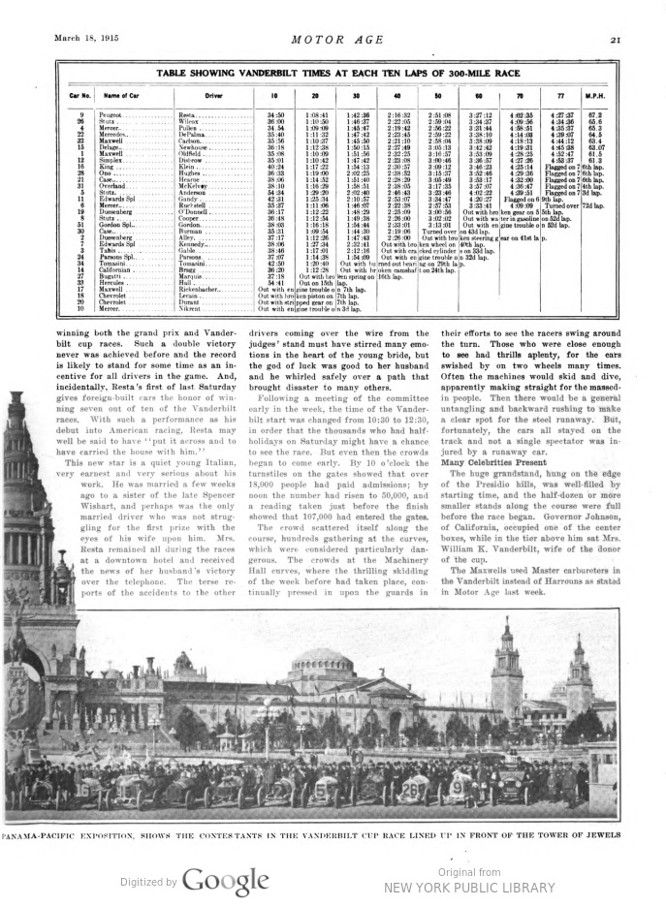
With permission of hathitrust hathitrust.org == Text and fotos compiled by motorracinghistory motorracinghistory.com
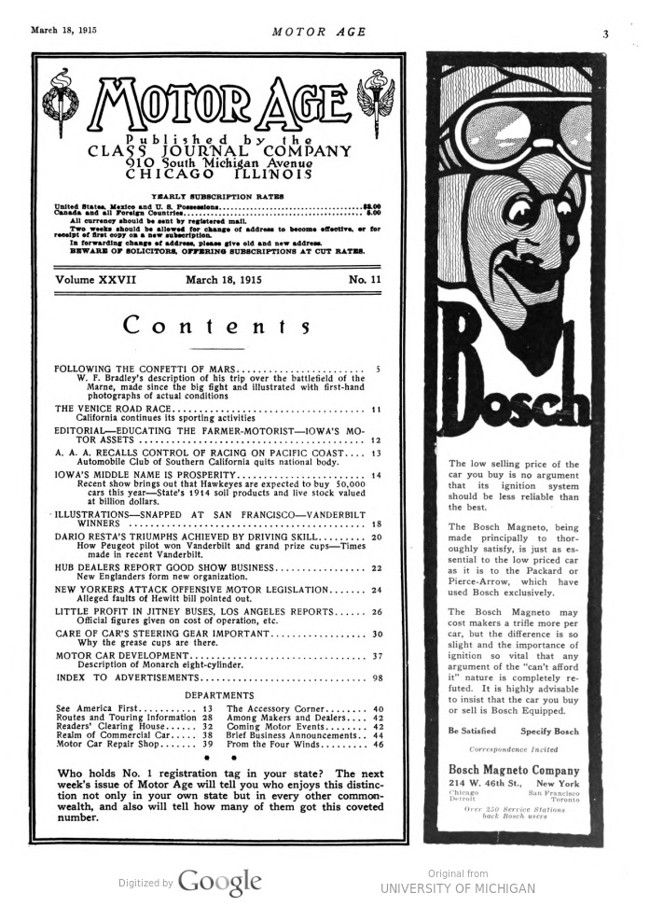
MOTOR AGE Vol. XXVIII, No.11, March 18, 1915
Dario Resta’s Triumphs Achieved by Driving Skill
How Peugeot Pilot Won the Vanderbilt and Grand Prize Cups
By Al. G. Waddell
SAN FRANCISCO, Cal., March 8 – Earl Cooper and Barney Oldfield have been forced to share their throne of popularity with an invader from across the Atlantic, for Dario Resta – by the way, his surname is Dario, not Darius – who achieved the seemingly impossible by winning the grand prize and the Vanderbilt cup with only a 6-day hiatus between his triumphs, is the idol of the speed fans of the Pacific coast.
Victories Not Accidental
With both trophies now in his possession, the natural question is “How did he put the double victory across?” Luck was not a factor in his dual triumphs, for two consecutive firsts are anything but accidental. That Resta is a master driver and was at the wheel of a car that was equal to the tasks demanded of it is the most logical answer to the question. In both the grand prize and the Vanderbilt cup races, Resta seemed prepared for any emergency. He was just as invincible on a dry course as on roads that were slippery and treacherous because of the rain. In each contest, his tactics differed radically from those of his rivals. Many of the pilots raced with one another. They seemed possessed with the idea that the thing to do was to pass the car just ahead. On the other hand, Resta paid little attention to the cars that went by him and those that his Peugeot passed. He was racing against time, not against cars. When he opened up wide, he sprinted not for the sake of beating the man just ahead, who might be an entire lap behind in running time, but to beat the ceaseless ticking of the stop watch in the judges’ stand. This was his race all through. He was steady and sure. Time was his only competitor.
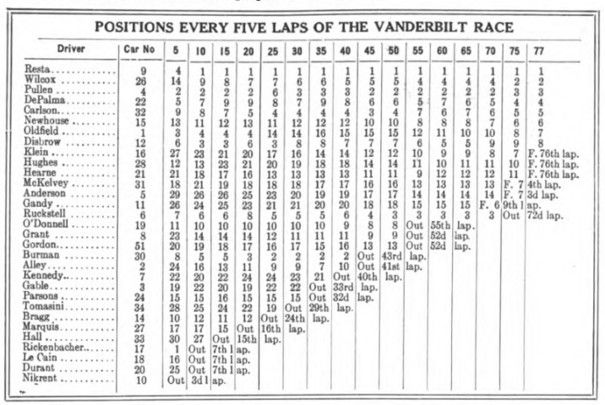
From the spectators’ viewpoint, this seemed to be shown many times during the Vanderbilt cup race. Even when Pullen and Resta were engaged in a forty-lap brush along toward the end of the race, the evenness of sprint and the regularity with which one or the other gained a lead seemed almost to approach hippodroming. If the serious nature of the contest had not been known, it is doubtful whether or not the crowds would even have been interested enough to cheer. But as it was, the speed duel furnished excitement for everyone. Pullen seemed to be the driver who was doing the racing. He was continually chasing Resta, who would allow himself only enough speed to keep ahead or close to his rival. When on the straight-aways the cherry-colored Mercer would pass the white Peugeot, the crowds roared their approval. On the next lap much the same thing would be repeated, but always the clocks showed Resta in the lead and that was all he cared about.
Resta Knows His Car
Not only is Dario Resta a skilled and experienced driver, but he knows his car as well. Although long a member of the Sunbeam racing team, he was equally at home in the seat of the Peugeot. Before coming to the United States to court fame and fortune, he tore down a Peugeot at the order of the Sunbeam engineers, who wanted to know just what made the wheels go round in the French speed creation and what was responsible for Boillot’s repeated successes in the French grand prix and other European road Consequently, Resta knows every bolt and rod in his fleet space-eater, knows its limitations as well as its ability and gets results. races. Dario Resta has set a new honor for racing drivers to strive for by winning both the grand prix and Vanderbilt cup races. Such a double victory never was achieved, before and the record is likely to stand for some time as an incentive for all drivers in the game. And, incidentally, Resta’s first of last Saturday gives foreign-built cars the honor of winning seven out of ten of the Vanderbilt races. With such a performance as his debut into American racing, Resta may well be said to have “put it across and to have carried the house with him.”
This new star is a quiet young Italian, very earnest and very serious about his work. He was married a few weeks ago to a sister of the late Spencer Wishart, and perhaps was the only married driver who was not struggling for the first prize with the eyes of his wife upon him. Mrs. Resta remained all during the races at a downtown hotel and received the news of her husband’s victory over the telephone. The terse reports of the accidents to the other drivers coming over the wire from the judges’ stand must have stirred many emotions in the heart of the young bride, but the god of luck was good to her husband and he whirled safely over a path that brought disaster to many others.
Following a meeting of the committee early in the week, the time of the Vanderbilt start was changed from 10:30 to 12:30, in order that the thousands who had half-holidays on Saturday might have a chance to see the race. But even then the crowds began to come early. By 10 o’clock the turnstiles on the gates showed that over 18,000 people had paid admissions; by noon the number had risen to 50,000, and a reading taken just before the finish showed that 107,000 had entered the gates.
The crowd scattered itself along the course, hundreds gathering at the curves, which were considered particularly dangerous. The crowds at the Machinery Hall curves, where the thrilling skidding of the week before had taken place, continually pressed in upon the guards in their efforts to see the racers swing around the turn. Those who were close enough to see had thrills aplenty, for the cars swished by on two wheels many times. Often the machines would skid and dive, apparently making straight for the massed-in people. Then there would be a general untangling and backward rushing to make a clear spot for the steel runaway. But fortunately, the cars all stayed on the track and not a single spectator was injured by a runaway car.
Many Celebrities Present
The huge grandstand, hung on the edge of the Presidio hills, was well-filled by starting time, and the half-dozen or more smaller stands along the course were full before the race began. Governor Johnson, of California, occupied one of the center boxes, while in the tier above him sat Mrs. William K. Vanderbilt, wife of the donor of the cup. The Maxwells used Master carbureters in the Vanderbilt instead of Harrouns as stated in Motor Age last week.
Photos.
Page 20-21.
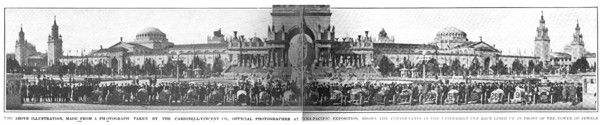
THE ABOVE ILLUSTRATION, MADE FROM A PHOTOGRAPH TAKEN BY THE CARDINELL-VINCENT CO., OFFICIAL PHOTOGRAPHER AT THE PANAMA-PACIFIC EXPOSITION, SHOWS THE CONTESTANTS IN THE VANDERBILT CUP RACE LINED UP IN FRONT OF THE TOWER OF JEWELS
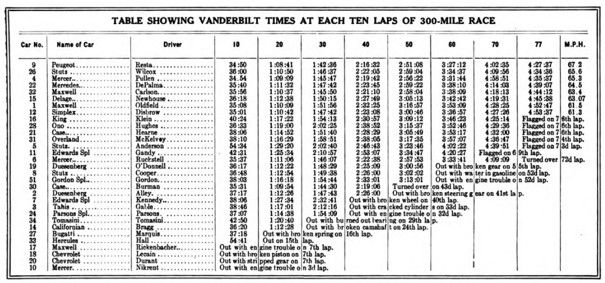
POSITIONS EVERY FIVE LAPS OF THE VANDERBILT RACE – TABLE SHOWING VANDERBILT TIMES AT EACH TEN LAPS OF 300-MILE RACE