The second Savannah Grand Prize for 1910 only had limited time available for preparation. A shorter course than in 1908 of 17 miles was laid out. Although less Europen contestants appered on the start, the race was even more eventful than it’s predecessor. In the last part of the race, three cars were within striking distance of each other. After De Palma’s engine cracked down in the lap before the last, this last lap saw a raging battle between the remaining two of that trio; Victor Hémery and David Bruce-Brown, both in a Benz. Finally Bruce-Brown came out as the winner, with just a wee bit more than one second difference. The closest finish up to then ever seen. Again, the Savannah Grand Prize was a fulminant succes.
Text and jpegs by courtesy of hathitrust.org www.hathitrust.org, compiled by motorracinghistory
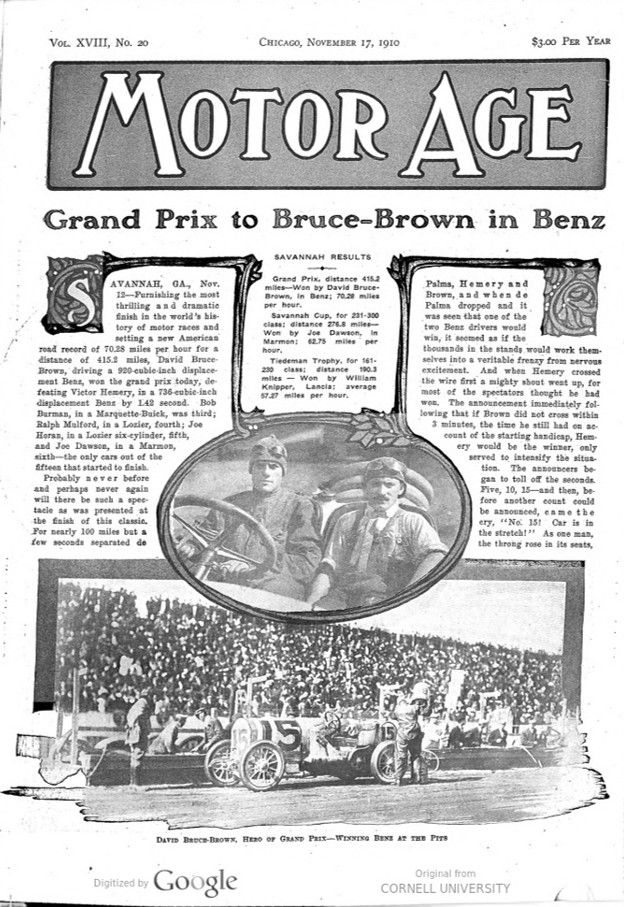
MOTOR AGE Vol. XVIII, No. 20, November 17, 1910
Grand Prix to Bruce-Brown in Benz
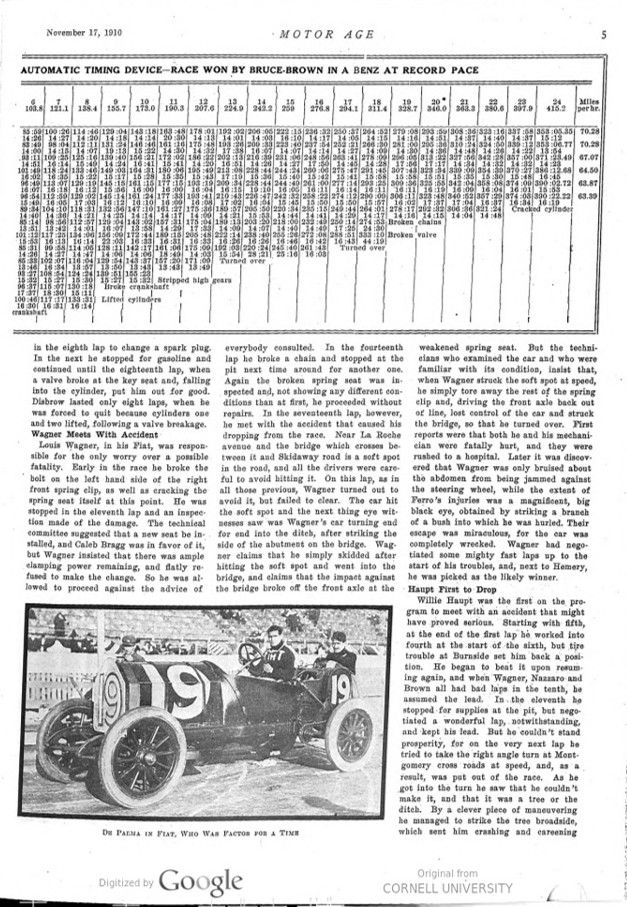
SAVANNAH, GA., Nov. 12 – Furnishing the most thrilling and dramatic finish in the world’s history of motor races and setting a new American road record of 70.28 miles per hour for a distance of 415.2 miles, David Bruce-Brown, driving a 920-cubic-inch displacement Benz, won the grand prix today, defeating Victor Hemery, in a 736-cubic-inch displacement Benz by 1.42 second. Bob Burman, in a Marquette-Buick, was third; Ralph Mulford, in a Lozier, fourth; Joe Horan, in a Lozier six-cylinder, fifth, and Joe Dawson, in a Marmon, sixth-the only cars out of the fifteen that started to finish.
SAVANNAH RESULTS
Grand Prix, distance 415.2 miles – Won by David Bruce-Brown, in Benz; 70.28 miles per hour.
Savannah Cup, for 231-300 class; distance 276.8 miles – Won by Joe Dawson, in Marmon; 62.75 miles per hour.
Tiedeman Trophy, for 161-230 class; distance 190.3 miles – Won by William Knipper, Lancia; average 57.27 miles per hour.
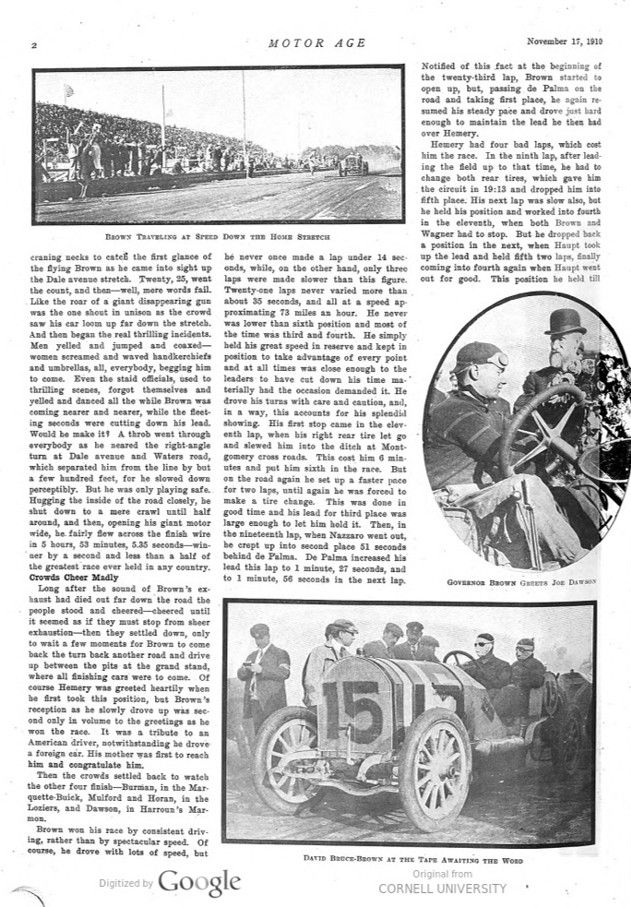
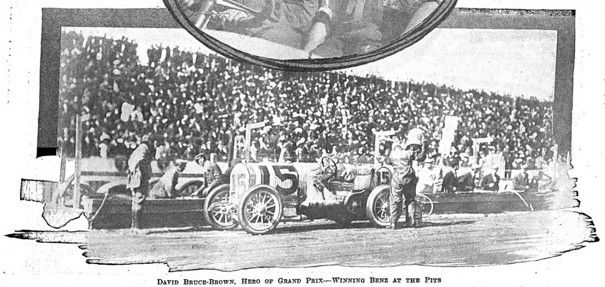
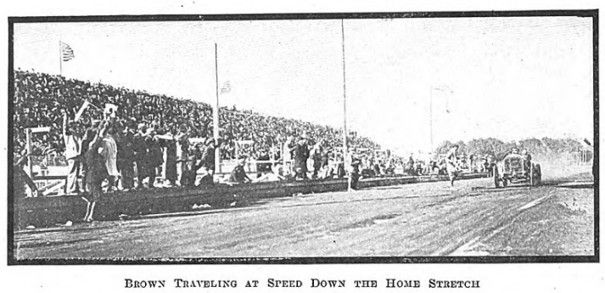
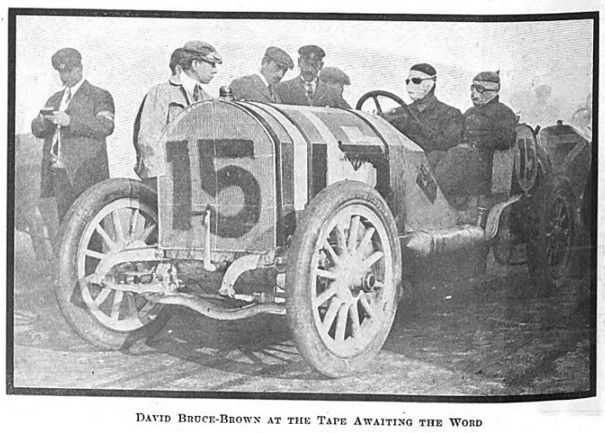
Probably never before and perhaps never again will there be such a spectacle as was presented at the finish of this classic. For nearly 100 miles but a few seconds separated de Palma, Hemery and Brown, and when de Palma dropped and it was seen that one of the two Benz drivers would win, it seemed as if the thousands in the stands would work themselves into a veritable frenzy from nervous excitement. And when Hemery crossed the wire first a mighty shout went up, for most of the spectators thought he had won. The announcement immediately following that if Brown did not cross within 3 minutes, the time he still had on account of the starting handicap, Hemery would be the winner, only served to intensify the situation. The announcers began to toll off the seconds. Five, 10, 15 – and then, before another count could be announced, came the cry, „No. 15! Car is in the stretch!“ As one man, the throng rose in its seats, craning necks to catch the first glance of the flying Brown as he came into sight up the Dale avenue stretch. Twenty, 25, went the count, and then – well, mere words fail. Like the roar of a giant disappearing gun was the one shout in unison as the crowd saw his car loom up far down the stretch. And then began the real thrilling incidents. Men yelled and jumped and coaxed – women screamed and waved handkerchiefs and umbrellas, all, everybody, begging him to come. Even the staid officials, used to thrilling scenes, forgot themselves and yelled and danced all the while Brown was coming nearer and nearer, while the fleeting seconds were cutting down his lead. Would he make it? A throb went through everybody as he neared the right-angle turn at Dale avenue and Waters road, which separated him from the line by but a few hundred feet, for he slowed down perceptibly. But he was only playing safe. Hugging the inside of the road closely, he shut down to a mere crawl until half around, and then, opening his giant motor wide, he. fairly flew across the finish wire in 5 hours, 53 minutes, 5.35 seconds – winner by a second and less than a half of the greatest race ever held in any country.
Crowds Cheer Madly
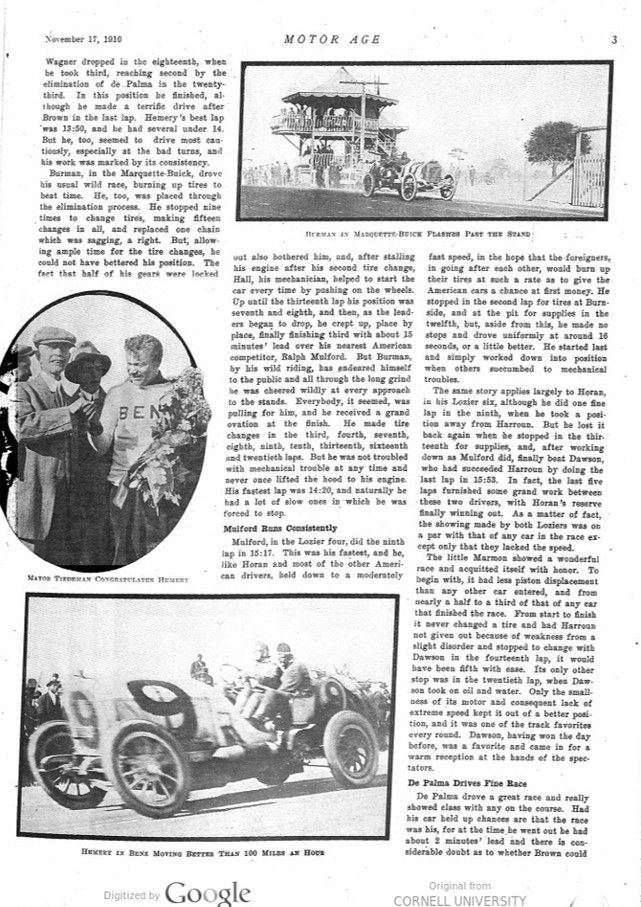
Long after the sound of Brown’s exhaust had died out far down the road the people stood and cheered – cheered until it seemed as if they must stop from sheer exhaustion – then they settled down, only to wait a few moments for Brown to come back the turn back another road and drive up between the pits at the grand stand, where all finishing cars were to come. Of course, Hemery was greeted heartily when he first took this position, but Brown’s reception as he slowly drove up was second only in volume to the greetings as he won the race. It was a tribute to an American driver, notwithstanding he drove a foreign car. His mother was first to reach him and congratulate him.
Then the crowds settled back to watch the other four finish – Burman, in the Marquette-Buick, Mulford and Horan, in the Loziers, and Dawson, in Harroun’s Marmon.
Brown won his race by consistent driving, rather than by spectacular speed. Of course, he drove with lots of speed, but he never once made a lap under 14 seconds, while, on the other hand, only three laps were made slower than this figure. Twenty-one laps never varied more than about 35 seconds, and all at a speed approximating 73 miles an hour. He never was lower than sixth position and most of the time was third and fourth. He simply held his great speed in reserve and kept in position to take advantage of every point and at all times was close enough to the leaders to have cut down his time materially had the occasion demanded it. He drove his turns with care and caution, and, in a way, this accounts for his splendid showing. His first stop came in the eleventh lap, when his right rear tire let go and slewed him into the ditch at Montgomery cross roads. This cost him 6 minutes and put him sixth in the race. But on the road again he set up a faster pace for two laps, until again he was forced to make a tire change. This was done in good time and his lead for third place was large enough to let him hold it. Then, in the nineteenth lap, when Nazzaro went out, he crept up into second place 51 seconds behind de Palma. De Palma increased his lead this lap to 1 minute, 27 seconds, and to 1 minute, 56 seconds in the next lap.
Notified of this fact at the beginning of the twenty-third lap, Brown started to open up, but, passing de Palma on the road and taking first place, he again resumed his steady pace and drove just hard enough to maintain the lead he then had over Hemery.
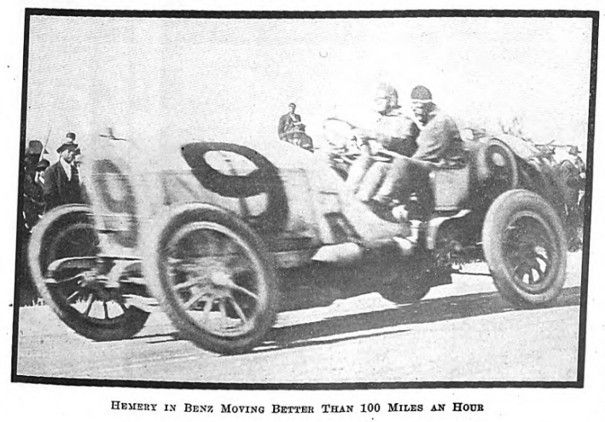
Hemery had four bad laps, which cost him the race. In the ninth lap, after leading the field up to that time, he had to change both rear tires, which gave him the circuit in 19:13 and dropped him into fifth place. His next lap was slow also, but he held his position and worked into fourth in the eleventh, when both Brown and Wagner had to stop. But he dropped back a position in the next, when Haupt took up the lead and held fifth two laps, finally coming into fourth again when Haupt went out for good. This position he held till Wagner dropped in the eighteenth, when he took third, reaching second by the elimination of de Palma in the twenty-third. In this position he finished, although he made a terrific drive after Brown in the last lap. Hemery’s best lap ‚was 13:50, and he had several under 14. But he, too, seemed to drive most cautiously, especially at the bad turns, and his work was marked by its consistency.
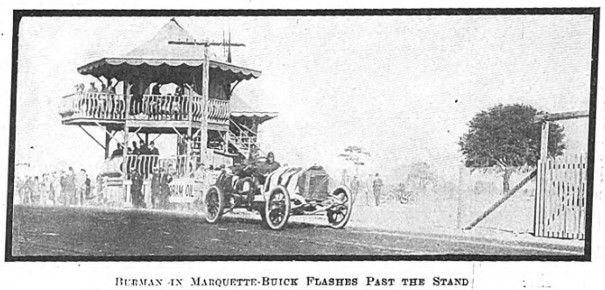
Burman, in the Marquette-Buick, drove his usual wild race, burning up tires to beat time. He, too, was placed through the elimination process. He stopped nine times to change tires, making fifteen changes in all, and replaced one chain which was sagging, a right. But, allowing ample time for the tire changes, he could not have bettered his position. The fact that half of his gears were locked out also bothered him, and, after stalling his engine after his second tire change, Hall, his mechanician, helped to start the car every time by pushing on the wheels. Up until the thirteenth lap his position was seventh and eighth, and then, as the leaders began to drop, he crept up, place by place, finally finishing third with about 15 minutes‘ lead over his nearest American competitor, Ralph Mulford. But Burman, by his wild riding, has endeared himself to the public and all through the long grind he was cheered wildly at every approach to the stands. Everybody, it seemed, was pulling for him, and he received a grand ovation at the finish. He made tire changes in the third, fourth, seventh, eighth, ninth, tenth, thirteenth, sixteenth and twentieth laps. But he was not troubled with mechanical trouble at any time and never once lifted the hood to his engine. His fastest lap was 14:20, and naturally he had a lot of slow ones in which he was forced to stop.
Mulford Runs Consistently
Mulford, in the Lozier four, did the ninth lap in 15:17. This was his fastest, and he, like Horan and most of the other American drivers, held down to a moderately fast speed, in the hope that the foreigners, in going after each other, would burn up their tires at such a rate as to give the American cars a chance at first money. He stopped in the second lap for tires at Burnside, and at the pit for supplies in the twelfth, but, aside from this, he made no stops and drove uniformly at around 16 seconds, or a little better. He started last and simply worked down into position when others succumbed to mechanical troubles.
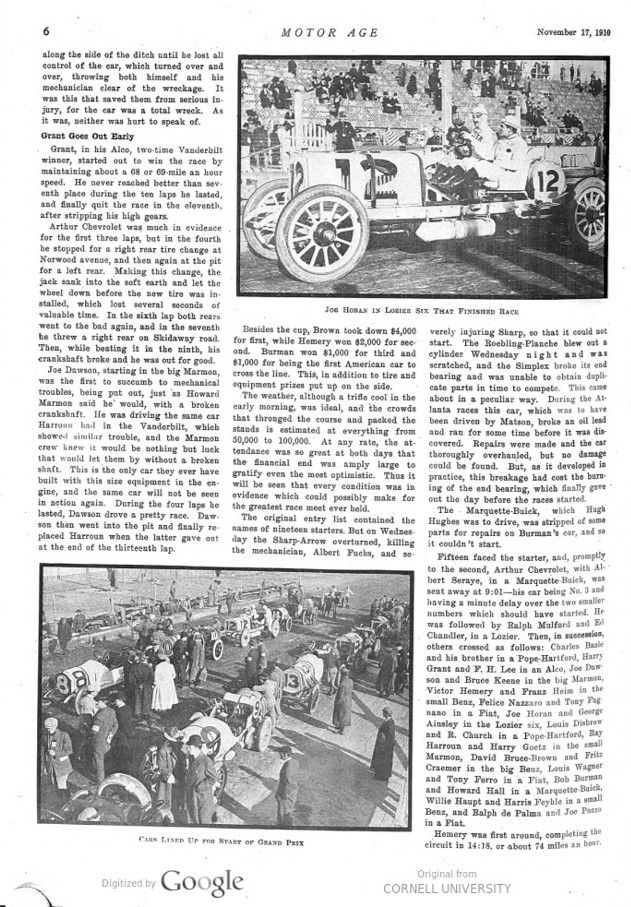
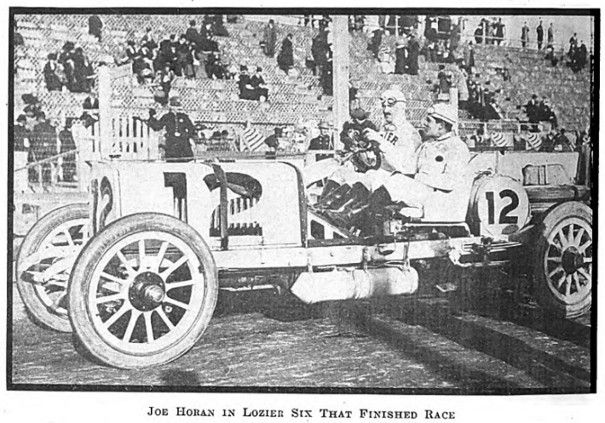
The same story applies largely to Horan, in his Lozier six, although he did one fine lap in the ninth, when he took a position away from Harroun. But he lost it back again when he stopped in the thirteenth for supplies, and, after working down as Mulford did, finally beat Dawson, who had succeeded Harroun by doing the last lap in 15:53. In fact, the last five laps furnished some grand work between these two drivers, with Horan’s reserve finally winning out. As a matter of fact, the showing made by both Loziers was on a par with that of any car in the race except only that they lacked the speed.
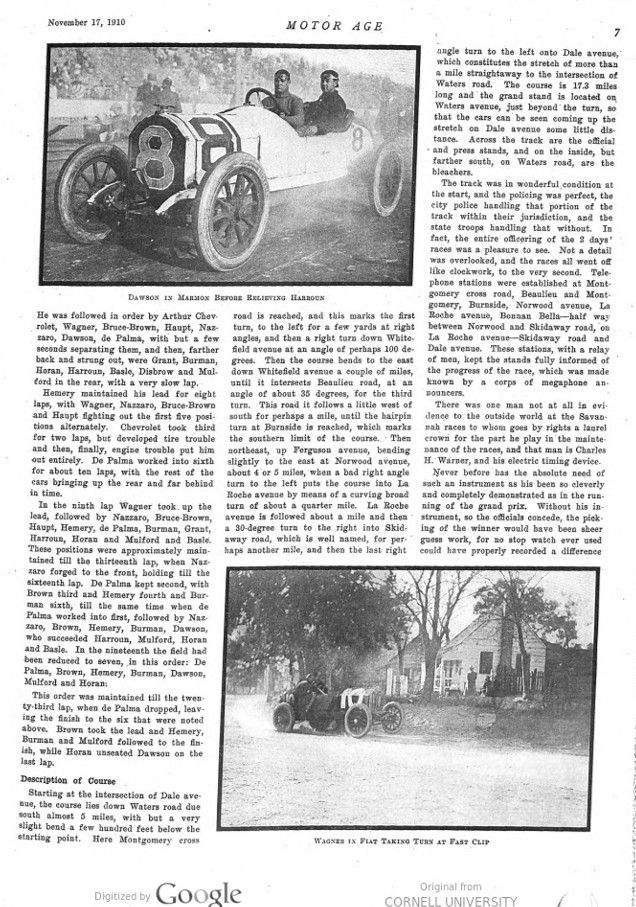
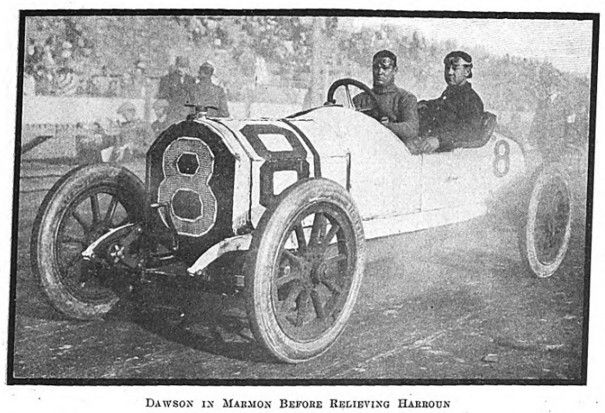
The little Marmon showed a wonderful race and acquitted itself with honor. To begin with, it had less piston displacement than any other car entered, and from nearly a half to a third of that of any car that finished the race. From start to finish it never changed a tire and had Harroun not given out because of weakness from a slight disorder and stopped to change with Dawson in the fourteenth lap, it would have been fifth with ease. Its only other stop was in the twentieth lap, when Dawson took on oil and water. Only the smallness of its motor and consequent lack of extreme speed kept it out of a better position, and it was one of the track favorites every round. Dawson, having won the day before, was a favorite and came in for a warm reception at the hands of the spectators.
De Palma Drives Fine Race
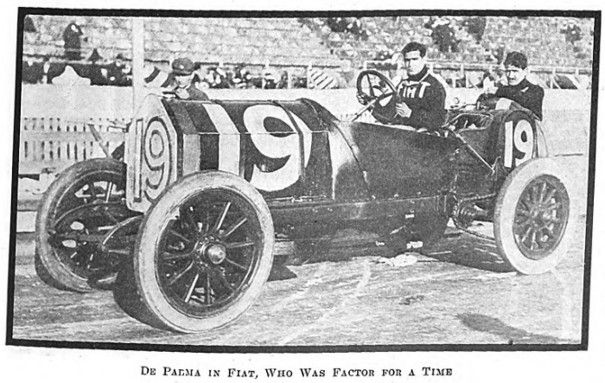
De Palma drove a great race and really showed class with any on the course. Had his car held up chances are that the race was his, for at the time he went out he had about 2 minutes‘ lead and there is considerable doubt as to whether Brown could have cut him down. Starting carefully, he hung onto sixth and seventh and eighth positions till the middle of the race, and then, when others began to fall, he commenced to cut down his time until he finally worked into the lead. In the twelfth he made his first stop to change a right rear and then made the lap next time in 14:21. In the thirteenth he stopped at the pit for supplies and took 15:53 to the lap. But that was his only slow lap after he got well started, and most of them were down around 14. His twenty-first was a fine lap, his fastest, in fact, 14:04, but in the next he began to slow down on account of the trouble that finally developed. The vibration and jar had broken a water connection and his radiator ran dry. On his last lap he noticed that the engine missed a few times, but it came in, apparently, and he concluded that it was a dirty plug that had finally cleared. But on the twenty-third lap his engine went all to the bad and investigation showed a cracked rear cylinder as the result of an empty radiator.
Dizzy Pace Set by Nazzaro
Nazzaro furnished about as much excitement as any entrant in the race, as well as the fastest lap. Starting in sixth position in the first and second laps, the clever Italian worked his way up by fast driving until he had reached second place in the sixth lap. Then, in the seventh, he negotiated the fastest lap of the race, in 13:42, or at the rate of almost 76 miles an hour. The next lap he continued his breakneck drive and probably lost the race as a result. Coming to the turn at Burnside he threw his right rear tire and skidded off into the ditch, bending his right side of the rear axle so that the line of tread was at least 6 or 7 inches nearer the center line of the chassis than it should have been. But he replaced the tire and drove like mad, making the lap in 14:01 in spite of the stop. In the next lap, however, he stopped for supplies, and the damaged rear axle having been reported to the technical committee and to Referee Morrell, he was held up in the eleventh lap for an inspection of the best rear member. In the meantime, Caleb Bragg, in charge of the team, had asked the committee to act upon the question of repairing the damage, and it was decided to put it up to Nazzaro. He insisted that the bend didn’t make any difference, and so was allowed to continue the race. But from that time on he was unable to attain the speed he had shown previously, although he made fast laps around 14 until the seventeenth, when he broke his right chain. He repaired the injury and proceeded, with some loss of time, and then, in the next lap, the chain broke again. Once more he made a repair, only to break another chain on the nineteenth lap, and, not having another which would fit his car in the camp, he was forced to quit the race. The interesting feature of this series of events lies in the fact that the right chain, which drove the bent axle, held up perfectly all through the race, while the left chain was the one that broke three times. This is explained by the technical men in this way: The bending of the right side of the axle threw the greater tractive effort on the left side and made the strain too great for that chain to bear. Nazzaro drove a great race while he lasted, and for four laps after his first misfortune was leading the procession.
The Pope-Hartfords kept up to their hard luck record set at Atlanta the week before. Basle, starting sixth, finished the first lap thirteenth, and kept about this position for ten laps, when he moved up a few notches when the other cars commenced to drop out. But he made no remarkably fast laps at any time, and stopped first at Montgomery crossroads in the eighth lap to change a spark plug. In the next he stopped for gasoline and continued until the eighteenth lap, when a valve broke at the key seat and, falling into the cylinder, put him out for good. Disbrow lasted only eight laps, when he was forced to quit because cylinders one and two lifted, following a valve breakage.
Wagner Meets With Accident
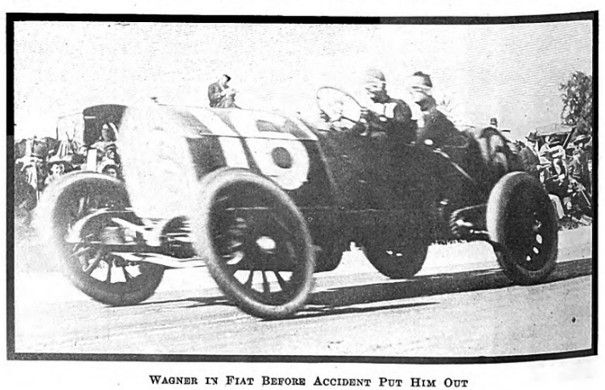
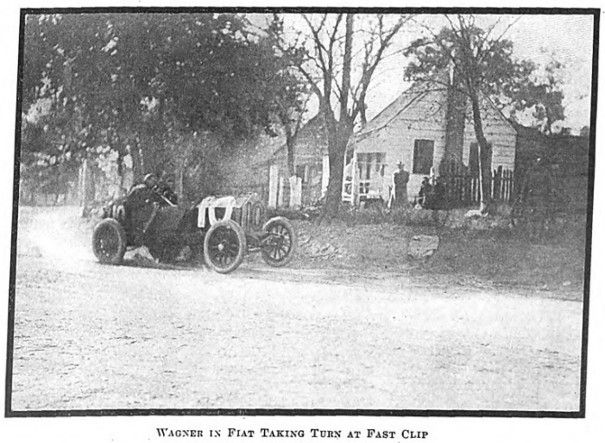
Louis Wagner, in his Fiat, was responsible for the only worry over a possible fatality. Early in the race he broke the bolt on the left hand side of the right front spring clip, as well as cracking the spring seat itself at this point. He was stopped in the eleventh lap and an inspection made of the damage. The technical committee suggested that a new seat be installed, and Caleb Bragg was in favor of it, but Wagner insisted that there was ample clamping power remaining, and flatly refused to make the change. So he was allowed to proceed against the advice of everybody consulted. In the fourteenth lap he broke a chain and stopped at the pit next time around for another one. Again, the broken spring seat was inspected and, not showing any different conditions than at first, he proceeded without repairs. In the seventeenth lap, however, he met with the accident that caused his dropping from the race. Near La Roche avenue and the bridge which crosses between it and Skidaway road is a soft spot in the road, and all the drivers were careful to avoid hitting it. On this lap, as in all those previous, Wagner turned out to avoid it, but failed to clear. The car hit the soft spot and the next thing eye witnesses saw was Wagner’s car turning end for end into the ditch, after striking the side of the abutment on the bridge. Wagner claims that he simply skidded after hitting the soft spot and went into the bridge, and claims that the impact against the bridge broke off the front axle at the weakened spring seat. But the technicians who examined the car and who were familiar with its condition, insist that, when Wagner struck the soft spot at speed, he simply tore away the rest of the spring clip and, driving the front axle back out of line, lost control of the car and struck the bridge, so that he turned over. First reports were that both he and his mechanician were fatally hurt, and they were rushed to a hospital. Later it was discovered that Wagner was only bruised about the abdomen from being jammed against the steering wheel, while the extent of Ferro’s injuries was a magnificent, big black eye, obtained by striking a branch of a bush into which he was hurled. Their escape was miraculous, for the car was completely wrecked. Wagner had negotiated some mighty fast laps up to the start of his troubles, and, next to Hemery, he was picked as the likely winner.
Haupt First to Drop
Willie Haupt was the first on the program to meet with an accident that might have proved serious. Starting with fifth, at the end of the first lap he worked into fourth at the start of the sixth, but tire trouble at Burnside set him back a position. He began to beat it upon resuming again, and when Wagner, Nazzaro and Brown all had bad laps in the tenth, he assumed the lead. In the eleventh he stopped for supplies at the pit, but negotiated a wonderful lap, notwithstanding, and kept his lead. But he couldn’t stand prosperity, for on the very next lap he tried to take the right angle turn at Montgomery cross roads at speed, and, as a result, was put out of the race. As he got into the turn, he saw that he couldn’t make it, and that it was a tree or the ditch. By a clever piece of maneuvering, he managed to strike the tree broadside, which sent him crashing and careening along the side of the ditch until he lost all control of the car, which turned over and over, throwing both himself and his mechanician clear of the wreckage. It was this that saved them from serious injury, for the car was a total wreck. As it was, neither was hurt to speak of.
Grant Goes Out Early
Grant, in his Alco, two-time Vanderbilt winner, started out to win the race by maintaining about a 68 or 69-mile an hour speed. He never reached better than seventh place during the ten laps he lasted, and finally quit the race in the eleventh, after stripping his high gears.
Arthur Chevrolet was much in evidence for the first three laps, but in the fourth he stopped for a right rear tire change at Norwood avenue, and then again at the pit for a left rear. Making this change, the jack sank into the soft earth and let the wheel down before the new tire was installed, which lost several seconds of valuable time. In the sixth lap both rears went to the bad again, and in the seventh he threw a right rear on Skidaway road. Then, while beating it in the ninth, his crankshaft broke and he was out for good.
Joe Dawson, starting in the big Marmon, was the first to succumb to mechanical troubles, being put out, just as Howard Marmon said he would, with a broken crankshaft. He was driving the same car Harroun had in the Vanderbilt, which showed similar trouble, and the Marmon crew knew it would be nothing but luck that would let them by without a broken shaft. This is the only car they ever have built with this size equipment in the engine, and the same car will not be seen in action again. During the four laps he lasted, Dawson drove a pretty race. Daw- son then went into the pit and finally replaced Harroun when the latter gave out at the end of the thirteenth lap.
Besides the cup, Brown took down $4,000 for first, while Hemery won $2,000 for second. Burman won $1,000 for third and $1,000 for being the first American car to cross the line. This, in addition to tire and equipment prizes put up on the side.
The weather, although a trifle cool in the early morning, was ideal, and the crowds that thronged the course and packed the stands is estimated at everything from 50,000 to 100,000. At any rate, the attendance was so great at both days that the financial end was amply large to gratify even the most optimistic. Thus, it will be seen that every condition was in evidence which could possibly make for the greatest race meet ever held.
The original entry list contained the names of nineteen starters. But on Wednesday the Sharp-Arrow overturned, killing the mechanician, Albert Fuchs, and severely injuring Sharp, so that it could not start. The Roebling-Planche blew out a cylinder Wednesday night and was scratched, and the Simplex broke its end bearing and was unable to obtain duplicate parts in time to compete. This came about in a peculiar way. During the Atlanta races this car, which was to have been driven by Matson, broke an oil lead and ran for some time before it was discovered. Repairs were made and the car thoroughly overhauled, but no damage could be found. But, as it developed in practice, this breakage had cost the burning of the end bearing, which finally gave out the day before the races started.
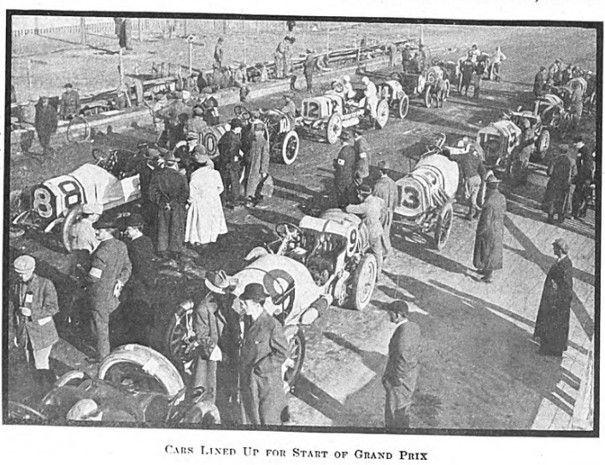
The Marquette-Buick, which Hugh Hughes was to drive, was stripped of some parts for repairs on Burman’s car, and so it couldn’t start. Fifteen faced the starter, and, promptly to the second, Arthur Chevrolet, with Albert Seraye, in a Marquette-Buick, was sent away at 9:01 – h is car being No. 3 and having a minute delay over the two smaller numbers which should have started. He was followed by Ralph Mulford and Ed Chandler, in a Lozier. Then, in succession, others crossed as follows: Charles Basle and his brother in a Pope-Hartford, Harry Grant and F. H. Lee in an Alco, Joe Dawson and Bruce Keene in the big Marmon, Victor Hemery and Franz Heim in the small Benz, Felice Nazzaro and Tony Fag- nano in a Fiat, Joe Horan and George Ainsley in the Lozier six, Louis Disbrow and R. Church in a Pope-Hartford, Ray Harroun and Harry Goetz in the small Marmon, David Bruce-Brown and Fritz Craemer in the big Benz, Louis Wagner and Tony Ferro in a Fiat, Bob Burman and Howard Hall in a Marquette-Buick, Willie Haupt and Harris Feyhle in a small Benz, and Ralph de Palma and Joe Pozzo in a Fiat.
Hemery was first around, completing the circuit in 14:18, or about 74 miles an hour. He was followed in order by Arthur Chevrolet, Wagner, Bruce-Brown, Haupt, Nazzaro, Dawson, de Palma, with but a few seconds separating them, and then, farther back and strung out, were Grant, Burman, Horan, Harroun, Basle, Disbrow and Mulford in the rear, with a very slow lap.
Hemery maintained his lead for eight laps, with Wagner, Nazzaro, Bruce-Brown and Haupt fighting out the first five positions alternately. Chevrolet took third for two laps, but developed tire trouble and then, finally, engine trouble put him out entirely. De Palma worked into sixth for about ten laps, with the rest of the cars bringing up the rear and far behind in time.
In the ninth lap Wagner took up the lead, followed by Nazzaro, Bruce-Brown, Haupt, Hemery, de Palma, Burman, Grant, Harroun, Horan and Mulford and Basle. These positions were approximately maintained till the thirteenth lap, when Nazzaro forged to the front, holding till the sixteenth lap. De Palma kept second, with Brown third and Hemery fourth and Burman sixth, till the same time when de Palma worked into first, followed by Nazzaro, Brown, Hemery, Burman, Dawson, who succeeded Harroun, Mulford, Horan and Basle. In the nineteenth the field had been reduced to seven, in this order: De Palma, Brown, Hemery, Burman, Dawson, Mulford and Horan.
This order was maintained till the twenty-third lap, when de Palma dropped, leaving the finish to the six that were noted above. Brown took the lead and Hemery, Burman and Mulford followed to the finish, while Horan unseated Dawson on the last lap.
Description of Course
Starting at the intersection of Dale avenue, the course lies down Waters road due south almost 5 miles, with but a very slight bend a few hundred feet below the starting point. Here Montgomery cross road is reached, and this marks the first turn, to the left for a few yards at right angles, and then a right turn down Whitefield avenue at an angle of perhaps 100 degrees. Then the course bends to the east down Whitefield avenue a couple of miles, until it intersects Beaulieu road, at an angle of about 35 degrees, for the third turn. This road it follows a little west of south for perhaps a mile, until the hairpin turn at Burnside is reached, which marks the southern limit of the course. Then northeast, up Ferguson avenue, bending slightly to the east at Norwood avenue, about 4 or 5 miles, when a bad right angle turn to the left puts the course into La Roche avenue by means of a curving broad turn of about a quarter mile. La Roche avenue is followed about a mile and then a 30-degree turn to the right into Skidaway road, which is well named, for perhaps another mile, and then the last right angle turn to the left onto Dale avenue, which constitutes the stretch of more than a mile straightaway to the intersection of Waters road. The course is 17.3 miles long and the grand stand is located on Waters avenue, just beyond the turn, so that the cars can be seen coming up the stretch on Dale avenue some little distance. Across the track are the official and press stands, and on the inside, but farther south, on Waters road, are the bleachers.
The track was in wonderful condition at the start, and the policing was perfect, the city police handling that portion of the track within their jurisdiction, and the state troops handling that without. In fact, the entire officering of the 2 days‘ races was a pleasure to see. Not a detail was overlooked, and the races all went off like clockwork, to the very second. Telephone stations were established at Montgomery cross road, Beaulieu and Montgomery, Burnside, Norwood avenue, La Roche avenue, Bonna Bella – halfway between Norwood and Skidaway road, on La Roche avenue – Skidaway road and Dale avenue. These stations, with a relay of men, kept the stands fully informed of the progress of the race, which was made known by a corps of megaphone announcers.
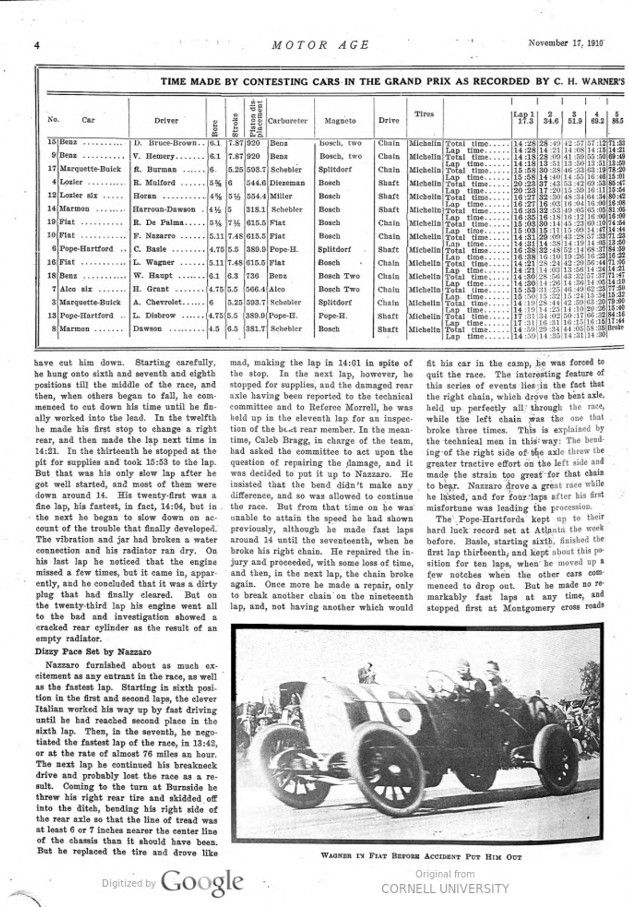
There was one man not at all in evidence to the outside world at the Savannah races to whom goes by rights a laurel crown for the part he play in the maintenance of the races, and that man is Charles H. Warner, and his electric timing device.
Never before has the absolute need of such an instrument as his been so cleverly and completely demonstrated as in the running of the grand prix. Without his instrument, so the officials concede, the picking of the winner would have been sheer guess work, for no stopwatch ever used could have properly recorded a difference
Photos.
Page 1. DAVID BRUCE-BROWN, HERO OF GRAND PRIX-WINNING BENZ AT THE PITS
Page 2. BROWN TRAVELING AT SPEED DOWN THE HOME STRETCH – GOVERNOR BROWN GREETS JOE DAWSON – DAVID BRUCE-BROWN AT THE TAPE AWAITING THE WORD
Page 3. MAYOR TIEDEMAN CONGRATULATES HEMERY – BURMAN IN MARQUETTE-BUICK FLASHES PAST THE STAND – HEMERY IN BENZ MOVING BETTER THAN 100 MILES AN HOUR
Page 4. TIME MADE BY CONTESTING CARS IN THE GRAND PRIX AS RECORDED BY C. H. WARNER’S AUTOMATIC TIMING DEVICE – RACE WON BY BRUCE-BROWN IN A BENZ AT RECORD PACE – WAGNER IN FIAT BEFORE ACCIDENT PUT HIM OUT
Page 5. DE PALMA IN FIAT, WHO WAS FACTOR FOR A TIME
Page 6. JOE HORAN IN LOZIER SIX THAT FINISHED RACE – CARS LINED UP FOR START OF GRAND PRIX
Page 7. DAWSON IN MARMON BEFORE RELIEVING HARROUN – WAGNER IN FIAT TAKING TURN AT FAST CLIP