The second article on the 1911 Savannah Grand Prize, is the direct follow-up of the first one in the December 7 issue of Motor Age. The entire race over the 24 laps in total is covered here, reporting specific results of each and every lap, including position changes and sequences, times, speeds and the different overtakes, incidents and failures.
Text and jpegs by courtesy of hathitrust.org www.hathitrust.org, compiled by motorracinghistory
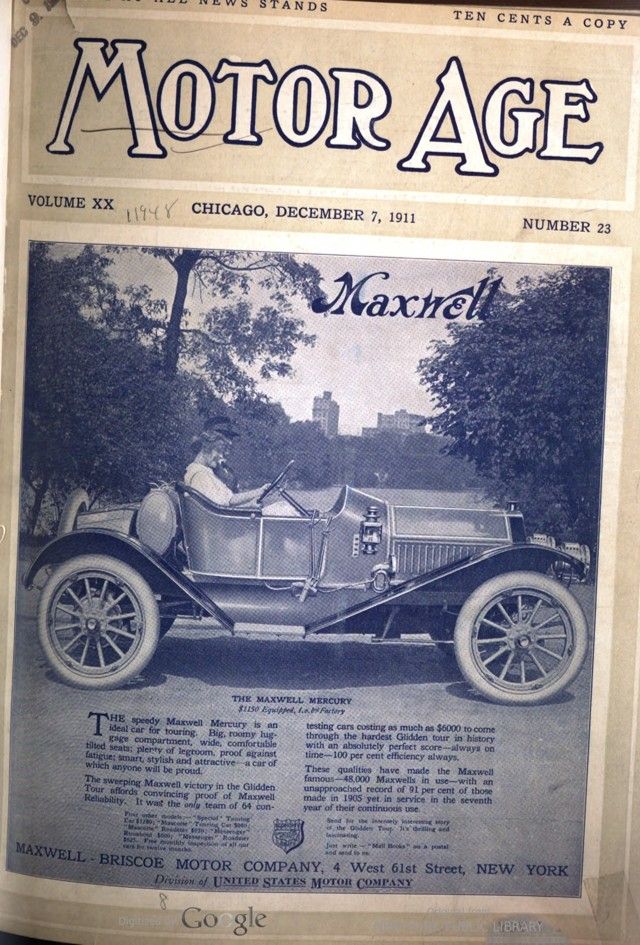
MOTOR AGE Vol. XX, No. 23, December 7, 1911
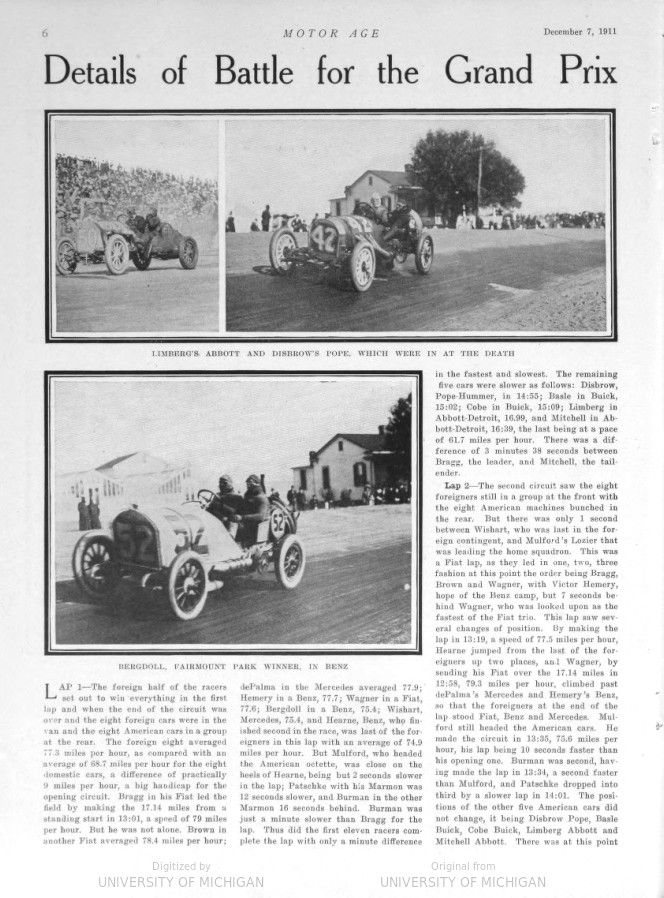
Details of Battle for the Grand Prix
Brown – Hearne – Mulford – DePalma Duel
LAP 1 – The foreign half of the racers set out to win everything in the first lap and when the end of the circuit was over and the eight foreign cars were in the van and the eight American cars in a group at the rear. The foreign eight averaged 77.3 miles per hour, as compared with an average of 68.7 miles per hour for the eight domestic cars, a difference of practically 9 miles per hour, a big handicap for the opening circuit. Bragg in his Fiat led the field by making the 17.14 miles from a standing start in 13:01, a speed of 79 miles per hour. But he was not alone. Brown in another Fiat averaged 78.4 miles per hour; DePalma in the Mercedes averaged 77.9; Hemery in a Benz, 77.7; Wagner in a Fiat, 77.6; Bergdoll in a Benz, 75.4; Wishart, Mercedes, 75.4, and Hearne, Benz, who finished second in the race, was last of the foreigners in this lap with an average of 74.9 miles per hour. But Mulford, who headed the American octette, was close on the heels of Hearne, being but 2 seconds slower in the lap; Patschke with his Marmon was 12 seconds slower, and Burman in the other Marmon 16 seconds behind. Burman was just a minute slower than Bragg for the lap. Thus did the first eleven racers complete the lap with only a minute difference in the fastest and slowest. The remaining five cars were slower as follows: Disbrow, Pope-Hummer, in 14:55; Basle in Buick, 15:02; Cobe in Buick, 15:09; Limberg in Abbott-Detroit, 16.99, and Mitchell in Abbott-Detroit, 16:39, the last being at a pace of 61.7 miles per hour. There was a difference of 3 minutes 38 seconds between Bragg, the leader, and Mitchell, the tail-ender.
Lap 2 – The second circuit saw the eight foreigners still in a group at the front with the eight American machines bunched in the rear. But there was only 1 second between Wishart, who was last in the foreign contingent, and Mulford’s Lozier that was leading the home squadron. This was a Fiat lap, as they led in one, two, three fashion at this point the order being Bragg, Brown and Wagner, with Victor Hemery, hope of the Benz camp, but 7 seconds behind Wagner, who was looked upon as the fastest of the Fiat trio. This lap saw several changes of position. By making the lap in 13:19, a speed of 77.5 miles per hour, Hearne jumped from the last of the foreigners up two places, and Wagner, by sending his Fiat over the 17.14 miles in 12:58, 79.3 miles per hour, climbed past DePalma’s Mercedes and Hemery’s Benz, so that the foreigners at the end of the lap stood Fiat, Benz and Mercedes. Mulford still headed the American cars. made the circuit in 13:35, 75.6 miles per hour, his lap being 10 seconds faster than his opening one. Burman was second, having made the lap in 13:34, a second faster than Mulford, and Patschke dropped into third by a slower lap in 14:01. The positions of the other five American cars did not change, it being Disbrow Pope, Basle Buick, Cobe Buick, Limberg Abbott and Mitchell Abbott. There was at this point a difference of 6 minutes 32 seconds be- tween the leader Bragg and Mitchell who was bringing up the rear. Only two cars in this lap averaged over 80 miles per hour, these being the Bragg and Brown Fiats. Burman’s Marmon was the fastest American car, doing the lap at 75.7 miles per hour, with Mulford next, having averaged 75.6 miles per hour.
Lap 3 – This lap witnessed the breaking up of the united lead of the foreigners, Burman, Mulford and Patschke, with their American cars, having broken into the European phalanx by getting ahead of Wagner’s Fiat, which had to stop at the grandstand pits for tires, they having passed Hemery’s Benz that broke an exhaust valve and Wishart’s Mercedes, which had chain trouble. It was a case of five Europeans heading the race at this point, being closely pursued by the three American cars, then Wagner’s Fiat, next four Americans and last Hemery and Wishart. Cobe’s Buick went through the outer fence at the Montgomery crossroad turn and upset. Fortunately, nobody was hurt. This could not be looked upon in any other way than that of being a Fiat lap. Bragg and Brown were first and second, DePalma had his Mercedes in third almost a minute back of the Fiats and the two Benzes were fourth and fifth, Hearne and Bergdoll being the order. This lap was a distinctive gain for the home cars, Burman averaging 76.8 miles per hour. Both of the Marmons were faster than Mulford’s Lozier, the times being: Burman Marmon, 13:23; Patschke Marmon, 13:26; Mulford Lozier, 13:39.
The remaining four American cars were running more than a minute to the lap slower than these three, so that everyone looked to Burman, Patschke and Mulford to wage the bitter war against the Fiats, Benz and Mercedes racing machines. Nobody knew at this moment what would be the outcome. The enormous speed of the foreigner had started to show its results in two different ways; in tires, Wagner having to change both rear after but three laps; and in mechanical troubles, both Hemery. and Wishart’s machines not being equal to the enormous speed possibilities of the course. Would Bragg and Brown still be able to maintain the 79 mile an hour pace they were setting? If they could the American car would have but little chance. Not taking into consideration Wishart and Hemery, who were tail-enders, there was at the end of this lap a difference of 10 minutes between the leader, Bragg, and Mitchell, last of those actually running steadily.
Lap 4 – This lap was a Fiat catastrophe. For the first time the Italians lost the leadership, DePalma’s Mercedes gaining first place, with Hearne and Bergdoll in the two Benz machines second and third and Burman’s Marmon fourth. An American car had jumped from eleventh to fourth place in four laps. The Fiats‘ downfall was due to tires. Bragg had to change and so did Brown. Brown’s stop was a long one, making the lap time 19:39 by far the slowest one he had in the entire race. In one fell swoop he dropped from second to eighth place, and many thought that his hopes for victory had gone with his tires. The race was becoming interesting, with an American car fourth and two others sixth and seventh. Everyone felt settled that the Fiats could not continue their 79 miles per hour without having to change tires every three or four laps, and as the driver and mechanic had to do all of the tire changing work, it was problematic if the slower cars, such as Marmons, Lozier, Benz and Mercedes, with fewer tire changes, would not win out. Everybody took a new view of the race at this point. The honor of the fastest lap went to Eddie Hearne in his Benz, his time being 13:15, his fastest lap so far and a speed of 77.9 miles per hour. Few knew what Hearne could do with his car. He started last of the foreign group, being slowest in the first circuit, but in four laps he jumped into second place and showed that he had a car as fast as the in the lead and all within 2 minutes of each other. DePalma, the first of the seven had made the four laps in 53:08 and Wagner the slowest in 55:32. Brown’s Fiat was not reckoned in this group as its time was 58:31, but a few seconds ahead of Basle’s Buick and the Pope. In this lap Hemery limped past the grandstand and drew off to one side of the road to change a new exhaust valve. He was over an hour in making the third circuit and 47 minutes in the fourth, so that he was nearly 1½ hour back of the leader and out of the race, excepting that he announced that he was going to make a repair and go after the fastest lap. Wishart, with his Mercedes, was now 1/2 hour back of the leaders, and there was 11 minutes between the first and the last of the thirteen cars that were running steadily at this point.
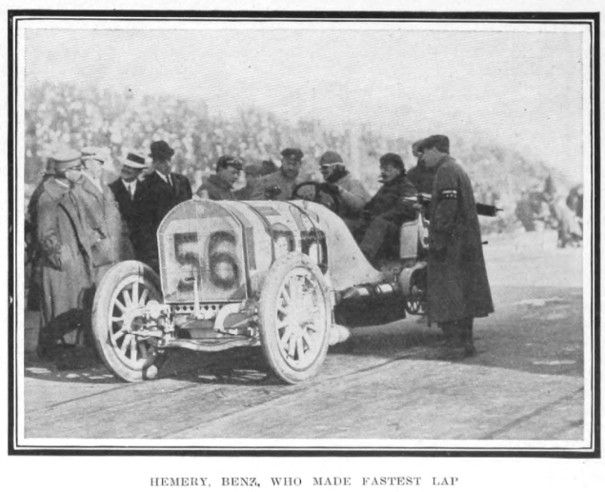
Lap 5 – This was an unfortunate lap for American representation as it saw Burman’s Marmon drop out when it was running in fourth place and leading the American representation by a matter of 32 seconds over Mulford and Patschke who had tied in lap four at 54:56. When Burman fell out Mulford took up his scepter, having gained 4 seconds on his rival, Patschke, in the fifth circuit. The remainder of the Americans, namely, Buick, Pope and the two Abbotts, were running in this order, the same as from the opening lap. The home representation had now dropped from eight to six, with Mulford and Patschke to look after the fast Italian and German cars. The end of this lap saw Hearne in the lead, he having got ahead of DePalma, who had trouble with a leak in the gasoline line, which compelled him to use an auxiliary gasoline line that he had already attached, so that all he had to do to couple it up was to change a threaded union. Hearne now led with a margin of but 29 seconds over Bragg, and Mulford and Patschke were not 2 minutes behind. Then came Wagner, Bergdoll and Brown. Brown was 6 minutes back of Hearne. Hemery fulfilled his previous announcement of going after the fastest lap of the race and he won it, doing the circuit in 12:36 or a speed of 81.6 miles per hour, the fastest official lap ever made on the course. He drove with all of his old-time fearlessness. He took all of the turns very fast. When he shot into the home stretch everybody saw by his lightning flash that he was after the coveted mark. He was slow in shutting down for the grandstand curve. He struck it at apparently 70 miles per hour. Entering the turn he held close to the inside, but the momentum of the car was too great to hold it and he skidded wide, almost to the upper side of the bank. He soon straightened up and roared past the grandstand. His skid was the only really bad one made by any of the big cars on the turn, and the hundreds in the grandstand who wanted to see such a performance were satisfied. Bragg sustained his previous reputations by making the second fastest lap, in 12:58, the only other one to get under the 13-minute mark. His pace was 79.3 miles per hour.
Lap 6 – There was a general changing of positions in this lap, Hearne retaining the lead but being about the only one of the leaders to hold his place. He had a lead of only 50 seconds on DePalma and but little over a minute on Patschke, Mulford and Wagner. The two Fiat drivers, Wagner and DePalma, were closing the gap between them and Hearne, both doing the lap in several seconds under Hearne. Patschke and Mulford were third and fifth, disputing every inch of the course with DePalma and Wagner, who was running a little slower than in the early laps and apparently taking more care of his tires. Brown made the lap in 8 seconds less than Hearne, but Wagner had the fastest circuit of the lap in 13:00, 79.1 miles per hour.
Laps 7 and 8 – These were the brilliant laps for the American contenders, because Cyrus Patschke put his Marmon racer to the front and led the entire field – the only two laps in which the American colors led – but unfortunately the pace he set was apparently too strenuous for he withdrew in the ninth lap, leaving Mulford to do the fighting singlehanded against the five foreign drivers who, along with Mulford, were making the race at this time. At this point Bruce-Brown was not very much in the limelight. He was still back in sixth place, not having recovered from that terrible setback in the fourth lap. But he was slowly coming out of the darkness, doing laps in 30 to 40 seconds lower than Mulford and Hearne. The seventh was a bad lap for Hearne. He had tire troubles, made a slow lap in 15:14, but hung onto second place by 7 seconds over Mulford and Bragg who were tied for third place. At this point the positions Patschke, Marmon, 94:55; Hearne, Benz, 95:30; Mulford, Lozier, 95:37; Bragg, Fiat, 95:37; Wagner, Fiat, 96:42; Brown, Fiat, 98:38; de Palma, Mercedes, were: 99:29.
These were the fighting seven, the other seven being trailing along, three, four and seven and as far as nearly 2 hours back. DePalma had fallen from second place in the sixth to sixth place in the seventh due to his gasoline lead. This advanced all of the other racers one place. The first four were not separated by a minute at the end of lap seven or 120 miles, good proof of the desperate struggle that was taking place. Lap eight was a duplicate of lap seven excepting that Wagner climbed above his teammate Bragg by a lap in 12:55 or 79.6 miles per hour. This lap marked the start of Bragg’s bad luck. An oil lead at the forward end of the motor broke, due to the vibration. It was a hard place in which to make a repair and he blistered his hands in doing the work. He also had to make a tire change on the course and stopped at the grandstand to take on a new shoe. Brown gained from 9 to 10 seconds on Mulford and Hearne in the circuit. Hemery finally withdrew at the end of the eighth circuit with valve trouble. Wishart also withdrew his Mercedes due to a cracked water-jacket
Lap 9 – The field was now down to ten machines, five American and five foreign contenders, with the race not one-half over. Of these ten, the first six were making the race, the order at the end of this lap being Hearne, Wagner, Mulford, Bragg, Brown and DePalma with only 4.5 minutes between the first and the last. The three Fiats made the fastest laps, 12:48, 12:53 and 13:03. They were 12 minutes faster than any of the others for the lap and so everybody wondered would the Fiat colors again come into the lead, they having been in the background since the third lap. Later laps showed this.
Lap 10 – Hearne increased his lead on Wagner, who stopped for oil and gasoline and also changed tires, making his lap a slow one, 14:31, as compared with 13:20 by Hearne. But Brown, though down in fourth place, was traveling fast. He reeled the lap off in 12:48, over 80 miles per hour, and was scarcely 2 minutes behind the leader at this point. He was steadily gaining. DePalma stopped 3 minutes and 30 seconds for gasoline and oil, as well as to change a right rear tire, and so found himself dropped from third to fifth place. Basle, who had been running in seventh place, dropped out due to engine troubles.
Laps 11 and 12 – Lap eleven saw Hearne running steadily in the lead with Fiats second and third and 4 minutes behind him, Wagner and Brown being the chasers. DePalma and Mulford were close back, but Bragg was 10 minutes in the background. In lap twelve the positions were the same as in lap eleven, this being about the only case of two successive laps in the race in which positions did not change, with the exception of lap twenty-four, in which they ran the same as in lap twenty-three. Hearne’s time was the fastest in lap eleven, it being 13:22. Hearne led in lap twelve, but stopped 2 minutes 35 seconds for gasoline and oil and tires. Wagner and Bragg made the fastest circuits, doing close to 80 miles per hour. There was now an interval of 36 minutes between the leader, Hearne, and Mitchell’s Abbott. Through all of these laps the Pope-Hummer, piloted by Disbrow, and the two Abbott-Detroits were showing their dogged persistency, going lap after lap at a steady pace. Disbrow was making nearly all of his circuits in 14:38, and the two Abbott-Detroits about a minute to the lap slower. With the race half over, Hearne had a lead of 3 minutes on Wagner’s Fiat and 4 minutes on Brown’s Fiat. He was 5 minutes ahead of DePalma in the Mercedes and 5.5 minutes ahead of Mulford. He looked to be in a safe position, excepting that it was known the Fiats could make faster laps than he, and if he had good fortune and the Fiats met with tire troubles he would certainly win the coveted prize.
Lap 13 – It was in the start of this lap that Hearne had stopped for fuel and he had a very slow lap, 16:16. Brown put his Fiat around the circuit in 13:12 and so cut off 3 minutes of the 4-minute lead Hearne had enjoyed. The five leaders, Hearne, Brown, Wagner, DePalma and Mulford, now were more closely bunched than at any other time since the start. It was proving a wonderful race. Hearne was just a minute ahead of Brown. Brown was only 21 seconds ahead of his teammate Wagner. DePalma was but a minute back and Mulford half a minute behind DePalma. It was now anybody’s race. These battlers were almost 20 minutes ahead of the Pope and the Abbotts. Brown was now second and only a minute from leadership. All expected him to cut that minute off in the next lap and take the lead from Hearne who had held it for five successive laps.
Lap 14 – The unexpected happened. Instead of taking the lead from Hearne, Brown stopped for tires, was stopped 1 minute, 20 seconds at the pit and found himself fifth or last in the bunch of leaders. Never before was there such a five-sided duel. It meant but a tire change to alter the state of affairs. A mere stop of less than 2 minutes made the first last and the last first. Wagner was the speed hero of the lap. He did the circuit in 12:48, a speed of 80.3 miles per hour. It put him in second place, only 24 seconds back of Hearne. He now was looked upon as the leader in the following lap. DePalma and Mulford were minutes back of Wagner and Brown a minute behind them.
Lap 15 – This lap was fatal to the Fiats, as Wagner was eliminated. His 80-mile pace of the previous lap was too much. He tried to duplicate in this circuit but over-ran a turn. Nobody knows exactly what did happen. But the rear axle was a little sprung and the steering put out of commission. He drove to the grand stand and withdrew. This left but four leaders in the real fight as Bragg was 12 minutes behind the group and he was in turn 10 minutes up on the Pope and 20 and 25 minutes on the Abbotts. There were yet nine laps to go and here was how the leaders stood: Hearne, Benz, 206:57; DePalma, Mercedes, 208:00; Mulford, Lozier, 208:28; Brown, Fiat, 208:31. There was not 2 minutes between the first and the last.
Lap 16 – Tis lap worked an upheaval: Brown passed both Mulford and DePalma and got in second place just 1 minute 25 seconds back of Hearne, almost as close to him as he had been three laps before. Brown was driving conservatively. For the last five laps he was making circuits in 13:12 or thereabouts, which averaged 30 seconds to the lap better than Hearne and apparently he had settled down to get into the lead by this kind of driving rather than by the terrific speeds that put Wagner out and also caused the oiling troubles on Bragg’s Fiat. It was now really a single handed fight among the Benz, Fiat, Lozier and Mercedes. Mulford, who started single-handed, was still in the ring; DePalma had lost his running mate in the ninth lap and both of Hearne’s supporters were gone. It was now a real fight, and with the Fiat cutting the frills out the race was taking on a new aspect. It was real business and not sensationalism.
Lap 17 – The real fight in this lap was between Hearne and Mulford, Hearne having the lead by only 27 seconds. Brown met with tire troubles and went slowly in 15:26, practically 2 minutes slower than the other three. Bragg was now running in fine shape but 5 minutes behind this group.
Laps 18 and 19 – These two laps were races, the order was Hearne in the Benz, Mulford in the Lozier, Brown in the Fiat and DePalma in the Mercedes. Brown made each of these laps in 30 seconds under the other drivers and so found himself at the end of lap nineteen but 43 seconds from first place, the closest he had been from the start of the race. Hearne still led with Mulford second. Here is the standing: Hearne, Benz, 263:03; Mulford, Lozier, 263:18; Brown, Fiat, 263:46; DePalma, Mercedes, 267:25. DePalma had lost his time on changing tires.
Lap 20– Brown leads! This was shouted everywhere, and for the first time the winner of the grand prize last year was able to put the Fiat colors to the front for the first time since the third lap, when Bragg had placed them there. Brown led and led with but four laps to go. And his lead was only 14 seconds on Mulford and 31 seconds on Hearne. Brown gained his pace by fast traveling, doing the circuit in 13:18, as compared with 14:00 by Mulford and 14:32 by Hearne. But Brown’s leadership was short.
Lap 21 – The struggle continued. Brown increased his lead from 14 seconds to 36 seconds over Hearne and was over a minute ahead of Mulford. DePalma was 4 minutes back.
Lap 22 – The end of this lap saw the most intense moment ever witnessed in a road race. It saw all three racers, Brown’s Fiat, Hearne’s Benz and Mulford’s Lozier stop at the pits together and with only more laps to go. Brown slowed up to change a tire. He was cheered to the echo. He slowed into the turn. „He is stopping“ was heard on every hand. Back of him raced Mulford; he slowed also and stopped. The entire grandstand was on its feet. Scarcely was he at the pits than Hearne rounded the turn and stopped. Brown was 1 minute and 8 seconds changing left rear tire; Mulford was 36 seconds taking on some gasoline and Hearne was 1 minute changing a right rear tire. Many at the Lozier pit did not want Mulford to stop, but he had been signaled the previous lap to stop for fuel and did not take any chances. Many in the Benz pit thought Hearne should not have stopped, but it seems that he was fatigued from the long grind and would not take any chances with a poor tire on the turns. Mulford was first away. He dropped into second and shot off. Brown was hot after him and Hearne was last. According to the official figures Hearne led for the lap. His time was 304.42; Mulford’s time was 305:08 and Brown’s 305:24. Brown was last, which was due to the fact that he did not cross the tape before repairing his tire, whereas Hearne and Mulford did.
Laps 23 and 24 – These were fatal to American interests. Scarcely had Mulford started on lap twenty-three when he went out of the running by breaking the shaft at the forward end of the car’s gearbox. He did it at a street car crossing. In taking the crossing the car bounded into the air and when the back wheels struck the ground the engine speeded up and the car slowed down. Mulford knew the trouble and pulled to the side of the road. The remainder was a procession. Brown was leading in the Fiat. At the end of the twenty-third lap when he got the green flag, he was 1 minute 30 seconds ahead of Hearne. Nothing but tires could stop him. The lap was a fast one, too, the time being 12:53 or nearly 80 miles per hour. DePalma was 3 minutes behind. In the last or twenty-fourth lap Brown slowed down to 13:12, still half a minute faster than Hearne but only a couple of seconds faster than DePalma made the circuit. At this time Brown was laps ahead of the Pope and the two Abbott- Detroits. He was 50 minutes ahead of Disbrow and an hour ahead of the leading Abbott, all of which were lower-powered cars which had been running consistently from the start.
Photos.
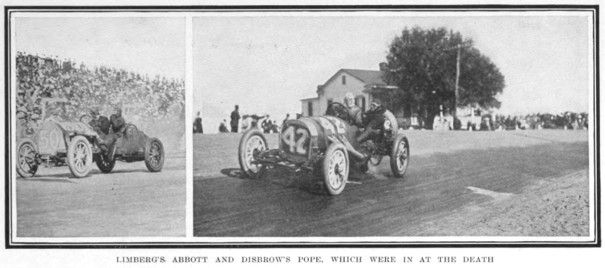
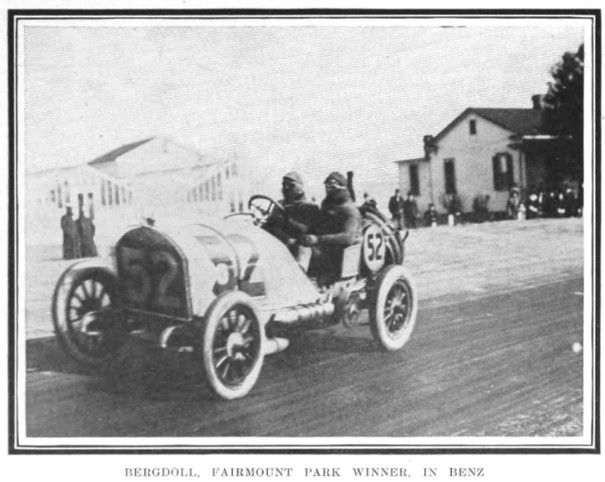
Page 6. LIMBERG’S ABBOTT #50 AND DISBROW’S POPE #42, WHICH WERE IN AT THE DEATH – BERGDOLL #52, FAIRMOUNT PARK WINNER, IN BENZ
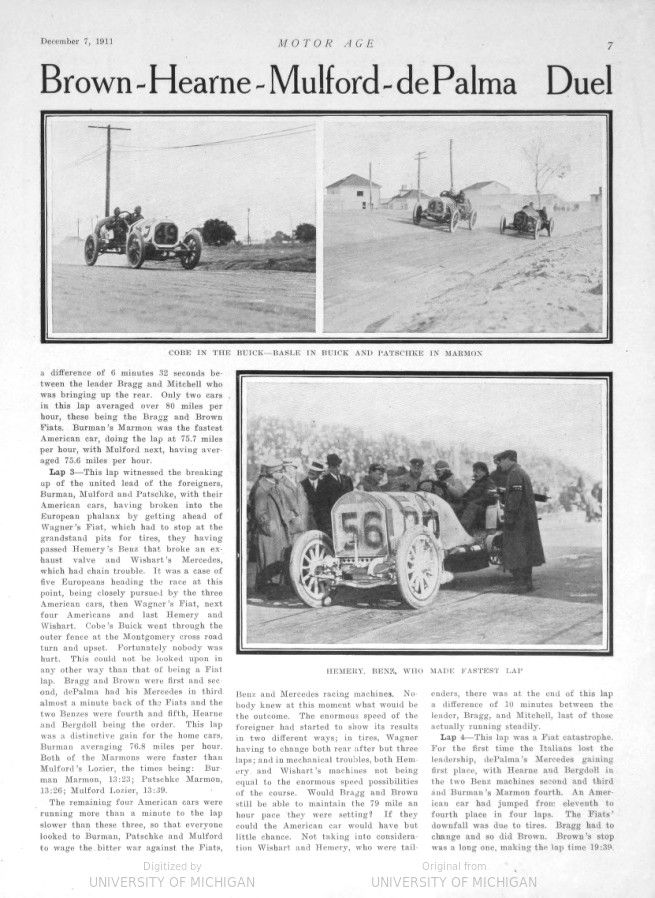
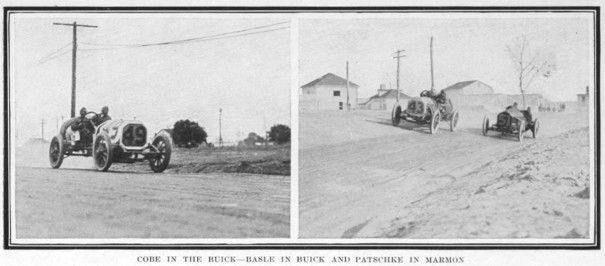
Page 7. COBE IN THE BUICK # 49 – BASLE IN BUICK #43 AND PATSCHKE IN MARMON #51 – HEMERY, BENZ #56, WHO MADE FASTEST LAP
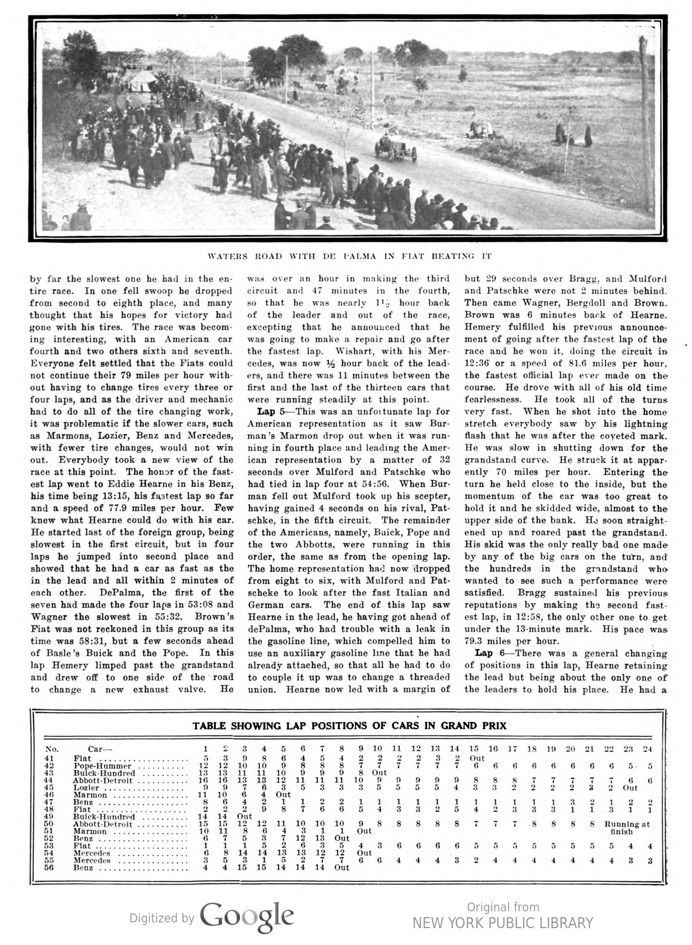
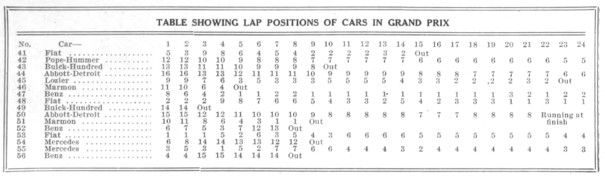
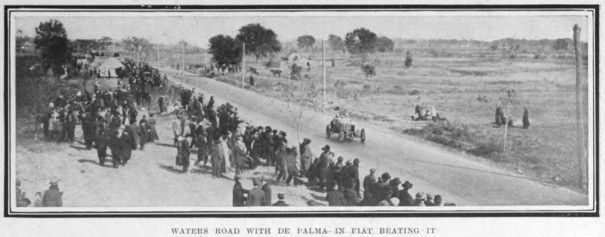
Page 8. WATERS ROAD WITH DE PALMA IN FIAT BEATING IT – TABLE SHOWING LAP POSITIONS OF CARS IN GRAND PRIX
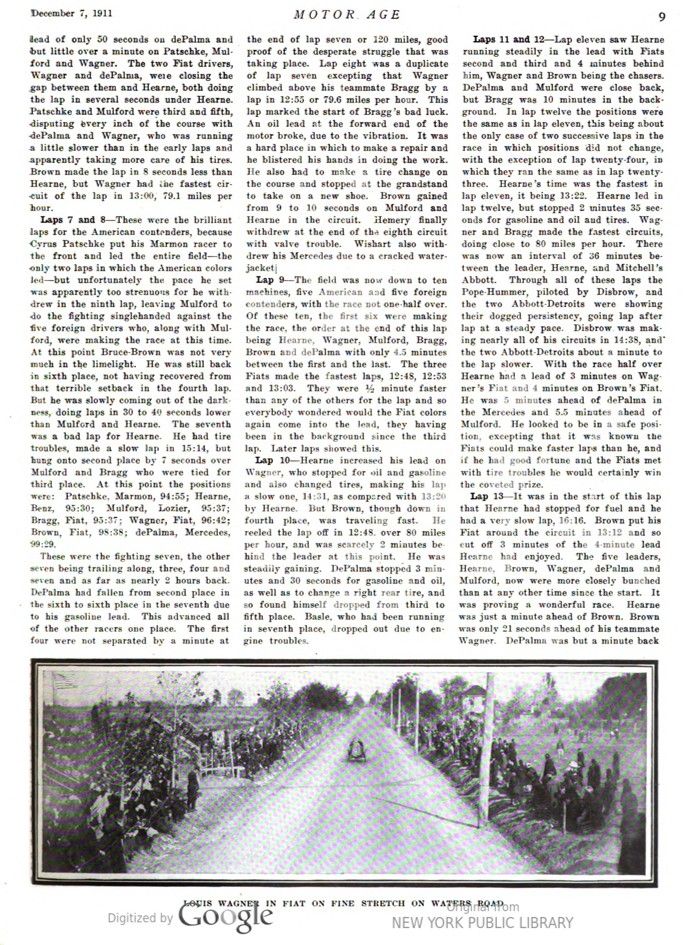
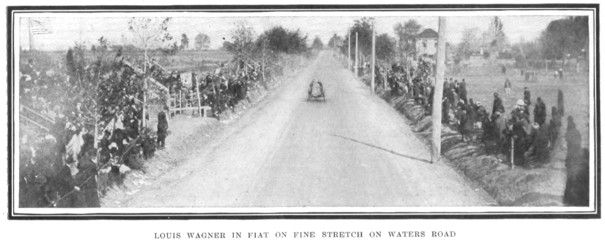
Page 9. LOUIS WAGNER IN FIAT ON FINE STRETCH ON WATERS ROAD
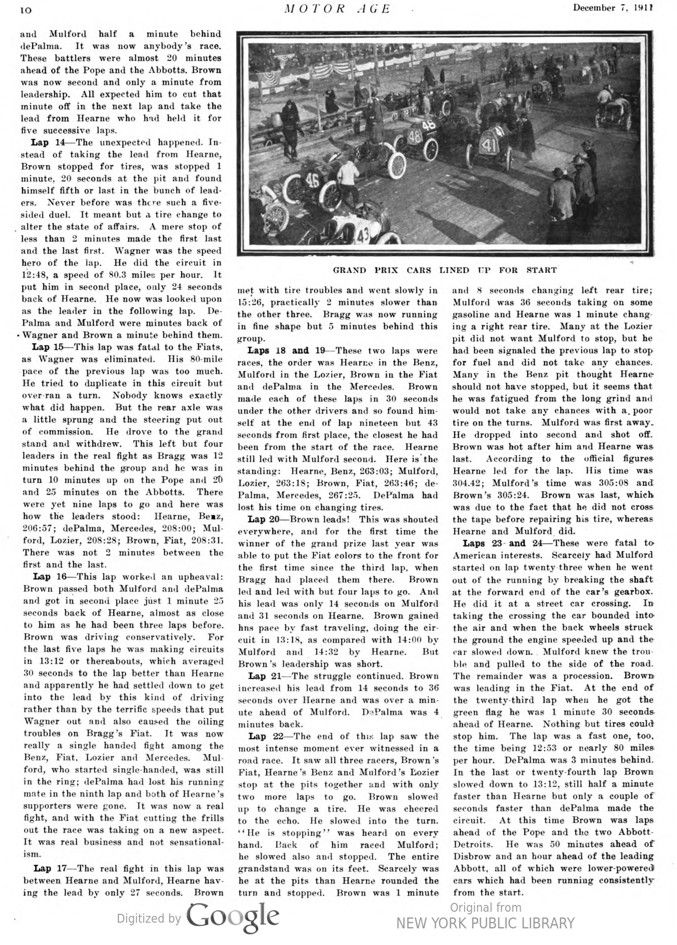
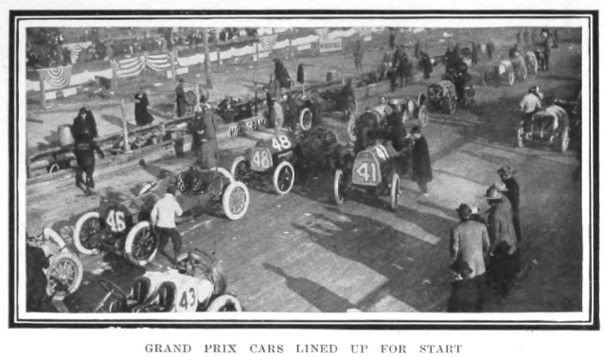
Page 10. GRAND PRIX CARS LINED UP FOR START