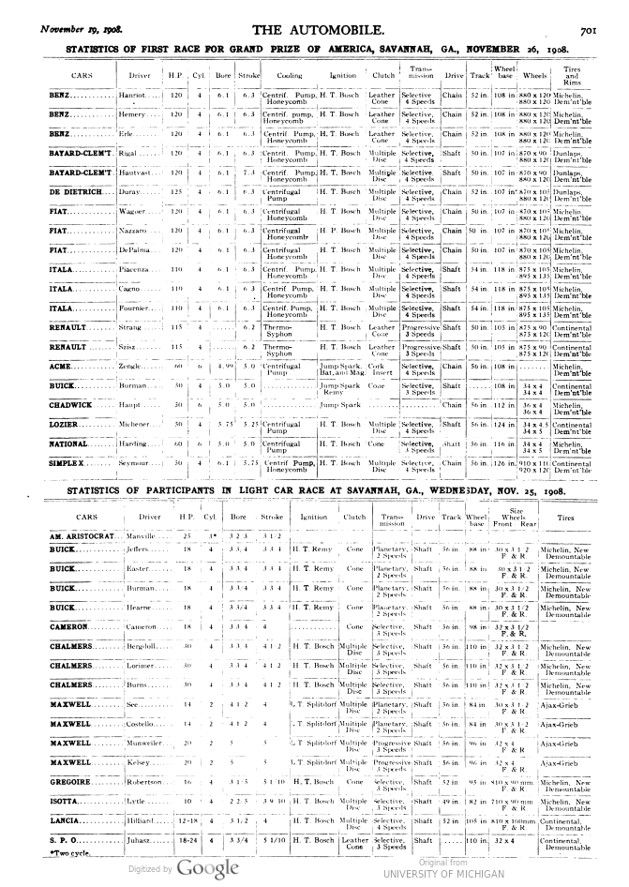
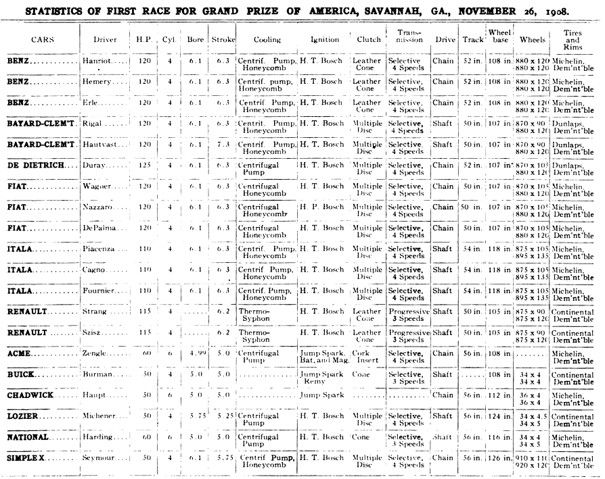
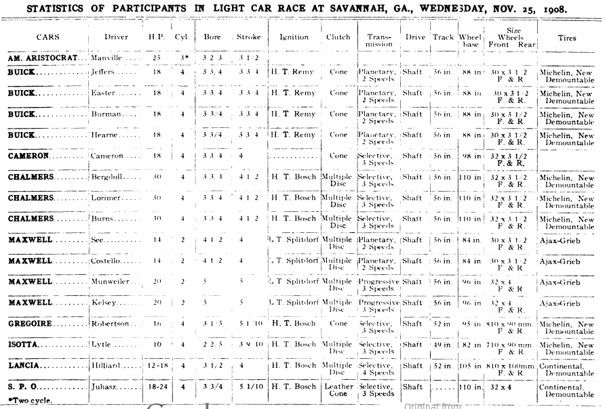
Short before the first Savannah Grand Prize of 1908, a summary is given in this issue of The Automobile on the participating drivers-and-cars, some organizational issues, the prize money as well as the officials for the race. Finally, two lists of statistics on the contestants of the November 26 Grand Prize of America and the accompanying Light Car Race, one day earlier.
By courtesy of hathitrust.org www.hathitrust.org, Text and jpegs compiled by motorracinghistory.
THE AUTOMOBILE Vol. XIX, No. 21, November 19, 1908
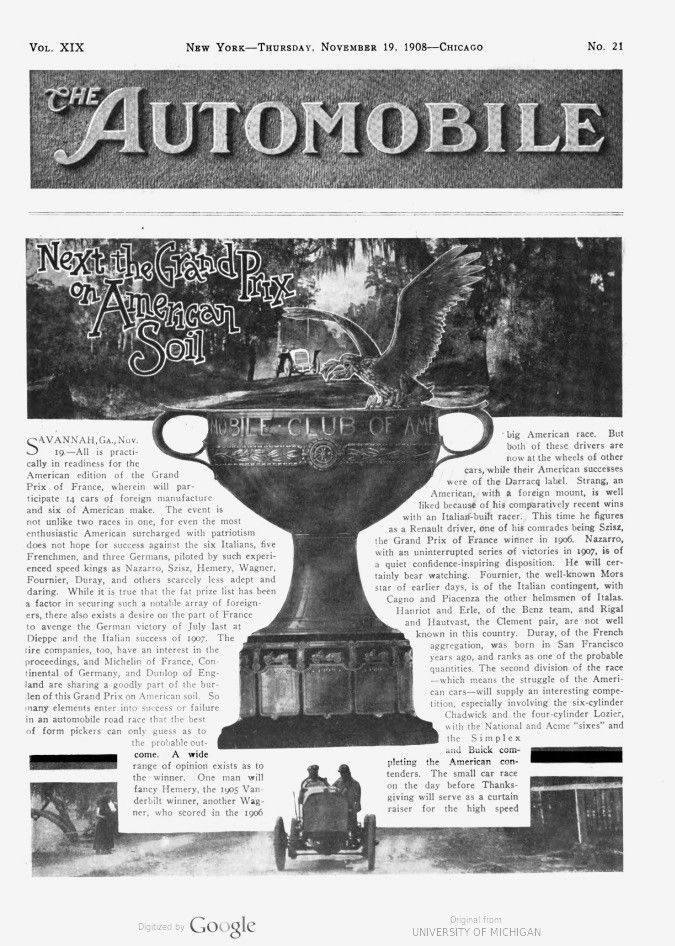
Next the Grand Prix on American Soil
SAVANNAH, GA., Nov. 19. All is practically in readiness for the American edition of the Grand Prix of France, wherein will participate 14 cars of foreign manufacture and six of American make. The event is not unlike two races in one, for even the most enthusiastic American surcharged with patriotism does not hope for success against the six Italians, five Frenchmen, and three Germans, piloted by such experienced speed kings as Nazarro, Szisz, Hemery, Wagner, Fournier, Duray, and others scarcely less adept and daring.
While it is true that the fat prize list has been a factor in securing such a notable array of foreigners, there also exists a desire on the part of France to avenge the German victory of July last at Dieppe and the Italian success of 1907. The tire companies, too, have an interest in the proceedings, and Michelin of France, Continental of Germany, and Dunlop of England are sharing a goodly part of the burden of this Grand Prix on American soil. So many elements enter into success or failure in an automobile road race that the best of form pickers can only guess as to the probable outcome.
A wide range of opinion exists as to the winner. One man will fancy Hemery, the 1905 Vanderbilt winner, another Wagner, who scored in the 1906 big American race. But both of these drivers are now at the wheels of other cars, while their American successes were of the Darracq label.
Strang, an American, with a foreign mount, is well liked because of his comparatively recent wins. with an Italian-built racer. This time he figures as a Renault driver, one of his comrades being Szisz, the Grand Prix of France winner in 1906.
Nazarro, with an uninterrupted series of victories in 1907, is of a quiet confidence-inspiring disposition. He will certainly bear watching. Fournier, the well-known Mors star of earlier days, is of the Italian contingent, with Cagno and Piacenza the other helmsmen of Italas. Hanriot and Erle, of the Benz team, and Rigal and Hautvast, the Clement pair, are not well known in this country. Duray, of the French aggregation, was born in San Francisco years ago, and ranks as one of the probable quantities.
The second division of the race – which means the struggle of the American cars – will supply an interesting competition, especially involving the six-cylinder Chadwick and the four-cylinder Lozier, with the National and Acme „sixes“ and the Simplex and Buick completing the American contenders.
The small car race on the day before Thanksgiving will serve as a curtain raiser for the high speed event. Seventeen little fellows, internationally divided, should supply some lively competition well worth the watching. It will be a source of regret that Herbert Lytle, one of the best of American drivers, will not be able to engage, as he is suffering from an attack of typhoid fever at his home in Toledo. Therefore, another one will have to be named for the Isotta car.
Concluding Arrangements for the Race.
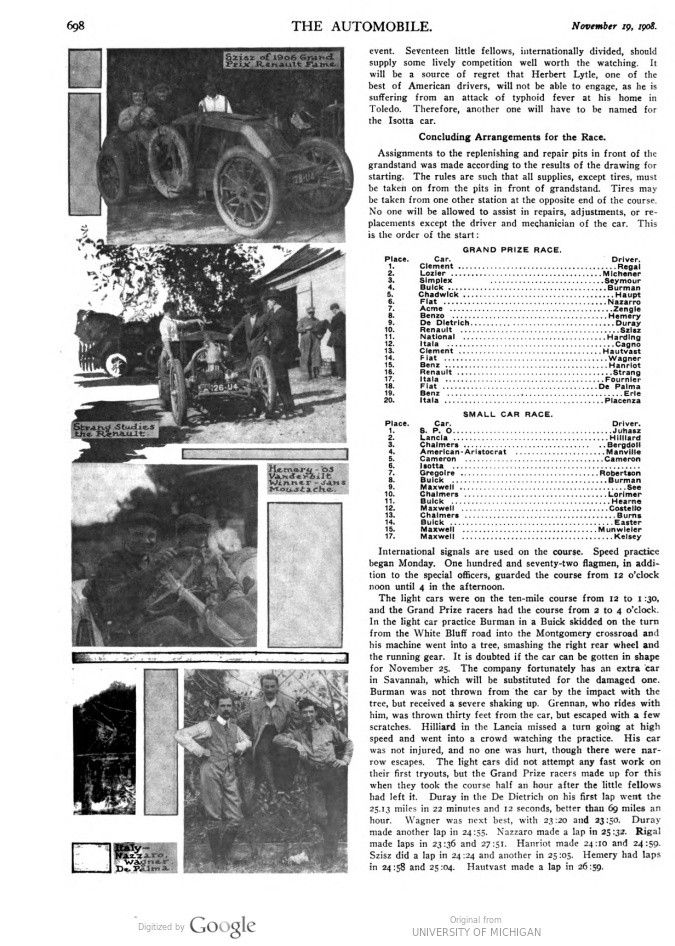
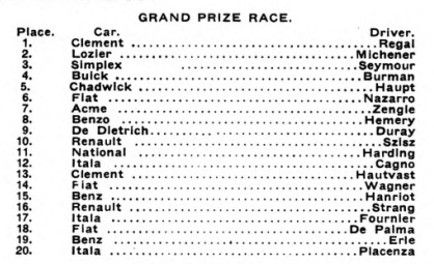
Assignments to the replenishing and repair pits in front of the grandstand was made according to the results of the drawing for starting. The rules are such that all supplies, except tires, must be taken on from the pits in front of grandstand. Tires may be taken from one other station at the opposite end of the course. No one will be allowed to assist in repairs, adjustments, or replacements except the driver and mechanician of the car. This is the order of the start:
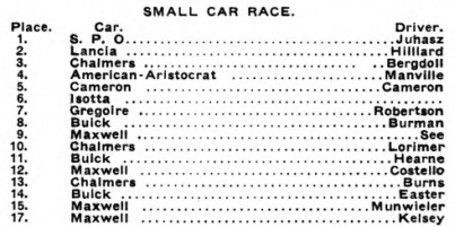
International signals are used on the course. Speed practice began Monday. One hundred and seventy-two flagmen, in addition to the special officers, guarded the course from 12 o’clock noon until 4 in the afternoon.
The light cars were on the ten-mile course from 12 to 1:30, and the Grand Prize racers had the course from 2 to 4 o’clock. In the light car practice Burman in a Buick skidded on the turn from the White Bluff road into the Montgomery crossroad and his machine went into a tree, smashing the right rear wheel and the running gear. It is doubted if the car can be gotten in shape for November 25. The company fortunately has an extra car in Savannah, which will be substituted for the damaged one. Burman was not thrown from the car by the impact with the tree, but received a severe shaking up. Grennan, who rides with him, was thrown thirty feet from the car, but escaped with a few scratches. Hilliard in the Lancia missed a turn going at high speed and went into a crowd watching the practice. His car was not injured, and no one was hurt, though there were narrow escapes. The light cars did not attempt any fast work on their first tryouts, but the Grand Prize racers made up for this when they took the course half an hour after the little fellows had left it. Duray in the De Dietrich on his first lap went the 25.13 miles in 22 minutes and 12 seconds, better than 69 miles an hour. Wagner was next best, with 23:20 and 23:50. Duray made another lap in 24:55. Nazzaro made a lap in 25:32. Rigal made laps in 23:36 and 27:51. Hanriot made 24:10 and 24:59. Szisz did a lap in 24:24 and another in 25:05. Hemery had laps in 24:58 and 25:04. Hautvast made a lap in 26:59.
The times in the first trials under racing conditions cause the experts to believe that the winner of the race will have to cover the 400 miles at the average rate of about 70 miles an hour to win. In the sprints on some of the longer stretches it is estimated that cars have gone faster than 100 miles an hour.
List of Officials Chosen.
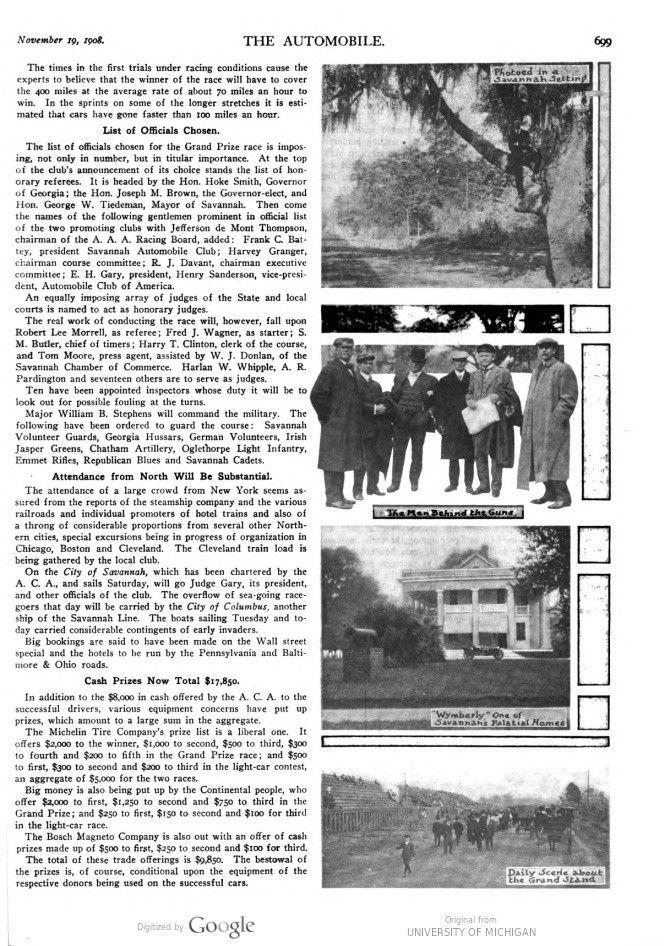
The list of officials chosen for the Grand Prize race is imposing, not only in number, but in titular importance. At the top of the club’s announcement of its choice stands the list of honorary referees. It is headed by the Hon. Hoke Smith, Governor of Georgia; the Hon. Joseph M. Brown, the Governor-elect, and Hon. George W. Tiedeman, Mayor of Savannah. Then come the names of the following gentlemen prominent in official list of the two promoting clubs with Jefferson de Mont Thompson, chairman of the A. A. A. Racing Board, added: Frank C. Battey, president Savannah Automobile Club; Harvey Granger, chairman course committee; R. J. Davant, chairman executive committee; E. H. Gary, president, Henry Sanderson, vice-president, Automobile Club of America.
An equally imposing array of judges of the State and local courts is named to act as honorary judges.
The real work of conducting the race will, however, fall upon Robert Lee Morrell, as referee; Fred J. Wagner, as starter; S. M. Butler, chief of timers; Harry T. Clinton, clerk of the course, and Tom Moore, press agent, assisted by W. J. Donlan, of the Savannah Chamber of Commerce. Harlan W. Whipple, A. R. Pardington and seventeen others are to serve as judges.
Ten have been appointed inspectors whose duty it will be to look out for possible fouling at the turns.
Major William B. Stephens will command the military. The following have been ordered to guard the course: Savannah Volunteer Guards, Georgia Hussars, German Volunteers, Irish Jasper Greens, Chatham Artillery, Oglethorpe Light Infantry, Emmet Rifles, Republican Blues and Savannah Cadets.
Attendance from North Will Be Substantial.
The attendance of a large crowd from New York seems assured from the reports of the steamship company and the various railroads and individual promoters of hotel trains and also of a throng of considerable proportions from several other Northern cities, special excursions being in progress of organization in Chicago, Boston and Cleveland. The Cleveland train load is being gathered by the local club.
On the City of Savannah, which has been chartered by the A. C. A., and sails Saturday, will go Judge Gary, its president, and other officials of the club. The overflow of sea-going race-goers that day will be carried by the City of Columbus, another ship of the Savannah Line. The boats sailing Tuesday and today carried considerable contingents of early invaders.
Big bookings are said to have been made on the Wall street special and the hotels to be run by the Pennsylvania and Baltiore & Ohio roads.
Cash Prizes Now Total $17,850. In addition to the $8,000 in cash offered by the A. C. A. to the successful drivers, various equipment concerns have put up prizes, which amount to a large sum in the aggregate.
The Michelin Tire Company’s prize list is a liberal one. It offers $2,000 to the winner, $1,000 to second, $500 to third, $300 to fourth and $200 to fifth in the Grand Prize race; and $500 to first, $300 to second and $200 to third in the light-car contest, an aggregate of $5,000 for the two races.
Big money is also being put up by the Continental people, who offer $2,000 to first, $1,250 to second and $750 to third in the Grand Prize; and $250 to first, $150 to second and $100 for third in the light-car race.
The Bosch Magneto Company is also out with an offer of cash prizes made up of $500 to first, $250 to second and $100 for third. The total of these trade offerings is $9,850. The bestowal of the prizes is, of course, conditional upon the equipment of the respective donors being used on the successful cars.
Photos.
Page 697. Cup: AUTOMOBILE CLUB OF AMERICA
Page 698. Szisz of 1906 Grand Prix Renault Fame – Strang Studies the Renault – Hemery – 05 Vanderbilt Winner – Sans Moustache – Italy – Nazzaro, Wagner, De Palma
Page 699. Photoed in a Savannah Setting – The Man Behind the Guns – “Wymberly“ One of Savannah’s Palatial Homes -Daily Scene about the Grand Stand