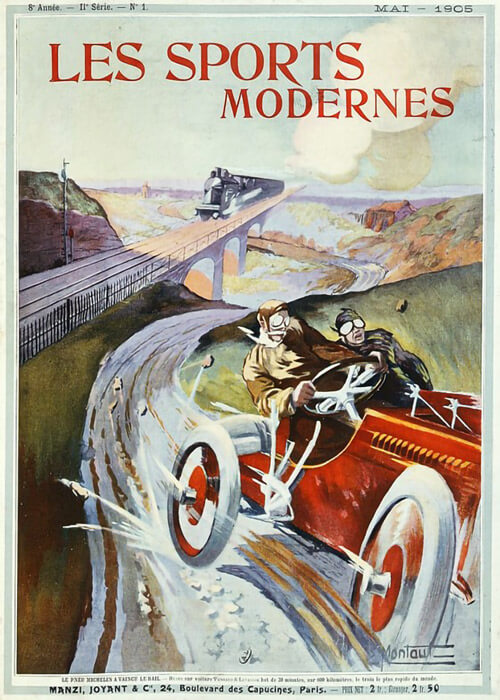
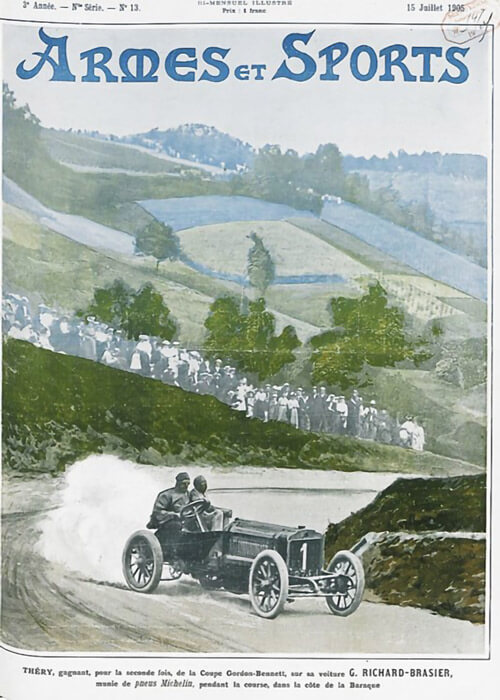
This Motor Age report, written by the well-known and long-time American correspondent in France, W. F. Bradley, deals with the course of the race and interwievs the technical aspects. It shows that he not only is a reporter for events, but als, and mostly writes on technical issues and development trends. The race performances of many of the individual drivers is discussed in this article. Here at least, it becomes clear how hard the cars (and drivers) were stressed because of the high speed level that racing cars already had attained. Ànd, what’s interesting, France had found a serious competitor in Germany. Among the first seven cars, only one was Fench.
By courtesy of hathitrust.org www.hathitrust.org, Text and jpegs compiled by motorracinghistory.
MOTOR AGE Vol. XIV, No. 3, July 16, 1908
STORY OF THE RUNNING OF THE RACE
By W. F. BRADLEY
Dieppe, July 7 – At 6 o’clock promptly, the boom of a cannon announced the approaching start of the race. One minute later and Darius Resta, England’s race track champion, had shot over the line in the long green Austin, the leader in what everybody was convinced would be the most keenly disputed motor race Europe had ever seen. One minute later, Poegge and his Mercedes had evoked the cheers of the strong German element and was racing down the road after the Britisher. Pierron and the Motobloc passed almost unnoticed. Then five of the best drivers Europe can boast stood in line in this order: Szisz, Duray, Hemery, Lancia, and Thery. Szisz and his low-built, fine-looking Renault, commanded a hearty cheer; Duray was not lacking in favoritism, but Hemery was treated to cold silence; Lancia, the unlucky, still showed he was popular with race crowds, but it remained to Thery, returned to the racing game and the Brasier team after an absence of 2 years, to receive the most prolonged and hearty roar of the morning.
Stricker, the Yankee driver of a six-cylinder Porthos, was followed by Opel, the German, in his own machine. Behind was little Rigal in the big blue Bayard-Clement, one of the fastest cars in the race, асcording to preliminary tests. Next followed Cagno in Itala, Harrison in Weigel, and Jenatzy in a Mors.
Then came the turn of No. 15 Thomas, with Strang at the wheel. Though the first and second gears had locked on the shaft while driving up to the starting line, Strang went away in excellent style, and was certainly a long way from being the slowest starter among a group of very fast cars.
Thirty-three other cars followed, every start being made with a dash and vim that revealed a determination to conquer in a hard, long struggle. Instead of the forty-nine cars originally entered, the actual starters were forty-eight, the third Mors, originally intended for Charles Jarrott, but later turned over to a factory mechanic, being absent on account of a break-up while on a previous practice spin. The three English Weigels, too, had at one time been doubtful starters, an accident 2 days before which cost the life of one of their friends, an amateur, driving the 1907 Renault of Szisz, completely disorganizing the team. The final settlement was that Weigel, the owner and builder of the three cars, withdrew from the race and was replaced by a factory tester.
The number of cars being large and the road reported rather loose and dusty in places, special protection had been taken by most of the drivers. A large proportion had their faces painted, and complete masks with but an opening for the mouth and eyes were used by many. Duray had a light wire gauze screen fitted up from the right-hand side of his dashboard as a preventative against flying stones. His breast was as usual adorned with Lorraine-Dietrich charms, and on the right-hand side of the chassis was a notice in English and German “Dangerous to lean out.“
A second after the Benz car driven by Erle had been sent away the first car to finish the round roared past the grand stand at a speed of about 70 miles an hour. It was Poegge in the Mercedes, who had succeeded in passing the Englishman Resta sent away 1 minute ahead of him. Before No. 49 Germain, driven by Perpere, had closed the starts, Szisz, Hemery, Lancia, Duray and Thery had finished their first round, the excitement as the last car left and the leading cars finished their initial trip being intense.
Thery in the Brasier and Szisz in the Renault each covered the first round in 37:06, which is at the rate of slightly over 77 miles an hour. Thus, last year’s record round made by Nazzaro in 38:16, or at the rate of 75 miles an hour, was beaten before the struggle had been in progress an hour. But even better time was to be made, for when Salzer roared past the grand stands in his Mercedes he had performed the stupendous feat of covering the 47.8 miles of road, with a standing start, in 36:31, which works out at the rate of 78.5 miles an hour. The limited bore cars had already proved themselves faster than their unfettered predecessors of 1907 and 1906.
Wagner, who had started fortieth on the list, beat his team mate Lancia and his rival Thery by covering the first round in 37:13. Bablot of the Brasier car, made second fastest time on the initial round by putting up figures of 36:40. The one other to break Nazzaro’s lap record of last year was Hemery in a Benz, with 37:55 to his credit.
Lancia’s brilliant work was only of short duration. After passing the tape at the end of his initial round the bulky Italian pulled in his car at the appointed tire station, jumped off hurriedly and lifted the bonnet. There was a quick examination, a shrug of the shoulders, then 10 minutes leisurely work terminated by the car being pushed off the track into the paddock at the rear of the grand stands. Lancia’s opportunity of winning the grand prix had been lost through the breaking of the water pump shaft.
Jenatzy ran in on completing his round in order to change the tires, in the manufacture of which he is interested. The work was done while the engine was running, a quantity of oil taken in, and the Mors car was off again.
Nazzaro had secured first place by the time the second round was completed, and was followed at an interval of exactly 1 minute by Lautenschlager, the newcomer on the Mercedes racing team. Thery had third place, Wagner fourth, Duray fifth, and Minoia, the de Dietrich driver, sixth. There was surprise that Szisz, who had tied with Thery for third place on the initial round, should not come around in his expected place. The absence was soon explained, for the Renault came slowly up the road minus its left rear tire and rim.
In a few hurried words the situation was explained: On approaching the hairpin turn near the Dieppe end of the course, and less than a mile from the grand stand, Szisz was suddenly flagged to stop, Poegge’s Mercedes having missed the turn and gone into the fence. Under the influence of the harsh application of the brakes, tire and rim flew off the wheel, the car meanwhile continuing to run along on the fixed wheel for a distance of several hundred yards. When the racer was finally pulled up it was found that the two flanges had been so flattened that it was impossible to fix a new rim. The car was running up to the grand stand on the rim, pulled up in front of its tire station, examined by Louis Renault and Chairman Rene de Knyff, then ordered to be pushed off the course, the regulations forbidding the changing of a wheel and a continuation of the race being impossible under any other conditions.
There were more surprises and disappointments in store, for the entire Dietrich team of Duray, Rougier, and Minoia, was soon put out of the running in quick succession. Duray, after covering two rounds, got back to the stand on foot and made the statement that the clutch collar had seized up. Rougier’s failure was put down to magneto trouble; for Minoia no explanation could be offered by the officials. Salzer, the acrobatic Mercedes driver, who furnished the record round, completed a second trip around the triangle, then disappeared. Gaubert, one of the Porthos drivers, was unable to get around one of the bends with his long wheelbase car in a satisfactory manner, ran into a wall, smashed his wheel and retired. Simons, his team mate on the No. 42 Porthos, met with a similar fate during the second round. Shannon of the Weigel team and Piacenza of the Itala each failed to report after a single round had been made.
It was early seen that the struggle was going to be a severe one between the Benz, Mercedes, and Brasier teams, with Bayard-Clement and Renault as runners-up. On the third round Wagner, the Fiat driver, had got first place, followed by Hemery, Benz; Lautenschlager, Mercedes; Nazarro, Fiat, and Thery, Brasier. It was indeed a star aggregation.
The proud position was not maintained for long, Wagner retiring on his fourth round owing to the breaking of a crankshaft of the Fiat racer. On the same round and at about the same time Nazzaro was reported as having quit the race, the trouble according to his team mate Wagner, being also a broken crankshaft. Thus all three Fiat cars were out of the race when only a third of the distance had been covered.
On the fourth round also Baras, the second Brasier driver, went out of the race as the result of the cams becoming loose on their keyways, the cams and shaft on the Brasier racers not being integral as on the touring car, in order to allow finer adjustment and changes. Laxen, the driver of No. 30 Weigel, skidded on a turn very early in the race and was unable thereafter to use any other than his third and fourth speeds. Later, while taking a turn at Eu during his third lap his car turned completely over without, however, any serious injury to the two men.
On the completion of the fourth round Hemery, the French driver of the German Benz, was in first position, with a lead of 2 minutes on Lautenschlager, the Mercedes conductor. Hanriot, also in a Benz, was third, with Thery running a very close fourth. Heath, who was driving his Panhard with remarkable dash, was in fifth place, Bablot in the Brasier in sixth, Cissac in the Panhard seventh and Hautvast, of the Bayard-Clement team eighth.
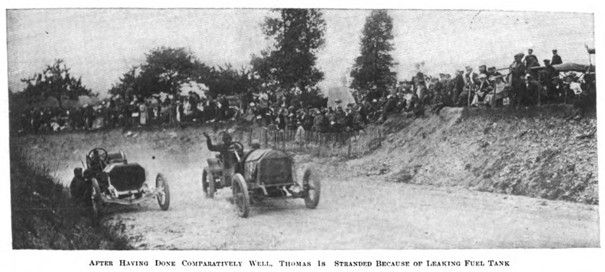
Owing partly to the forcing of the pace, and in a certain measure to the fact that the road was exceptionally hard, tire trouble was abundant. At the end of the first, second and fourth rounds Strang put into his station to change a punctured tire and take on replacements for those lost on the course. Guichard, the mechanic of the Thomas car, showed remarkable ability by climbing out to the bracket behind the gasoline tank and unstrapping the tires as the car was running down to the station. With the single fastener Michelin rim and prompt responses from those at the tire and gasoline station the changes were all made with remarkable speed.
Tire changing being an important factor in the race, it was interesting to notice the various arrangements adopted and methods of work of the different teams installed in the dugout „ravitaillement.“‚ Renault and Panhard both had pneumatic jacks which could be put under the axle of the car and the vehicle raised in less time than it often took to place the old type in position. Dietrich had a long double lever about 7 feet in length by which the entire front or rear could be lifted off the ground on one pull. Half a dozen firms maintained their gasoline under pressure in a large tank, the lead to the car being made by a long length of piping.
During the fifth round Lautenschlager in the Mercedes managed to wrest first place from Hemery in the Benz and to secure for himself a margin of 3 minutes. Hemery took second place, his companion, Hanriot, retained third and Thery kept in fourth position. There was now something like consternation in the French camp, for unless Thery could wear down the three fast cars in front of him victory was assured to Germany, and, in any case, the home industry would be poorly represented in the first half dozen. Heath and Cissac, each in a Panhard, were running well, but could not be expected to secure first place except by accident, and the two Renaults handled by Caillois and Dimitri were too far down at half distance to hope to get to the front.
On the termination of the sixth round the Mercedes-Benz duel was still in progress, Lautenschlager leading by 4 minutes on Hemery and 5 minutes on Hanriot, Benz. Thery, in fourth position, handled his car magnificently.
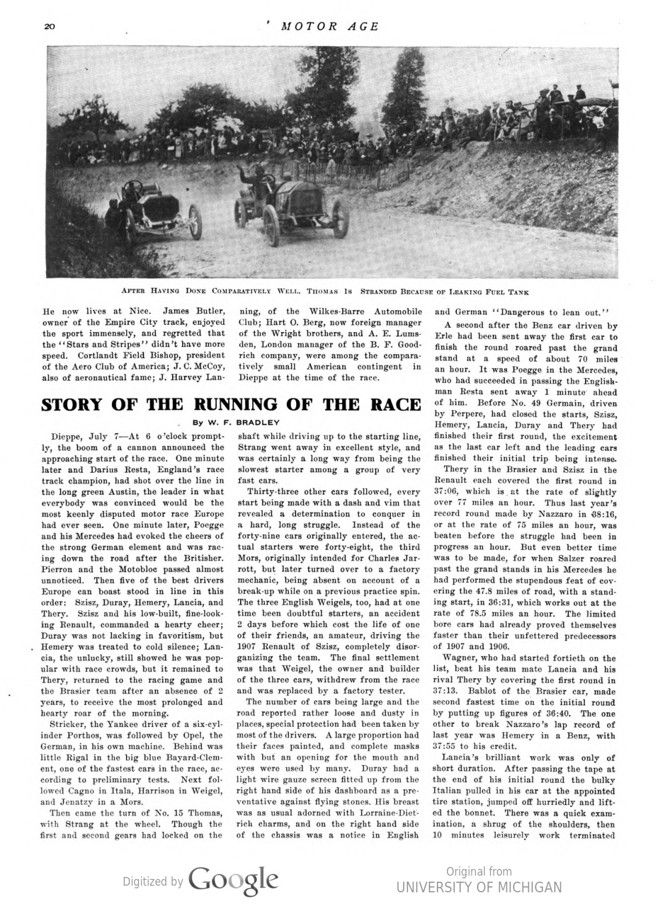
While the leaders were on their sixth round Strang pulled into the station at the end of his fourth round with the gasoline tank leaking badly. It was quickly filled, fresh tires taken, and a start made for a fifth round, Strang believing that he could run on gravity with his large supply and keep sufficient fuel to get round the course. In other respects the car had shown satisfaction, and, though not as fast as the Germans and French, seemed capable of going the entire distance.
Hemery managed to close up on Lautenschlager during the seventh round until the difference between the two men was barely a minute. Hanriot was 4 minutes behind the leading Mercedes, and Thery was 10 minutes in the rear. During this round Hemery was struck in the eye by a flying stone which broke his goggles and caused some of the glass to enter the eye. Though suffering intensely and only seeing with one eye, the Frenchman stubbornly refused to allow his car to be taken over by a reserve driver. One side of his head was horribly swollen, the effect of the tarred surface and dust aggravated the evil, but still the killing pace was maintained. Lautenschlager managed to draw away from Hemery 1 minute and from Thery 4 minutes, but the respective positions of the four leaders remained unchanged during the eighth round.
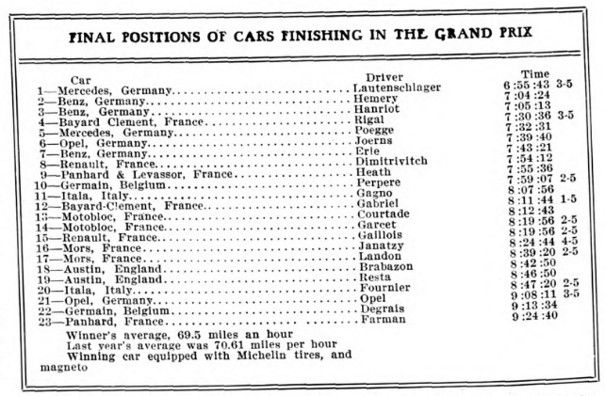
Hemery finished first with his left rear tire flat and his left eye probably useless for the rest of his life. But he had started earlier than Lautenschlager carrying No. 35, and had to be content with second place, 9 minutes behind the Mercedes. Hanriot, who had struggled hard to wrest second place from his team mate, finally had to accept third position, less than 1 minute behind the second.
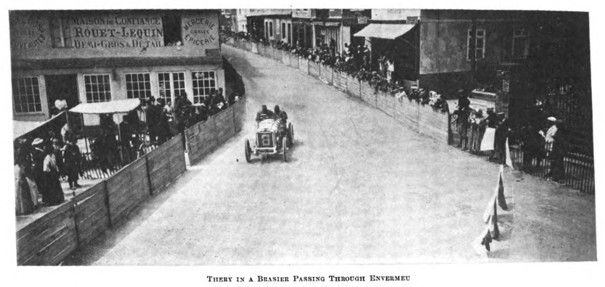
At the commencement of the last round, fourth place had seemed certain for Thery; it was even imagined by his supporters that a supreme effort would be made to run up to third or second position, first place being manifestly beyond his reach except in case of accident. Henry Brasier wandered up and down the track with a worried look on his face and glancing every few minutes at the announcement board for news of the passage of his crack driver. Louis Renault strode up and down nervously and anxiously, stopping now and again to explain to Rene de Knyff how Caillois had been delayed by trouble with his dismountable rims. The minutes passed, but no reports came in of the approach of Thery. The time necessary to secure first place elapsed, then the cruel truth burst upon them that Thery, long looked upon as superior to breakdowns and accidents, had met with defeat. It was not, however, until an hour later that it was learned that the Brasier car had completely broken down during the last round, a cylinder having cracked and the big racer finished its career in the ditch.
Rigal, who earlier had been delayed by trouble with his dismountable rims, made a supreme effort and finally brought his Bayard-Clement into the fourth place vacated by Thery. Poegge, who had undone the first Renault, brought his Mercedes into fifth place; Joerns in the Opel secured sixth place, Erle in the Benz took seventh position and Dimitri, the Renault driver, was classed eighth.
Though George Heath was unable to officially finish the race, his car took ninth position. The winner of the first Vanderbilt race had suffered severely from the effects of the tar on his eyes all through the race. At the end of the ninth round he declared that it was impossible for him to continue and immediately Artois, who was in the gasoline station, jumped onto the road and was off with the car. During the final round the mechanic was thrown out of the car on one of the turns, the rear wheel passing over his left hand and severely crushing it.
Henry Fournier, one of the several veterans who have returned to racing this year after a long absence, was delayed by tire and slight mechanical trouble early in the race, and later suffered intensely from the action of the tar on his eyes. On completing the course in twentieth position he had to be led away to the doctor, his eyesight having temporarily left him. Moore, Brabazon and Resta, the English drivers, were similarly in a pitiful condition, while George Heath had to take to his bed for a day or so.
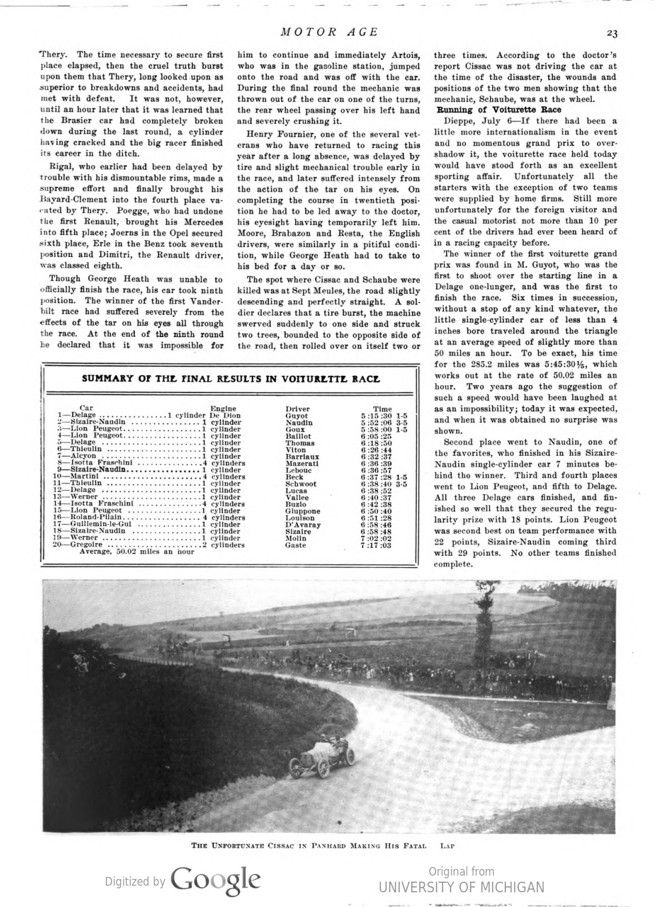
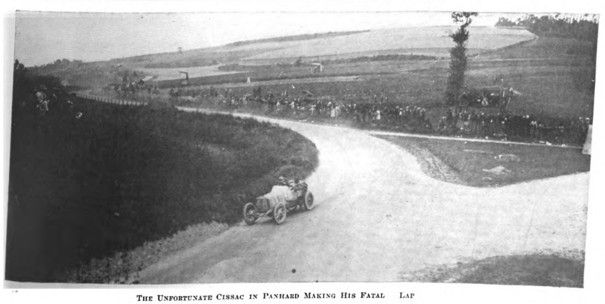
The spot where Cissac and Schaube were killed was at Sept Meules, the road slightly descending and perfectly straight. A soldier declares that a tire burst, the machine swerved suddenly to one side and struck two trees, bounded to the opposite side of the road, then rolled over on itself two or three times. According to the doctor’s report, Cissac was not driving the car at the time of the disaster, the wounds and positions of the two men showing that the mechanic, Schaube, was at the wheel.
Running of Voiturette Race
Dieppe, July 6 – If there had been a little more internationalism in the event and no momentous grand prix to overshadow it, the voiturette race held today would have stood forth as an excellent sporting affair. Unfortunately all the starters with the exception of two teams were supplied by home firms. Still more unfortunately for the foreign visitor and the casual motorist not more than 10 per cent of the drivers had ever been heard of in a racing capacity before.
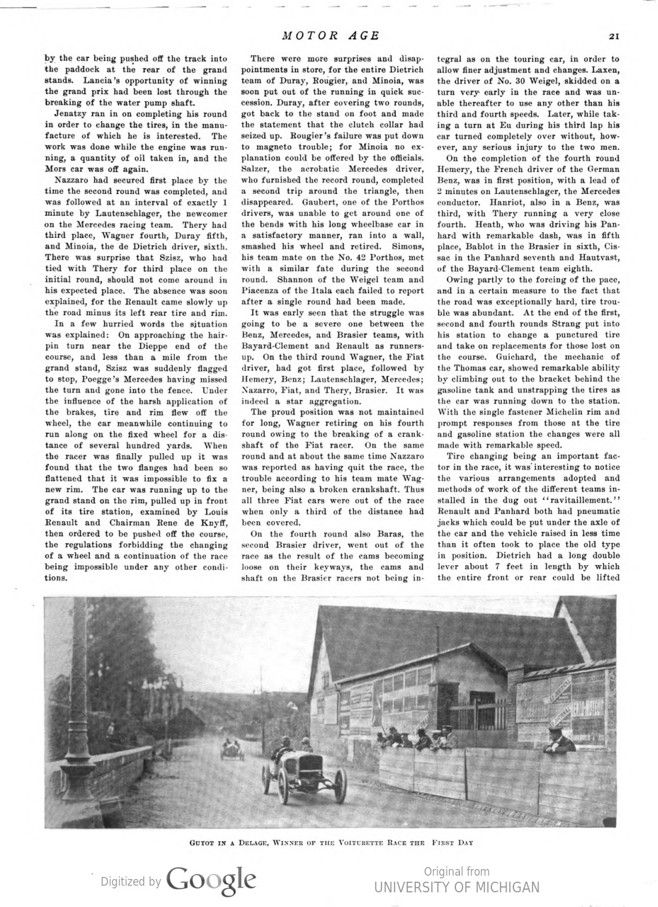
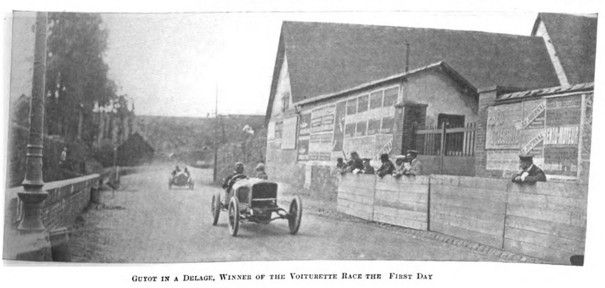
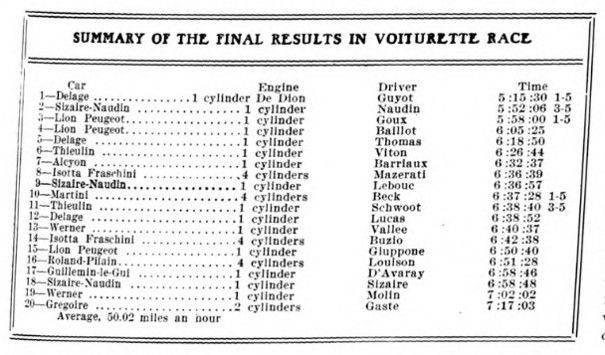
The winner of the first voiturette grand prix was found in M. Guyot, who was the first to shoot over the starting line in a Delage one-lunger, and was the first to finish the race. Six times in succession, without a stop of any kind whatever, the little single-cylinder car of less than 4 inches bore traveled around the triangle at an average speed of slightly more than 50 miles an hour. To be exact, his time for the 285.2 miles was 5:45:30-1/5, which works out at the rate of 50.02 miles an hour. Two years ago, the suggestion of such a speed would have been laughed at as an impossibility; today it was expected, and when it was obtained no surprise was shown.
Second place went to Naudin, one of the favorites, who finished in his Sizaire-Naudin single-cylinder car 7 minutes behind the winner. Third and fourth places went to Lion Peugeot, and fifth to Delage. All three Delage cars finished, and finished so well that they secured the regularity prize with 18 points. Lion Peugeot was second best on team performance with 22 points, Sizaire-Naudin coming third with 29 points. No other teams finished complete.
Photos.
Page 20.
AFTER HAVING DONE COMPARATIVELY WELL, THOMAS IS STRANDED BECAUSE OF LEAKING FUEL TANK
Page 21.
GUYOT IN A DELAGE, WINNER OF THE VOITURETTE RACE THE FIRST DAY
Page 22.
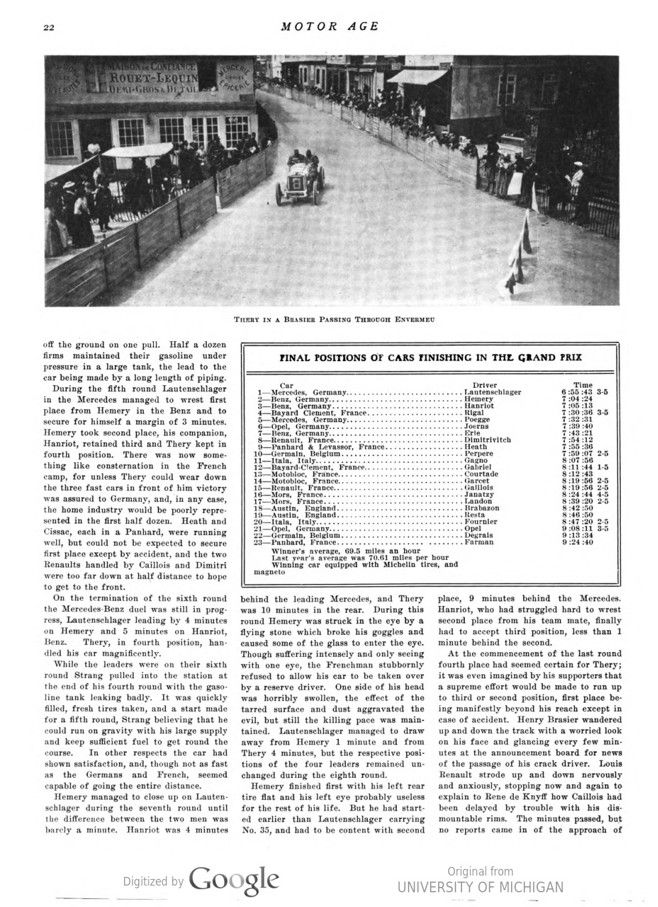
THERY IN A BRASIER PASSING THROUGH ENVERMEU
(MAISON DE CONFIANCE ROUET-LEQUIN DEMI-GROS & DETAIL / MERCERIE-CIERGES-ÉPICERIE)
FINAL POSITIONS OF CARS FINISHING IN THE GRAND PRIX
Page 23.
SUMMARY OF THE FINAL RESULTS IN VOITURETTE RACE
THE UNFORTUNATE CISSAC IN PANHARD MAKING HIS FATAL LAP