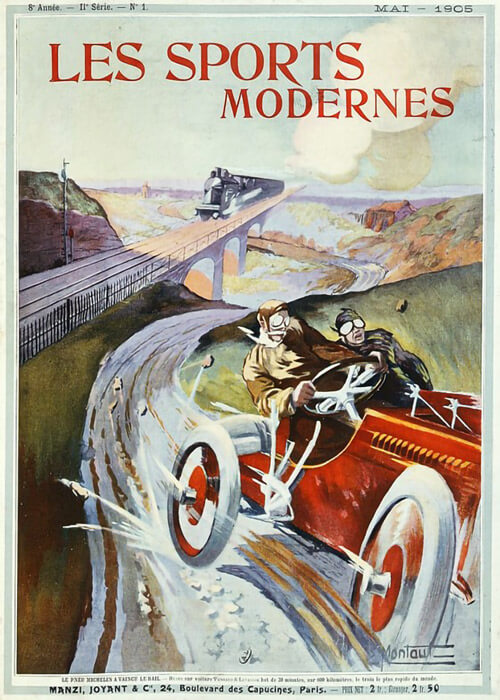
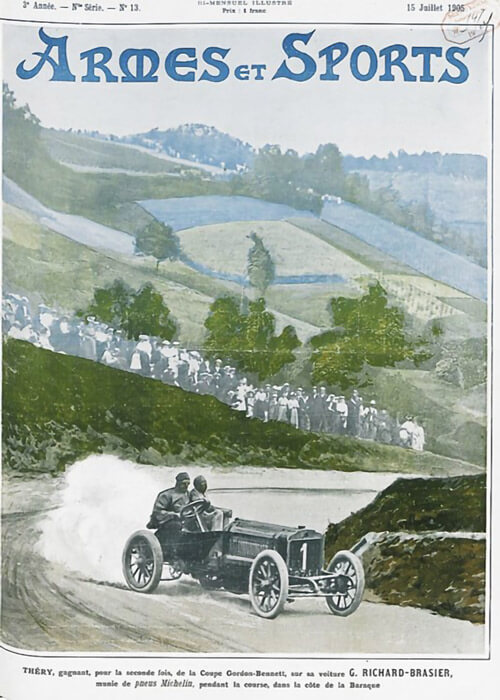
This Motor Age article is written by none less that Mr. Batchelder, who played such a important role in many American motorracing contests. The defeat that the French overcame that racing day was elusively described here. But his conclusion on the American contenders even so, not harmful but correct. His opinion also contains a warning that the speed now attained, could be a limit in view of the two victims of this race. As can be expected, this article deals more with organisational aspects. Technical view can be expected in the other articles.

By courtesy of hathitrust.org www.hathitrust.org, Text and jpegs compiled by motorracinghistory.
MOTOR AGE Vol. XIV, No. 3, July 16, 1908
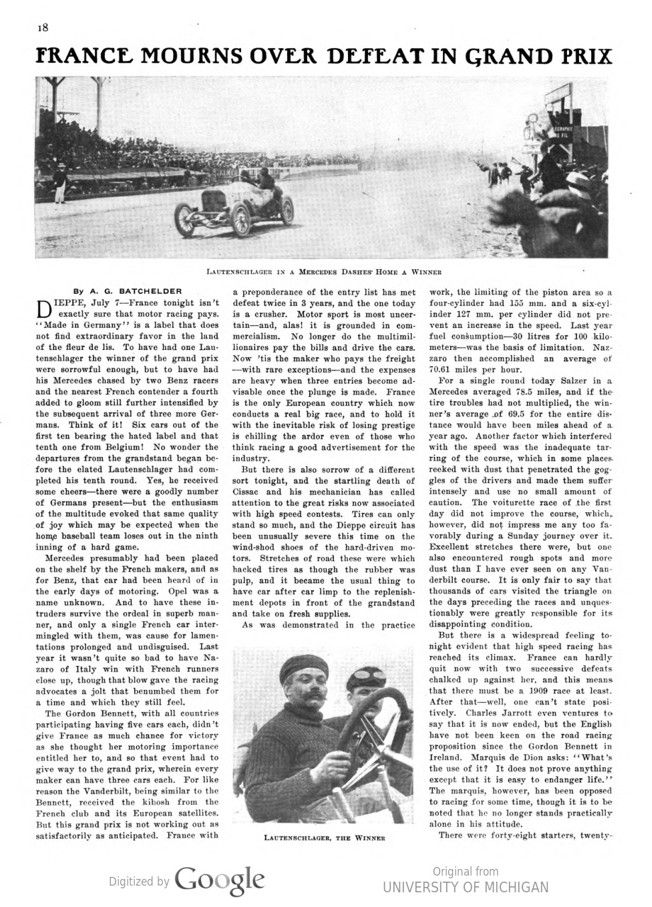
FRANCE MOURNS OVER DEFEAT IN GRAND PRIX
By A. G. BATCHELDER
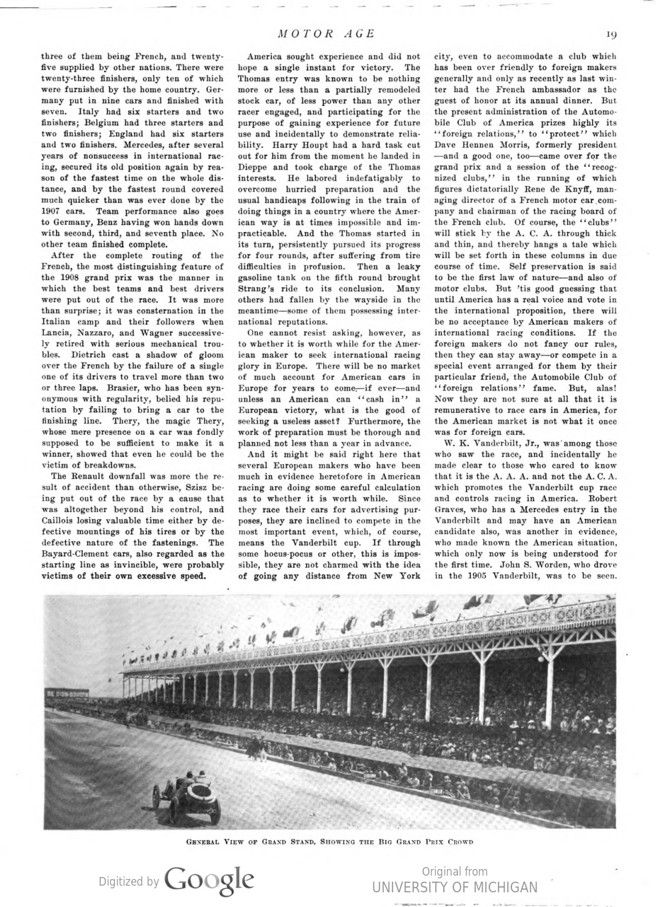
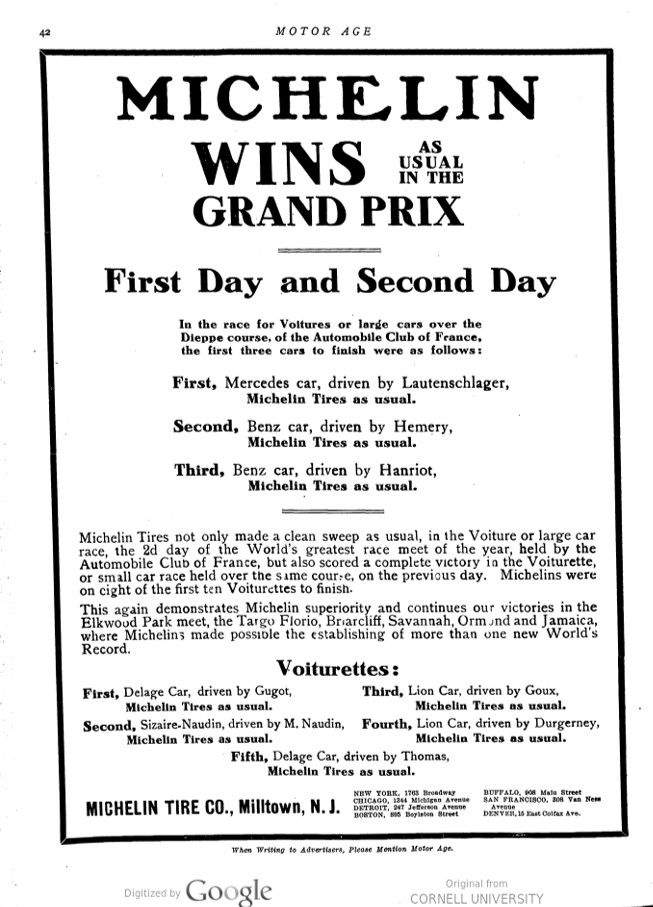
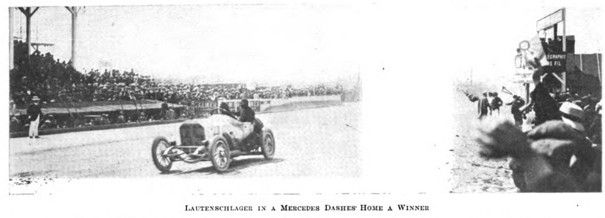
DIEPPE, July 7 – France tonight wasn’t exactly sure that motor racing pays. „Made in Germany“ is a label that does not find extraordinary favor in the land of the fleur de lis. To have had one Lautenschlager the winner of the grand prix were sorrowful enough, but to have had his Mercedes chased by two Benz racers and the nearest French contender a fourth added to gloom still further intensified by the subsequent arrival of three more Germans. Think of it! Six cars out of the first ten bearing the hated label and that tenth one from Belgium! No wonder the departures from the grandstand began before the elated Lautenschlager had completed his tenth round. Yes, he received some cheers – there were a goodly number of Germans present – but the enthusiasm of the multitude evoked that same quality of joy which may be expected when the home baseball team loses out in the ninth inning of a hard game.
Mercedes presumably had been placed on the shelf by the French makers, and as for Benz, that car had been heard of in the early days of motoring. Opel was a name unknown. And to have these intruders survive the ordeal in superb manner, and only a single French car intermingled with them, was cause for lamentations prolonged and undisguised. Last year it wasn’t quite so bad to have Nazzaro of Italy win with French runners close up, though that blow gave the racing advocates a jolt that benumbed them for a time and which they still feel.
The Gordon Bennett, with all countries participating having five cars each, didn’t give France as much chance for victory as she thought her motoring importance entitled her to, and so that event had to give way to the grand prix, wherein every maker can have three cars each. For like reason the Vanderbilt, being similar to the Bennett, received the kibosh from the French club and its European satellites. But this grand prix is not working out as satisfactorily as anticipated. France with a preponderance of the entry list has met defeat‘ twice in 3 years, and the one today is a crusher. Motor sport is most uncertain – and, alas! it is grounded in commercialism. No longer do the multimillionaires pay the bills and drive the cars. Now it’s the maker who pays the freight – with rare exceptions – and the expenses are heavy when three entries become advisable once the plunge is made. France is the only European country which now conducts a real big race, and to hold it with the inevitable risk of losing prestige is chilling the ardor even of those who think racing a good advertisement for the industry.
But there is also sorrow of a different sort tonight, and the startling death of Cissac and his mechanician has called attention to the great risks now associated with high-speed contests. Tires can only stand so much, and the Dieppe circuit has been unusually severe this time on the wind-shod shoes of the hard-driven motors. Stretches of road these were which hacked tires as though the rubber was pulp, and it became the usual thing to have car after car limp to the replenishment depots in front of the grandstand and take on fresh supplies.
As was demonstrated in the practice work, the limiting of the piston area so a four-cylinder had 155 mm. and a six-cylinder 127 mm. per cylinder did not prevent an increase in the speed. Last year fuel consumption – 30 litres for 100 kilometres – was the basis of limitation. Nazzaro then accomplished an average of 70.61 miles per hour.
For a single round today Salzer in a Mercedes averaged 78.5 miles, and if the tire troubles had not multiplied, the winner’s average of 69.5 for the entire distance would have been miles ahead of a year ago. Another factor which interfered with the speed was the inadequate tarring of the course, which in some places reeked with dust that penetrated the goggles of the drivers and made them suffer intensely and use no small amount of caution. The voiturette race of the first day did not improve the course, which, however, did not impress me any too favorably during a Sunday journey over it. Excellent stretches there were, but one also encountered rough spots and more dust than I have ever seen on any Vanderbilt course. It is only fair to say that. thousands of cars visited the triangle on the days preceding the races and unquestionably were greatly responsible for its disappointing condition.
But there is a widespread feeling tonight evident that high speed racing has reached its climax. France can hardly quit now with two successive defeats chalked up against her, and this means- that there must be a 1909 race at least. After that well, one can’t state positively. Charles Jarrott even ventures to say that it is now ended, but the English have not been keen on the road racing proposition since the Gordon Bennett in Ireland. Marquis de Dion asks: „What’s the use of it? It does not prove anything except that it is easy to endanger life.“ The marquis, however, has been opposed to racing for some time, though it is to be noted that he no longer stands practically alone in his attitude. There were forty-eight starters, twenty-three of them being French, and twenty-five supplied by other nations. There were twenty-three finishers, only ten of which were furnished by the home country. Germany put in nine cars and finished with seven. Italy had six starters and two finishers; Belgium had three starters and two finishers; England had six starters and two finishers. Mercedes, after several years of non-success in international racing, secured its old position again by reason of the fastest time on the whole distance, and by the fastest round covered much quicker than was ever done by the 1907 cars. Team performance also goes to Germany, Benz having won hands down with second, third, and seventh place. No other team finished complete.
After the complete routing of the French, the most distinguishing feature of the 1908 grand prix was the manner in which the best teams and best drivers were put out of the race. It was more than surprise; it was consternation in the Italian camp and their followers when Lancia, Nazzaro, and Wagner successively retired with serious mechanical troubles. Dietrich cast a shadow of gloom over the French by the failure of a single one of its drivers to travel more than two or three laps. Brasier, who has been synonymous with regularity, belied his reputation by failing to bring a car to the finishing line. Thery, the magic Thery, whose mere presence on a car was fondly supposed to be sufficient to make it a winner, showed that even he could be the victim of breakdowns.
The Renault downfall was more the result of accident than otherwise, Szisz being put out of the race by a cause that was altogether beyond his control, and Caillois losing valuable time either by defective mountings of his tires or by the defective nature of the fastenings. The Bayard-Clement cars, also regarded as the starting line as invincible, were probably victims of their own excessive speed.
America sought experience and did not hope a single instant for victory. The Thomas entry was known to be nothing more or less than a partially remodelled stock car, of less power than any other racer engaged, and participating for the purpose of gaining experience for future use and incidentally to demonstrate reliability. Harry Houpt had a hard task cut out for him from the moment he landed in Dieppe and took charge of the Thomas interests. He labored indefatigably to overcome hurried preparation and the usual handicaps following in the train of doing things in a country where the American way is at times impossible and impracticable. And the Thomas started in its turn, persistently pursued its progress for four rounds, after suffering from tire difficulties in profusion. Then a leaky gasoline tank on the fifth round brought Strang’s ride to its conclusion. Many others had fallen by the wayside in the meantime – some of them possessing international reputations.
One cannot resist asking, however, as to whether it is worthwhile for the American maker to seek international racing glory in Europe. There will be no market of much account for American cars in Europe for years to come – if ever – and unless an American can „cash in“ a European victory, what is the good of seeking a useless asset? Furthermore, the work of preparation must be thorough and planned not less than a year in advance.
And it might be said right here that several European makers who have been much in evidence heretofore in American racing are doing some careful calculation as to whether it is worthwhile. Since they race their cars for advertising purposes, they are inclined to compete in the most important event, which, of course, means the Vanderbilt cup. If through some hocus-pocus or other, this is impossible, they are not charmed with the idea of going any distance from New York city, even to accommodate a club which has been over friendly to foreign makers generally and only as recently as last winter had the French ambassador as the guest of honor at its annual dinner. But the present administration of the Automobile Club of America prizes highly its „foreign relations,“ to „protect“ which Dave Hennen Morris, formerly president – and a good one, too – came over for the grand prix and a session of the „recognized clubs,“ in the running of which figures dictatorially Rene de Knyff, managing director of a French motor car company and chairman of the racing board of the French club. Of course, the „clubs““ will stick by the A. C. A. through thick and thin, and thereby hangs a tale which will be set forth in these columns in due course of time. Self-preservation is said to be the first law of nature – and also of motor clubs. But ‚tis good guessing that until America has a real voice and vote in the international proposition, there will be no acceptance by American makers of international racing conditions. If the foreign makers do not fancy our rules, then they can stay away – or compete in a special event arranged for them by their particular friend, the Automobile Club of „foreign relations“ fame. But, alas! Now they are not sure at all that it is remunerative to race cars in America, for the American market is not what it once was for foreign cars.
W. K. Vanderbilt, Jr., was among those who saw the race, and incidentally he made clear to those who cared to know that it is the A. A. A. and not the A. C. A. which promotes the Vanderbilt cup race and controls racing in America. Robert Graves, who has a Mercedes entry in the Vanderbilt and may have an American candidate also, was another in evidence, who made known the American situation, which only now is being understood for the first time. John S. Worden, who drove in the 1905 Vanderbilt, was to be seen. He now lives at Nice. James Butler, owner of the Empire City track, enjoyed the sport immensely, and regretted that the „Stars and Stripes“ didn’t have more speed. Cortlandt Field Bishop, president of the Aero Club of America; J. C. McCoy, also of aeronautical fame; J. Harvey Lanning, of the Wilkes-Barre Automobile Club; Hart O. Berg, now foreign manager of the Wright brothers, and A. E. Lumsden, London manager of the B. F. Good- rich company, were among the comparatively small American contingent in Dieppe at the time of the race.
Photos.
Page 18.
LAUTENSCHLAGER IN A MERCEDES DASHES HOME A WINNER
LAUTENSCHLAGER, THE WINNER
Page 19.
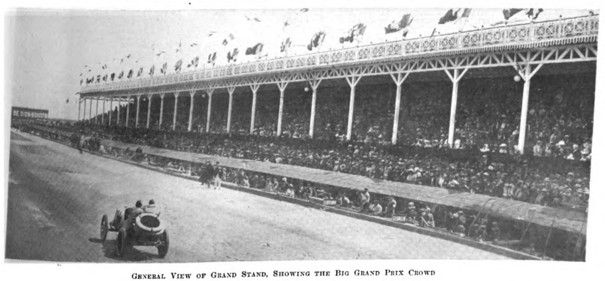
GENERAL VIEW OF GRAND STAND, SHOWING THE BIG GRAND PRIX CROWD