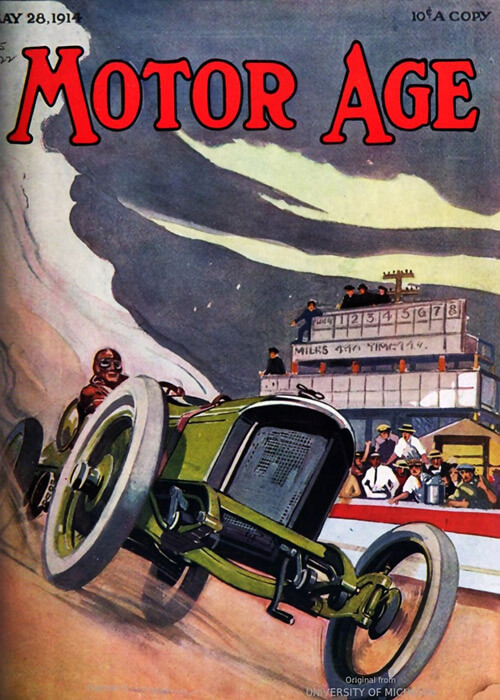
This Motor Age report of the 1908 French Grand Prix mentions both races, inclusive the race of the Voiturette. First of all the results of this race are summarized, followed by mentioning the illustrous fate of the only two American contenders. The fatal accident of the French driver Henri Cissac and his mechanic Jules Schaud was decribed too, followed by short surveys of sunday’s and monday’s races. It’s the intro to the next, more specialised articles on the 1908 race.
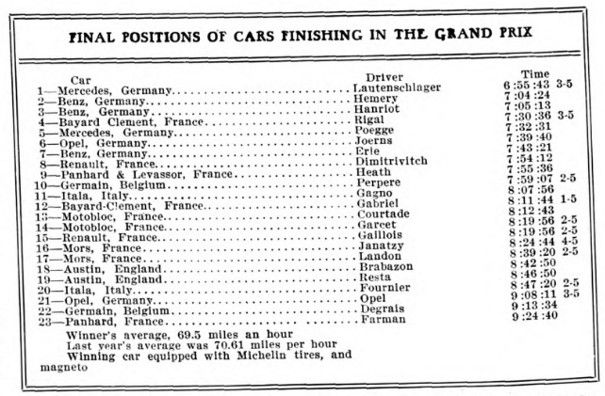
By courtesy of hathitrust.org www.hathitrust.org, Text and jpegs compiled by motorracinghistory.
MOTOR AGE Vol. XIV, No. 2, July 9, 1908
CLEAN SWEEP FOR GERMANY IN GRAND PRIX
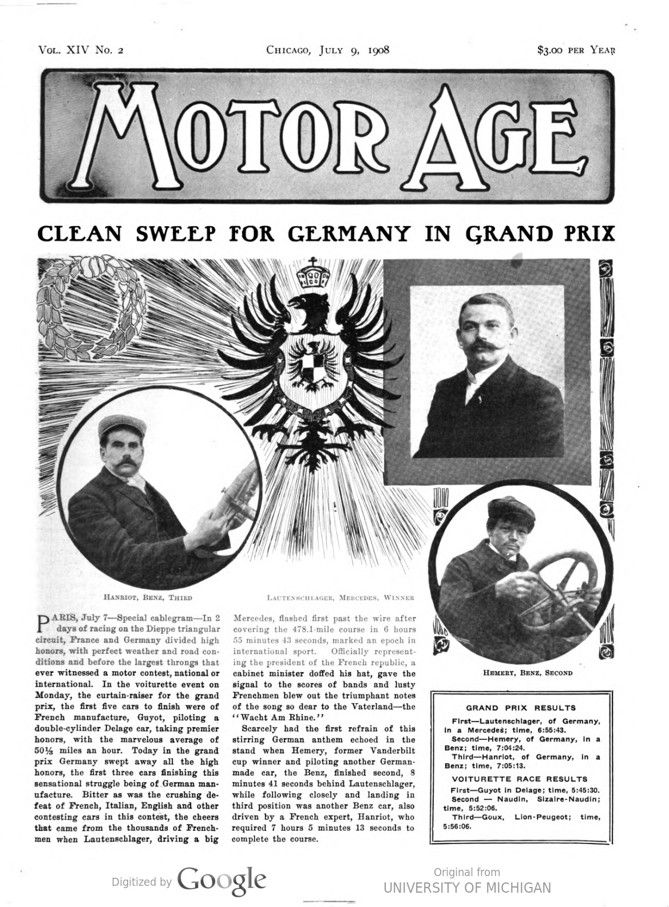
PARIS, July 7 – Special cablegram – In 2 days of racing on the Dieppe triangular circuit, France and Germany divided high honors, with perfect weather and road conditions and before the largest throngs that ever witnessed a motor contest, national or international. In the voiturette event on Monday, the curtain-raiser for the grand prix, the first five cars to finish were of French manufacture, Guyot, piloting a double-cylinder Delage car, taking premier honors, with the marvelous average of 50½ miles an hour. Today in the grand prix Germany swept away all the high honors, the first three cars finishing this sensational struggle being of German manufacture. Bitter as was the crushing defeat of French, Italian, English and other contesting cars in this contest, the cheers that came from the thousands of Frenchmen when Lautenschlager, driving a big Mercedes, flashed first past the wire after covering the 478.1-mile course in 6 hours 55 minutes 43 seconds, marked an epoch in international sport. Officially representing the president of the French republic, a cabinet minister doffed his hat, gave the signal to the scores of bands and lusty Frenchmen blew out the triumphant notes of the song so dear to the Vaterland – the „Wacht Am Rhine.‘
Scarcely had the first refrain of this stirring German anthem echoed in the stand when Hemery, former Vanderbilt cup winner and piloting another German-made car, the Benz, finished second, 8 minutes 41 seconds behind Lautenschlager, while following closely and landing in third position was another Benz car, also driven by a French expert, Hanriot, who required 7 hours 5 minutes 13 seconds to complete the course.
GRAND PRIX RESULTS
First – Lautenschlager, of Germany, in a Mercedes; time, 6:55:43.
Second – Hemery, of Germany, in a Benz; time, 7:04:24.
Third – Hanriot, of Germany, in Benz; time, 7:05:13.
VOITURETTE RACE RESULTS
First – Guyot in Delage; time, 5:45:30.
Second – Naudin, Sizaire-Naudin; time, 5:52:06.
Third – Goux, Lion-Peugeot; time, 5:56:06.
Although a marvelous pace was maintained in the grand prix, six drivers setting new marks for the circuit in the first round, the speed all the way through did not exceed that averaged in last year’s grand prix, when the mighty Nazzaro attained the record-breaking average of more than 70 miles – close to 71. But the 1908 performance of the winning Mercedes car was better than the mark of 1906 and quite creditable considering the adverse wind that prevailed at certain portions of the course. Official declaration is that Lautenschlager averaged 111 kilometers or 69.24 miles an hour for the race.
Thomas Meets With Accident
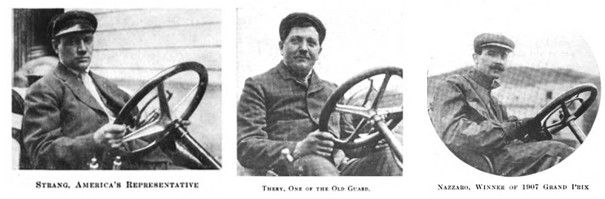
But if continental Europe and Great Britain looked for the favorite Renault to capture the highest honors, with Nazzaro piloting the Fiat making the concluding round a dare-devil finish for the goal one long to be remembered, what of the United States? Only one American car, the Thomas Flyer, had been pitted against the nearly fifty other machines of European make and Lewis Strang, pilot of the victorious Isotta Fraschini car in two of the United States‘ greatest stock car races – the Savannah trophy and the Briarcliff – was the man expected to carry old glory to the front in this big event.
The Thomas car, however, was doomed to an inglorious defeat because of an untoward accident an hour before the signal was given to line up for the start. While driving the American car into the inclosure previous to the early morning start Strang’s machine came to a sudden stop with a whirr and a crash. Something was wrong with the transmission and reversing gear. In desperation Strang called for his mechanic to eliminate the trouble. „Do something, for heaven’s sake,“ was the frenzied cry of the driver, who had studied the course for weeks for this crucial test of speed.
But there was not time to remedy matters. Forced to enter the international battle disabled – with the first and second speed and reversing gear out of commission – the American competed only on his nerve. Technically speaking, had there been time for a conference, the American car would have been disqualified, as the rules of the race plainly call for a reverse gear driven by the motor of the car. French, German, Italian, English and other cars were snorting around the picturesque and admirably protected circuit, and Strang had no alternative. With the car hopelessly out of the running, he drove it around the first circuit in 53 minutes 44 seconds, yielded several more minutes to tire troubles, kept up his courage when damaged cylinders gave the remainder of the motor its warning to desist, and withdrew from the unequal conflict after four rounds. He had plenty of company, for one by one the foreign cars that were in trouble retired soon after. Nearly 48 miles in less than 54 minutes with a damaged car! But that was not all. Strang’s time for the second round with infinitely more tire trouble was 3 minutes and 43 seconds more than an hour. On the third round he totaled 56:47, and on the concluding round for his efforts his time was 58:01.
For the protection of the public – nearly countries 1,000,000 enthusiasts of all countries viewed the struggle from advantageous points on this Dieppe circuit – a whole brigade of soldiery was utilized. Not even the proverbial chicken or dog was reported destroyed under the flying wheels and no spectator attempted to pass the wall of steel bayonets. But this admirable police system did not serve to save the contestants themselves, the grand prix furnishing a distressing feature in the deaths of two contestants and the serious injury of another, as well as the partial blinding of Hemery, whose goggles were smashed by a flying stone sent hurtling through the dusty air by a racing car. Physicians immediately took charge of the Vanderbilt cup hero, injected cocaine into his eye to assuage the terrible pain and were horror- stricken when, a moment later, the plucky Frenchman insisted upon mounting his seat in the Benz car.
Cissac and Mechanic Killed
On the final round, after making a gal lant effort to put the Panhard into a commanding position and while driving at a rate computed to be close to 77 miles an hour, Cissac, at the wheel of the French Panhard, together with his mechanic, Schaub, were hurled to the roadway, the great car falling on top of their unconscious forms and crushing their bodies into a pulp. A tire had been torn off and before human hands could make a move to stem the disaster the destruction of the racing machine and its occupants was complete. Near Eu the Weigel car rounded a turn badly, upset and hurled Harrison, its driver, into the embankment. He was conveyed to a neighboring hospital tent and attended by physicians. Harrison was badly shocked and severely injured,, but will be convalescent in a few days.
If despair due to accidents, failure of cars to maintain the desired speed and other circumstances seized Salzer, Szisz, Lancia, Wagner, Cagno, Jarrott, Jenatzy and others, misery was the whole portion of Nazzaro, who had set his heart upon beating an average of 70.05 miles an hour. Tire troubles in the third round, together with a jammed clutch, put the hero of the 1907 grand prix into the slough of despond. His work in the opening round, in which he fought it out side by side when the roadway permitted this desperate racing with Salzer, the pair circling the course in the initial round in the heart- breaking time of 36:31 for 48 miles. This is at the rate of 126.5 kilometers an hour, and if it had been maintained all world’s records would have appeared insignificant beside this one. But this was not the limit of the efficiency of the Fiat. In the second round the mighty Nazzaro, who seemed fearless, fought his way to the front. A great favorite among thousands in the crowds, the Italian started out to open a gap that would make his lead commanding. But he figured without the cost on tires. Szisz, Thery, Bablot, Wagner, Salzer and an Italian and a German driver who had tested out Nazzaro’s boldness in the awful drive in the opening round, sharing with him the honor of breaking last year’s record for a circuit, also found the effect upon the tires was tremendous as well as dangerous.
The morning of the grand prix opened fair and favorable, the light breeze that tempered the air giving promise of a day as pleasant as the preceding one had been when the voiturettes had their struggle. All the contestants were brought into orderly sequence according to numbers, under the direction of the trained attendants, while the representatives of the department of war with their field telegraph apparatus gave the final instructions to the soldiery. Closed to the racing cars for more than a week, the course had been treated with a preparation of tar and never was in better condition.
Lautenschlager a Dark Horse
„Made in Germany“ was a phrase conveying little beyond a sentiment of pride for another country with the hundreds of thousands of Frenchmen. „Germany has been out of a prominent position in the great motor racing world for years,“ said the adherents of the Panhard and Brazier.
„Poof, poof, the Fiat under Lancia, Nazzaro and Wagner has this contest in its grasp,“ was the strain from the Italians, with a considerable number of the experts from the sunny clime pinning their faith directly to the Itala car with Cagno, Fournier and Piacenza as pilots.
As for Lautenschlager, the handsome man who had one of the Mercedes cars in charge, there were few to pay him homage in the dawn hours. What a difference 6 hours made with this German. M. Maujan, undersecretary of the department of the interior, personal representative of President Fallieres, was glad, apparently, to bow his respects to the hero of the hour. It was no sacrifice of national honor for this high official to direct that the musical salute written boldly in French aria style in honest anticipation of a French victory on French soil, be transposed instantly into the familiar tune of the Rheinland.
Germany had repeated its victory of years ago gained in sanguinary traversing of French soil, followed by the exacting of a great gold treasure, but this time the triumph had come with steel steeped in oil, not blood; with hickory wood fashioned into spokes, not rifle butts; with essence as fuel, not gunpowder – but with the same stolid, patriotic and obedient character of man at the head of the mechanical invasion as the man in panoply of war. „Hoch der Kaiser“ sounded just as loudly from the throats of Frenchmen, Britons, Italians and Americans gathered at the official stand as it did when uttered by alien forces, but there was a cadence about today’s shouts that was interpreted by the visitors in this country that spelled out „wholesome competition.“
Desperate Effort by French
Lautenschlager undoubtedly profited immensely by the trouble encountered by Nazzaro, taking the lead when the Fiat got into distress. After that the Mercedes plugged around the circuit like mad, steadily and with little tire trouble, no contesting car seriously menacing its lead. Szisz in a Renault and Duray in a Lorraine awoke to the desperate nature of their task when the German had the lead and made a terrific drive to get the first place. Thery, hero of the Gordon Bennett cup race of a few years ago and the man upon whose veteran experience many pinned their faith, was unable to achieve a commanding place. The Germans! latter seemed to have monopolized every favorable position. There were Germans in front of him, but none behind him!
Thery found Frenchmen ahead of him in the fourth round, his compatriots Hemery and Hanriot having passed him. But they were at the wheels of German cars! Tire troubles marked the veteran’s car. It was no use. The Germans seemed immune from tire troubles. And Thery constructively gave up the ghost. France was robbed of its only chance to show colors in front in the seventh round.
But Regal, at the wheel of a Bayard-Clement, had not given up hope. He kept the bonnet of his car headed in the center of the roadway with all speed on even the bad turns, managing to get the honor of fourth position at the finish and to be the recipient of the only strains of the French national air that came from the side of the presidential box. He finished the long route in 7:30:36, nearly 46 minutes after Lautenschlager had earned the title of hero of the Dieppe circuit. Two minutes behind Regal came Poegge piloting another Mercedes, while another „Made in Germany“ car, the Opel, with Joerns at the wheel, followed the Mercedes into sixth place about 7 minutes later.
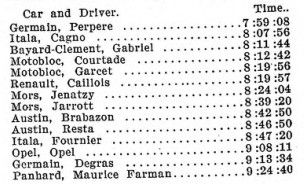
Erle, at the wheel of the second Benz car to finish, was compelled to accept seventh place and have his time for the race posted as 7:43:31. Dimitriewitch, piloting another, Renault, finished the course with scarcely a cheer for him, taking eighth place in 7:54:12. Heath, with the Panhard that escaped the fate of Cissac’s car, came next, a minute later. The order of finish of the remaining cars was:
Guyot Wins Monday’s Race
Motor history may assign larger letters and bigger numbers to the racing cars that participated in the grand prix, but the keen, thoughtful manufacturers of France are devoting more than ordinary attention to the marvelous results of the voiturette contest in which there were forty-seven starters out of an entry list of sixty-four and thirty-two finishers, including eight complete teams. France monopolized the first five honors of the voiturette race, not so much because forty of the entries were of French construction, say the critics, but because France is excelling the world in the manufacture of these little cars that perform what the designers confidently predicted they would do. Besides the care that the authorities had given the course set aside for the voiturettes had not sufficed to keep the stock touring cars from cutting up the roadway in places and the final stages of the subordinate struggle. The start in the curtain-raiser was taken for granted, many thousands preferring to have late breakfasts and still be in time for the crucial rounds.
It would require a bold use of the word to describe the voiturette race as thrilling – rather was it most interesting, while the going for the little cars was less advantageous than it was the following day.
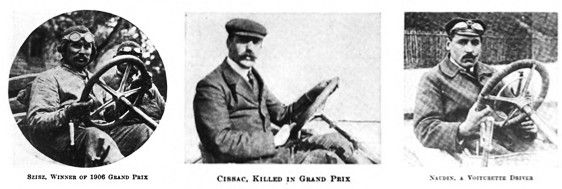
While only a comparatively small crowd was out at the start of the small car event, fewer than 1,000 persons being seated on the monster grand stand, the crowds began to arrive before the third hour and it is estimated that fully 200,000 witnessed the astonishing average of more than 50 miles an hour was recorded, the cars did not seem to be tearing up Mother Earth as did the racers in the grand prix. The Delage car which took first honors had two mates in a team in the race, while three cars each of the following teams were also in the contest: Gregoire, Le Mebais, Lion, Werner, Roland, Pilain and Sizaire-Naudin. Guyot seemed to set his pace for an average of 80 kilometers or 4 more than Thery’s average in the coupe international at Auvergne. The motor of his car is a double-cylinder and the official time for the course was 5 hours 45 minutes 30 seconds. Victory came to the winner not wholly because it was the speediest in the contest, but because of the remarkable regularity of Guyot’s pace. A single-cylinder Sizaire-Naudin, that finished second, piloted by M. Naudin, in 5 hours 52 minutes 6 seconds, at times showed wonderful bursts of speed. The Lion-Peugeot, a single-cylinder car, driven respectively by Goux and Dugernoy, finished third and fourth, the first being only 4 minutes behind Naudin’s car. Fifth place went to a Delage car with Thomas at the wheel. All were fitted with Michelin tires, which gives the makers of these tires the distinguished honor of having five leading cars in the small car race and the three leading cars in the grand prix-itself enough of a French triumph to assuage some of the grief of the patriots for the loss of high honors in the long race.
The regularity cup, a trophy much prized by the winners, was awarded to the Delage manufacturers because their team was adjudged to have made the best showing.
Accidents were comparatively numerous, but none was serious. Five machines overturned, the drivers escaping bad injuries. The first to meet disaster was the Truffault, driven by Charles. This struck the bridge at Ancourt and was almost destroyed, the driver escaping miraculously with only a few bruises.
Martini, driving a Demeester, struck a bridge at Eu where the fatal accident of today occurred and the car was overturned. The driver was badly cut about the head and shoulders. Prompt medical attendance put the wounded driver in a good frame of mind and he made light of his accident.
At Maux another accident marred the contest, Bordes, in a Guillemin, turning over at the turn. Martini’s machine overturned without doing the driver much damage and St. Mare broke a wheel.
Photos.
Page 1.
HANRIOT, BENZ, THIRD – LAUTENSCHLAGER, MERCEDES, WINNER – HEMERY, BENZ, SECOND
Page 2.
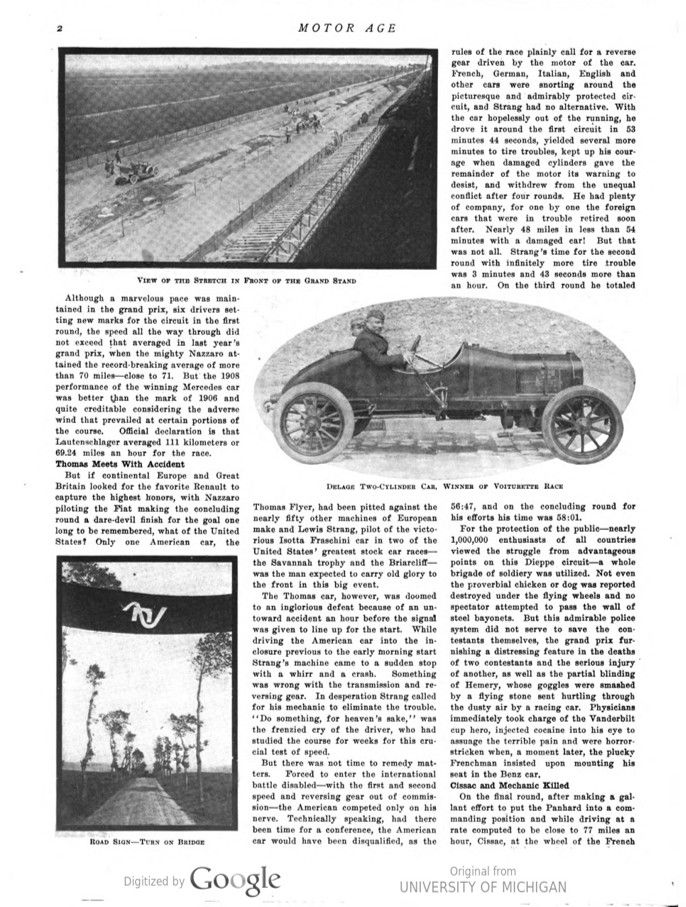
VIEW OF THE STRETCH IN FRONT OF THE GRAND STAND
ROAD SIGN – TURN ON BRIDGE
DELAGE TWO-CYLINDER CAR, WINNER OF VOITURETTE RACE
Page 3.
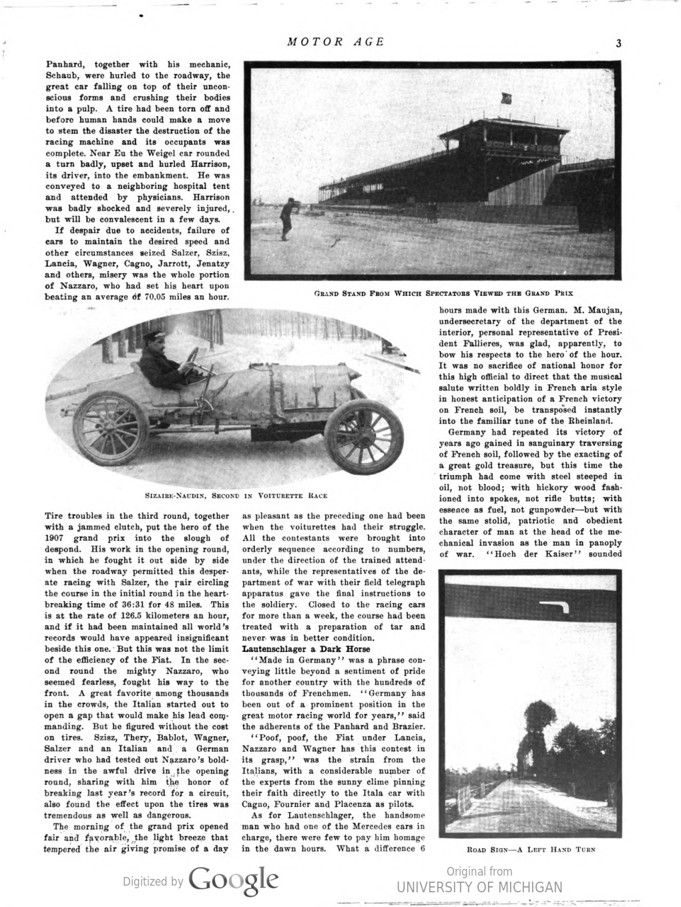
GRAND STAND FROM WHICH SPECTATORS VIEWED THE GRAND PRIX
SIZAIRE-NAUDIN, SECOND IN VOITURETTE RACE
Page 4.
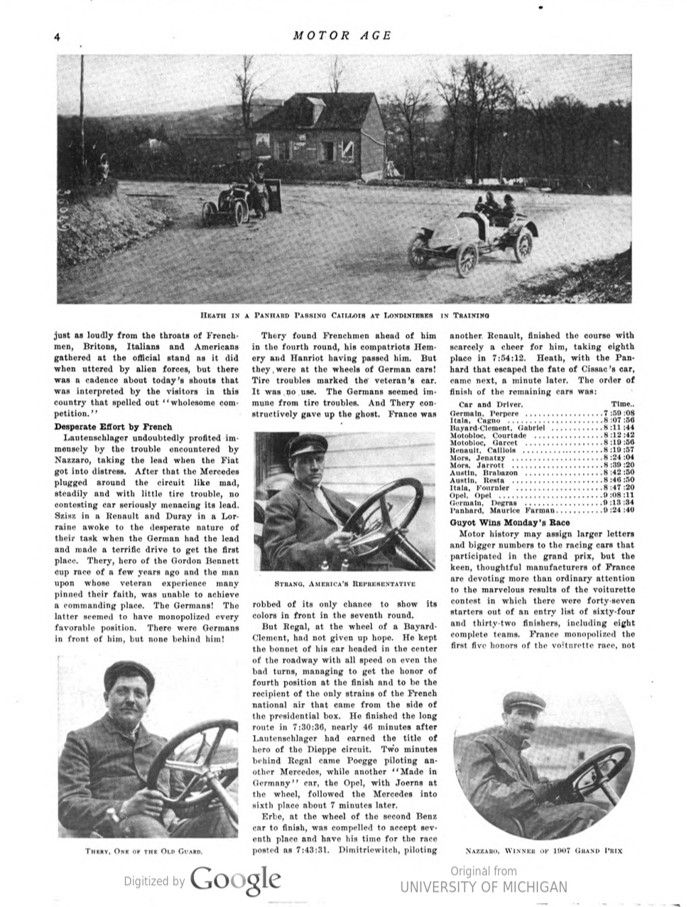
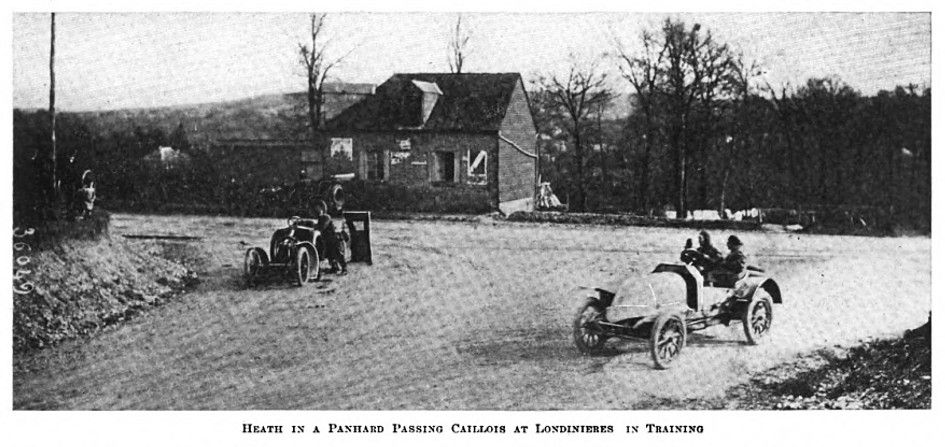
HEATH IN A PANHARD PASSING CAILLOIS AT LONDINIERES IN TRAINING
THERY, ONE OF THE OLD GUARD – STRANG, AMERICA’S REPRESENTATIVE – NAZZARO, WINNER OF 1907 GRAND PRIX
Page 5.
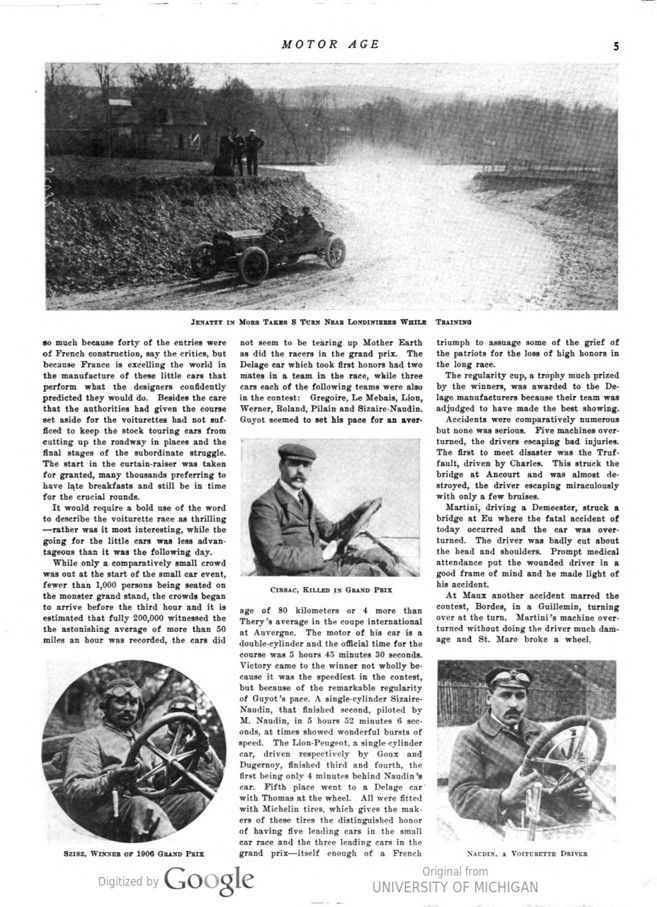
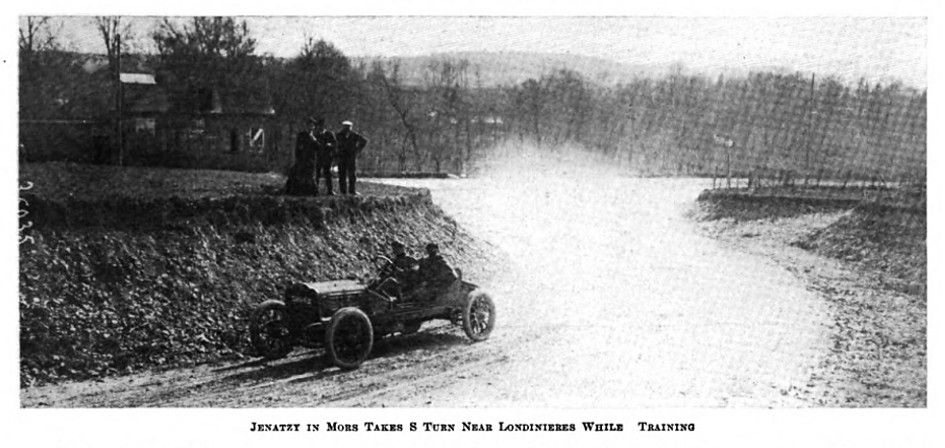
JENATZY IN MORS TAKES S TURN NEAR LONDINIERES WHILE TRAINING
SZISZ, WINNER OF 1906 GRAND PRIX – CISSAC, KILLED IN GRAND PRIX – NAUDIN, A VOITURETTE DRIVER