June 4, 2026: comment stall to be written; is coming soon. (GrocerJack)
Text and jpegs by courtesy of hathitrust.org www.hathitrust.org, compiled by motorracinghistory
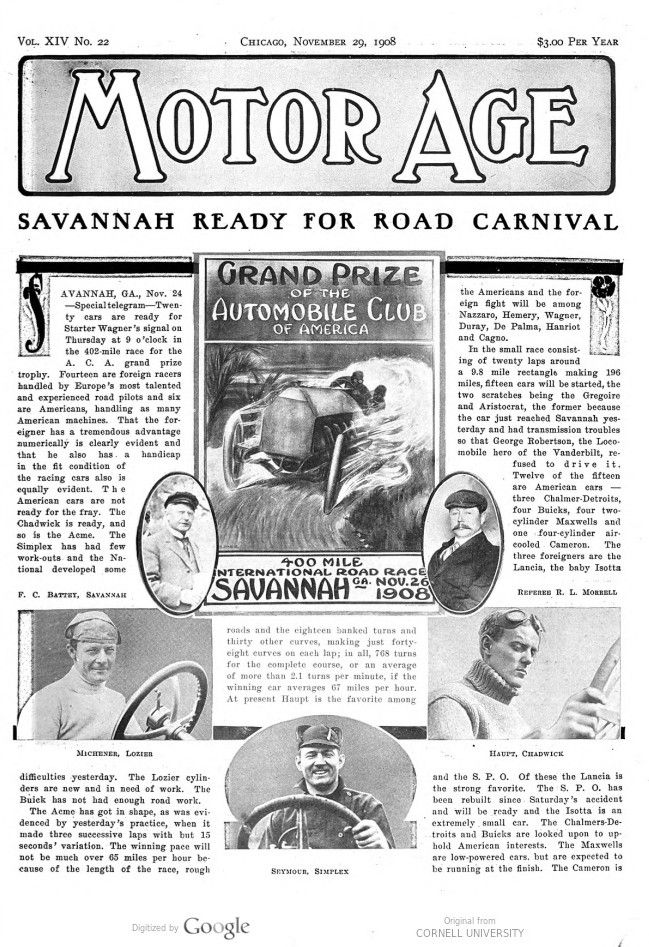
MOTOR AGE Vol. XXIV, No. 22, November 26, 1908
SAVANNAH READY FOR ROAD CARNIVAL
GRAND PRIZE OF THE AUTOMOBILE CLUB OF AMERICA
400 MILE INTERNATIONAL ROAD RACE SAVANNAH GA. NOV.26 1908
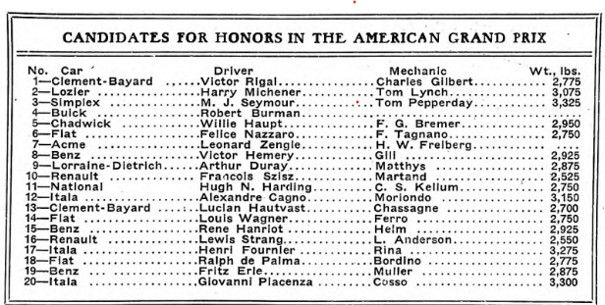
SAVANNAH, GA., Nov. 24 – Special telegram – Twenty cars are ready for Starter Wagner’s signal on Thursday at 9 o’clock in the 402-mile race for the A. C. A. grand prize trophy. Fourteen are foreign racers handled by Europe’s most talented and experienced road pilots and six are Americans, handling as many American machines. That the foreigner has a tremendous advantage numerically is clearly evident and that he also has a handicap in the fit condition of the racing cars also is equally evident. The American cars are not ready for the fray. The Chadwick is ready, and so is the Acme. The Simplex has had few work-outs and the National developed some difficulties yesterday. The Lozier cylinders are new and in need of work. The Buick has not had enough road work.
The Acme has got in shape, as was evidenced by yesterday’s practice, when it made three successive laps with but 15 seconds variation. The winning pace will not be much over 65 miles per hour because of the length of the race, rough roads and the eighteen banked turns and thirty other curves, making just forty-eight curves on each lap; in all, 768 turns for the complete course, or an average of more than 2.1 turns per minute, if the winning car averages 67 miles per hour. At present Haupt is the favorite among the Americans and the foreign fight will be among Nazzaro, Hemery, Wagner, Duray, De Palma, Hanriot and Cagno.
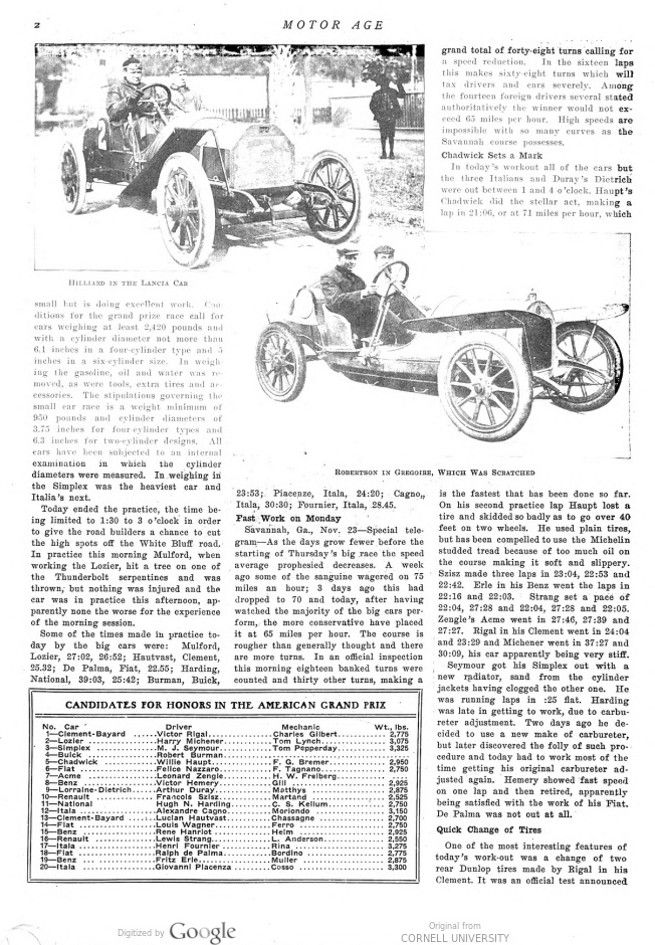
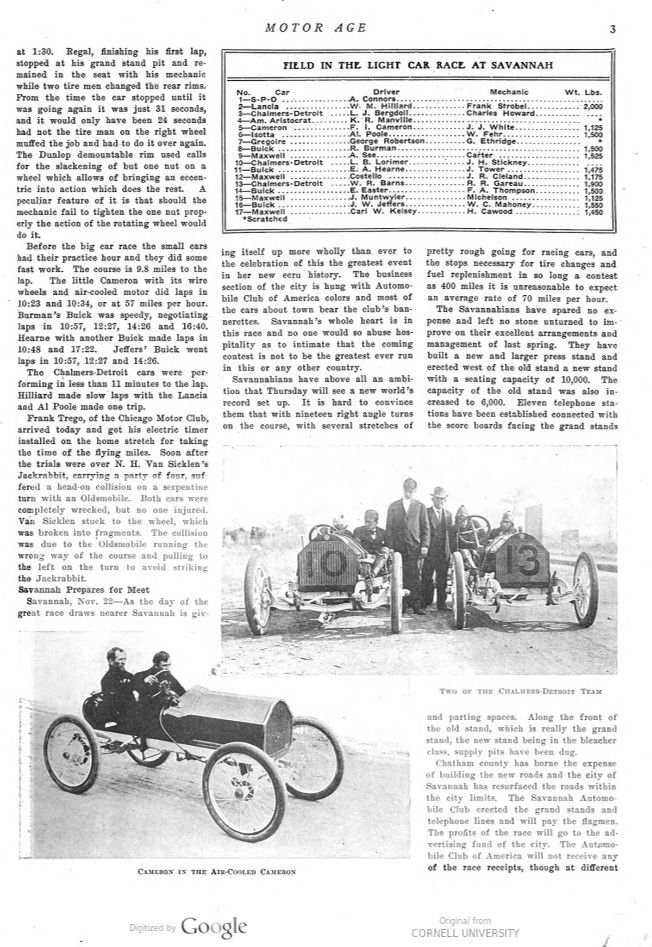
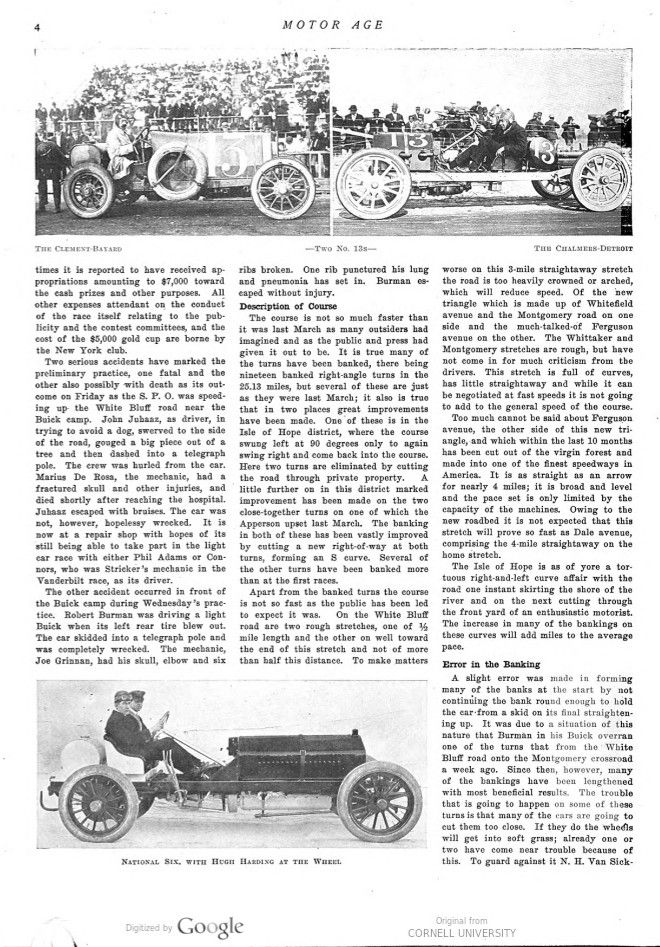
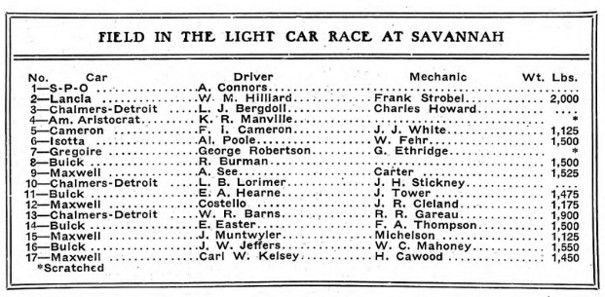
In the small race consisting of twenty laps around a 9.8-mile rectangle making 196 miles, fifteen cars will be started, the two scratches being the Gregoire and Aristocrat, the former because the car just reached Savannah yesterday and had transmission troubles so that George Robertson, the Loco- mobile hero of the Vanderbilt, refused to drive it. Twelve of the fifteen are American cars three Chalmer-Detroits, four Buicks, four two- cylinder Maxwells and one four-cylinder air- cooled Cameron. The three foreigners are the Lancia, the baby Isotta and the S. P. Q. Of these, the Lancia is the strong favorite. The S. P. O. has been rebuilt since Saturday’s accident and will be ready and the Isotta is an extremely small car. The Chalmers-Detroits and Buicks are looked upon to uphold American interests. The Maxwells are low-powered cars. but are expected to be running at the finish. The Cameron is small but is doing excellent work. Conditions for the grand prize race call for cars weighing at least 2,420 pounds and with a cylinder diameter not more than 6.1 inches in a four-cylinder type and 5 inches in a six-cylinder size. In weighing the gasoline, oil and water was removed, as were tools, extra tires and accessories. The stipulations governing the small car race is a weight minimum of 950 pounds and cylinder diameters of 3.75 inches for four-cylinder types and 6.3 inches for two-cylinder designs. All cars have been subjected to an internal examination in which the cylinder diameters were measured. In weighing in the Simplex was the heaviest car and Italia’s next.
Today ended the practice, the time being limited to 1:30 to 3 o’clock in order to give the road builders a chance to cut the high spots off the White Bluff road. In practice this morning Mulford, when working the Lozier, hit a tree on one of the Thunderbolt serpentines and was thrown, but nothing was injured and the car was in practice this afternoon, apparently none the worse for the experience of the morning session.
Some of the times made in practice today by the big cars were: Mulford, Lozier, 27:02, 26:52; Hautvast, Clement, 25.32; De Palma, Fiat, 22.55; Harding, National, 39:03, 25:42; Burman, Buick, 23:53; Piacenza, Itala, 24:20; Cagno, Itala, 30:30; Fournier, Itala, 28.45.
Fast Work on Monday
Savannah, Ga., Nov. 23 – Special telegram – As the days grow fewer before the starting of Thursday’s big race the speed average prophesied decreases. A week ago, some of the sanguine wagered on 75 miles an hour; 3 days ago this had dropped to 70 and today, after having watched the majority of the big cars perform, the more conservative have placed it at 65 miles per hour. The course is rougher than generally thought and there are more turns. In an official inspection this morning eighteen banked turns were counted and thirty other turns, making a grand total of forty-eight turns calling for a speed reduction. In the sixteen laps this makes sixty-eight turns which will tax drivers and cars severely. Among the fourteen foreign drivers several stated authoritatively the winner would not exceed 65 miles per hour. High speeds are impossible with so many curves as the Savannah course possesses.
Chadwick Sets a Mark
In today’s workout all of the cars but the three Italians and Duray’s Dietrich were out between 1 and 4 o’clock. Haupt’s Chadwick did the stellar act, making a lap in 21:06, or at 71 miles per hour, which is the fastest that has been done so far. On his second practice lap Haupt lost a tire and skidded so badly as to go over 40 feet on two wheels. He used plain tires, but has been compelled to use the Michelin studded tread because of too much oil on the course making it soft and slippery. Szisz made three laps in 23:04, 22:53 and 22:42. Erle in his Benz went the laps in 22:16 and 22:03. Strang set a pace of 22:04, 27:28 and 22:04, 27:28 and 22:05. Zengle’s Acme went in 27:46, 27:39 and 27:27. Rigal in his Clement went in 24:04 and 23:29 and Michener went in 37:27 and 30:09, his car apparently being very stiff.
Seymour got his Simplex out with a new radiator, sand from the cylinder jackets having clogged the other one. He was running laps in :25 flat. Harding was late in getting to work, due to carbureter adjustment. Two days ago he decided to use a new make of carbureter, but later discovered the folly of such procedure and today had to work most of the time getting his original carbureter adjusted again. Hemery showed fast speed on one lap and then retired, apparently being satisfied with the work of his Fiat. De Palma was not out at all.
Quick Change of Tires
One of the most interesting features of today’s work-out was a change of two rear Dunlop tires made by Rigal in his Clement. It was an official test announced at 1:30. Regal, finishing his first lap, stopped at his grand stand pit and remained in the seat with his mechanic while two tire men changed the rear rims. From the time the car stopped until it was going again it was just 31 seconds, and it would only have been 24 seconds had not the tire man on the right wheel muffed the job and had to do it over again. The Dunlop demountable rim used calls for the slackening of but one nut on a wheel which allows of bringing an eccentric into action which does the rest. A peculiar feature of it is that should the mechanic fail to tighten the one nut properly the action of the rotating wheel would do it.
Before the big car race the small cars had their practice hour and they did some fast work. The course is 9.8 miles to the lap. The little Cameron with its wire wheels and air-cooled motor did laps in 10:23 and 10:34, or at 57 miles per hour. Burman’s Buick was speedy, negotiating laps in 10:57, 12:27, 14:26 and 16:40. Hearne with another Buick made laps in 10:48 and 17:22. Jeffers‘ Buick went laps in 10:57, 12:27 and 14:26.
The Chalmers-Detroit cars were performing in less than 11 minutes to the lap. Hilliard made slow laps with the Lancia and Al Poole made one trip.
Frank Trego, of the Chicago Motor Club, arrived today and got his electric timer installed on the home stretch for taking the time of the flying miles. Soon after the trials were over N. H. Van Sicklen’s Jackrabbit, carrying a party of four, suffered a head-on collision on a serpentine turn with an Oldsmobile. Both cars were completely wrecked, but no one injured. Van Sicklen stuck to the wheel, which was broken into fragments. The collision was due to the Oldsmobile running the wrong way of the course and pulling to the left on the turn to avoid striking the Jackrabbit.
Savannah Prepares for Meet
Savannah, Nov. 22-As the day of the great race draws nearer Savannah is giving itself up more wholly than ever to the celebration of this the greatest event in her new ecru history. The business section of the city is hung with Automobile Club of America colors and most of the cars about town bear the club’s bannerettes.
Savannah’s whole heart is in this race and no one would so abuse hospitality as to intimate that the coming contest is not to be the greatest ever run in this or any other country. Savannahians have above all an ambition that Thursday will see a new world’s record set up. It is hard to convince them that with nineteen right-angle turns on the course, with several stretches of pretty rough going for racing cars, and the stops necessary for tire changes and fuel replenishment in so long a contest as 400 miles it is unreasonable to expect an average rate of 70 miles per hour.
The Savannahians have spared no expense and left no stone unturned to im- prove on their excellent arrangements and management of last spring. They have built a new and larger press stand and erected west of the old stand a new stand with a seating capacity of 10,000. The capacity of the old stand was also increased to 6,000. Eleven telephone stations have been established connected with the score boards facing the grand stands and parting spaces. Along the front of the old stand, which is really the grand stand, the new stand being in the bleacher class, supply pits have been dug. Chatham county has borne the expense of building the new roads and the city of Savannah has resurfaced the roads within the city limits. The Savannah Automobile Club erected the grand stands and telephone lines and will pay the flagmen. The profits of the race will go to the advertising fund of the city. The Automobile Club of America will not receive any of the race receipts, though at different times it is reported to have received appropriations amounting to $7,000 toward the cash prizes and other purposes. All other expenses attendant on the conduct of the race itself relating to the publicity and the contest committees, and the cost of the $5,000 gold cup are borne by the New York club.
Two serious accidents have marked the preliminary practice, one fatal and the other also possibly with death as its outcome on Friday as the S. P. O. was speeding up the White Bluff road near the Buick camp. John Juhaaz, as driver, in trying to avoid a dog, swerved to the side of the road, gouged a big piece out of a tree and then dashed into a telegraph pole. The crew was hurled from the car. Marius De Rosa, the mechanic, had a fractured skull and other injuries, and died shortly after reaching the hospital. Juhaaz escaped with bruises. The car was not, however, hopelessly wrecked. It is now at a repair shop with hopes of it still being able to take part in the light car race with either Phil Adams or Connors, who was Stricker’s mechanic in the Vanderbilt race, as its driver.
The other accident occurred in front of the Buick camp during Wednesday’s practice. Robert Burman was driving a light Buick when its left rear tire blew out. The car skidded into a telegraph pole and was completely wrecked. The mechanic, Joe Grinnan, had his skull, elbow and six ribs broken. One rib punctured his lung and pneumonia has set in. Burman escaped without injury.
Description of Course
The course is not so much faster than it was last March as many outsiders had imagined and as the public and press had given it out to be. It is true many of the turns have been banked, there being nineteen banked right-angle turns in the 25.13 miles, but several of these are just as they were last March; it also is true that in two places great improvements have been made. One of these is in the Isle of Hope district, where the course swung left at 90 degrees only to again swing right and come back into the course. Here two turns are eliminated by cutting the road through private property. A little further on in this district marked improvement has been made on the two close-together turns on one of which the Apperson upset last March. The banking in both of these has been vastly improved by cutting a new right-of-way at both turns, forming an S curve. Several of the other turns have been banked more than at the first races.
Apart from the banked turns the course is not so fast as the public has been led to expect it was. On the White Bluff road are two rough stretches, one of 2 mile length and the other on well toward the end of this stretch and not of more than half this distance. To make matters worse on this 3-mile straightaway stretch the road is too heavily crowned or arched, which will reduce speed. Of the new triangle which is made up of Whitefield avenue and the Montgomery road on one side and the much-talked-of Ferguson avenue on the other. The Whittaker and Montgomery stretches are rough, but have not come in for much criticism from the drivers. This stretch is full of curves, has little straightaway and while it can be negotiated at fast speeds it is not going to add to the general speed of the course.
Too much cannot be said about Ferguson avenue, the other side of this new triangle, and which within the last 10 months has been cut out of the virgin forest and made into one of the finest speedways in America. It is as straight as an arrow for nearly 4 miles; it is broad and level and the pace set is only limited by the capacity of the machines. Owing to the new roadbed it is not expected that this stretch will prove so fast as Dale avenue, comprising the 4-mile straightaway on the home stretch.
The Isle of Hope is as of yore a tortuous right-and-left curve affair with the road one instant skirting the shore of the river and on the next cutting through the front yard of an enthusiastic motorist. The increase in many of the bankings on these curves will add miles to the average pace. Error in the Banking A slight error was made in forming many of the banks at the start by not continuing the bank round enough to hold the car from a skid on its final straightening up. It was due to a situation of this nature that Burman in his Buick overran one of the turns that from the White Bluff road onto the Montgomery crossroad a week ago. Since then, however, many of the bankings have been lengthened with most beneficial results. The trouble that is going to happen on some of these turns is that many of the cars are going to cut them too close. If they do the wheels will get into soft grass; already one or two have come near trouble because of this. To guard against it N. H. Van Sicklen, Sr., who has the superintendency of the preparation of the course in charge, has placed oblong blue banners carried on a couple of 3-foot stakes marking the inside safety point of these turns, but in spite of these the drivers persist in cutting close and running down the banners. Banners of this nature are placed along the course to indicate danger points such as drops at the end of bridges, narrow places and soft spots that are located along the side of the road.
Comment on Banked Turns
It is interesting to hear the comment among the drivers on the banked turns. Many of the foreign drivers are averse to them because they are not accustomed to them and having learned the art of taking flat turns at high speeds, feel that these banked turns do not really make their performances as brilliant as if they were not banked. On the other hand, Haupt with his Chadwick and Seymour with his Simplex are experts at the banked turn art, because of experiences on circular tracks, which will count greatly in their favor during the contest. The big car drivers hold to the bottom of these turns but there has been too much taking of them a little wide by many drivers in the light car event.
When computing on record-making time over the course it must be remembered that there are not a few places on the circuit on which it is impossible for one car to pass another at speed and that the faster will have to do a little trailing before executing the pass which will reduce the average speed not a little. These districts occur in the Isle of Hope and Thunderbolt districts as well as at points on Whitefield road.
The course is ready for the day of the gladiatorial contests, one of the electric road crossings having already been removed and the work on removal of another nearly completed. The telephone arrangements are practically finished also, N. H. Van Sicklen having selected the places for the eleven stations around the route, had the equipment installed and all wires placed. Closely associated with it is the location of the ambulance headquarters. One hundred and thirty-four flagmen are used in signal work. Using the yellow flag means danger the red flag clear course. Each of these 134 men is on the job each day during practice, so that they will be in perfect control on the race days. Also scattered along the course will be 500 soldiers guarding the course, which lies outside of the city of Savannah limits and within city limits city police will be in control. The instructions to the militia are to be diplomatic and courteous at all times, but to keep the course clear, and it is expected that the big record of clear courses established in March will be again duplicated and perhaps improved upon. Greater precaution will be taken in keeping the crowds away at the turns, where wire fences are being erected and along the Isle of Hope district spectators will not be allowed between the course and the river, where the road winds close to the stream.
What Happens to the Cars
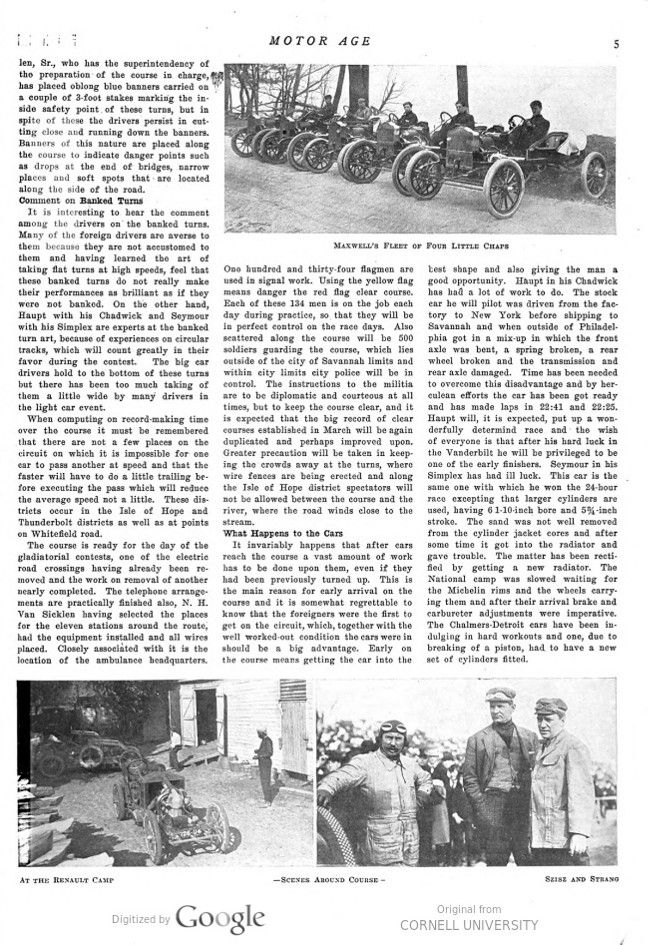
It invariably happens that after cars reach the course a vast amount of work has to be done upon them, even if they had been previously turned up. This is the main reason for early arrival on the course and it is somewhat regrettable to know that the foreigners were the first to get on the circuit, which, together with the well worked-out condition the cars were in should be a big advantage. Early on the course means getting the car into the best shape and also giving the man a good opportunity. Haupt in his Chadwick has had a lot of work to do. The stock car he will pilot was driven from the factory to New York before shipping to Savannah and when outside of Philadelphia got in a mix-up in which the front axle was bent, a spring broken, a rear wheel broken and the transmission and rear axle damaged. Time has been needed to overcome this disadvantage and by herculean efforts the car has been got ready and has made laps in 22:41 and 22:25. Haupt will, it is expected, put up a wonderfully determined race and the wish of everyone is that after his hard luck in the Vanderbilt he will be privileged to be one of the early finishers. Seymour in his Simplex has had ill luck. This car is the same one with which he won the 24-hour race excepting that larger cylinders are used, having 61-10-inch bore and 54-inch stroke. The sand was not well removed from the cylinder jacket cores and after some time it got into the radiator and gave trouble. The matter has been rectified by getting a new radiator. The National camp was slowed waiting for the Michelin rims and the wheels carrying them and after their arrival brake and carbureter adjustments were imperative. The Chalmers-Detroit cars have been indulging in hard workouts and one, due to breaking of a piston, had to have a new set of cylinders fitted.
Photos.
Pages 1 – 4
F. C. BATTEY, SAVANNAH – REFEREE R. L. MORRELL
MICHENER, LOZIER – SEYMOUR, SIMPLEX – HAUPT, CHADWICK
HILLIARD IN THE LANCIA CAR
ROBERTSON IN GREGOIRE, WHICH WAS SCRATCHED
CAMERON IN THE AIR-COOLED CAMERON
TWO OF THE CHALMERS-DETROIT TEAM
THE CLEMENT-BAYARD – Two No. 13s – THE CHALMERS-DETROIT
NATIONAL SIX, WITH HUGH HARDING AT THE WHEEL
MAXWELL’S FLEET OF LITTLE CHAPS
AT THE RENAULT CAMP – SCENES AROUND COURSE – SZISZ AND STRANG