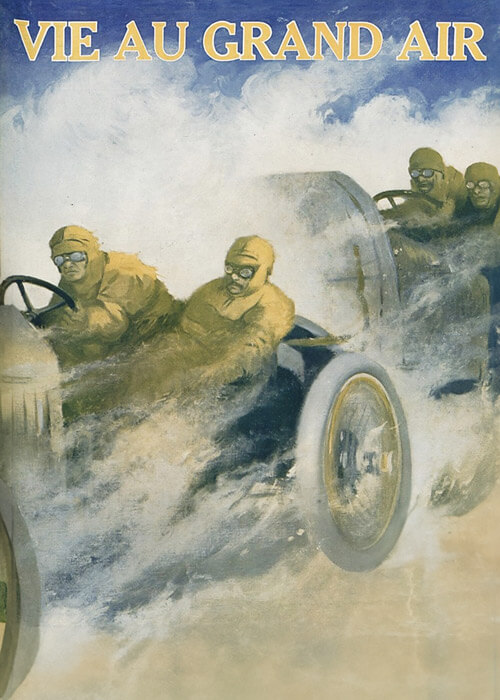
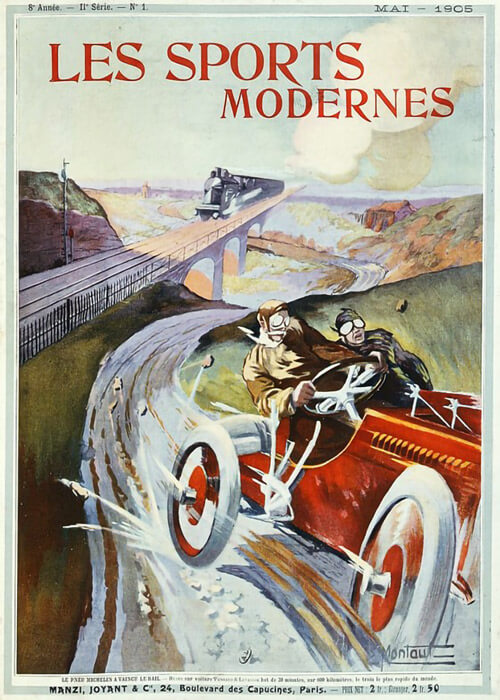
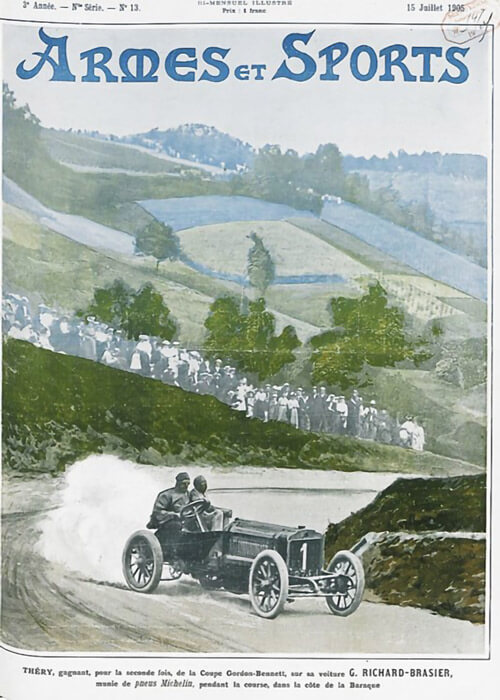
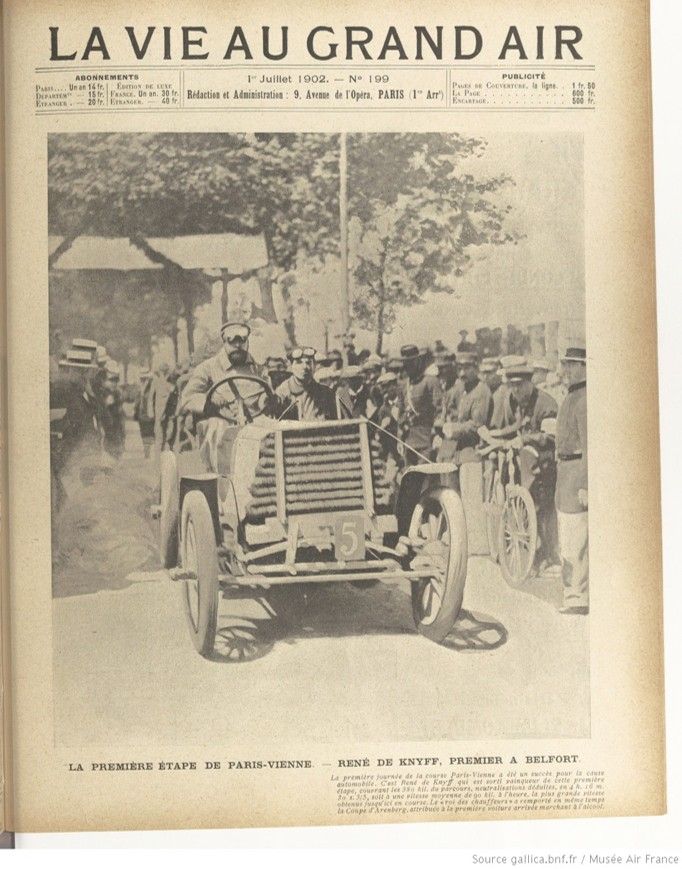
In the very early hours of 26th of June 1902, many thousand spectators gathered in Paris and Champigny to whitness the start of the 1902 Paris-Vienna Race, that was to last until 29th June. This issue of La Vie au Grand Air mentioned that even ten thousand spectators were on the road that night. Must have been something like: “And in the naked lights I saw, ten thousand people maybe more” by Simon and Garfunkel in the Sound of Silence. This gathering of so many people must have been an unprecedently happening. The first car started 4 o’clock in the morning and a 112 more were to follow until bright daylight. Finally, at the end of this first day, René de Knyff finished first in Belfort.
Text and jpegs by courtesy of Bibliotheque national francais, gallica.bnf.fr; compiled by motorracinghistory, Translation by DeepL.com
La Vie au Grand Air, No. 199, July 1, 1902, Special issue.
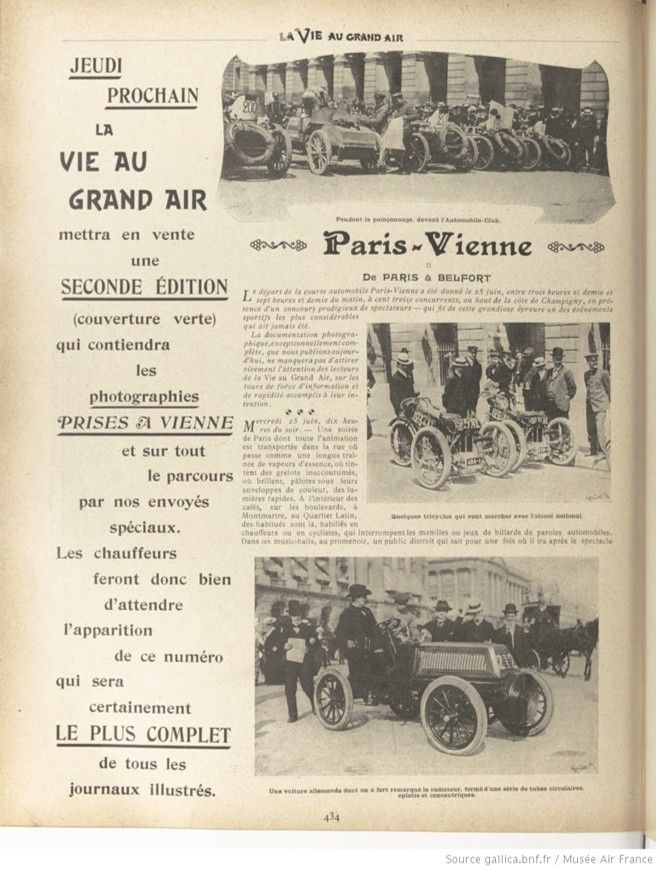
Paris ~ Vienna I – From PARIS to BELFORT
The Paris-Vienna car race began on June 25, between 3:30 and 7:30 a.m., with 113 competitors at the top of the Champigny hill, in the presence of a huge crowd of spectators — which made this spectacular event one of the most significant sporting events ever held.
The exceptionally comprehensive photographic coverage we are publishing today is sure to capture the attention of La Vie au Grand Air readers, highlighting the feats of information gathering and speed accomplished for their benefit.
* * *
Wednesday, June 25, 10:00 p.m. — A Parisian evening whose entire liveliness has spilled out onto the street, where a long trail of gasoline fumes drifts by, where unusual bells jingle, and where rapid lights shine, pale beneath their colored covers. Inside the cafés, on the boulevards, in Montmartre, in the Latin Quarter, regulars are there, dressed as chauffeurs or cyclists, interrupting their card games or billiard matches with talk of automobiles.
In the music halls, in the promenade, a distracted audience that for once knows where it will go after the show, and at the hour when nightspots usually fill up, the immense exodus toward the east of Paris, of a teeming mass that takes flight, abandoning the usual nocturnal pleasures, toward a spectacle in which women have no part, in search of a pleasure that owes nothing to Champagne.
A sporting attraction is the cause of all this movement and draws, in the intensity of its appeal, a crowd of onlookers.
Across Boulevard Saint-Germain and Rue de Rivoli, exclamations ring out amid the commotion of an unending throng, signaling the convergence of all walks of life: socialites and employees, bourgeois and workers, night owls and early risers—all are there, undeterred by the thought of spending the night in the coolness of the approaching summer, and setting out simply because they know there is something beautiful to see over there, unconcerned with tomorrow, with its heavy burden, its tearful eyes, its terrible yawns, before the daily grind.
Paris-Vienna, an elusive phantom in its grandiose evocation of wild things, hovering over all of France, whose fleeting contours are now becoming so distinct that everyone hopes to wrest from it all the knowledge of emotions it holds.
Ding-a-ding! Toot! Toot! Go on, eh! “You half-baked calf!” In the teeming crowd fleeing toward the Bois de Vincennes, cyclists, drivers, coachmen, and pedestrians call out to one another, exchange words, and hurl insults in a loud and cheerful tone, and the procession that began at nine o’clock continues steadily at midnight.
Ding! Ding! Toot! Toot! Hey! Hop!
Midnight. — The peaceful commuter trains, which usually carry the residents of the Paris suburbs home from the theater at the pace of a wheezing locomotive, are overrun by an unusual crowd in need of excessive speed. Amid the crossfire of conversations about everyday life with its monotony and grievances, cheerfulness emerges from the occasion of an event so significant that it sparks a night of wild revelry and a moment of joy in the dreary routine of ordinary life. A wind of madness seems to hover over this crowd dreaming of fantastically covered miles, and at each of the many stations leading up to Champigny, a chorus of furious irony shouts from the train’s upper deck, singing familiar refrains: and chants
— It’s such a shame, That she limps like that, The poor girl. — while inside the train cars the tracks echo back
— Where is Saint-Nazaire…
The thrill of the race has taken hold of these pedestrians, these men who are not sportsmen, but who want to see, to see right away the machines and the people “who go fast.”
Champigny, 1 a.m. — The road leading to the starting line. — Cyclists have been passing along the road since 9 p.m. A procession of Venetian and multicolored lanterns that emerges endlessly from the bend over there, plunges into the night, and stretches, stretches along the slope leading up to the fort. With no gaps in its ranks, this luminous procession is staggering in its numbers and continuity. A procession of free spirits who, in a moment, will seek out their own place as they please, men whom an extra 10 kilometers or so does not daunt.
Cyclists, more cyclists, interspersed here and there with cars whose large headlights cast beams of light across the entire road — and the usual sports indifference of those who have come here, driven by a vague curiosity or to accompany more athletic friends, watching, dumbfounded by the sight of “so many people so passionate about the sport that they’re happy to stay up all night.”
At the start, a crowd of police officers. Pedestrians and cyclists make their way a few kilometers away to watch the riders pass by. No officials in sight, no race marshals, no cars; at table corners, foreign correspondents are drafting dispatches, reporting on the success of the start. The nearby inns are packed; food vendors set up here and there are a huge hit. A few cautious souls crowd into more or less shabby restaurants and wolf down an omelet. At 5 a.m., you won’t find a single slice of ham or a cup of coffee within four kilometers—and spectators are still passing by in a jumble of various modes of transportation. Through the tarnished windows of a dive bar, a flash of magnesium is visible.
Two-and-a-half hours. — “The Triumph of Photography” or “How We Report for *Vie au Grand Air*.” The race’s top drivers arrive in their monsters. Here are Gabriel, Girardot, Fournier, de Knyft, Baron de Caters, Edge, and the Farmans. — A quick pose for *Vie au Grand Air*, please! — Certainly. Two seconds to focus, a flash, and the star, frozen for a moment, regains his freedom. — Not much, really. But when dealing with people who have far more important things to worry about, the incident takes on singular importance.
Three and a half hours. — As far as the eye can see, a road teeming with people, now and then interrupted by sparse patrols of gendarmes, powerless and useless. Will “they” crush everything? No. — The Parisian crowd is admirable. — In a little while, not a single crushed finger will be counted. Beneath the long banner reading “Paris-Vienna: Departure,” Girardot has stopped his throbbing machine.
How they take off. — What must be the state of mind of these drivers who are about to cover 1,500 kilometers, hands on the wheel, at racing speed, and what strange sense of infinity and doubt might fill their minds at the moment of departure? All have a steady hand… but their eyes are blinking. Their nostrils flare, their mouths stretch into a pout. A hint of emotion.
The flag drops for the first time, and Girardot the underdog, “the eternal runner-up,” surges forward. “Godspeed!” he says with a wave of his hand, and his heavy machine, which was shaking terribly, comes to a sudden stop only to shoot off in a long slide down the road, where a twist of the throttle sends it to 100 kilometers per hour in a matter of seconds. The crowd parts and the whirlwind passes, leaving behind nothing but blinding dust.
Here is Fournier, magnificent, strong, and proud in this machine of which he is the soul, and with which he seems to form a single entity. Of all the drivers setting off, he is the finest, and when, at the starter’s signal, he lets his car go, he seems to launch himself forward with a movement of head and neck that is not Girardot’s resigned farewell, but the sign of a firm resolve to always move forward. Misfortune has struck this true thoroughbred of the automobile.
Edge, phlegmatic, not a gesture or a smile; de Knyff, almost disdainful, who has been cursing the traffic for two hours and seems happy to see a clear road ahead; Gabriel, smiling; de Caters, whose slender face is hidden by a veil that falls below his chin — all surge forward with the same enthusiasm, and the same calm movement of the hand, a poor and insignificant little gesture, propels the machine forward.
4 o’clock. — On the descent from Queue-en-Brie, 4 kilometers from the start. — Since the start, I have seen with my own eyes nearly twenty thousand people, ten thousand of whom have come here to watch the riders at full speed through the “dangerous turn.” The sight is striking. The race seems over, so thick is the crowd. Suddenly, a newspaper appears at the end of an outstretched arm, right at the top of the hill, then two, then ten, a hundred, and a great cry that seems to stretch on: “There he is, there he is!”
A whirlwind bursts forth. The mystery of the Parisian crowds. Everyone has stepped aside, and the racing car, skidding wildly through the bend of this 7% gradient descent, passes without grazing a single person. The crowd closes in again. Every two minutes the scene repeats itself. And there are more than five hundred of them, who, from 3:30 to 8:00, have stayed to wave the newspaper in the air and shout every two minutes. “Watch out! There he is.”
The Return. — One hundred and thirteen vehicles pass along the road: light cars, small cars, tricycles, motorcycles. For an hour now, the crowd has been beginning to disperse. With haggard faces, drawn features, and puffy eyes, everyone heads back to Paris where their daily duties await them, tired, exhausted, especially now that the excitement of the spectacle has faded. The fatigue of the sleepless night is setting in, yet they are content and already recounting — as they will continue to do for a long time to come — the unforgettable impression left by this magnificent event, one of the most striking manifestations of the sporting spirit in France.
Noon, Place du Théâtre-Français. — L’Auto – Vélo has just been published! Its second edition! De Knyff, first in Belfort!
A. FOUCAUT.
Photos.
Page 0.
THE FIRST STAGE OF PARIS-VIENNA. – RENÉ DE KNYFF, FIRST IN BELFORT.
The first day of the Paris-Vienna race was a success for the automobile industry. René de Knyff emerged victorious in this first stage, covering the 380 km of the course, excluding neutralized sections, in 4 hours, 16 minutes, and 30 seconds, 3/5, or at an average speed of 90 km per hour—the highest speed achieved in a race to date. The “king of drivers” also won the Arenberg Cup, awarded to the first car to finish running on alcohol.
Page 434.
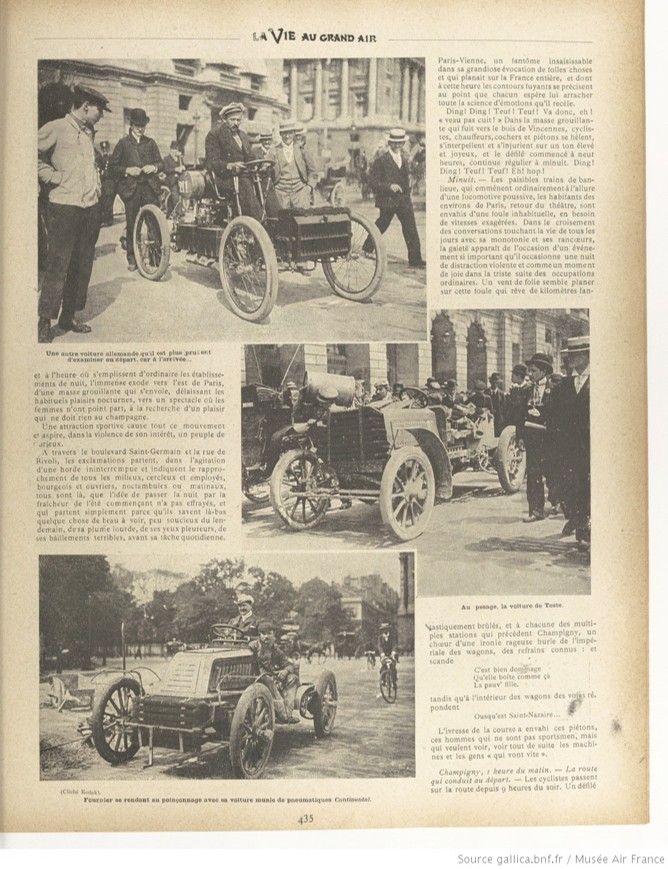
During the time trials, in front of the Automobile Club.
A few tricycles that will run on domestic alcohol.
A German car whose radiator was particularly noteworthy, consisting of a series of circular, flattened, and concentric tubes.
Page 435.
Another German car that is best examined at the start, because at the finish…
At the weigh-in, Teste’s car.
Fournier heading to the inspection with his car fitted with Continental tires. (Kodak photo).
Page 436.
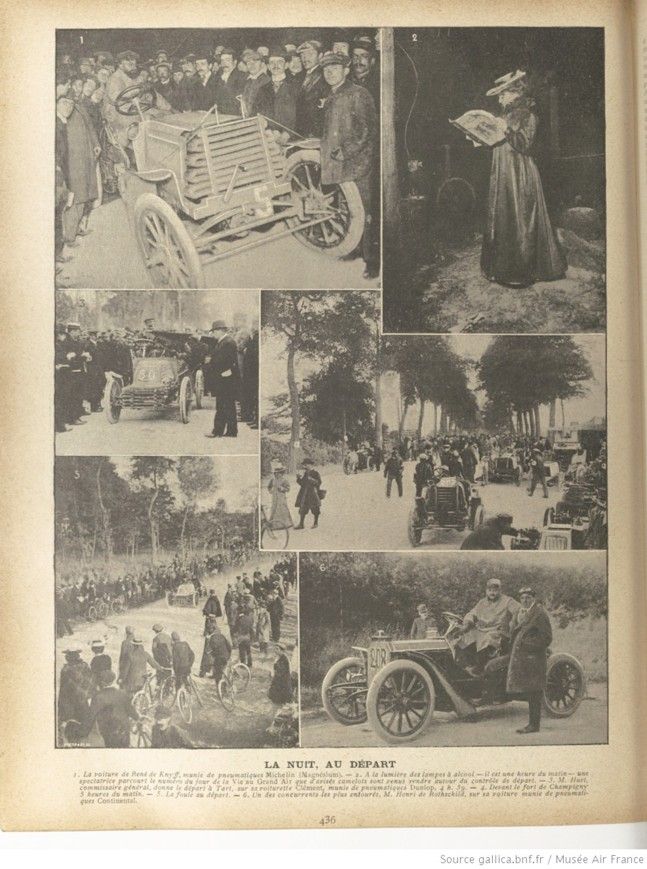
AT NIGHT, AT THE START
1. René de Knylf’s car, equipped with Michelin tires (Magnesium). — 2. By the light of alcohol lamps—it is one o’clock in the morning—a spectator leafs through the day’s issue of *La Vie au Grand Air*, which shrewd street vendors have come to sell around the starting line. — 3. Mr. Huet, general commissioner, gives the starting signal in Tart, in his Clément runabout, equipped with Dunlop tires, 4:03 a.m. — 4. In front of the Champigny fort, 5 a.m. — 5. The crowd at the starting line. — 6. One of the most popular competitors, Mr. Henri de Rothschild, in his car equipped with Continental tires.
Page 437.
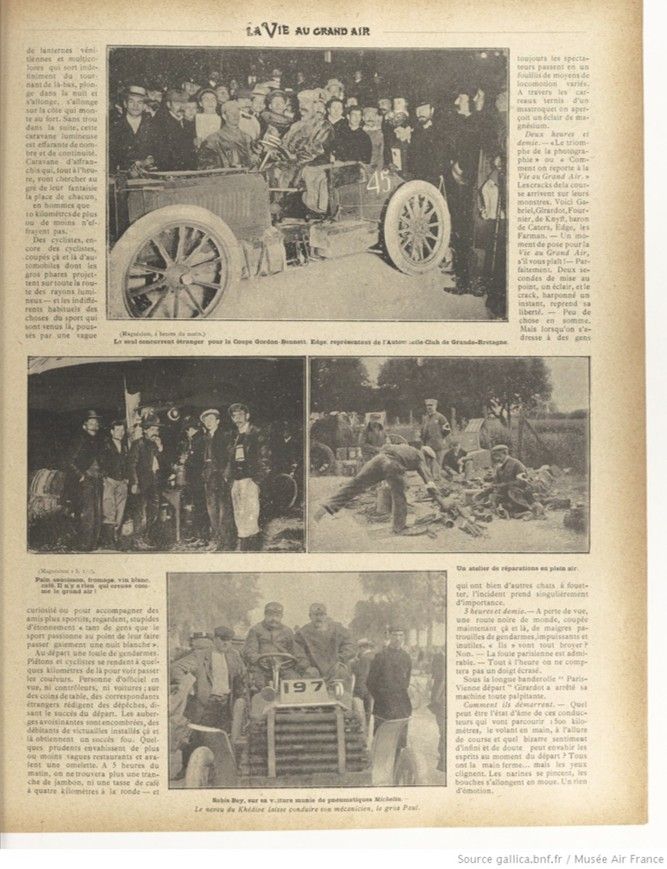
(Magnésium, 2 a.m.) The only foreign competitor for the Gordon-Bennett Cup. Edge, representative of the Automobile Club of Great Britain.
(Magnesium, 1:30 a.m.) Bread, sausage, cheese, white wine, coffee. Nothing whets the appetite like the great outdoors! — An open-air repair shop.
Sabis-Bey, in his car fitted with Michelin tires.
The Khedive’s nephew lets his mechanic, Big Paul, take the wheel.
Page 438.
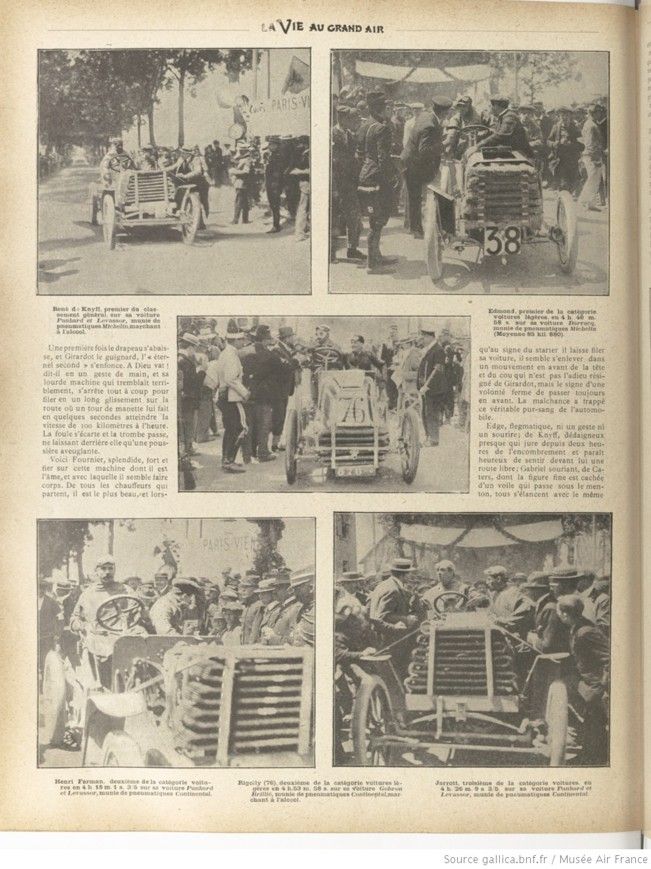
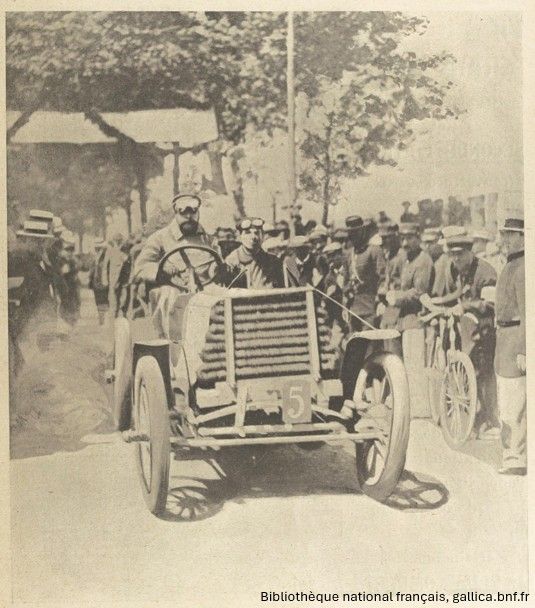
René de Knyff, first in the overall standings, in his Panhard & Levassor car, fitted with Michelin tires, running on alcohol.
Edmond, first in the light car category, in 4 hrs. 46 min. 58 sec. in his Darracq car, fitted with Michelin tires (Average 85.880 km/h).
Henri Farman, second in the car category in 4 hours, 18 minutes, 1 second, and 3/5 of a second in his Panhard & Levassor car, equipped with Continental tires.
Rigolly (76), second in the light car category in 4 hours, 53 minutes, and 58 seconds in his Gobron Brillié car, equipped with Continental tires, running on alcohol.
Jarrott, third in the car category, in 4 hours, 26 minutes, 9.35 seconds in his Panhard & Levassor car, equipped with Continental tires.
Page 439.
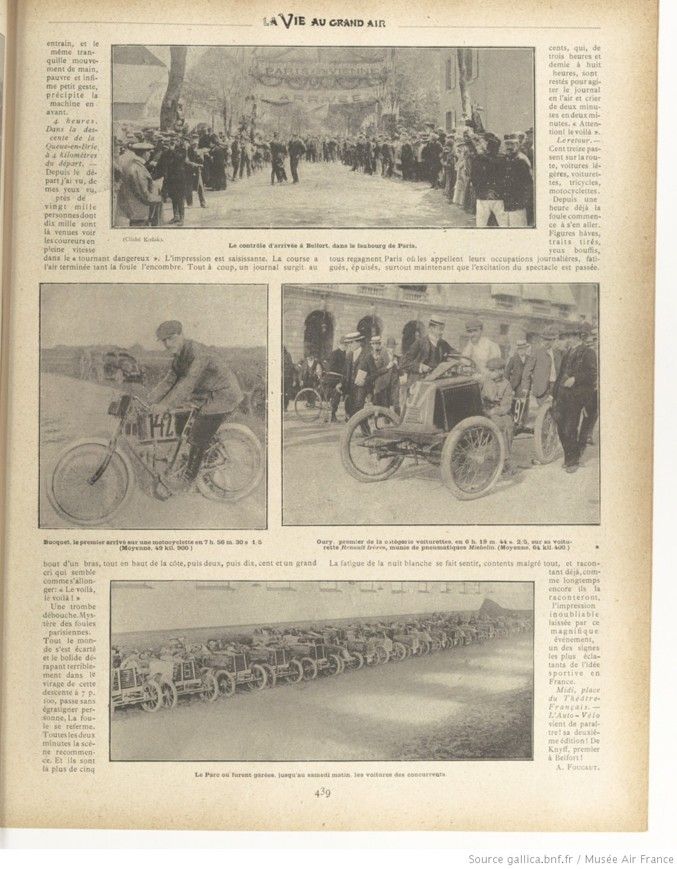
The finish line checkpoint in Belfort, in the Paris suburbs. (Kodak photo).
Bucquet, the first to arrive on a motorcycle in 7 hours, 56 minutes, 30.5 seconds (Average speed: 49.9 km/h). Oury, first in the small car category, in 6 hours, 19 minutes, 44.2 seconds, in his Renault Frères small car, equipped with Michelin tires. (Average speed: 64.4 km/h.)
The parking lot where the competitors’ cars were parked until Saturday morning.