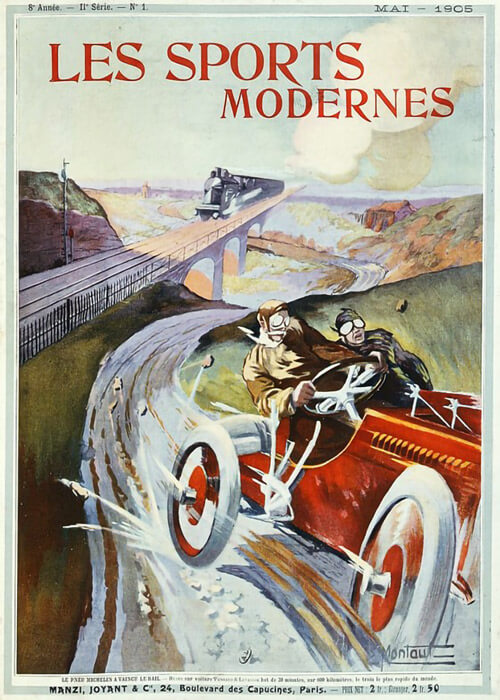
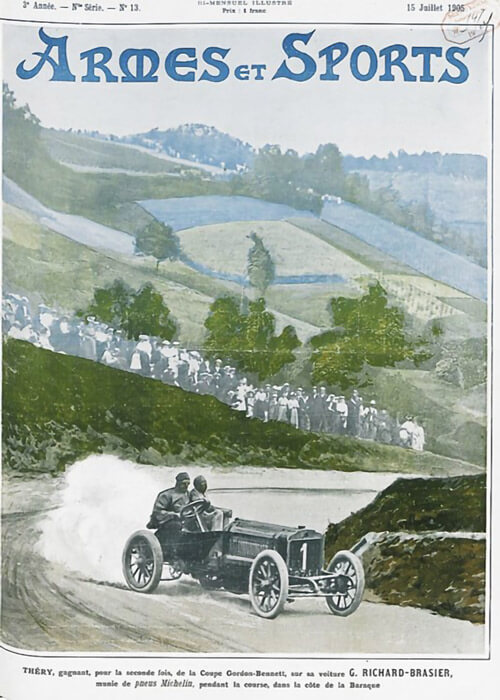
The 1907 Grand Prix de l’ACF, the second-ever, was held on one day on July 2nd on the triangular road course of Dieppe. Total distance was about 770 km. In contrast to last year’s Grand Prix at la Sarthe, that took two days. And of course, by chosing Dieppe near the coast, it was much better to travel by the Belgian and British public. Alas though, a consumption requirement was added to the rules this year; it brought no improvement for the spectators. Once the race got started, the distances between competitors were relative moderate, leading to a more exciting race. In the forelast round, the leader Duray ran into engine problems. Then in the last round, the new leader Lancia also ran into problems, now with the clutch. This meant that Felice Nazzaro on Fiat became the winner! Second was last year’s winner Ferenc Szisz; both drivers swapped first and second place of 1906 to 1907. For nazzaro, this was extra succes, as he had also won the Traga Florio and the Emperor’s Cup
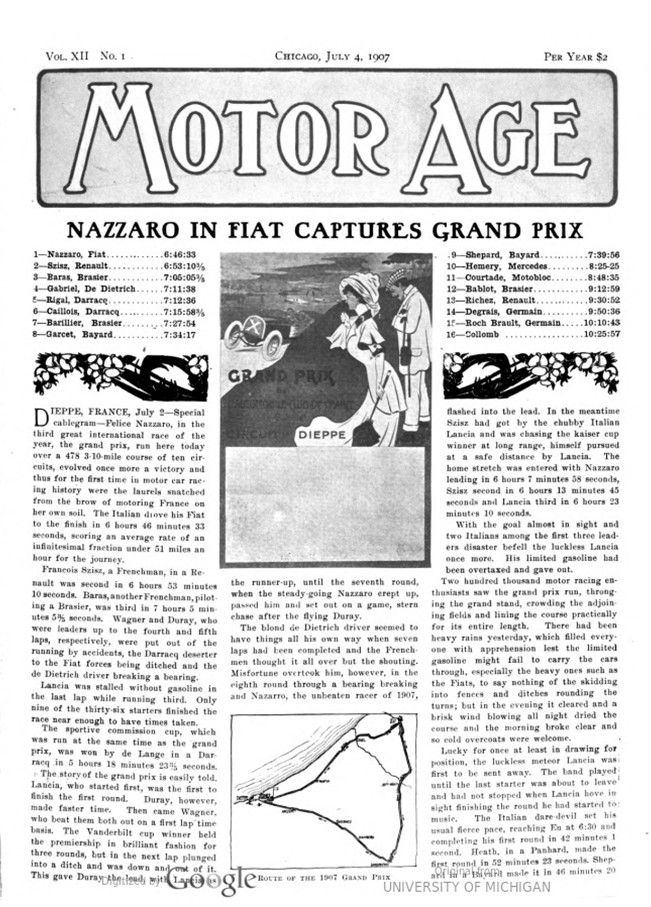
Text and jpegs by courtesy of hathitrust.org www.hathitrust.org, compiled by motorracinghistory.com
MOTOR AGE Vol. XII, No. 1, July 4, 1907
NAZZARO IN FIAT CAPTURES GRAND PRIX

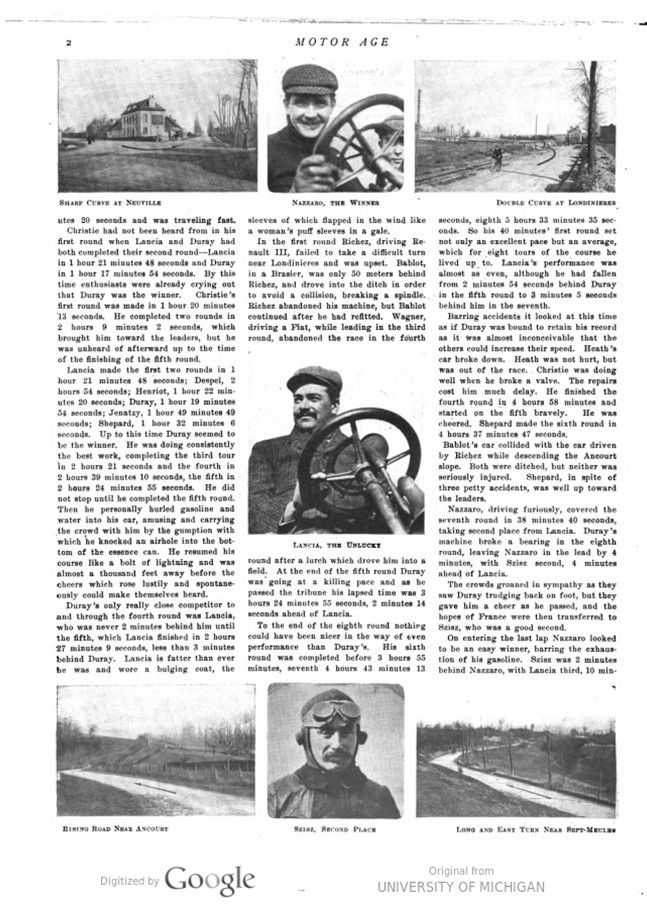
DIEPPE, FRANCE, July 2 – Special cablegram Felice Nazzaro, in the third great international race of the year, the grand prix, run here today over a 478 3-10-mile course of ten circuits, evolved once more a victory and thus for the first time in motor car racing history were the laurels snatched from the brow of motoring France on her own soil. The Italian dove his Fiat to the finish in 6 hours 46 minutes 33 Seconds, scoring an average rate of an infinitesimal fraction under 51 miles an hour for the journey.
Francois Szisz, a Frenchman, in a Renault was second in 6 hours 53 minutes 10 seconds. Baras, another Frenchman, piloting a Brasier, was third in 7 hours 5 minutes 5% seconds. Wagner and Duray, who were leaders up to the fourth and fifth laps, respectively, were put out of the running by accidents, the Darracq deserter to the Fiat forces being ditched and the de Dietrich driver breaking a bearing.
Lancia was stalled without gasoline in the last lap while running third. Only nine of the thirty-six starters finished the race near enough to have times taken.
The sportive commission cup, which was run at the same time as the grand prix, was won by de Lange in a Darracq in 5 hours 18 minutes 23 3/5 seconds.
The story of the grand prix is easily told. Lancia, who started first, was the first to finish the first round. Duray, however, made faster time. Then came Wagner who beat them both out on a first lap time basis. The Vanderbilt cup winner held the premiership in brilliant fashion for three rounds, but in the next lap plunged into a ditch and was down and out of it. This gave Duray the lead, with Lancia as the runner-up, until the seventh round, when the steady-going Nazzaro crept up, passed him and set out on a game, stern chase after the flying Duray.
The blond de Dietrich driver seemed to have things all his own way when seven laps had been completed, and the Frenchmen thought it all over but the shouting. Misfortune overtook him, however, in the eighth round through a bearing breaking and Nazarro, the unbeaten racer of 1907, flashed into the lead. In the meantime Szisz had got by the chubby Italian Lancia and was chasing the kaiser cup winner at long range, himself pursued at a safe distance by Lancia. The home stretch was entered with Nazzaro leading in 6 hours 7 minutes 58 seconds, Szisz second in 6 hours 13 minutes 45 seconds and Lancia third in 6 hours 23 minutes 10 seconds.
With the goal almost in sight and two Italians among the first three leaders, disaster befell the luckless Lancia once more. His limited gasoline had been overtaxed and gave out.
Two hundred thousand motor racing enthusiasts saw the grand prix run, thronging the grandstand, crowding the adjoining fields and lining the course practically for its entire length. There had been heavy rains yesterday, which filled everyone with apprehension lest the limited gasoline might fail to carry the cars through, especially the heavy ones such as the Fiats, to say nothing of the skidding into fences and ditches rounding the turns; but in the evening it cleared and a brisk wind blowing all night dried the course and the morning broke clear and so cold overcoats were welcome.
Lucky for once at least in drawing for position, the luckless meteor Lancia was first to be sent away. The band played until the last starter was about to leave and had not stopped when Lancia hove in sight finishing the round he had started to music. The Italian daredevil set his usual fierce pace, reaching Eu at 6:30 and completing his first round in 42 minutes. 1 second. Heath, in a Panhard, made the first round in 52 minutes 23 seconds. Shepard in a Bayard made it in 46 minutes 20 seconds and was traveling fast.
Christie had not been heard from in his first round when Lancia and Duray had both completed their second round – lancia in 1 hour 21 minutes 48 seconds and Duray in 1 hour 17 minutes 54 seconds. By this time enthusiasts were already crying out that Duray was the winner. Christie’s first round was made in 1 hour 20 minutes 13 seconds. He completed two rounds in 2 hours 9 minutes 2 seconds, which brought him toward the leaders, but he was unheard of afterward up to the time of the finishing of the fifth round.
Lancia made the first two rounds in 1 hour 21 minutes 48 seconds; Despel, 2 hours 54 seconds; Henriot, 1 hour 22 minutes 20 seconds; Duray, 1 hour 19 minutes 54 seconds; Jenatzy, 1 hour 49 minutes 49 seconds; Shepard, 1 hour 32 minutes 6 seconds. Up to this time Duray seemed to be the winner. He was doing consistently the best work, completing the third tour in 2 hours 21 seconds and the fourth in 2 hours 39 minutes 10 seconds, the fifth in 2 hours 24 minutes 55 seconds. He did not stop until he completed the fifth round. Then he personally hurled gasoline and water into his car, amusing and carrying the crowd with him by the gumption with which he knocked an airhole into the bottom of the essence can. He resumed his course like a bolt of lightning and was almost a thousand feet away before the cheers which rose lustily and spontaneously could make themselves heard.
Duray’s only really close competitor to and through the fourth round was Lancia, who was never 2 minutes behind him until the fifth, which Lancia finished in 2 hours 27 minutes 9 seconds, less than 3 minutes behind Duray. Lancia is fatter than ever he was and wore a bulging coat, the sleeves of which flapped in the wind like a woman’s puff sleeves in a gale.
In the first round Richez, driving Renault III, failed to take a difficult turn near Londinières and was upset. Bablot, in a Brasier, was only 50 meters behind Richez, and drove into the ditch in order to avoid a collision, breaking a spindle. Richez abandoned his machine, but Bablot continued after he had refitted. Wagner, driving a Fiat, while leading in the third round, abandoned the race in the fourth round after a lurch which drove him into a field. At the end of the fifth round Duray was going at a killing pace and as he passed the tribune his lapsed time was 3 hours 24 minutes 55 seconds, 2 minutes 14 seconds ahead of Lancia.
To the end of the eighth round nothing could have been nicer in the way of even performance than Duray’s. His sixth round was completed, before 3 hours 55 minutes, seventh 4 hours 43 minutes 13 seconds, eighth 5 hours 33 minutes 35 seconds. So his 40 minutes’ first round set not only an excellent pace but an average, which for eight tours of the course he lived up to. Lancia’s performance was almost as even, although he had fallen from 2 minutes 54 seconds behind Duray in the fifth round to 3 minutes 5 seconds behind him in the seventh.
Barring accidents it looked at this time as if Duray was bound to retain his record as it was almost inconceivable that the others could increase their speed. Heath’s car broke down. Heath was not hurt but was out of the race. Christie was doing well when he broke a valve. The repairs cost him much delay. He finished the fourth round in 4 hours 58 minutes and started on the fifth bravely. He was cheered. Shepard made the sixth round in 4 hours 37 minutes 47 seconds.
Bablot’s car collided with the car driven by Richez while descending the Ancourt slope. Both were ditched, but neither was seriously injured. Shepard, in spite of three petty accidents, was well up toward the leaders.
Nazzaro, driving furiously, covered the seventh round in 38 minutes 40 seconds, taking second place from Lancia. Duray’s machine broke a bearing in the eighth round, leaving Nazzaro in the lead by 4 minutes, with Szisz second, 4 minutes ahead of Lancia.
The crowds groaned in sympathy as they saw Duray trudging back on foot, but they gave him a cheer as he passed, and the hopes of France were then transferred to Szisz, who was a good second.
On entering the last lap, Nazzaro looked to be an easy winner, barring the exhaustion of his gasoline. Szisz was 2 minutes behind Nazzaro, with Lancia third, 10 minutes behind Szisz. Then Lancia had to stop and Baras passed him. Duray was leading in the seventh round, when the breaking of a ball-bearing put him out of the race for all time.
If any additional thrill were required to key up the spectators of this great race it was supplied when the cars entered for the sportive commission cup started. It should be remembered that the great cars were passing the grand stand sometimes many minutes, sometimes not half a minute apart, and at tremendous speed. At this juncture, and in such conditions, the smaller cars were started, and not when the track showed clear, but at the times previously set, at 5-minute intervals, from 9 o’clock. This was not all. The cup cars were started from a side track, which joined the main track at an acute angle; and to add to the excitement and apparent danger this arm or switch by which the smaller cars entered the main track was where the grand prix cars ran in off the main track for reprovisioning and repairs. Then, shooting out again, they passed the cup cars, just starting themselves.
To add to the complications the land between the switch and the main track was filled with spectators, who had made their way to it through a tunnel. The spectators, who were all standing, obstructed the view of the racers on the main track of what was doing on the side track. Just what this meant may be understood in part from an incident that occurred when the second cup car started. The word had just been given and there was an uproar by the distance spectators, reinforced by the sounds of fish horns, which were blown whenever any one of the racing cars was grand stand rising to their feet and all sighted up the track. This signal was always followed by all the spectators in the *** others rushing to the fence that bordered the track. Just at this time all eyes were on the starting of the cup racer and the horns and the uproar up the track sent a thrill of apprehension through the whole concourse. There were exclamations which blended into one long expression of relief when the flying prix racer passed the junction just before the cup racer had time to get under way. It had hardly time to get on to the main track and the exclamation of relief from the spectators had hardly died away when another prix racer flashed from the side track, where it had stopped for a supply of gasoline.
The cup racers were under the same regulations as the grand prix racers, except that they were limited to 15 liters of gasoline per 100 kilometers and make six rounds of the course instead of ten.
Preliminary Arrangements
Paris, June 20 – The arrangements for posting the times of the contestants to the grand prix gave a great deal of dissatisfaction last year at the Sarthe circuit and this time the organizers have, rather late in the day, made arrangements which in theory will give every satisfaction. This is another result of the splendid system and order observed at the emperor’s cup race in Germany a few days ago. In the Dieppe race the times will be strung up on the timing board within a minute of the passage of the cars. The cars of the first series will have a separate division on the board so that confusion will be avoided. In addition, the colors of the cars as well as their names will be visible, so a very ready reference will be established. This will be facilitated by the exclusion from the timing board of the fractions of a second. The portions of a second will not be lost sight of but added to the time of the succeeding turn, in order to make even figures.
Just in front of the starting line will be a small timing board where the exact times and the speeds will be painted up immediately on the passage of the cars. All these arrangements tend to make the matter of timing clear and simple.
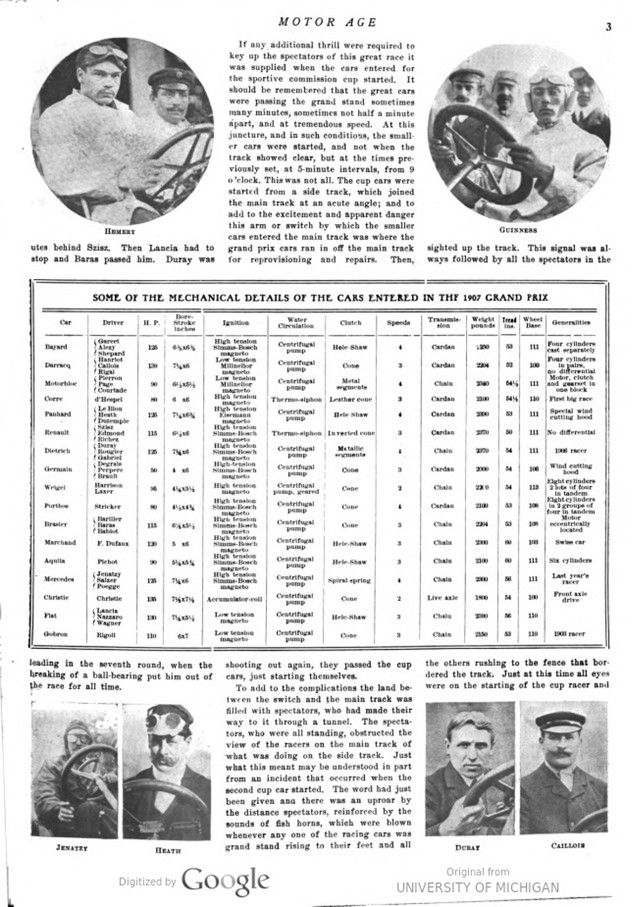
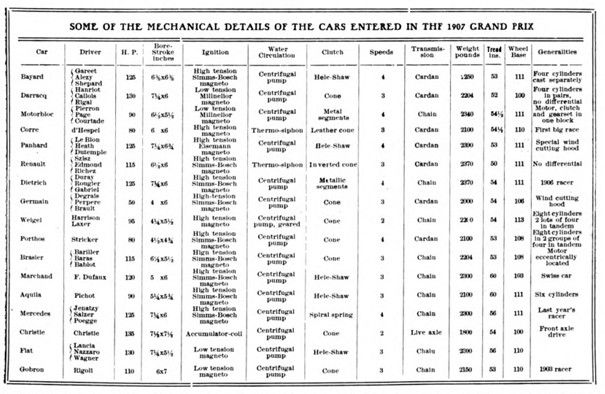
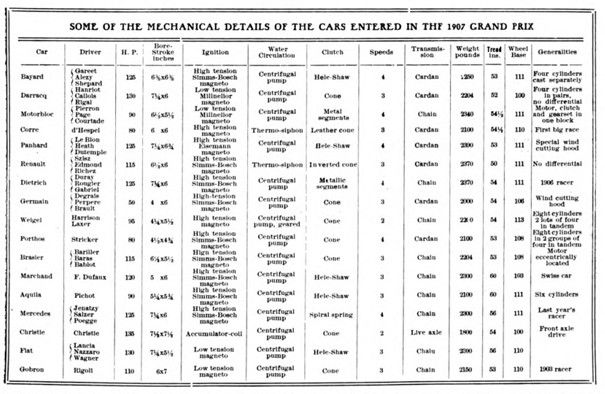
There are few remarks to be made regarding the cars in general. Some of the principal French makes are frankly racing their 1906 cars in the present grand prix, with special dispositions regarding the feed, as obtained by a new carbureter which has of course been designed to meet the regulation of 8 gallons of fuel per 62 miles. Cars like the Germain, Weigel, Marchand, Corré and Motorbloc have special motors to meet the new conditions, but this is because they did not race last year. The race will be instructive from the fact that a very wide range of cars and horsepowers are competing under the same conditions, for the horsepower of the cars ranges from about 50 on the Germain to 130 on the Fiat and Darracq and 135 on the Christie. In addition to this four-cylinder cars are in the majority, one six-cylinder and three eight-cylinder cars, which, if they finish, also will furnish a valuable basis of comparison of results obtained with the same fuel and over the same ground.
The Lorraine-Dietrich, Germain and the Panhard will fit wind-cutting hoods. The chain-driven cars are slightly in the majority, there being four more on the road. The prime favorites are the Fiats, and after them come the Renault, followed by the remaining crack French makes. The Fiat team is the strongest, and barring very bad luck the best fight should be made by This is Lancia, Nazzaro and Wagner. the feeling in France on the eve of the second running of the race.
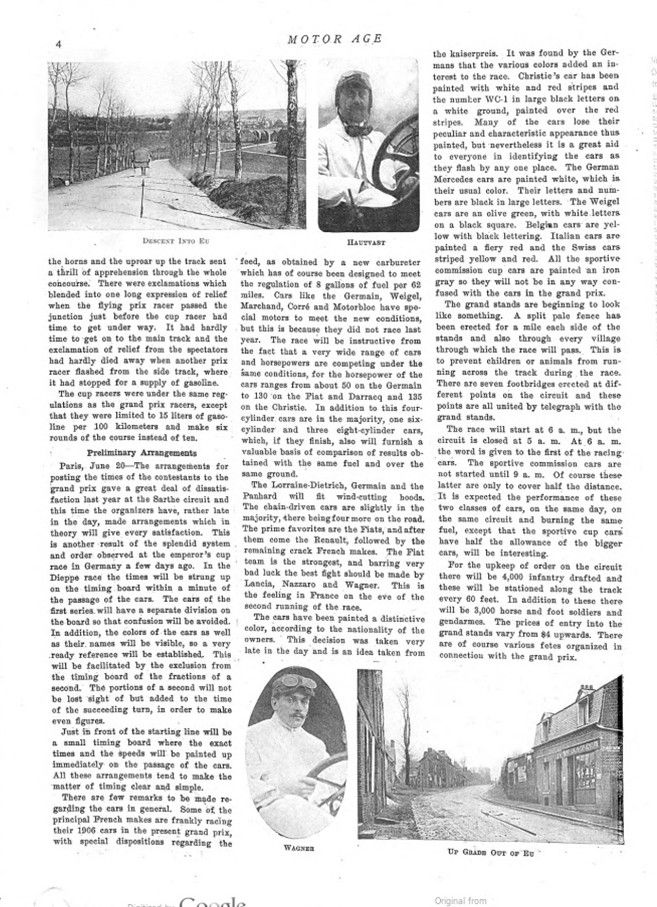
The cars have been painted a distinctive color, according to the nationality of the This decision was taken very late in the day and is an idea taken from the Kaiserpreis. It was found by the Germans that the various colors added an interest to the race. Christie’s car has been painted with white and red stripes and the number WC-1 in large black letters on a white ground, painted over the rad stripes. Many of the cars lose their peculiar and characteristic appearance thus painted, but nevertheless, it is a great aid to everyone in identifying the cars as they flash by any one place. The German Mercedes cars are painted white, which is their usual color. Their letters and numbers are black in large letters. The Weigel cars are an olive green, with white letters on a black square. Belgian cars are yellow with black lettering. Italian cars are painted a fiery red and the Swiss cars striped yellow and red. All the sportive commission cup cars are painted an iron gray so they will not be in any way confused with the cars in the grand prix.
The grand stands are beginning to look like something. A split pale fence has been erected for a mile each side of the stands and also through every village through which the race will pass. This is to prevent children or animals from running across the track during the race. There are seven footbridges erected at different points on the circuit and these points are all united by telegraph with the grand stands.
The race will start at 6 a.m., but the circuit is closed at 5 a.m. At 6 a.m. the word is given to the first of the racing cars. The sportive commission cars are not started until 9 a.m. Of course, these latter are only to cover half the distance. It is expected the performance of these two classes of cars, on the same day, on the same circuit and burning the same fuel, except that the sportive cup cars have half the allowance of the bigger cars, will be interesting.
For the upkeep of order on the circuit, there will be 4,000 infantry drafted and these will be stationed along the track every 60 feet. In addition to these there will be 3,000 horse and foot soldiers and gendarmes. The prices of entry into the grand stands vary from $4 upwards. There are of course various fetes organized in connection with the grand prix.
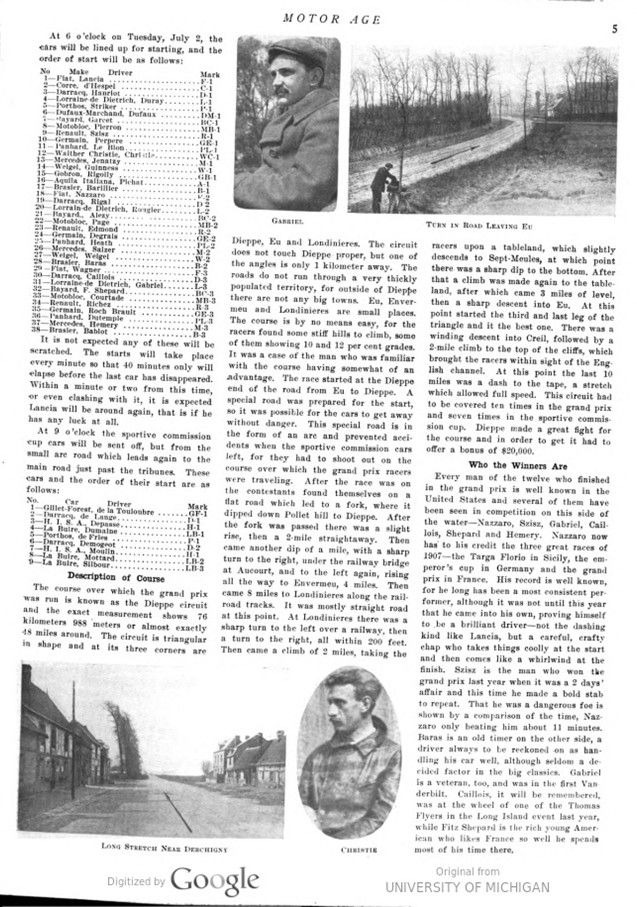
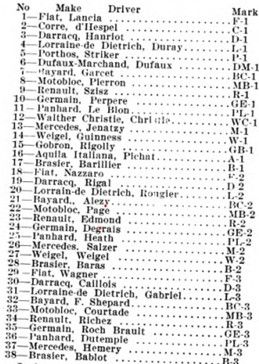
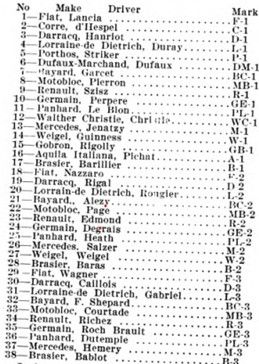
At 6 o’clock on Tuesday, July 2, the cars will be lined up for starting, and the order of start will be as follows: (see list 1 page 5).
It is not expected any of these will be scratched. The starts will take place every minute so that 40 minutes only will elapse before the last car has disappeared. Within a minute or two from this time, or even clashing with it, it is expected Lancia will be around again, that is if he has any luck at all.
At 9 o’clock the sportive commission cup cars will be sent off, but from the small arc road which leads again to the main road just past the tribunes. These cars and the order of their start are as follows: (see list 2 page 5).
Description of Course
The course over which the grand prix was run is known as the Dieppe circuit and the exact measurement shows 76 kilometers 988 meters or almost exactly 48 miles around. The circuit is triangular in shape and at its three corners are Dieppe, Eu and Londinieres. The circuit does not touch Dieppe proper, but one of the angles is only 1 kilometer away. The roads do not run through a very thickly populated territory, for outside of Dieppe there are not any big towns. Eu, Envermeu and Londinieres are small places. The course is by no means easy, for the racers found some stiff hills to climb, some of them showing 10 and 12 per cent grades. It was a case of the man who was familiar with the course having somewhat of an advantage. The race started at the Dieppe end of the road from Eu to Dieppe. A special road was prepared for the start, so it was possible for the cars to get away without danger. This special road is in the form of an arc and prevented accidents when the sportive commission cars left, for they had to shoot out on the course over which the grand prix racers were traveling. After the race was on the contestants found themselves on a flat road which led to a fork, where it dipped down Pollet hill to Dieppe. After the fork was passed there was a slight rise, then a 2-mile straightaway. came another dip of a mile, with a sharp turn to the right, under the railway bridge at Aucourt, and to the left again, rising all the way to Envermeu, 4 miles. Then came 8 miles to Londinieres along the railroad tracks. It was mostly straight road at this point. At Londinieres there was a sharp turn to the left over a railway, then a turn to the right, all within 200 feet. Then came a climb of 2 miles, taking the racers upon a tableland, which slightly descends to Sept-Meules, at which point there was a sharp dip to the bottom. After that a climb was made again to the tableland, after which came 3 miles of level, then a sharp descent into Eu. At this point started the third and last leg of the triangle and it the best one. There was a winding descent into Creil, followed by a 2-mile climb to the top of the cliffs, which brought the racers within sight of the English channel. At this point the last 10 miles was a dash to the tape, a stretch which allowed full speed. This circuit had to be covered ten times in the grand prix and seven times in the sportive commission cup. Dieppe made a great fight for the course and in order to get it had to offer a bonus of $20,000.
Who the Winners Are
Every man of the twelve who finished in the grand prix is well known in the United States and several of them have been seen in competition on this side of the water-Nazzaro, Szisz, Gabriel, Caillois, Shepard and Hemery. Nazzaro now has to his credit the three great races of 1907-the Targa Florio in Sicily, the emperor’s cup in Germany and the grand prix in France. His record is well known, for he long has been a most consistent performer, although it was not until this year that he came into his own, proving himself to be a brilliant driver-not the dashing kind like Lancia, but a careful, crafty chap who takes things coolly at the start and then comes like a whirlwind at the finish. Szisz is the man who won the grand prix last year when it was a 2 days‘ affair and this time he made a bold stab to repeat. That he was a dangerous foe is shown by a comparison of the time, Nazzaro only beating him about 11 minutes. Baras is an old timer on the other side, a driver always to be reckoned on as handling his car well, although seldom a decided factor in the big classics. Gabriel is a veteran, too, and was in the first Vanderbilt. Caillois, it will be remembered, was at the wheel of one of the Thomas Flyers in the Long Island event last year, while Fitz Shepard is the rich young American who likes France so well he spends most of his time there.
Photos.
Page 1.
GRAND PRIX AUTOMOBILE CLUB DE FRANCE CIRCUIT DIEPPE – ROUTE OF THE 1907 GRAND PRIX – MARTIN DIEPPE ANCOURT ENVERMEU DOUVREND LANDANIERES
Page 2.
SHARP CURVE AT NEUVILLE – NAZZARO, THE WINNER – DOUBLE CURVE AT LONDINIERES – LANCIA, THE UNLUCKY – RISING ROAD NEAR ANCOURT – SZISZ, SECOND PLACE – LONG AND EASY TURN NEAR SEPT-MEULES
Page 3.
HEMERY – GUINNESS – JENATZY – HEATH – DURAY – CAILLOIS = SOME OF THE MECHANICAL DETAILS OF THE CARS ENTERED IN THE 1907 GRAND PRIX
Page 4.
DESCENT INTO EU – HAUTVAST – WAGNER – UP GRADE OUT OF EU
Page 5.
GABRIEL – TURN IN ROAD LEAVING EU – LONG STRETCH NEAR DERCHIGNY – CHRISTIE