Part of the 1902 Paris-Vienna Race ran through Austria. Here’s the Austrian magazine “Allgemeine Automobil-Zeitung” with several issues, dedicating to that very race. In this first of some more articles, not only the results, but also the second placed Count Zborowski in a Mercedes.
Text and jpegs by courtesy of Österreichische Nationalbibliothek – Austrian National Library anno.onb.ac.at
compiled by motorracinghistory.com. Translation by DeepL.com
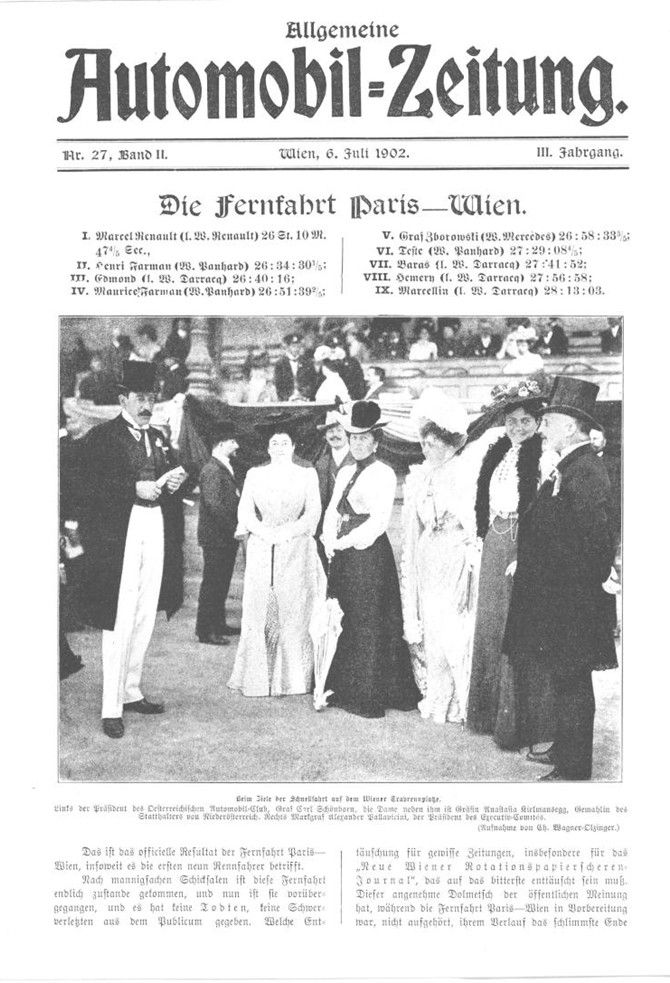
Allgemeine Automobil-Zeitung, III. Jahrgang, Band II, No. 27 – Wien, July 6, 1902
The PARIS-VIENNA long-distance race
I. Marcel Renault (l. W. Renault) 26 St.10 M. 47 4/5 Sec.;
II. Henri Farman (W. Panhard) 26:34:30 1/5;
III. Edmond (l. W. Darracq) 26:40:16:
IV. Maurice Farman (W. Panhard) 26:51:39 2/5;
V. Graf Zborowski (W. Mercedes) 26:58:33 3/5;
VI. Teste (W. Panhard) 27:29:08 4/5;
VII. Baras (l. W. Daracq) 27:41:52;
VIII. Hemery (l. W. Darracq) 27:56:58;
IX. Marcellin (l. W. Darracq) 28:13:03.
These are the official results of the Paris-Vienna long-distance race for the first nine drivers.
After many twists and turns, this long-distance race has finally come to an end, and there were no deaths or serious injuries among the spectators. What a disappointment for certain newspapers, especially for the “Neue Wiener Rotationspapierscheren-Journal,” (or directly translated, the “New Vienna Rotational Paper Scissor-Journal”) which must be bitterly disappointed. While the Paris-Vienna long-distance race was in preparation, this pleasant interpreter of public opinion did not cease to predict the worst possible outcome. Trembling and shaking, we read day after day about the “bloodbaths” that the race would inevitably cause, that the dead would ride fast, and that the seriously injured would fly through the air, to use a vulgar expression. And lo and behold—there is not a single death, not even a tiny injury. This is indeed cruel on the part of the race organizers, and they should be bitterly reproached for having prepared everything so carefully, so meticulously and thoroughly, that not a single one of the dozens of accidents predicted came to pass. The governor of Lower Austria, Count Kielmansegg, said in his speech at the banquet held in honor of the long-distance drivers that he was proud to be able to say that no reports of damage on public roads had been received. We would like to add that Count Georg Fries, who drove the route from Salzburg to Vienna by car after the race, asked us to report that he had confirmed that there had been no accidents involving people who were not actively participating in the race. As for the accidents that befell individual racers, it should be noted that all competitors voluntarily exposed themselves to the dangers inherent in any sporting competition, and that it is no one’s business if a racer, who is master of his own decisions, risks his life. However, we expressly state that even among those actively participating in the race, only a few accidents occurred, none of which were serious.
The press bureau of the Paris-Vienna long-distance race has issued a communiqué stating:
It has been officially confirmed that no injuries to any persons not involved in the race occurred on Austrian territory. Based on the investigations carried out, an official and truthful account of all accidents and incidents involving competitors and participants will be sent to all newspapers in a few days with a request for publication.
The Paris-Vienna long-distance race is now part of automotive history. It is fair to say that the race was the largest and most important ever held in motor racing. The introduction of “parts” and the ban on support vehicles made the racing conditions more challenging. No sooner had they reached the stage than the vehicles were taken to the park, where they had to remain untouched during the night. No loose screws were allowed to be tightened, no ignition devices were allowed to be changed, and no punctured tires were allowed to be replaced. All these tasks had to be carried out on the track and therefore took up time during the actual race.
Paris–Vienna was the first major race—apart from the Circuit du Nord, which was really only of regional interest—to be run with weight restrictions. No car was allowed to weigh more than 1,000 kg, and the ingenuity of the designers had to prove the correctness of their theoretical considerations on the obstacle-strewn Paris–Vienna course.
Power and weight are the two most important factors that automobile designers have to take into account. “More power, less weight” has been the slogan for years, and this time the aim was to prove the maximum power a vehicle can achieve with a minimum weight of 1,000 kg.
Many subtle calculations, many ingenious designs, and many clever engineering tricks were ruined on the long journey, but much was also learned in the process. Of course, not all that glitters is gold, and the idea of limiting racing cars to a weight limit of 1000 kg, as appealing as it may seem at first glance, has by no means been implemented as its creator intended. Giraud, the famous French racing driver, was the first to demand that the weight be fixed. The industry embraced the idea and decided to impose restrictions on itself so as not to be forced by mutual competition to build incredibly fast but also incredibly heavy vehicles that were therefore unusable for practical purposes. A thousand kilograms! That is precisely the weight a vehicle is allowed to weigh. But what has been made of these 1,000 kg? The skeleton of a vehicle, a frame, four wheels, an engine of enormous dimensions, a seat that leaves nothing to be desired in terms of comfort. That is the racing car of today. It is weighed with empty fuel, water, and oil tanks and without an ignition mechanism. In this state, however, it is nothing less than a self-propelled vehicle. When Giraud proposed the weight limit, he had in mind a comfortably bodied car, equipped with all reserves and operating fluids, weighing less than 1000 kg. If you wanted to equip a modern racing car in this way, you would certainly end up with 1500 kg instead of 1000 kg.
The real solution to the problem of weight reduction did not come from larger cars, but from lighter ones. The regulations allow designers to build lightweight cars weighing up to 650 kg. By omitting all superfluous details, manufacturers were able to put these vehicles with relatively powerful engines into the race. With bodywork and all the fittings, the weight is around 800 kg, which is almost the limit set by Giraud.
Nevertheless, the new 70 hp Panhard and Mors racing cars are masterpieces of engineering and extremely instructive. Designers are learning how to build tourist vehicles from them. The Daimler factory in Cannstatt proved this in spectacular fashion with its Mercedes cars.
We reported at the time that the Mercedes cars would not be taking part in the Paris-Vienna race, and we also gave the reasons for this. It was therefore reasonable to assume that the Paris-Vienna race would be a duel between the two great French companies Panhard and Mors, who were eager to compete for victory with all the power of their ingenious skills, their high-class machinery, their virtuoso drivers, and their wealth of capital.
But how differently things turned out in this race, which had already caused enough excitement among those involved during the preparatory stages. First there was the long wait and anxiety caused by the uncertainty surrounding the official permits. Would the race be allowed to go ahead or not? Contradictory reports continued to circulate, and when the Italian government banned the Nice-Abbazia race, almost all hope of obtaining permission to hold the race on French territory was lost. Then came the Circuit du Nord race organized by the French government, which went so well that the French Automobile Club, with the support of Minister Dupuy, von Waldeck-Rousseau, obtained the long-awaited permission to hold the Paris-Vienna race. In a rush, the 1,400 km race track had to be organized in barely four weeks. Outsiders can hardly imagine the work that had to be done and, to the credit of the organizers, was actually accomplished.
Automotive connoisseurs were already anticipating the thrill of the battle between the three world brands Panhard, Mors, and Mercedes. By this year, Mercedes was no longer a rising star, but already a star of the first magnitude; in the space of two years, the Cannstatt Daimler factory had managed to bring its cars to such a high level of perfection that the Mercedes would have gone into the Paris-Vienna race as hot favorites alongside the Panhards and Mors.
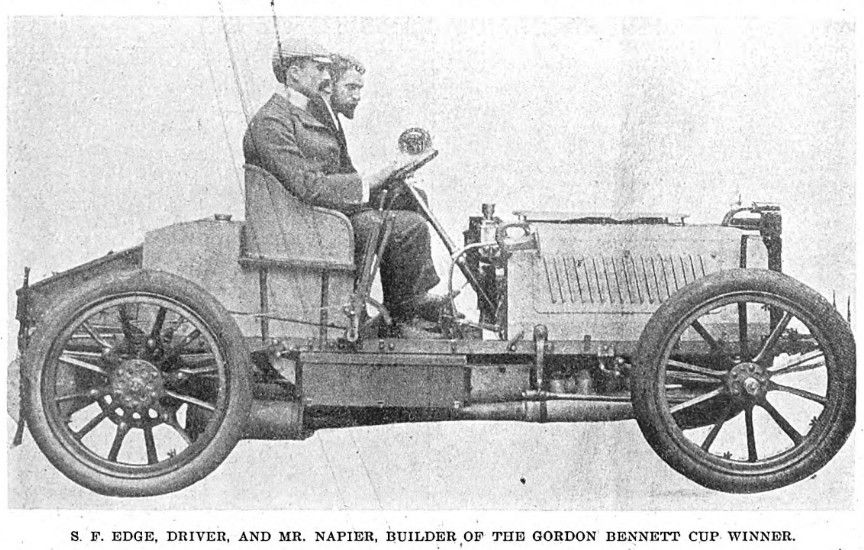
Suddenly – a new sensation. Mercedes did not start in the Paris-Vienna race. Now it seemed that sporting interest in the battle between the great cars would suffer from the absence of the Mercedes cars, and once again there was the prospect of a match between the great French houses of Panhard and Mors. And when the race began with the first stage from Paris to Belfort, and the Mors drivers broke down one after the other, the situation was such that one could have sworn that victory was a foregone conclusion for Panhard, and one could already see the first Panhard driver crossing the finish line in Vienna “hands down”…. René de Knyff was the first in Belfort, René de Knyff was still in the lead after conquering the Arlberg — there, not quite 50 km before Innsbruck, at the finish line for the Gordon Bennett Prize race, the “first Jochen” Panhard also dropped out of the race, and the Englishman Edge won the Gordon Bennett Prize in a walkover.
While the trophy donated by Mr. Gordon Bennett for the international challenge race of this kind fell almost effortlessly into the lap of the representative of England, a new sensational turn of events took place in the general race: the two Mercedes cars that were in the running came to the front. Two amateurs, Baron Forest and Count Zborowski, had pushed their way to the front without the slightest support, closely followed by Renault’s light car. But that was by no means the end of the sensations; the day of the Bregenz-Salzburg stage brought the final twist, the disqualification of Edge from the Gordon Bennett Prize.
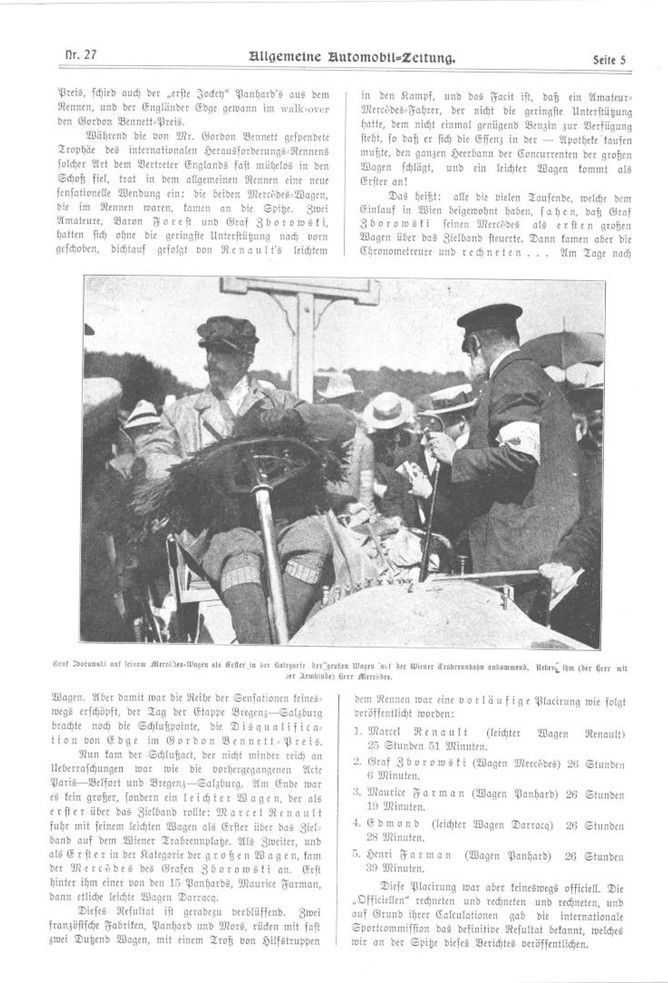
Now came the final act, which was no less rich in surprises than the previous acts in Paris-Belfort and Bregenz-Salzburg. In the end, it was not a large car but a light one that crossed the finish line first: Marcel Renault was the first to cross the finish line at the Vienna trotting track in his light car. Second, and first in the large car category, was Count Zborowski’s Mercedes. Behind him came one of the 13 Panhards, Maurice Farman, followed by several light Darracq cars.
This result is nothing short of astonishing. Two French factories, Panhard and Mors, entered the fray with almost two dozen cars and a retinue of support staff, and the result was that an amateur Mercedes driver, who had no support whatsoever and not even enough benzine, which he had to buy in essence form at the pharmacy, beat the entire army of competitors in the large car category, and a light car came in first!
This means that all the thousands who witnessed the finish in Vienna saw Count Zborowski drive his Mercedes across the finish line as the first large car. But then the timekeepers came and did their calculations… The day after the race, the preliminary rankings were published as follows:
1. Marcel Renault (light Renault car) 25 hours 51 minutes
2. Count Zborowski (Mercedes car) 26 hours 6 minutes
3. Maurice Farman (Panhard car) 26 hours 19 minutes
4. Edmond (light Darracq car) 26 hours 28 minutes
5. Henri Farman (Panhard car) 26 hours 39 minutes.
However, this ranking was by no means official. The “officials” calculated and calculated and calculated, and based on their calculations, the international sports commission announced the definitive result, which we publish at the top of this report.
Count Zborowski has thus moved from second place in the overall classification to fifth place (which is equivalent to losing first place in the large car category).
The explanation given for this change in position is that Count Zborowski had to make a lengthy stop in one of the neutralized sections of Switzerland. Count Zborowski had customs difficulties at the border, which were only resolved after a lengthy and complicated process. As a result, the count lost 48 minutes in the neutralized areas, i.e., not during the race, which were now added to his time by the timekeepers. On June 29, Count Zborowski’s time was 26 hours and 6 minutes, and on July 1, it was 48 minutes more, i.e., 26:54…
The general public will find these various calculations incomprehensible and uninteresting. But the many thousands who witnessed the finish at the Vienna trotting track saw that Count Zborowski was the first to cross the finish line in the class of large cars in his Mercedes. Whether Count Zborowski lost 48 minutes due to customs manipulation on a stage that was his race stage, thereby losing the actual victory in his class, is now only of statistical value. Count Zborowski came first in the “big guns” category, and the German Mercedes car beat the entire army of French “grosses voitures.” That is a moral victory that no timekeeper in the world can take away.
—————
A French voice.
Georges Prade, the special correspondent sent to Vienna by Auto-Vélo, telegraphed the following to his newspaper under the fresh impression of Count Zborowski’s arrival as the first in the large car category:
“Who would have dared to predict, at a time when the formidable fleet of Panhard cars was arriving in Belfort at the head of all the competing vehicles, that one of the Mercedes cars, which had hardly been noticed, would win the great battle?
The two Mercedes machines were driven by amateurs, one of whom, Count Zborowski, was driving in his first race; the other, Baron de Forest, was driving his car for the third time. One lost two hours on the first day repairing the magneto ignition, the other’s fuel pipe broke just outside Vienna and he had to stop just before the finish line.
What conclusions should we draw from these facts? I believe there is reason to fear that our industry has been led down the wrong path.
Either we build vehicles for France and then let them run on French roads, or we go abroad to compete with our rivals, but then we would first need to allow sufficient time for our designers to study the changed conditions.
A brilliant thoroughbred breed has been bred at enormous expense and through countless trials, and now it is being allowed to gallop for miles on country roads. Logically, this circumstance had to benefit the Cannstatt factory, where they have a wealth of experience with poor country roads and where they build vehicles that are unanimously regarded as excellent all over the world and have no fear of bad terrain.
The weight limit of 1,000 kilograms led us to resort to extreme measures that were perhaps not always the best. I am referring less to the engine than to the chassis. Incidentally, when you think about it calmly, it wasn’t a bad lesson. We can speak all the more freely as Renault’s position is certainly not humiliating for us.
“Why isn’t Mercedes taking part in the race?” I asked Mr. Mercedes in Paris.
Smiling, he replied: “Pah! Amateurs are enough for that. Roads like these are no match for your cars.”
That is obviously an exaggeration, but it is quite true. And now? What does that prove? Let’s be honest and admit that our cars “failed” like a student who was given an unfamiliar problem to solve. The Mercedes cars were beaten in the Paris-Berlin race, but they took revenge in the Paris-Vienna race and defeated their opponents, who were only working toward higher speeds. This clearly proves that speed, at least in certain cases, is not the be – all and end – all of a racing car.
What will Georges Prade write now, after the change in the rankings?
There will still be a lot to say about the Paris-Vienna race. For now, let the reports speak for themselves. The following account of the race from start to finish certainly contains a number of errors, for which we kindly ask our readers to excuse us. After all, the “officials,” who had all the official material at their disposal, had a difficult and error-prone job, as did the press, which had to gather its data from all possible sources.
After reading this issue, our esteemed readers will not be able to deny that we have made every effort, both in terms of text and illustrations, to further enhance the reputation of the “Allgemeine Automobil-Zeitung”. We believe we can say that we have set a new record with this issue.
Pictures.
Page 1.
At the finish line of the speed race at the Vienna Trabrennbahn racecourse.
On the left is the president of the Austrian Automobile Club, Count Carl Schönborn, and the lady next to him is Countess Anastasia Kielmansegg, wife of the governor of Lower Austria. On the right is Margrave Alexander Ballavieini, president of the executive committee. (Photo by Ch. Wagner-Elzinger).
Page 4
Paris-Vienna race.
The winner in all categories, Marcel Renault, in his lightweight Renault car upon arrival at the Vienna Trabrennbahn racetrack. To his left is the president of the Austrian Automobile Club, Count Carl Schönborn. (Amateur photograph by Otto Bels.)
Page 5.
Count Zborowski in his Mercedes car, arriving first in the large car category at the Vienna Trabrennbahn. Next to him (the gentleman with the armband) is Mr. Mercedes.
Page 6.
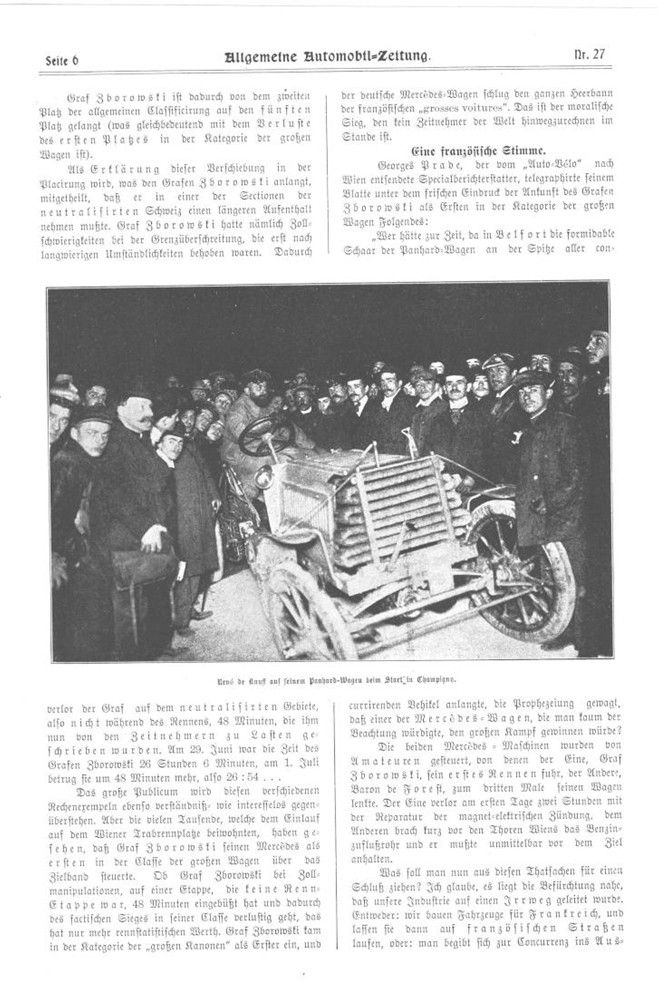
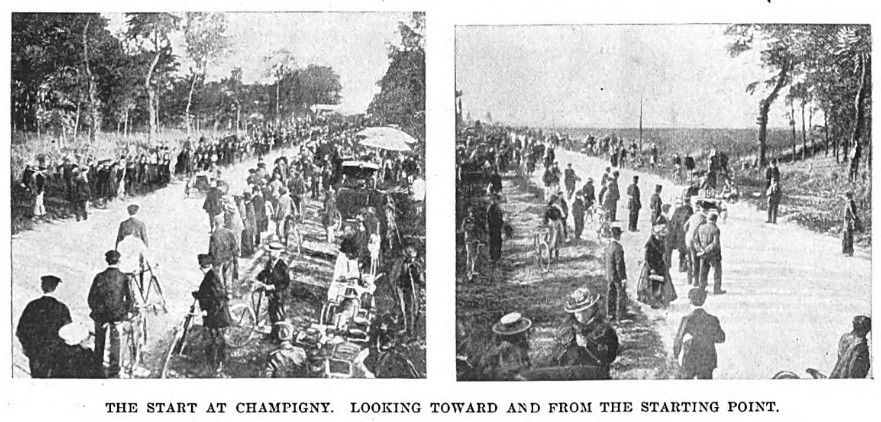
René de Knyff in his Panhard car at the start in Champigny.
Page 7.
Allgemeine Automobil-Zeitung. – Pictures from the Paris-Vienna race.
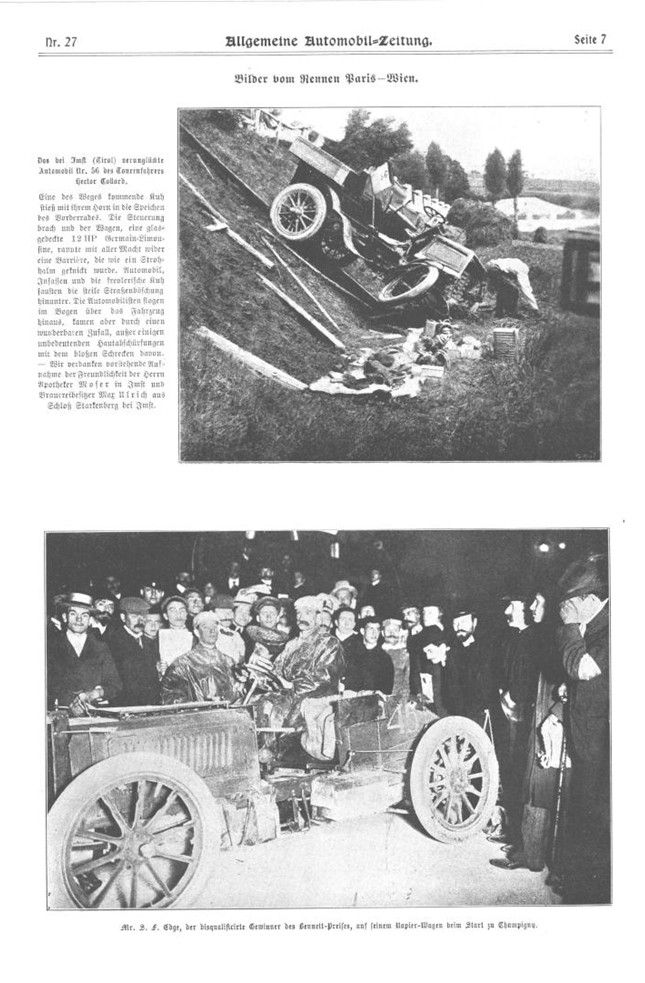
Car No. 56, driven by Tollard, which crashed near Jmst (Tyrol).
A cow coming across the road struck the spokes of the front wheel with its horn. The steering broke and the car, a glass-covered 12 HP Germain limousine, crashed with full force into a barrier, which was bent like a straw. The car, its occupants, and the mischievous cow hurtled down the steep embankment. The motorists were thrown in an arc over the vehicle.
They were thrown out, but by a miraculous coincidence, they escaped with nothing more than a few minor abrasions and a good fright.
We owe the above photograph to the kindness of Mr. Moser, pharmacist in Imst, and Mr. Max Ulrich, brewery owner at Starkenberg Castle near Imst.
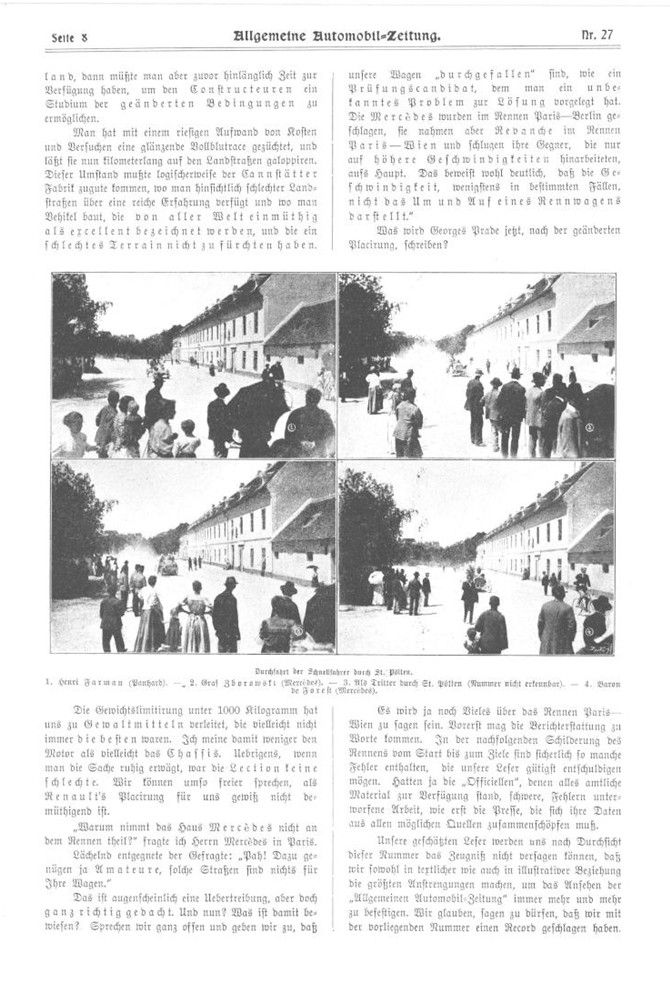
Mr. S. F. Edge, the disqualified winner of the Bennett Prize, in his Napier car at the start in Chamnpigny.
Page 8.
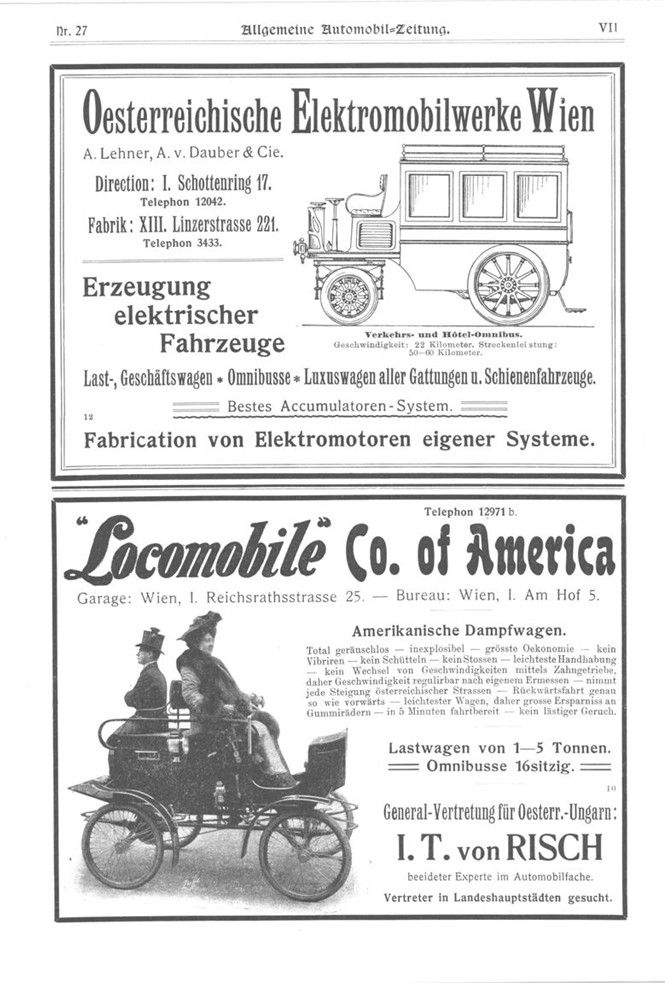
The speedsters passing through St. Pölten.
1. Henri Farman (Panhard). — 2. Count Zborowski (Mercedes). 3. — As a knight through St. Pölten (number not recognizable). —. 4. Baron de Forest (Mercedes)