The 1927 Indianapolis 500 saw un never before experienced large number of failures, as 21 of the 33 cars that started, became DNF’s as a result of technical issues. The most dominant failure modes were the supercharger drive mechanism and broken timing gears. Failures on the rear axle and on some driving parts were the next contributors. The reason for that? The relative high speeds of this year caused increased vibrations, which some cars‘ parts simply could not withstand even over a 100-mile distance. This read by the French expert Paul Dumas gives a thorough analysis.
Text and jpegs by courtesy of hathitrust.org www.hathitrust.org, compiled by motorracinghistory.com
Automotive Industries, Vol. 56, No. 22, June 4, 1927
Superchargers and Timing Gears Cause Most Failures
High average speed during first part of Indianapolis race and bumpy condition of track responsible for large number of mechanical troubles this year.
By Paul Dumas
THE very high average speed of the leader during the first 200 miles, combined with the bumpy condition of the track, was responsible for the abnormally large number of mechanical troubles encountered by the 33 cars which started in this year’s Indianapolis Race.
The very things that have produced the speed ability of the 91½ cu. in. cars were the greatest offenders.
Of the 21 cars that were eliminated, four were put out of commission due to definite failure of the supercharger drive mechanism. Two other cars, Schneider’s Miller and Hartz’s Erskine-Miller, were forced out due to broken timing gears and broken crankshaft key respectively, and it is probable that, in at least one of these two cases, the supercharger drive assembly was indirectly responsible.
Next to supercharger and timing gear troubles, which took toll of five cars, came failure of the rear axle and driveshaft parts. Four cars were eliminated due to failure at these points, one of them being the No. 24 Perfect Circle Duesenberg, which was forced out with broken axle drive gears, when five miles from the finish in second position. The Miller Special driven by Bauman was forced out on account of simi- lar trouble at a time when he was leading.
The condition of the track played a large part in sending three cars permanently to the pits with leaking gasoline tanks. Two of these cars, Batten’s Miller and Duray’s Miller, were set afire from this cause.
Lockhart led until eliminated at the 300-mile mark by a broken connecting rod. This and Shattuck’s broken valve were the only mechanical failures attributable to the engine proper.
Aside from frequent replacement of plugs, there was no ignition trouble. It is apparent that chassis parts, especially those of front axle and power transmitting mechanism, need greater factors of safety to withstand high speeds on tracks of this type.
More thorough study of the problem of a reliable supercharger drive able to withstand frequent decelerations is also imperative. In the past there have been some failures of the supercharger impeller but the recent use of ribbed and heavier casings of bronze instead of aluminum has almost entirely eliminated trouble at this point. The new casings and impellers have made possible outputs as high as 28 lb. absolute.
Cars finishing in the money and not troubled with blower failure in most cases were fitted with balanced step-up assemblies having gears of wider face than last year. The lack of rigidity of the rear system under the heavy strain of cornering at high speed may prompt the use of radius rods between rear axle housings and frame, or equivalent measures, just as it will bring more serious study of the causes of failure as exhibited by the broken front axle on the No. 9 Cooper Special and failure of front axle spring pad on Lewis‘ Miller front drive.
Not Built for Rough Track
It was apparent that many of the contesting cars, although adequate for satisfactory performance on board tracks, do not have sufficient vibration–withstanding ability to permit of long sustained high speed on a track of this nature, where mere speed does not decide the winner.
Of the 33 cars starting, 21 were eliminated due either to driving accidents or mechanical troubles. There were a total of 110 pitstops and the unusual number of 49 reliefs were made, these 49 being confined to 18 cars. A considerable number of pit stops were devoted to supercharger testing and to the tightening of loose engine and chassis parts.
That the fast pace set by the leader was too much for the cars is evident in the fact that 10 were eliminated before the 100-mile mark had been passed.
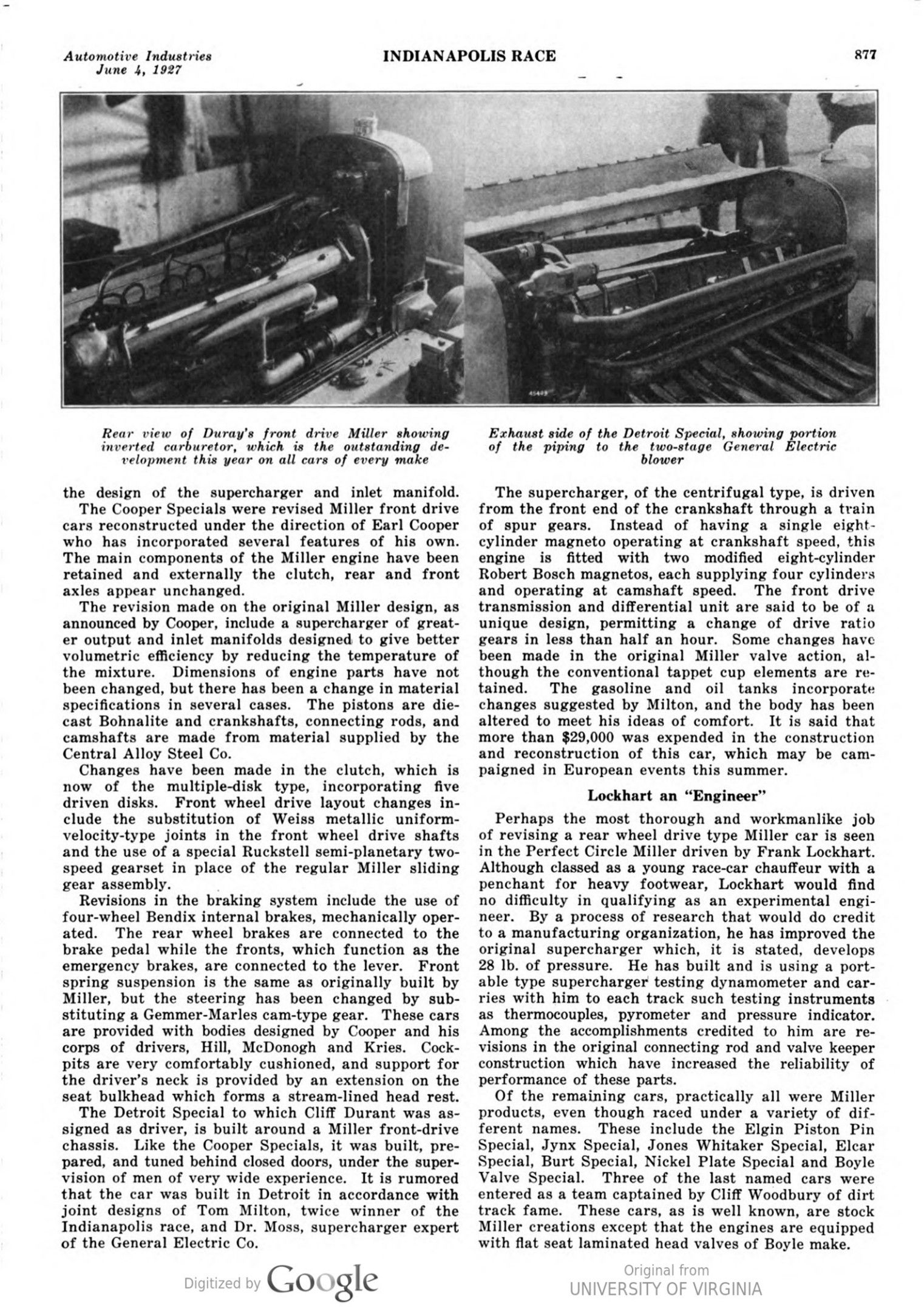
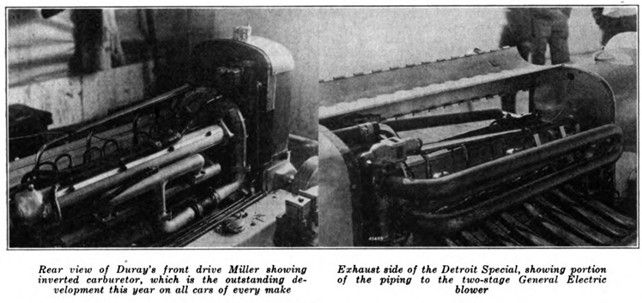
Observed at rest in their garages, the 1927 models of 91½ cu. in. racing cars are essentially duplicates of the 1926 models, and the impression remains even after a hasty glance under their hoods. But observe them in action with the stopwatch, and the chances are that you will ask who inserted the dynamite, and where. For the 1927 racing cars of 91½ cu. in. displacement represent the fastest pieces of machinery that ever performed on the brick-surfaced Indianapolis Speedway. The results of last year’s development work are not immediately apparent to the eye, but they are evidenced by the performance and stand out on close examination. And it is likely that when the story of the 1927 race is told over the drafting boards, there will be much talk about how the inverted carburetor, the high-pressure blower and new inlet manifolds made possible such engines. These, together with the lowered centers of gravity and speeds as high as 7800 r. p. m., attained even with the rear-driven cars, have been the outstanding speed-increasing developments of the year.
All American-Built
There were approximately 36 cars that constituted the real field at Indianapolis, and these are all American-built and of the eight-cylinder in-line type. Of these 36 cars, the offset-type Duesenbergs (Perfect-Circle, Duesenberg and Thompson-Valve Specials) are the only outstanding new chassis creations. These new jobs, which are characterized by an extremely low center of gravity, compare favorably with the front drive jobs in the matter of over-all height and are decidedly lower than any of the other rear wheel drive cars. It was with one of these cars that Souders won the race.
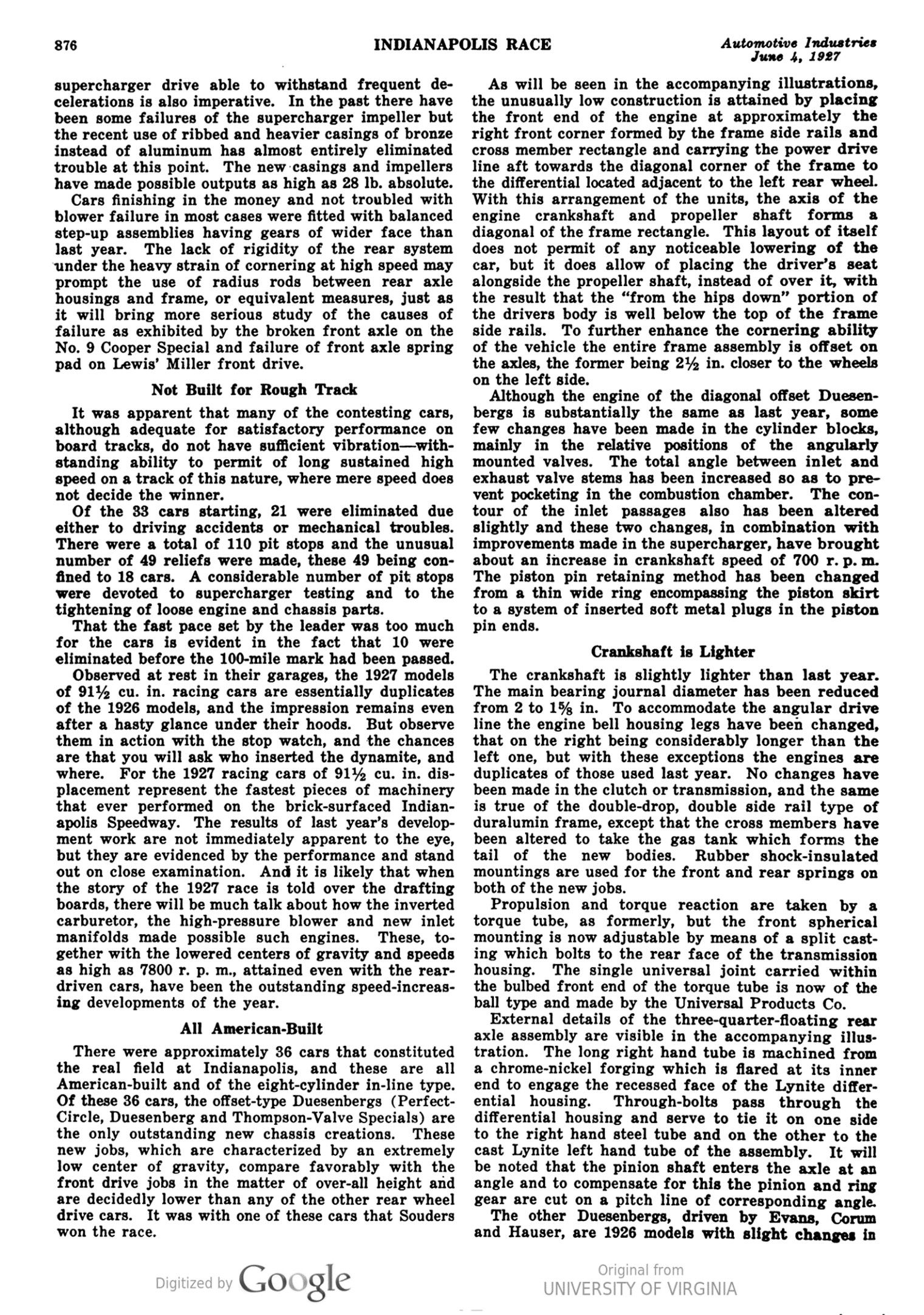
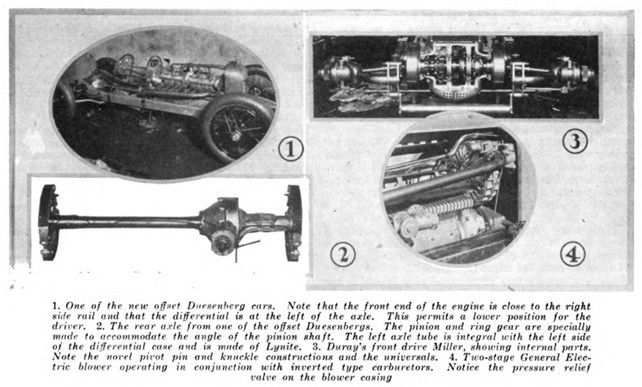
As will be seen in the accompanying illustrations, the unusually low construction is attained by placing the front end of the engine at approximately the right front corner formed by the frame side rails and cross member rectangle and carrying the power drive line aft towards the diagonal corner of the frame to the differential located adjacent to the left rear wheel. With this arrangement of the units, the axis of the engine crankshaft and propeller shaft forms diagonal of the frame rectangle. This layout of itself does not permit of any noticeable lowering of the car, but it does allow of placing the driver’s seat alongside the propeller shaft, instead of over it, with the result that the „from the hips down“ portion of the drivers body is well below the top of the frame side rails. To further enhance the cornering ability of the vehicle the entire frame assembly is offset on the axles, the former being 2½ in. closer to the wheels on the left side.
Although the engine of the diagonal offset Duesenbergs is substantially the same as last year, some few changes have been made in the cylinder blocks, mainly in the relative positions of the angularly mounted valves. The total angle between inlet and exhaust valve stems has been increased so as to prevent pocketing in the combustion chamber. The contour of the inlet passages also has been altered slightly and these two changes, in combination with improvements made in the supercharger, have brought about an increase in crankshaft speed of 700 r.p.m. The piston pin retaining method has been changed from a thin wide ring encompassing the piston skirt to a system of inserted soft metal plugs in the piston pin ends.
Crankshaft is Lighter
The crankshaft is slightly lighter than last year. The main bearing journal diameter has been reduced from 2 to 1 5/8 in. To accommodate the angular drive line the engine bell housing legs have been changed, that on the right being considerably longer than the left one, but with these exceptions the engines are duplicates of those used last year. No changes have been made in the clutch or transmission, and the same is true of the double-drop, double side rail type of duralumin frame, except that the cross members have been altered to take the gas tank which forms the tail of the new bodies. Rubber shock-insulated mountings are used for the front and rear springs on both of the new jobs.
Propulsion and torque reaction are taken by a torque tube, as formerly, but the front spherical mounting is now adjustable by means of a split casting which bolts to the rear face of the transmission housing. The single universal joint carried within the bulbed front end of the torque tube is now of the ball type and made by the Universal Products Co.
External details of the three-quarter-floating rear axle assembly are visible in the accompanying illustration. The long right-hand tube is machined from a chrome-nickel forging which is flared at its inner end to engage the recessed face of the Lynite differential housing. Through-bolts pass through the differential housing and serve to tie it on one side to the right-hand steel tube and on the other to the cast Lynite left hand tube of the assembly. It will be noted that the pinion shaft enters the axle at an angle and to compensate for this the pinion and ring gear are cut on a pitch line of corresponding angle.
The other Duesenbergs, driven by Evans, Corum and Hauser, are 1926 models with slight changes in the design of the supercharger and inlet manifold.
The Cooper Specials were revised Miller front drive cars reconstructed under the direction of Earl Cooper who has incorporated several features of his own. The main components of the Miller engine have been retained and externally the clutch, rear and front axles appear unchanged.
The revision made on the original Miller design, as announced by Cooper, include a supercharger of greater output and inlet manifolds designed to give better volumetric efficiency by reducing the temperature of the mixture. Dimensions of engine parts have not been changed, but there has been a change in material specifications in several cases. The pistons are diecast Bohnalite and crankshafts, connecting rods, and camshafts are made from material supplied by the Central Alloy Steel Co.
Changes have been made in the clutch, which is now of the multiple-disk type, incorporating five driven disks. Front wheel drive layout changes include the substitution of Weiss metallic uniform-velocity-type joints in the front wheel drive shafts and the use of a special Ruckstell semi-planetary two-speed gearset in place of the regular Miller sliding gear assembly.
Revisions in the braking system include the use of four-wheel Bendix internal brakes, mechanically operated. The rear wheel brakes are connected to the brake pedal while the fronts, which function as the emergency brakes, are connected to the lever. Front spring suspension is the same as originally built by Miller, but the steering has been changed by substituting a Gemmer-Marles cam-type gear. These cars are provided with bodies designed by Cooper and his corps of drivers, Hill, McDonogh and Kries. Cockpits are very comfortably cushioned, and support for the driver’s neck is provided by an extension on the seat bulkhead which forms a stream-lined head rest.
The Detroit Special to which Cliff Durant was assigned as driver, is built around a Miller front-drive chassis. Like the Cooper Specials, it was built, prepared, and tuned behind closed doors, under the supervision of men of very wide experience. It is rumored that the car was built in Detroit in accordance with joint designs of Tom Milton, twice winner of the Indianapolis race, and Dr. Moss, supercharger expert of the General Electric Co.
The supercharger, of the centrifugal type, is driven from the front end of the crankshaft through a train of spur gears. Instead of having a single eight-cylinder magneto operating at crankshaft speed, this engine is fitted with two modified eight-cylinder Robert Bosch magnetos, each supplying four cylinders and operating at camshaft speed. The front drive transmission and differential unit are said to be of a unique design, permitting a change of drive ratio gears in less than half an hour. Some changes have been made in the original Miller valve action, although the conventional tappet cup elements are retained. The gasoline and oil tanks incorporate changes suggested by Milton, and the body has been altered to meet his ideas of comfort. It is said that more than $29,000 was expended in the construction and reconstruction of this car, which may be campaigned in European events this summer.
Lockhart an „Engineer“
Perhaps the most thorough and workmanlike job of revising a rear-wheel drive type Miller car is seen in the Perfect Circle Miller driven by Frank Lockhart. Although classed as a young race-car chauffeur with a penchant for heavy footwear, Lockhart would find no difficulty in qualifying as an experimental engineer. By a process of research that would do credit to a manufacturing organization, he has improved the original supercharger which, it is stated, develops 28 lb. of pressure. He has built and is using a portable type supercharger testing dynamometer and carries with him to each track such testing instruments as thermocouples, pyrometer and pressure indicator. Among the accomplishments credited to him are revisions in the original connecting rod and valve keeper construction which have increased the reliability of performance of these parts.
Of the remaining cars, practically all were Miller products, even though raced under a variety of different names. These include the Elgin Piston Pin Special, Jynx Special, Jones Whitaker Special, Elcar Special, Burt Special, Nickel Plate Special and Boyle Valve Special. Three of the last named cars were entered as a team captained by Cliff Woodbury of dirt track fame. These cars, as is well known, are stock Miller creations except that the engines are equipped with flat seat laminated head valves of Boyle make.
Photos.
Page 875.
1. One of the new offset Duesenberg cars. Note that the front end of the engine is close to the right-side rail and that the differential is at the left of the axle. This permits a lower position for the driver.
2. The rear axle from one of the offset Duesenbergs. The pinion and ring gear are specially made to accommodate the angle of the pinion shaft. The left axle tube is integral with the left side of the differential case and is made of Lynite.
3. Duray’s front drive Miller, showing internal parts. Note the novel pivot pin and knuckle constructions and the universals.
4. Two-stage General Electric blower operating in conjunction with inverted type carburetors. Notice the pressure relief valve on the blower casing
Page 877.
Rear view of Duray’s front drive Miller showing inverted carburetor, which is the outstanding development this year on all cars of every make Exhaust side of the Detroit Special, showing portion of the piping to the two-stage General Electric blower