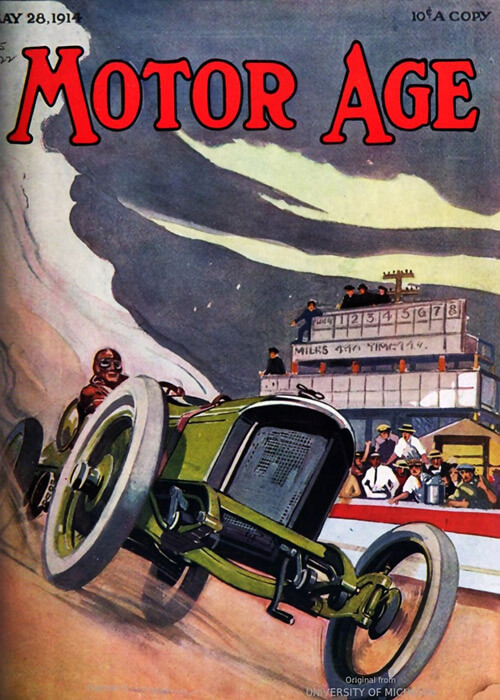
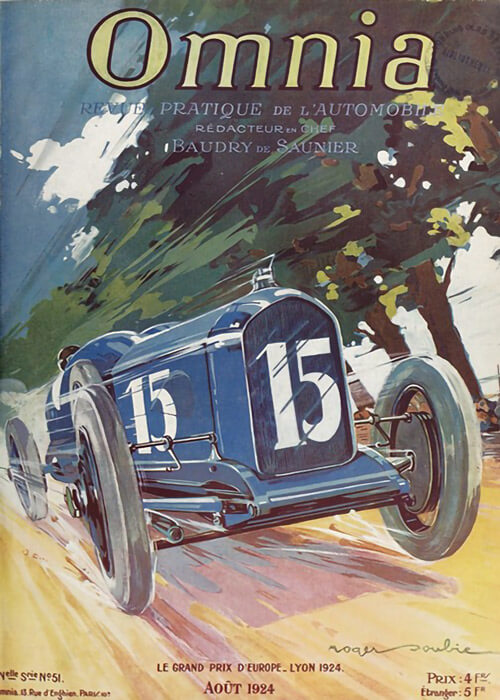
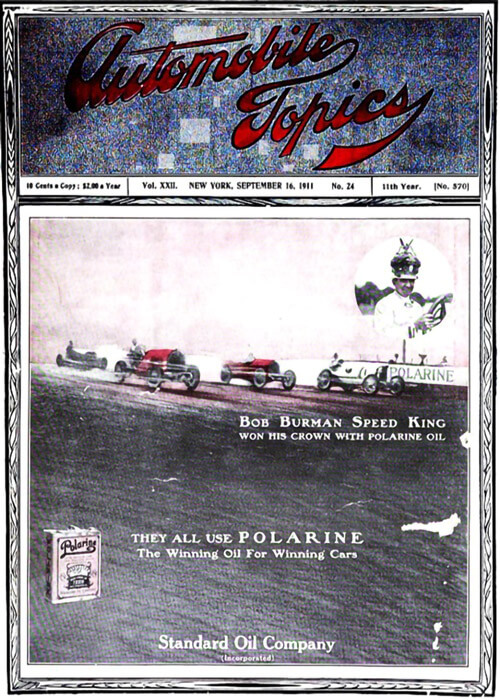
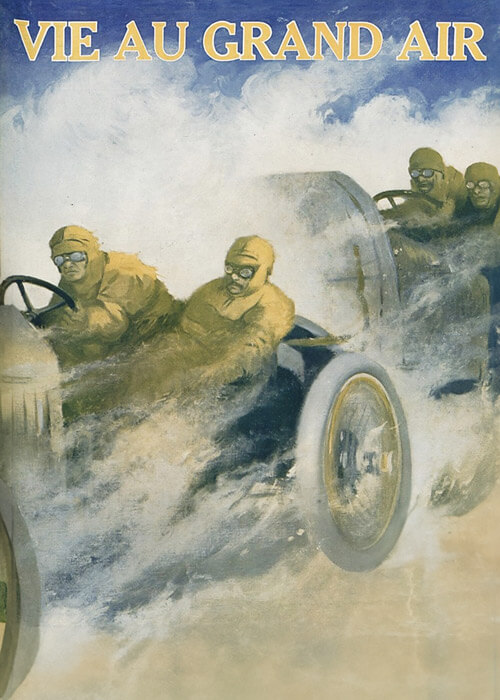
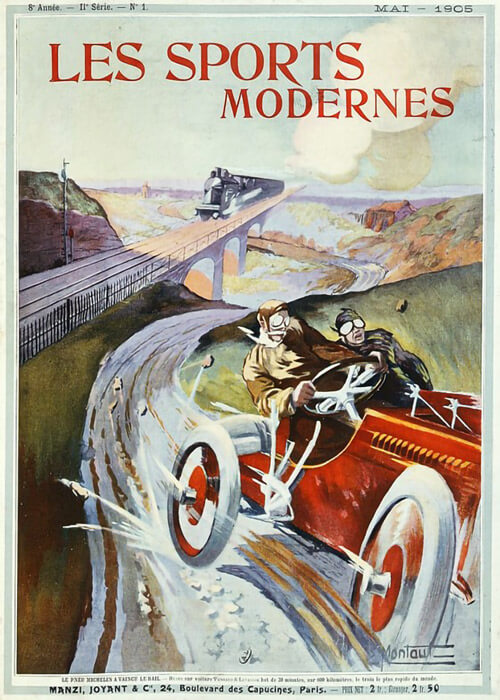
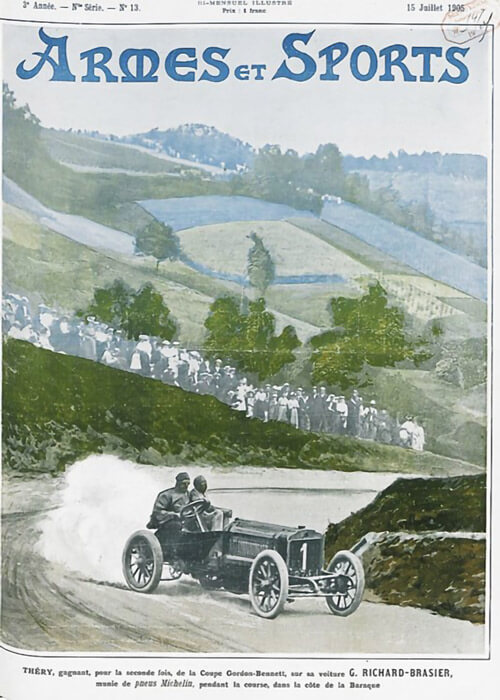
As already indicated by YKW in his introduction of „Indianapaolis 1926-1929“, early thoughts on stock car races rose up from older days. Most of the racetrack owners became more and more disatisfied with the gradually diminishing publics interest. In consequence, there earnings reduced bit by bit. Many car manufactureres on the other hand, were only less interested in such kind of racing. Here now, a start of a discussion, that would last several years and in several magazines.
Text and jpegs by courtesy of hathitrust.org www.hathitrust.org, compiled by motorracinghistory.com
Automotive Industries, Vol. 56, No. 17, April 30, 1927
Does the Industry want Revival of Stock-Car Racing?
Manufacturers face many perplexing questions in deciding what their course will be as speedways of country plan stock car contests to swell receipts.
By Robert L. Cusick
A QUESTION that is being argued in practically every passenger car factory in the country at the present time is, „Shall we, or shall we not, put the stamp of approval on stock car racing?“
For stock car racing, which most people thought had been relegated long ago to the limbo of forgotten things, in the United States at least, has flared up suddenly on the automotive horizon after an absence of a dozen years and the factories are faced with the necessity of deciding whether they like it or not.
At first glance, it would seem to be a simple thing to decide. But the longer it is pondered the more complicated the issues it leads to, especially in the cases of certain factories. Their position might be likened to that of a man who has been challenged in public to fight. He runs the chance of being licked if he does, and he’s probably going to be branded as a coward if he doesn’t.
Involved in the question are such things as the desires of the car dealers; the reaction of the buying public in case of victory, and ditto in case of defeat; the millions of dollars that might be poured into good advertising if a few records are hung up, and the painful experience of reading the other fellow’s good ads if he happens to get the breaks; the wisdom of going into anything that will lay so much stress on speed to the possible exclusion of many other splendid features in a car’s design; and the danger, if the factory doesn’t enter and race its own cars, of having some dub private owner enter a car of the same make and knock the edge off its reputation with a showing that doesn’t do justice to its real ability.
All of these factors demand consideration, irrespective of how keen any group of factory executives may be for the movement, or how strongly opposed to it they may be.
The movement to revive stock car racing was not born in the manufacturing end of the industry, but the infant, it seems, is going to be left on the industry’s doorstep with a note asking the industry to take it in. If the industry decides that it doesn’t want the orphan, then, according to present speedway plans, the public will be asked to adopt it without factory blessing.
Speedway Receipts Dwindling
Financial considerations on the part of speedway magnates are mainly responsible for the propagation of the idea. Various speedway managements have been dissatisfied with the profit-earning possibilities of their investments; they feel that the public is pretty well „fed up“ on contests between professional drivers in special racing cars, since such contests have been dished up regularly during the last few years all over the country and have lost much of their original appeal. On smooth, steeply-banked board tracks, especially 200 or 300-mile races of this kind become monotonous after a while and it is felt that variety is needed to bring out the crowds.
As all of the big tracks in the country are conducted under the sanction of the American Automobile Association, it was necessary to place the matter before the A.A.A. officials for approval before going ahead. The final working out of the plans was due largely to the efforts of Van Haresnape, secretary of the A.A.A. Contest Board, and the movement has received the solid backing of the A.A.A., which in turn, Mr. Haresnape says, is getting „the cordial support and cooperation of leading car manufacturers throughout the country.“
Undoubtedly it will receive the support of some factories, but many seem to be against it if we accept as a criterion of general sentiment the views expressed by a number of executives recently interviewed on the subject.
The executives interviewed, and their views on the matter, are as follows:
W. R. Tracy, vice-president and director of sales, Oakland Motor Car Co.: „Stock car racing would not interest us. I can see no sales value in it, and the little engineering experience which might be gained would simply be a repetition of the work accomplished by the engineering department, especially at the General Motors Proving Grounds.“
J. E. Fields, vice-president in charge of sales, Chrysler Sales Corp.: „I question if they will interest the manufacturers until they can guarantee that the rules will be strictly adhered to. In my opinion the manufacturers are more interested in endurance runs to show actually what is in a car, not so much from the stand- point of speed as to demonstrate durability and service.“
Paige Not Interested
W. A. Wheeler, president, Paige-Detroit Motor Car Co.: „As far as Paige is concerned, I do not believe that we will be interested in stock car racing. When stock car racing was formerly in vogue it no doubt served a very useful purpose by stimulating the interest of the general public in motor cars. But times have changed and in contrast the public is sold on the need of motor cars and it also understands cars sufficiently well to realize that cars prepared for racing are not so much of the type required for everyday requirements. The thought also strikes me sometimes that perhaps the industry is laying too much stress on the speed possibilities of the cars it is merchandising today, for how often has a motorist the opportunity to use the maximum speeds that are being claimed?”
C. A. Triphagen, sales manager, Reo Motor Car Co.: „It would not interest us, and what is more, I sometimes believe that the speed possibilities of motor cars are being played up too much. As I see it, Reo will not plan to participate in stock car racing.“
Lynn McNaughton, vice-president, Cadillac Motor Car Co.: „Although the public is generally interested in motor car performance, I doubt very much if anything can be gained by a revival of stock car racing. The public is interested in performance that motorists can prove by their own experience. Furthermore, so far as I am able to discover, no one has ever been able to set the controversy as to what is a stock car.“
DuBoise Young, president, Hupp Motor Car Corp.: „I can see absolutely no value to the industry in stock car racing. Everyone knows that all so-called stock cars raced in the old days had much special attention and if participants were forced to take cars exactly as they left the regular production line and race them, that might be different, for it would be a true test. At any rate I cannot see where there would be any sales value from this activity.“
Olds Motor Works: „This country and the automotive industry have outgrown stock car races. Nothing will be gained by the public or the industry from these contests. Institutions such as the General Motors Proving Grounds are furnishing automobile engineers with more significant and accurate data than could be derived from stock car racing. Performance of stock cars is today a known factor. It is the opinion of Oldsmobile officials that high speed is not the primary car requirement in the mind of the public, but that efficient performance in the safe and legal driving range is most paramount.“
„What is a Stock Car?“
It will be noted that several of those quoted above raise the question of „What is a stock car?“ In preparation for the coming revival, Mr. Haresnape has laid down a special set of rules and specifications which serve as the A.A.A.’s answer to that question. The cars which are entered are to be mechanically the same as when they leave the manufacturers‘ assembly lines. Fenders, running boards and aprons may be removed; this is done as a safety precaution, in order that drivers may see their tires, and not with the thought of lightening the cars. Windshield glass may be taken out, also in the interest of safety. Tops may be lowered and lashed to the body of the car. Headlights may be removed if they are built into the fenders; otherwise, they must remain. Stock wheels and standard tires are required. Extra tire must be carried in the car. Gear ratios may not be changed unless it is specified in the manufacturer’s catalog that the selection of gear ratio is optional to a person buying a car without additional charge. One man, the driver, is permitted in each car. No change is to be made in the motor except that the pistons may be freed up by hand grinding, but the cylinders may not be rebored. Connecting rod bearings may be given proper clearance. A standard grade of fuel must be used, but the selection of lubricating oil is optional with the entrant. All cars entered will be examined and sealed by the A.A.A. officials prior to the start of the race.
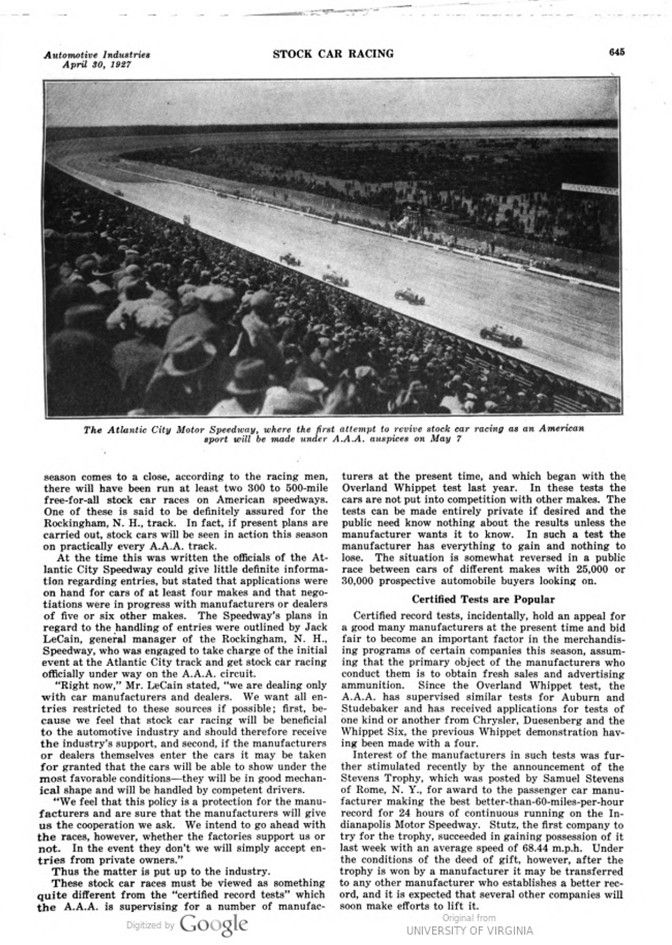
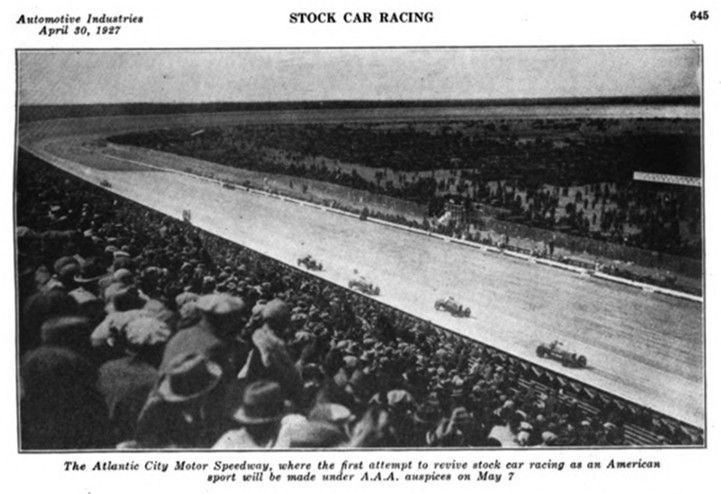
The first contest under these conditions will be held at the Atlantic City Speedway, Hammonton, N. J., as a preliminary to a regular 200-mile A.A.A. championship race on May 7. The stock cars will cover 75 miles and cars of any make may be entered except that the piston displacement is limited to 300 cu. in. This restriction automatically bars several well-known makes which have been merchandised during recent years largely on the appeal of speed and power. On June 12 a 50-mile dirt track event is scheduled for the Altoona, Pa., Speedway and before the 1927 season comes to a close, according to the racing men, there will have been run at least two 300 to 500-mile free-for-all stock car races on American speedways. One of these is said to be definitely assured for the Rockingham, N. H., track. In fact, if present plans are carried out, stock cars will be seen in action this season on practically every A.A.A. track.
At the time this was written the officials of the Atlantic City Speedway could give little definite information regarding entries, but stated that applications were on hand for cars of at least four makes and that negotiations were in progress with manufacturers or dealers of five or six other makes. The Speedway’s plans in regard to the handling of entries were outlined by Jack LeCain, general manager of the Rockingham, N. H., Speedway, who was engaged to take charge of the initial event at the Atlantic City track and get stock car racing officially under way on the A.A.A. circuit.
„Right now,“ Mr. LeCain stated, “we are dealing only with car manufacturers and dealers. We want all entries restricted to these sources if possible; first, because we feel that stock car racing will be beneficial to the automotive industry and should therefore receive the industry’s support, and second, if the manufacturers or dealers themselves enter the cars it may be taken for granted that the cars will be able to show under the most favorable conditions—they will be in good mechanical shape and will be handled by competent drivers.
„We feel that this policy is a protection for the manufacturers and are sure that the manufacturers will give us the cooperation we ask. We intend to go ahead with the races, however, whether the factories support us or not. In the event they don’t we will simply accept entries from private owners.”
Thus, the matter is put up to the industry.
These stock car races must be viewed as something quite different from the „certified record tests“ which the A.A.A. is supervising for a number of manufacturers at the present time, and which began with the Overland Whippet test last year. In these tests the cars are not put into competition with other makes. The tests can be made entirely private if desired and the public need know nothing about the results unless the manufacturer wants it to know. In such a test the manufacturer has everything to gain and nothing to lose. The situation is somewhat reversed in a public race between cars of different makes with 25,000 or 30,000 prospective automobile buyers looking on.
Certified Tests are Popular
Certified record tests, incidentally, hold an appeal for a good many manufacturers at the present time and bid fair to become an important factor in the merchandising programs of certain companies this season, assuming that the primary object of the manufacturers who conduct them is to obtain fresh sales and advertising ammunition. Since the Overland Whippet test, the A.A.A. has supervised similar tests for Auburn and Studebaker and has received applications for tests of one kind or another from Chrysler, Duesenberg and the Whippet Six, the previous Whippet demonstration having been made with a four.
Interest of the manufacturers in such tests was further stimulated recently by the announcement of the Stevens Trophy, which was posted by Samuel Stevens of Rome, N. Y., for award to the passenger car manufacturer making the best better-than-60-miles-per-hour record for 24 hours of continuous running on the Indianapolis Motor Speedway. Stutz, the first company to try for the trophy, succeeded in gaining possession of it last week with an average speed of 68.44 m.p.h. Under the conditions of the deed of gift, however, after the trophy is won by a manufacturer it may be transferred to any other manufacturer who establishes a better record, and it is expected that several other companies will soon make efforts to lift it.
Photos.
Page 643.
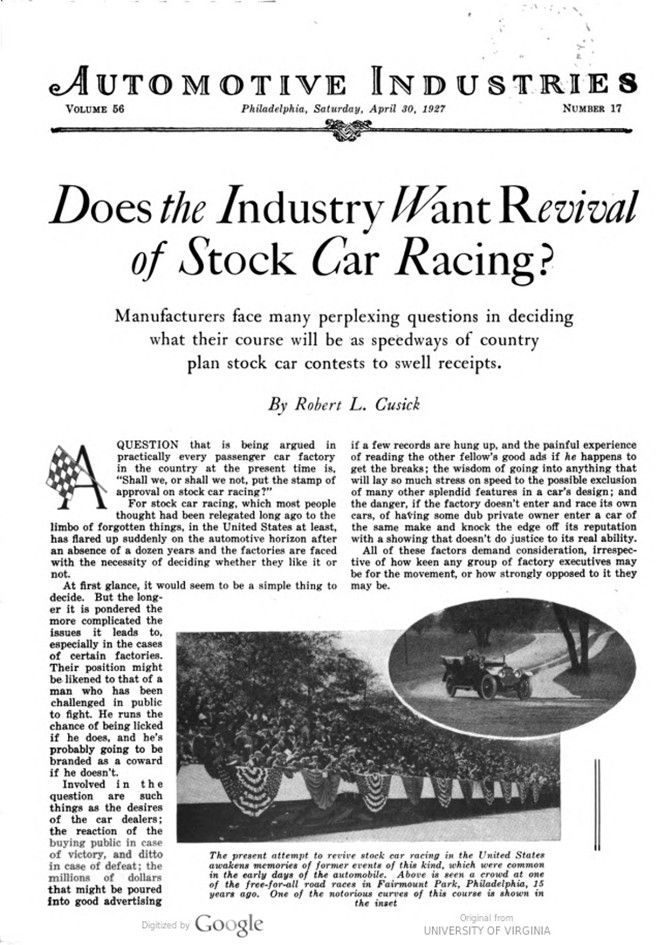
The present attempt to revive stock car racing in the United States awakens memories of former events of this kind, which were common in the early days of the automobile. Above is seen a crowd at one of the free-for-all road races in Fairmount Park, Philadelphia, 15 years ago. One of the notorious curves of this course is shown in the inset
Page 645.
The Atlantic City Motor Speedway, where the first attempt to revive stock car racing as an American sport will be made under A.A.A. auspices on May 7