After superchargers appeared more and more on the race cars, one of the logical developments was the use of inter-coolers. That would reduce temperatures of compressed air-gasoline mixtures into the combustion chamber, therby increase therma efficiency and hence power output. This development already came into practice some five years after the first introduction. This article from the same author also appeared in Automotive Industries of May 31, 1928.
Text and jpegs by courtesy of hathitrust.org www.hathitrust.org, compiled by motorracinghistory.com
Motor Age, Vol. LIII, 53, No. 22, May 31, 1928
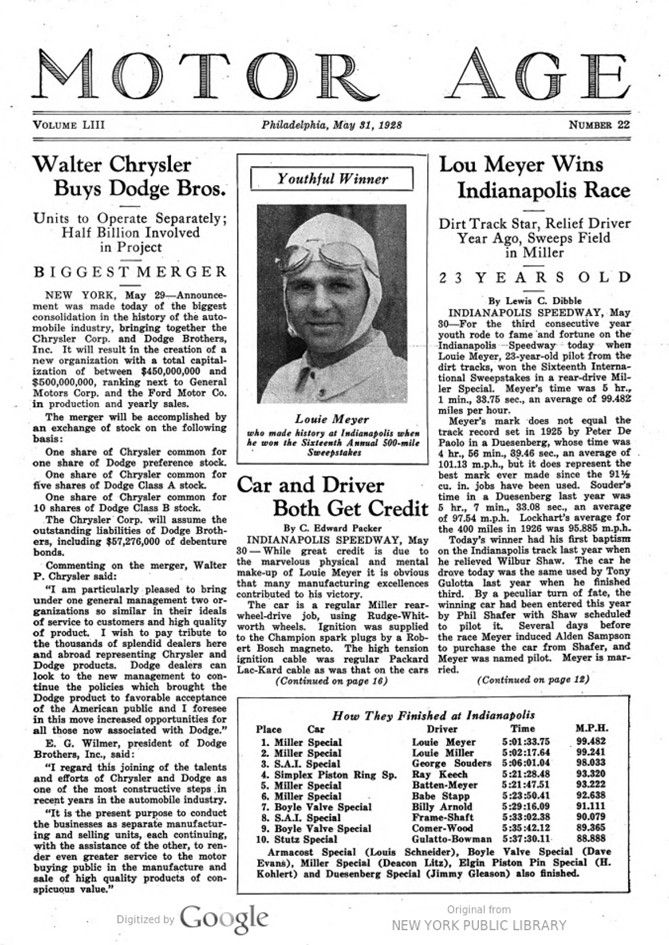
Car and Driver Both Get Credit
Indianapolis Race Cars Feature Intercooling Inlet Manifolds
By C. Edward Packer
INDIANAPOLIS SPEEDWAY, May 30 – While great credit is due to the marvelous physical and mental make-up of Louie Meyer it is obvious that many manufacturing excellences contributed to his victory.
The car is a regular Miller rear-wheel-drive job, using Rudge-Whit-orth wheels. Ignition was supplied to the Champion spark plugs by a Robert Bosch magneto. The high-tension ignition cable was regular Packard Lac-Kard cable as was that on the cars finishing second and third as well as on many other cars.
The Miller engine pistons were made by Aluminum Industries, Inc., of Cincinnati, Ohio. The piston rings were supplied by the Perfect Circle Piston Ring Co. Connecting rods and piston pins were of chrome-vanadium steel as were also the gears, knuckles and driveshafts. The crankshaft was of chrome nickel molybdenum steel furnished by Central Alloy Steel Corp., of Massillon, Ohio.
Rich intake and exhaust valves were actuated by Gibson valve springs. The engine was cooled by an Eskimo radiator. Hose connections were secured by Deal clamps. A Boyce distance type heat indicator was used.
The oil pressure was recorded by a National oil gage. Power from the engine was transmitted to the wheels by a regular Miller clutch and transmission by way of a Mechanic’s universal joint. The chassis was lubricated through Zerk fittings. Hartford shock absorbers were used.
Outstanding in the performance was the fact that no tire trouble of any kind was experienced. Riding on 30 x 5.25 Firestone balloons, as did all other drivers, Meyer stopped only once. That was at the eighty-fifth lap. At that time both the right front and right rear tires were replaced merely as a precaution. At the same time 20 gal. of gasoline and 1 gal. of oil were added. Union ethyl gasoline was used during the run. Lubricating oil used was Oilzumcastor.
All ball bearings in the engine, supercharger, clutch, transmission, wheels and rear axle were of New Departure make.
While the winning car was most interesting and a remarkably consistent performer, let us see what some of the other boys had and what are the latest developments.
It is evident on most of the cars that a very great amount of attention has been given to the problem of cooling the incoming gas after it has left the supercharger and before it enters the engine.
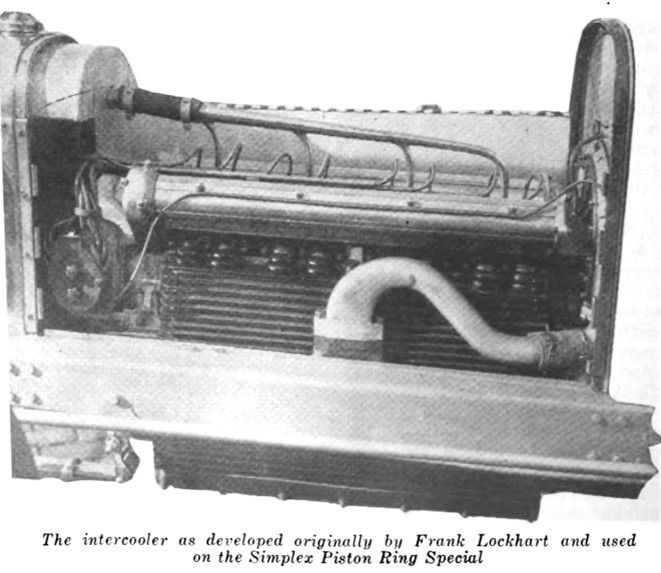
More than a year ago Frank Lockhart developed a successful intercooling-type of intake manifold. This manifold will again be used on the Simplex Piston Ring Special which Ray Keech, holder of the world’s speed record, is driving. As is common practice the carburetor is mounted under the cowl on the back of the supercharger. The mixture from the supercharger enters a large-finned intake manifold. This intercooler, as it is called, is an aluminum casting with a maximum of surface.
Another feature of this car is the use of Simplex Piston Rings which, according to Fred Ferguson, has resulted in the engine turning up 400 r.p.m’s. more than ever before. This is one of the cars purchased from the Lockhart estate. The other one is the Stutz Special with Anthony Gulotta at the wheel. It is practically identical with the car Keech is driving except for the rings, which are Perfect Circles.
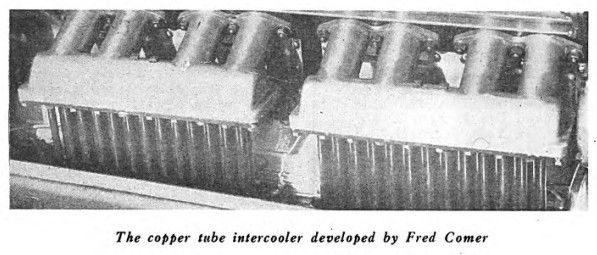
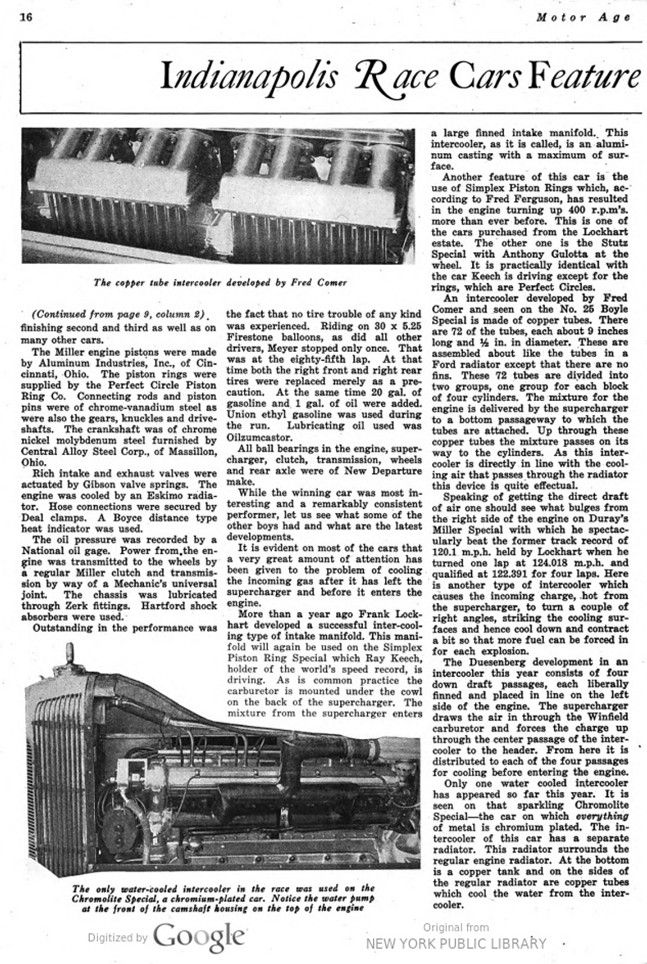
An intercooler developed by Fred Comer and seen on the No. 25 Boyle Special is made of copper tubes. There are 72 of the tubes, each about 9 inches long and ½ in. in diameter. These are assembled about like the tubes in a Ford radiator except that there are no fins. These 72 tubes are divided into two groups, one group for each block of four cylinders. The mixture for the engine is delivered by the supercharger to a bottom passageway to which the tubes are attached. Up through these copper tubes the mixture passes on its way to the cylinders. As this intercooler is directly in line with the cooling air that passes through the radiator this device is quite effectual.
Speaking of getting the direct draft of air one should see what bulges from the right side of the engine on Duray’s Miller Special with which he spectacularly beat the former track record of 120.1 m.p.h. held by Lockhart when he turned one lap at 124.018 m.p.h. and qualified at 122.391 for four laps. Here is another type of intercooler which causes the incoming charge, hot from the supercharger, to turn a couple of right angles, striking the cooling surfaces and hence cool down and contract a bit so that more fuel can be forced in for each explosion.
The Duesenberg development in an intercooler this year consists of four down draft passages, each liberally finned and placed in line on the left side of the engine. The supercharger draws the air in through the Winfield carburetor and forces the charge up through the center passage of the inter- cooler to the header. From here it is distributed to each of the four passages for cooling before entering the engine.
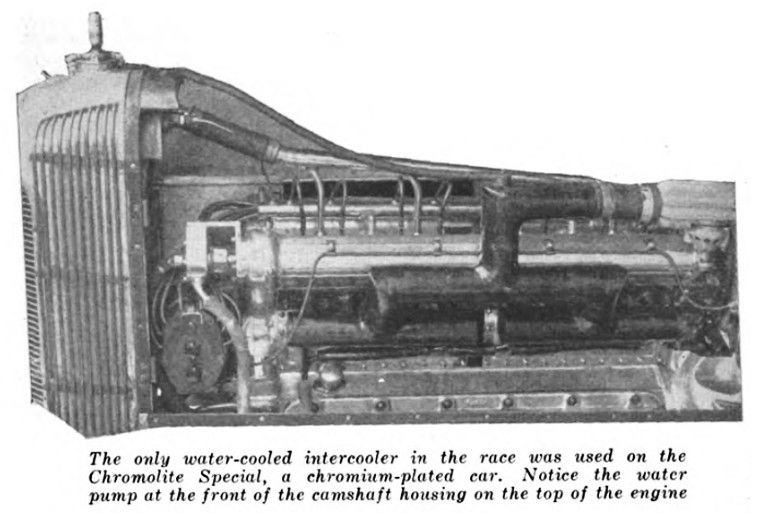
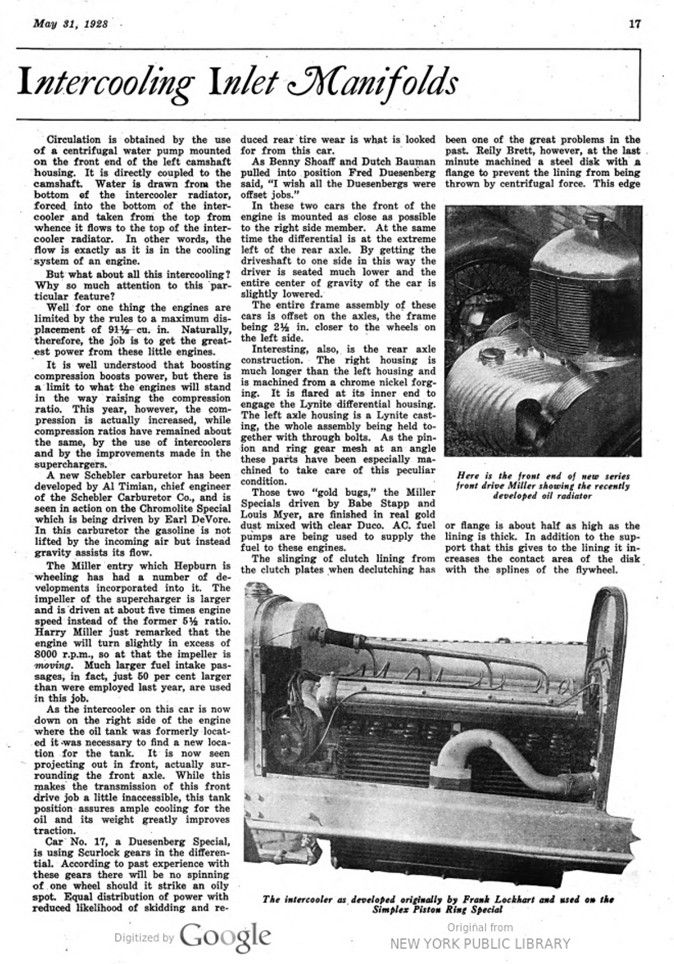
Only one water cooled intercooler has appeared so far this year. It is seen on that sparkling Chromolite Special – the car on which everything of metal is chromium plated. The intercooler of this car has a separate radiator. This radiator surrounds the regular engine radiator. At the bottom is a copper tank and on the sides of the regular radiator are copper tubes which cool the water from the intercooler.
Circulation is obtained by the use of a centrifugal water pump mounted on the front end of the left camshaft housing. It is directly coupled to the camshaft. Water is drawn from the bottom of the intercooler radiator, forced into the bottom of the intercooler and taken from the top from whence it flows to the top of the intercooler radiator. In other words, the flow is exactly as it is in the cooling system of an engine.
But what about all this intercooling? Why so much attention to this particular feature?
Well for one thing the engines are limited by the rules to a maximum displacement of 91½ cu. in. Naturally, therefore, the job is to get the greatest power from these little engines.
It is well understood that boosting compression boosts power, but there is a limit to what the engines will stand in the way raising the compression ratio. This year, however, the compression is actually increased, while compression ratios have remained about the same, by the use of intercoolers and by the improvements made in the superchargers.
A new Schebler carburetor has been developed by Al Timian, chief engineer of the Schebler Carburetor Co., and is seen in action on the Chromolite Special which is being driven by Earl DeVore. In this carburetor the gasoline is not lifted by the incoming air but instead gravity assists its flow.
The Miller entry which Hepburn is wheeling has had a number of developments incorporated into it. The impeller of the supercharger is larger and is driven at about five times engine speed instead of the former 5½ ratio. Harry Miller just remarked that the engine will turn slightly in excess of 8000 r.p.m., so at that the impeller is moving. Much larger fuel intake passages, in fact, just 50 per cent larger than were employed last year, are used in this job.
As the intercooler on this car is now down on the right side of the engine where the oil tank was formerly located it was necessary to find a new location for the tank. It is now seen projecting out in front, actually surrounding the front axle. While this makes the transmission of this front drive job a little inaccessible, this tank position assures ample cooling for the oil and its weight greatly improves traction.
Car No. 17, a Duesenberg Special, is using Scurlock gears in the differential. According to past experience with these gears there will be no spinning of one wheel should it strike an oily spot. Equal distribution of power with reduced likelihood of skidding and reduced rear tire wear is what is looked for from this car.
As Benny Shoaff and Dutch Bauman pulled into position Fred Duesenberg said, „I wish all the Duesenbergs were offset jobs.“
In these two cars the front of the engine is mounted as close as possible to the right-side member. At the same time the differential is at the extreme left of the rear axle. By getting the driveshaft to one side in this way the driver is seated much lower and the entire center of gravity of the car is slightly lowered.
The entire frame assembly of these cars is offset on the axles, the frame being 2½ in. closer to the wheels on the left side.
Interesting, also, is the rear axle construction. The right housing is much longer than the left housing and is machined from a chrome nickel forging. It is flared at its inner end to engage the Lynite differential housing. The left axle housing is a Lynite casting, the whole assembly being held together with through bolts. As the pinion and ring gear mesh at an angle these parts have been especially machined to take care of this peculiar condition.
Those two „gold bugs,“ the Miller Specials driven by Babe Stapp and Louis Myer, are finished in real gold dust mixed with clear Duco. AC. fuel pumps are being used to supply the fuel to these engines.
The slinging of clutch lining from the clutch plates when declutching has been one of the great problems in the past. Reily Brett, however, at the last minute machined a steel disk with a flange to prevent the lining from being thrown by centrifugal force. This edge or flange is about half as high as the lining is thick. In addition to the support that this gives to the lining it increases the contact area of the disk with the splines of the flywheel.
Photos.
Page 16 – 17.
The copper tube intercooler developed by Fred Comer
The only water-cooled intercooler in the race was used on the Chromolite Special, a chromium-plated car. Notice the water pump. at the front of the camshaft housing on the top of the engine
Page 17.
Here is the front end of new series front drive Miller showing the recently developed oil radiator
The intercooler as developed originally by Frank Lockhart and used on the Simplex Piston Ring Special