This was the first run of the 1926 A.A.A. season. The race itself showed many leader changes. Leon Duray and Clif Woodbury, the first leader combination had to pit with an overheatedand engine, after 133 rounds. Then it was Jimmy Gleason who led the pack, followed by Tony Gulotta as a new number one. After his failed pitstop in the last part of the race, Louis Meyer finally emerged as the winner. he made only one pitstop for oil and fuel and to change two tyres, very neat and wise!
Text and jpegs by courtesy of hathitrust.org www.hathitrust.org, compiled by motorracinghistory.com
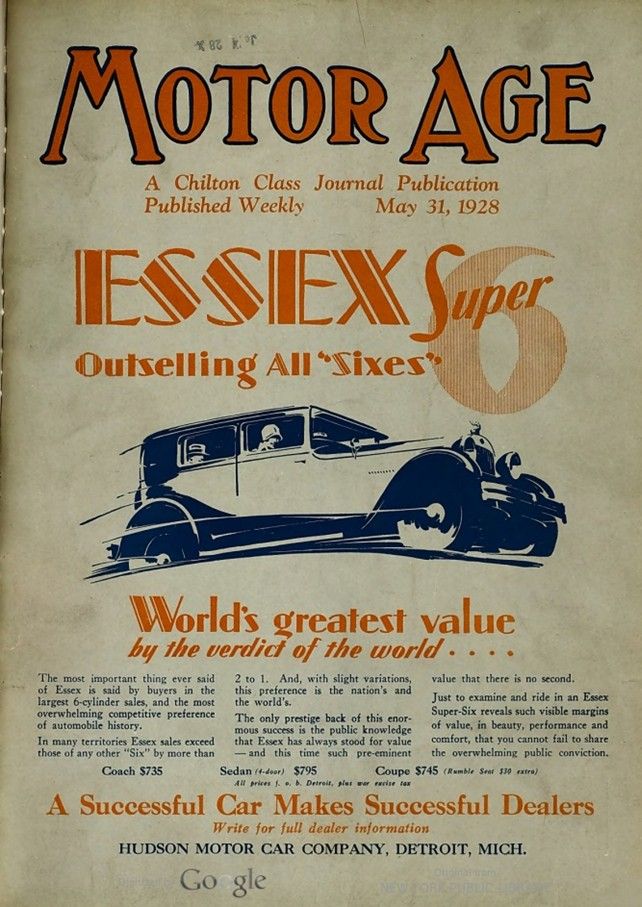
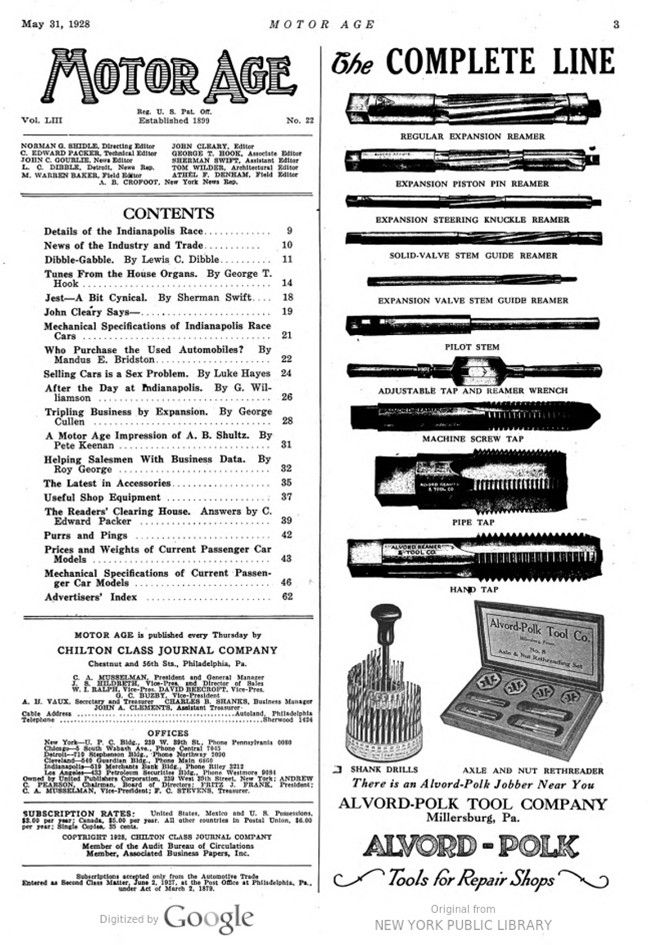
Motor Age, Vol. LIII, 53, No. 22, May 31, 1928
Lou Meyer Wins Indianapolis Race
Dirt Track Star, Relief Driver Year Ago, Sweeps Field in Miller – 23 YEARS OLD
Star Flat Track Driver New to Big Time Breaks 91½ Cu. In. Mark
By Lewis C. Dibble
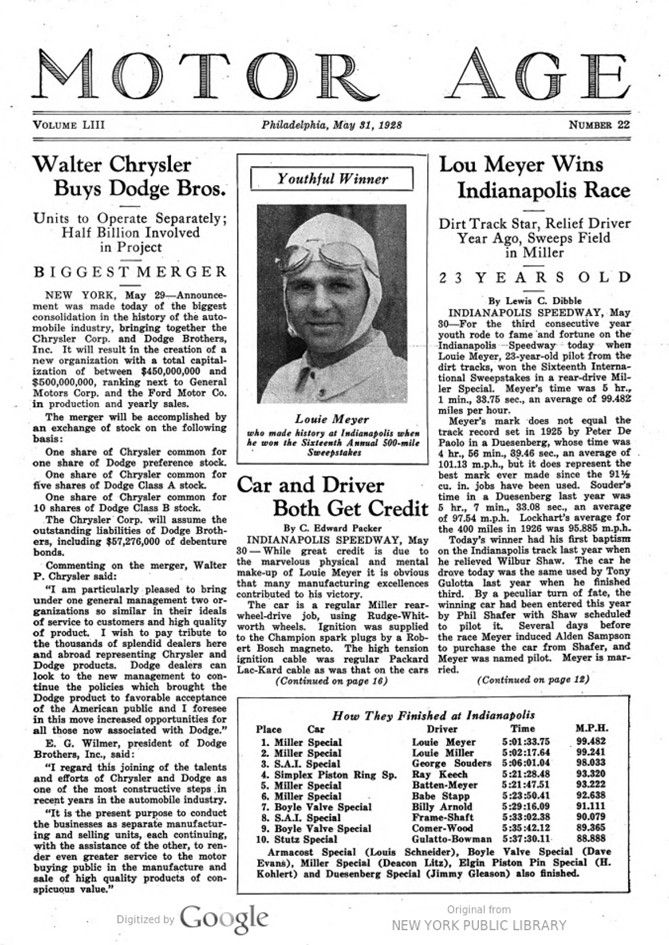
INDIANAPOLIS SPEEDWAY, 30-For the third consecutive year youth rode to fame and fortune on the Indianapolis Speedway today when Louie Meyer, 23-year-old pilot from the dirt tracks, won the Sixteenth International Sweepstakes in a rear-drive Miller Special. Meyer’s time was 5 hr., 1 min., 33.75 sec., an average of 99.482 miles per hour.
Meyer’s mark does not equal the track record set in 1925 by Peter De Paolo in a Duesenberg, whose time was 4 hr., 56 min., 39.46 sec., an average of 101.13 m.p.h., but it does represent the best mark ever made since the 91½ cu. in. jobs have been used. Souder’s time in a Duesenberg last year was Both Get Credit 5 hr., 7 min., 33.08 sec., an average of 97.54 m.p.h. Lockhart’s average for the 400 miles in 1926 was 95.885 m.p.h.
Today’s winner had his first baptism on the Indianapolis track last year when he relieved Wilbur Shaw. The car he drove today was the same used by Tony Gulotta last year when he finished third. By a peculiar turn of fate, the winning car had been entered this year by Phil Shafer with Shaw scheduled to pilot it. Several days before the race Meyer induced Alden Sampson to purchase the car from Shafer, and Meyer was named pilot. Meyer is married.
Star Flat Track Driver New to Big Time Breaks 91½ Cu. In. Mark
The last 50 miles of the race provided the most spectacular upsets of the day. Gulotta’s Stutz, which had been performing beautifully and was leading the field, stalled on the northeast turn with a plugged gasoline line and fell way down the list before mechanics got it running again. Gleason’s Duesenberg next went to the pits and Meyer swept into the lead never to relinquish the position. Meyer’s victory saw him come from ninth place early in the race to first. His driving was not spectacular but represented steady plugging, and the fact that his car made only one trip to the pits for fuel and tires was a determining factor.
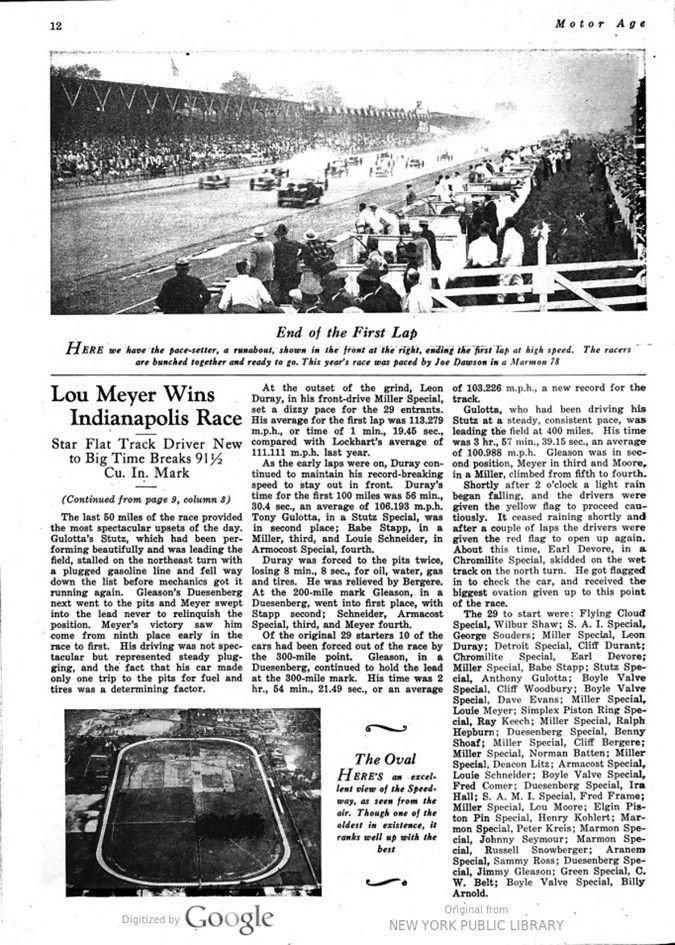
At the outset of the grind, Leon Duray, in his front-drive Miller Special, set a dizzy pace for the 29 entrants. Indianapolis Race His average for the first lap was 113.279 m.p.h., or time of 1 min., 19.45 sec., compared with Lockhart’s average of 111.111 m.p.h. last year.
As the early laps were on, Duray continued to maintain his record-breaking speed to stay out in front. Duray’s time for the first 100 miles was 56 min., 30.4 sec., an average of 106.193 m.p.h. Tony Gulotta, in a Stutz Special, was in second place; Babe Stapp, in a Miller, third, and Louie Schneider, in Armocost Special, fourth.
Duray was forced to the pits twice, losing 8 min., 8 sec., for oil, water, gas and tires. He was relieved by Bergere. At the 200-mile mark Gleason, in a Duesenberg, went into first place, with Stapp second; Schneider, Armacost Special, third, and Meyer fourth.
Of the original 29 starters 10 of the cars had been forced out of the race by the 300-mile point. Gleason, in Duesenberg, continued to hold the lead at the 300-mile mark. His time was 2 hr., 54 min., 21.49 sec., or an average of 103.226 m.p.h., a new record for the track.
Gulotta, who had been driving his Stutz at a steady, consistent pace, was leading the field at 400 miles. His time was 3 hr., 57 min., 39.15 sec., an average of 100.988 m.p.h. Gleason was in second position, Meyer in third and Moore, in a Miller, climbed from fifth to fourth.
Shortly after 2 o’clock a light rain began falling, and the drivers were given the yellow flag to proceed cautiously. It ceased raining shortly and after a couple of laps the drivers were given the red flag to open up again. About this time, Earl Devore, in a Chromilite Special, skidded on the wet track on the north turn. He got flagged in to check the car, and received the biggest ovation given up to this point of the race.
The 29 to start were:
Flying Cloud Special, Wilbur Shaw; S. A. I. Special, George Souders; Miller Special, Leon Duray; Detroit Special, Cliff Durant; Chromilite Special, Earl Devore; Miller Special, Babe Stapp; Stutz Special, Anthony Gulotta; Boyle Valve Special, Cliff Woodbury; Boyle Valve Special, Dave Evans; Miller Special, Louie Meyer; Simplex Piston Ring Special, Ray Keech; Miller Special, Ralph Hepburn; Duesenberg Special, Benny Shoaf; Miller Special, Cliff Bergere; Miller Special, Norman Batten; Miller Special, Deacon Litz; Armacost Special, Louie Schneider; Boyle Valve Special, Fred Comer; Duesenberg Special, Ira Hall; S. A. M. I. Special, Fred Frame; Miller Special, Lou Moore; Elgin Piston Pin Special, Henry Kohlert; Marmon Special, Peter Kreis; Marmon Special, Johnny Seymour; Marmon Special, Russell Snowberger; Aranem Special, Sammy Ross; Duesenberg Special, Jimmy Gleason; Green Special, C. W. Belt; Boyle Valve Special, Billy Arnold.
Page 13
Many Out With Mechanical Ills
Supercharger and Timing Gear Failures Take Heaviest Toll – By M. Warren Baker
INDIANAPOLIS SPEEDWAY, May 30-Mechanical difficulties, some occasioned by wrecks, some by failure of supercharger and timing gear trouble and some apparently as the result of carelessness, caused 14 of the 29 cars entered in the sixteenth annual 500-mile race to drop out before the final lap. Ten were out of the race at the four hundred and seventy-fifth mile.
No. 6, the Chromilite Special driven by Earl Devore, smashed into the south. wall at the one hundred and sixty-second lap and wrecked the gas tank in the tail so seriously the car was unable to complete the route.
Cliff Durant in the Detroit Special, for which Tommy Milton had such high hopes, was forced out on the one hundred and seventy-fourth lap by a supercharger break.
No. 39, the Duesenberg Special which held the lead for many laps and at the four hundredth mile looked like a certain winner, came into the pits for water. A pit crew, anxious to make time, poured a goodly portion of fluid over the magneto.
Supercharger and timing gear troubles had taken the heaviest toll of any of the forms of mechanical difficulties when the three hundred and seventy-fifth mile was reached. By far the greater number of stops were for the purposes of refueling or changing tires.
Marmon No. 34 was the first car out of the race of the 29 that faced the starter. Stripped supercharger gears were responsible. Russell Snowberger was driving.
Cars 18 and 26, driven by Benny Shoaf and Ira Hall respectively, were forced out of the race when they hit Neither driver was injured seriously. Both cars the wall on the south turn. were Duesenberg Specials.
Broken timing gears were responsible for the disappearance of four cars from the field up to this point of the race. Pete DePaolo’s Flying Cloud Special went out on the forty-second lap from this cause after it had been rebuilt in four days, following a crackup during the qualification trials. Wilbur Shaw was driving the car, and it was believed by many that the severe treatment the car received when it skidded an eighth of a mile in the first crackup may have been largely responsible for the mechanical trouble during the race. No. 10, Cliff Woodbury’s Boyle Valve Special, and No. 16, the Miller Special driven by Ralph Hepburn, also were casualties as a result of broken timing gears. No. 10 went out on the fifty- fifth lap and No. 16 on the forty-seventh lap.
No. 38, Sam Ross‘ Aranem Special, also went out on the one hundred and thirty-first lap with broken timing gears.
No. 4, Leon Duray’s Miller Special, which at the opening of the race looked like the best bet of all the contenders, went out on the one hundred and thirty-second lap when his engine became overheated and stuck.
A wrecked transmission caused Cliff Berger in a Miller Special to call it a day on the sixth lap. One of the remaining Marmon entries, No. 32, driven by Pete Kreis, went out on the seventy-second lap with a burned-out connecting rod bearing. This car had been a serious contender for one of the initial three places. Harry Nichols, driving a Green Special, was forced out of the race on the south turn when his car dropped a valve.
Marmon’s No. 33, driven by Johnny Seymour, of motorcycle race fame, stayed in the race until the one hundred and fifty-first lap, when it was forced out by supercharger trouble.
Three cars were wrecked Tuesday afternoon and Wednesday morning. Corum’s Duesenberg, No. 17, wrecked while it was being exercised Dutch early the morning of the race. Baumann’s Duesenberg was wrecked in the same fashion. The B. W. Cooke Special was wrecked Wednesday.
DePaolo, Injured, Sees Race Start From Stretcher
INDIANAPOLIS SPEEDWAY, May 30-Peter DePaolo, plucky little Italian driver and 1925 winner who miraculously escaped death Saturday evening when his Flying Cloud Special turned over in the time trials, was given an ovation when he was carried on a stretcher from an ambulance to witness the start of the race. Despite his injuries Pete appeared in good spirits but soon after the start he was taken back to the hospital.
The real sportsmanship that exists among competitors in the race was demonstrated after DePaolo’s accident. F. E. Moskovics, president of Stutz, offered the facilities of his entire organization to recondition DePaolo’s mount. The car was finally rebuilt in Louis Chevrolet’s shops and qualified shortly before the race with Wilbur Shaw driving. The car went out of the race on the forty-second lap.
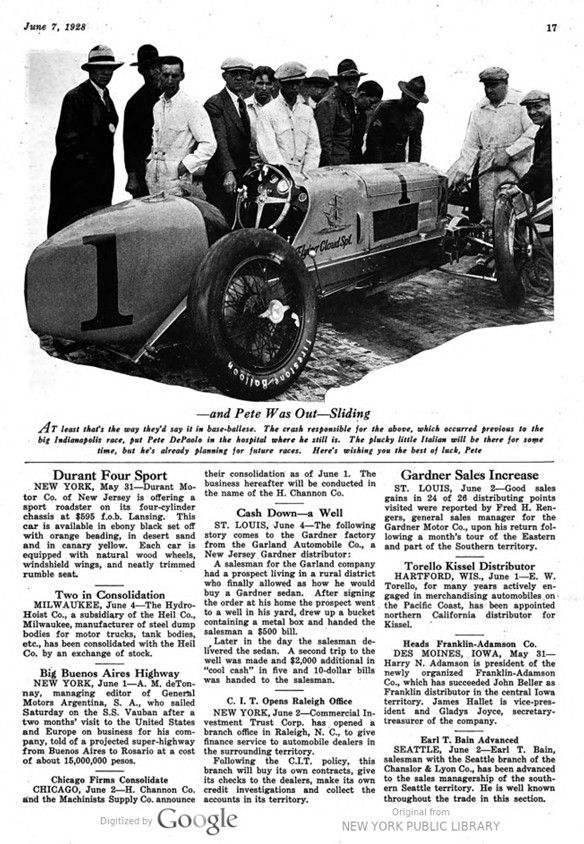
Motor Age, June 7, 1928 page 17. – And Pete Was Out – Sliding
AT least that’s the way they’d say it in base-ballese. The crash responsible for the above, which occurred previous to the big Indianapolis race, put Pete DePaolo in the hospital where he still is. The plucky little Italian will be there for some time, but he’s already planning for future races. Here’s wishing you the best of luck, Pete.
Photos.
Page 9. Youthful Winner – Louie Meyer who made history at Indianapolis when he won the Sixteenth Annual 500-mile Sweepstakes
Page 12. End of the First Lap – HERE we have the pace-setter, a runabout, shown in the front at the right, ending the first lap at high speed. The racers are bunched together and ready to go. This year’s race was paced by Joe Dawson in a Marmon 78
The Oval – HERE’S an excellent view of the Speedway, as seen from the air. Though one of the oldest in existence, it ranks well up with the best
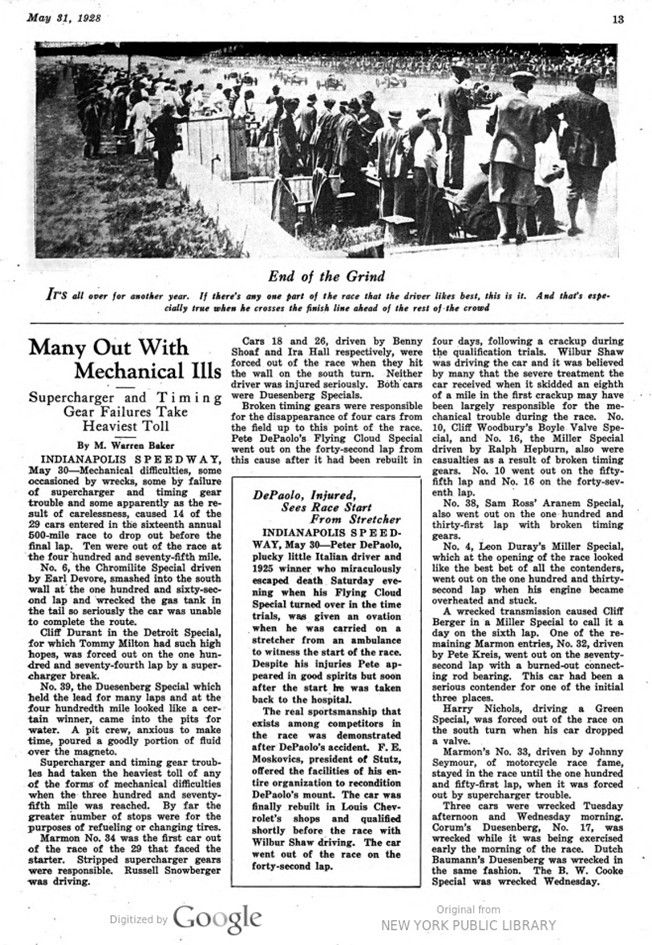
Page 13. End of the Grind – IT’S all over for another year. If there’s any one part of the race that the driver likes best, this is it. And that’s especially true when he crosses the finish line ahead of the rest of the crowd