
In 1926, the British-French manaufacturer Sunbeam-Talbot-Darracq, STD, created a Grand Prix car with 91½ inch engine displacement which was very succesfull in the European Grands Prix. A technical desciption is given here.



Text and jpegs by courtesy of hathitrust.org www.hathitrust.org, compiled by motorracinghistory.com
Motor Age, Vol. XLIV (49), No. 25, June 24, 1926
Novel Features in New Talbot 91/2 Inch Racing Car
French Vehicle Built for Grand Prix Has Offset Engine, Special 10-Inch Girder Frame and Is Only 32 Inches High
By W. L. BRADLEY
OFFICIALLY 1926 marks the adoption of the 91½ inch piston displacement rule in Europe, but minor races for this type of car have been held for the last three years and some European manufacturers already have a lengthy experience of racing cars with an engine of this size.
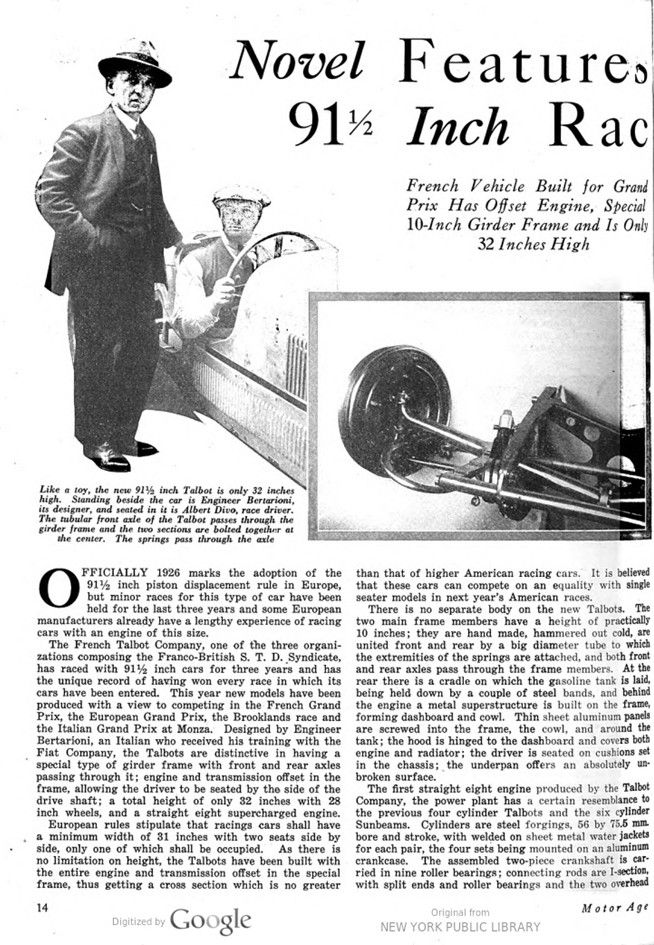
The French Talbot Company, one of the three organizations composing the Franco-British S. T. D. Syndicate, has raced with 91½ inch cars for three years and has the unique record of having won every race in which its cars have been entered. This year new models have been produced with a view to competing in the French Grand Prix, the European Grand Prix, the Brooklands race and the Italian Grand Prix at Monza. Designed by Engineer Bertarioni, an Italian who received his training with the Fiat Company, the Talbots are distinctive in having a special type of girder frame with front and rear axles passing through it; engine and transmission offset in the frame, allowing the driver to be seated by the side of the drive shaft; a total height of only 32 inches with 28 inch wheels, and a straight eight supercharged engine.
European rules stipulate that racings cars shall have a minimum width of 31 inches with two seats side by side, only one of which shall be occupied. As there is no limitation on height, the Talbots have been built with the entire engine and transmission offset in the special frame, thus getting a cross section which is no greater than that of higher American racing cars. It is believed that these cars can compete on an equality with single seater models in next year’s American races.
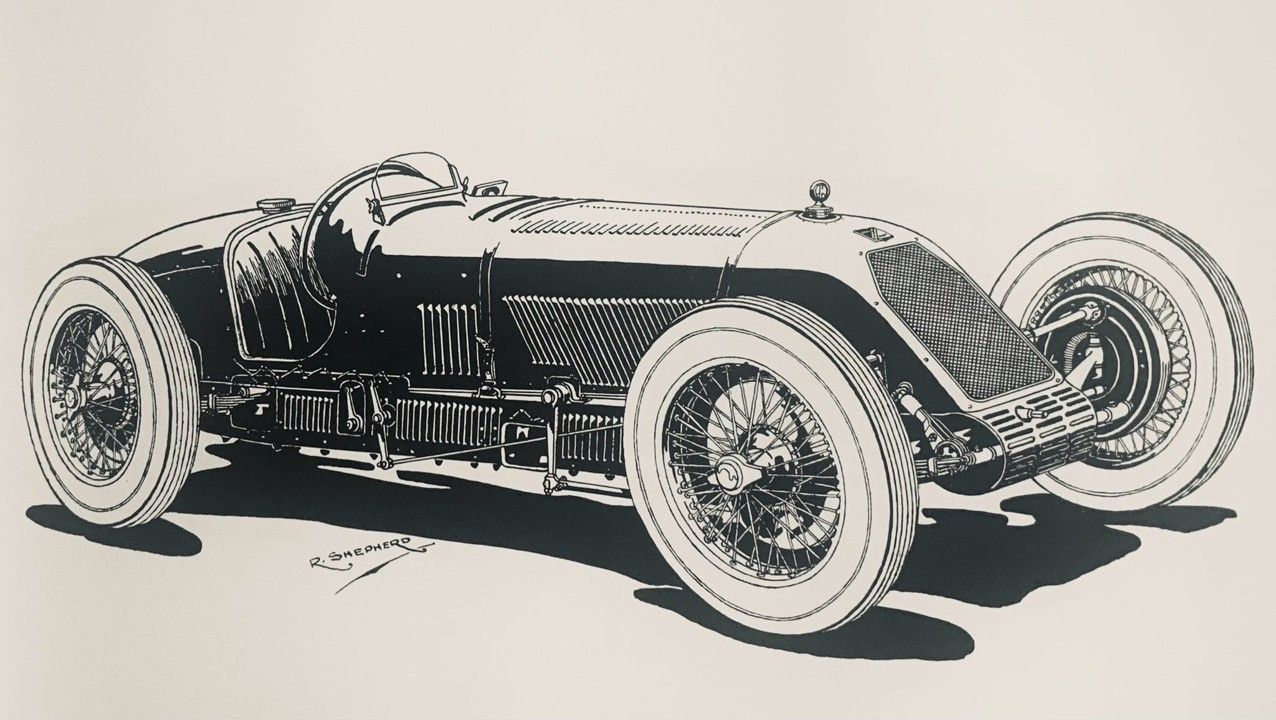
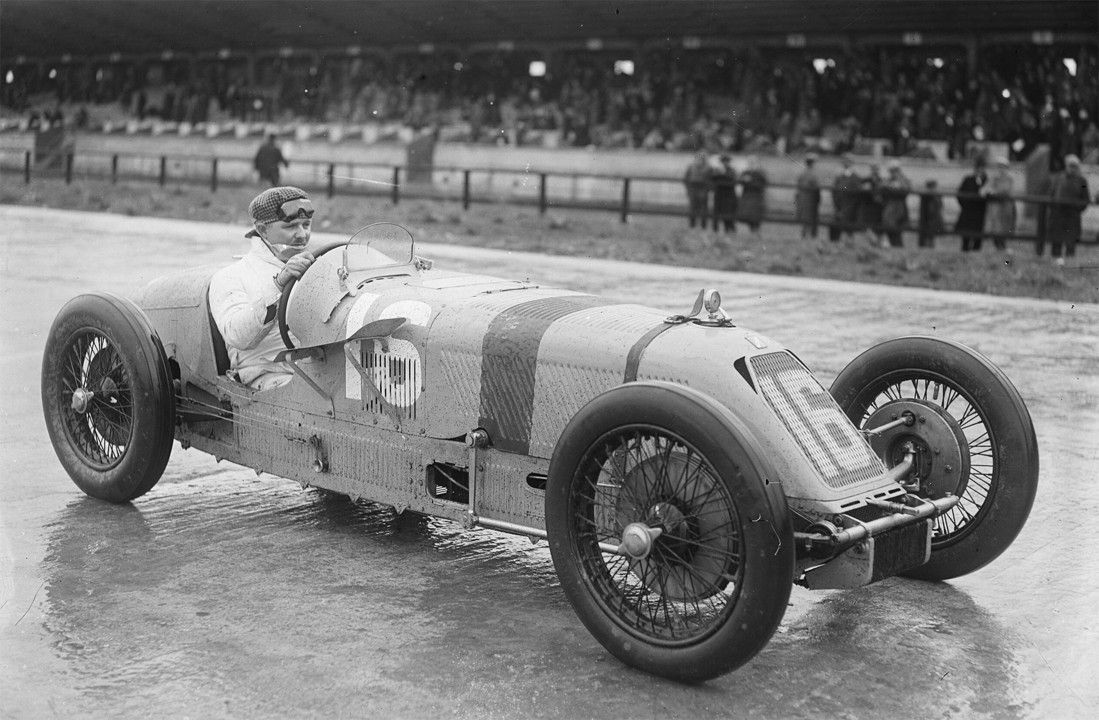
There is no separate body on the new Talbots. The two main frame members have a height of practically 10 inches; they are hand made, hammered out cold, are united front and rear by a big diameter tube to which the extremities of the springs are attached, and both front and rear axles pass through the frame members. At the rear there is a cradle on which the gasoline tank is laid, being held down by a couple of steel bands, and behind the engine a metal superstructure is built on the frame, forming dashboard and cowl. Thin sheet aluminum panels are screwed into the frame, the cowl, and around the tank; the hood is hinged to the dashboard and covers both engine and radiator; the driver is seated on cushions set in the chassis; the underpan offers an absolutely unbroken surface.
The first straight eight engine produced by the Talbot Company, the power plant has a certain resemblance to the previous four cylinder Talbots and the six cylinder Sunbeams. Cylinders are steel forgings, 56 by 75.5 mm. bore and stroke, with welded on sheet metal water jackets for each pair, the four sets being mounted on an aluminum crankcase. The assembled two-piece crankshaft is carried in nine roller bearings; connecting rods are I-section, with split ends and roller bearings and the two overhead camshafts are driven by a chain of spur pinions at the rear. The peak of the power curve is said to be reached at 7,500 revolutions.
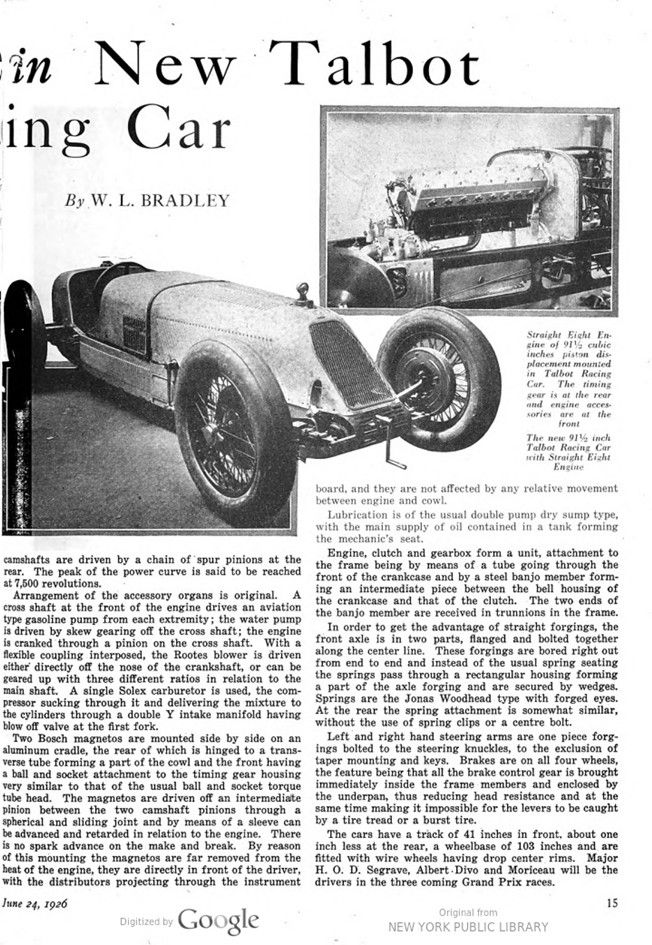
Arrangement of the accessory organs is original. A cross shaft at the front of the engine drives an aviation type gasoline pump from each extremity; the water pump is driven by skew gearing off the cross shaft; the engine is cranked through a pinion on the cross shaft. With a flexible coupling interposed, the Rootes blower is driven either directly off the nose of the crankshaft, or can be geared up with three different ratios in relation to the main shaft. A single Solex carburetor is used, the compressor sucking through it and delivering the mixture to the cylinders through a double Y intake manifold having blow off valve at the first fork.
Two Bosch magnetos are mounted side by side on an aluminum cradle, the rear of which is hinged to a transverse tube forming a part of the cowl and the front having a ball and socket attachment to the timing gear housing very similar to that of the usual ball and socket torque tube head. The magnetos are driven off an intermediate pinion between the two camshaft pinions through a spherical and sliding joint and by means of a sleeve can be advanced and retarded in relation to the engine. There is no spark advance on the make and break. By reason of this mounting the magnetos are far removed from the heat of the engine, they are directly in front of the driver, with the distributors projecting through the instrument board, and they are not affected by any relative movement between engine and cowl.
Lubrication is of the usual double pump dry sump type, with the main supply of oil contained in a tank forming the mechanic’s seat.
Engine, clutch and gearbox form a unit, attachment to the frame being by means of a tube going through the front of the crankcase and by a steel banjo member forming an intermediate piece between the bell housing of the crankcase and that of the clutch. The two ends of the banjo member are received in trunnions in the frame.
In order to get the advantage of straight forgings, the front axle is in two parts, flanged and bolted together along the center line. These forgings are bored right out from end to end and instead of the usual spring seating the springs pass through a rectangular housing forming a part of the axle forging and are secured by wedges. Springs are the Jonas Woodhead type with forged eyes. At the rear the spring attachment is somewhat similar, without the use of spring clips or a centre bolt.
Left and right hand steering arms are one piece forgings bolted to the steering knuckles, to the exclusion of taper mounting and keys. Brakes are on all four wheels, the feature being that all the brake control gear is brought immediately inside the frame members and enclosed by the underpan, thus reducing head resistance and at the same time making it impossible for the levers to be caught by a tire tread or a burst tire.
The cars have a track of 41 inches in front, about one inch less at the rear, a wheelbase of 103 inches and are fitted with wire wheels having drop center rims. Major H. O. D. Segrave, Albert Divo and Moriceau will be the drivers in the three coming Grand Prix races.
Photos.
Page 14.
Like a toy, the new 91½ inch Talbot is only 32 inches high. Standing beside the car is Engineer Bertarioni, its designer, and seated in it is Albert Divo, race driver. The tubular front axle of the Talbot passes through the girder frame and the two sections are bolted together at the center. The springs pass through the axle
Page 15.
Straight Eight Engine of 91½ cubic inches piston displacement mounted in Talbot Racing Car. The timing gear is at the rear and engine accessories are at the front.
The new 91½ inch Talbot Racing Car with Straight Eight Engine