Text and jpegs by courtesy of hathitrust.org www.hathitrust.org, compiled by motorracinghistory.com
Automobile Trade Journal Vol. 29, No. 12, June 1, 1925
Eight-Cylinder Car Probable Indianapolis Race Winner
Since nearly all entries are eights, prophecy of dopster might be correct
COINCIDENTAL with going to press on this issue of the Automobile Trade Journal, there is being groomed at Indianapolis, Ind., the fastest array of ground traversing land vehicles that ever graced the honored bricks of the famous Hoosier speedway. May 30th, Decoration Day, these petted and pampered incubators of future stock car design, will be given 500 miles of exposure to the deadly automotive disease germs of rack, revolutions and vibration. Despite the fact that the lung volume of these special engines is just slightly more than two-thirds that of the popular Ford, it is expected that they will maintain their respiratory functions sufficiently well to propel themselves at an average velocity in excess of 96 m.p.h. for the full period of exposure.
The creations of Fred Duesenberg and Harry Miller, the latter being campaigned under a variety of names, will provide the major competition. There are approximately 12 Miller built cars that can be counted on as starters and four Duesenberg Specials. Forgetting for the moment the dominance of the human element, the driver, in these competitions, it probably will settle down to a contest wherein the merits of different supercharger layouts, engine valves and tires will decide the winner. Fred Duesenberg has been successful with a mechanically driven blower unit, and Harry Miller has faith in his method of supercharger propulsion which consists of a similar unit mounted above and driven by the camshaft.
On the Duesenberg cars the blower is placed at the side of the engine between the inlet manifold and the carburetor. This circuit, which is the opposite of that used on most of the foreign race cars, eliminates the necessity of balancing the difference in pressure between the float chamber and that existing above the carburetor throttle.
Engine valves of special and different alloys and designs will be used. The effects of heat, of the constant hammering of a camshaft revolving at 2500 rev., impose duties on these vital parts that seldom are encountered in stock car service.
Tires are much better than three years ago, but the terrific centrifugal force imposed on the carcass structure due to the high car speeds is responsible for their occasional failure. Where in former years tires bursted due to the heat generated by their internal friction, they now fly apart from the forces tending to pull the cords from the bead. The remains of a bursted modern cord racing tire do not show the pieces of melted and semi-melted rubber that characterized a blown tire in the days of fabric shoes.
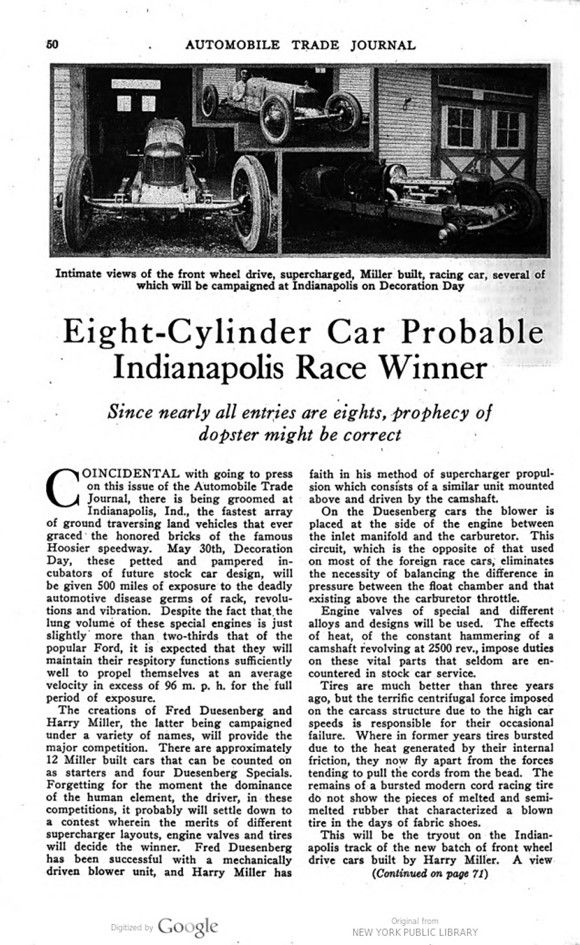
This will be the tryout on the Indianapolis track of the new batch of front wheel drive cars built by Harry Miller. A view of one of these cars is shown on Page 50. It is believed that the 2½ mile course with its short turns and treacherous approaches will afford an ideal testing ground for these jobs. They are much lower than the regular models and are noticeable by their raked or swept back front axles and the dropped end of the rear axle. The drop of approximately 3½ in. is secured by mounting the rear wheels on an extension plate bolted to the rear axle tube. The hub center line of the rear wheels is thus placed above the center line of the rear axle housing.
The transmission is located ahead of the engine and between it and the front axle. The engine power is transmitted to the front wheels by short drive shafts parallel to the axle. These drive shafts are equipped with fabric universal joints to compensate for steering and vertical misalignment caused from chassis spring movement. The chassis springs are of a type new on racing cars, being of the double quarter elliptic type, one mounted above the other. The details of the front end transmission have not as yet been divulged and it is said that many of the features are awaiting patent claim confirmation before being announced. If the front drive lives up to expectations it will be incorporated in the 91½ cubic inch race cars now under test at the plant in Los Angeles.
By the time this issue has reached subscribers, the race will have been history, but it will be interesting to compare the prophecy of the rail bird with the happened facts as they will be recorded in the daily papers of June first. Hartz, Milton, Hill, Cooper, on Miller-built products and De Paolo of the Duesenberg team are considered the out- standing favorites. This leaves such stars as Ralph De Palma, with a Miller, Pietro Bordino driving a Fiat, Corum, Comer, and Frank Elliot, on Millers, Phil Shafer on a Duesenberg, and Antonio Mourre, mount un- named at present, unaccounted for.
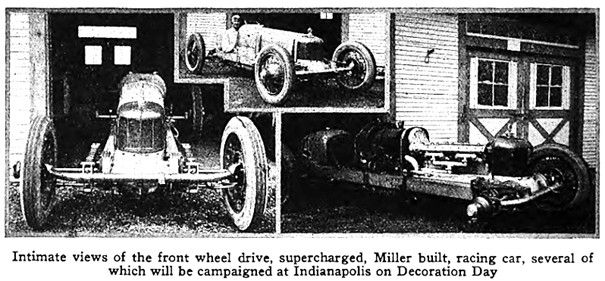
Photos. Page 50. Intimate views of the front wheel drive, supercharged, Miller built, racing car, several of which will be campaigned at Indianapolis on Decoration Day