

Aleady in the beginning of 1929, ideas were established, on how the Indianapolis racing rules could be changed for the next years, starting with the 1930 Indianapolis 500. This rather lengthy article points out the basics. Whether the Indianapolis Race would be improved from that year on, I leave that to another chapter. In our view, however, 1929 to 1929 eventually may be considered as the „Golden Era of Indianapolis“.







Text and jpegs by courtesy of hathitrust.org www.hathitrust.org, compiled by motorracinghistory.com
MoToR, Vol. LI, 51, No. 3, March 1929
The Racing Car of 1930
Indianapolis Discards 911 Cubic-Inch Engine in Favor of 366 Cubic-Inch Un-supercharged Motor for 1930 Classic
By Harold F. Blanchard Technical Editor of MOTOR
EARLY AUTOMOBILES HAD SLOW SPEED ENGINES:
the maximum was about 1000 R.P.M. The constant demand for greater power was met by more cylinders of increased size, while racing cars had unlimited displacement, sometimes 2000 cubic inches.
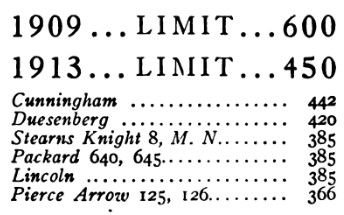
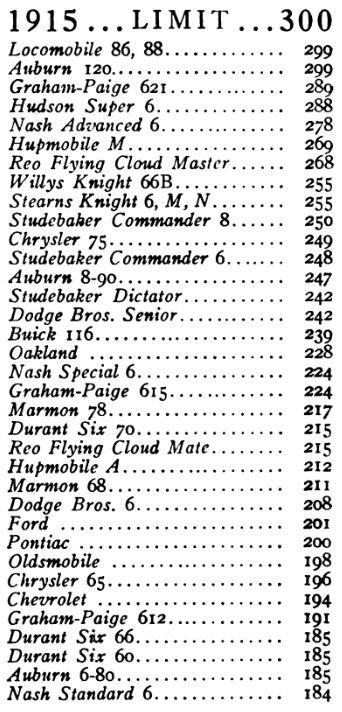
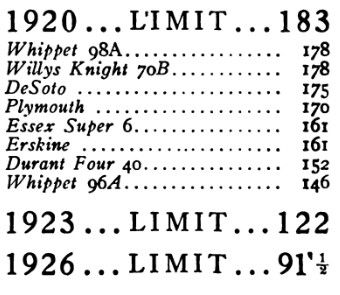
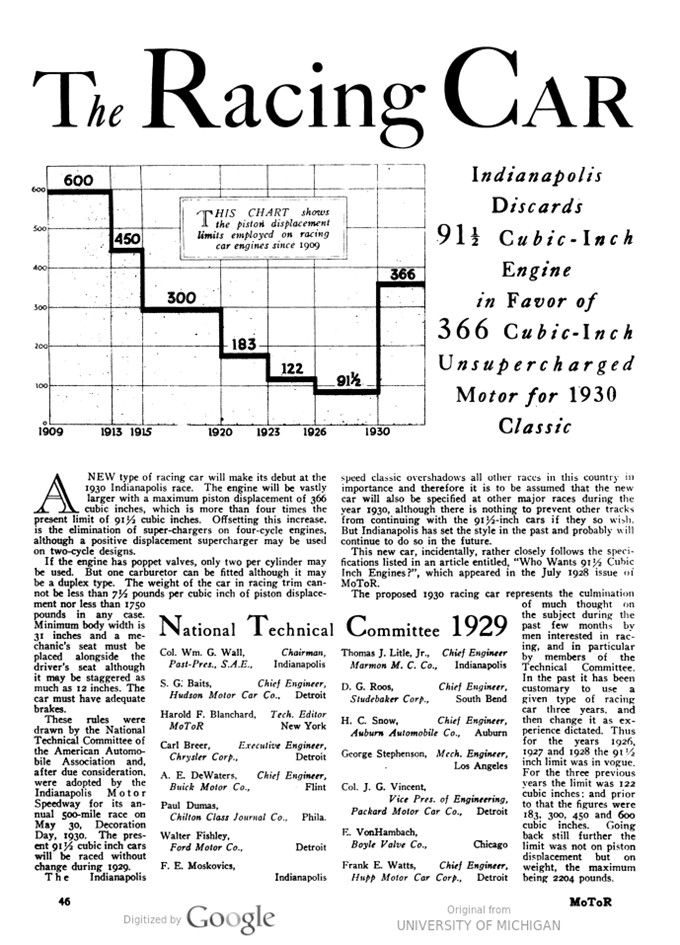
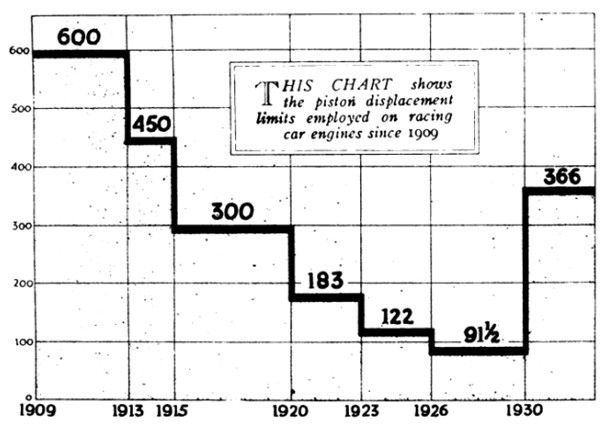
Then dawned a new era. Someone suggested the piston displacement of racing engines be reduced to secure greater power with lessened bulk. Thereupon the limit in this country was set at 600 inches in 1909, reduced to 450 in 1913, to 300 in 1915, to 183 in 1920, to 122 in 1923, to 91½ in 1926.
With each reduction, larger power was obtained by more efficient design plus higher engine speed. The lessons learned were quickly applied to passenger cars until experience proved that 3000 to 4000 revolutions per minute was the practical maximum. The industry halted here, while racing engines became still smaller and speeds increased to 7000 or 8000.
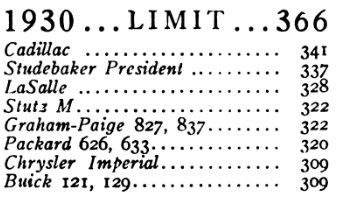
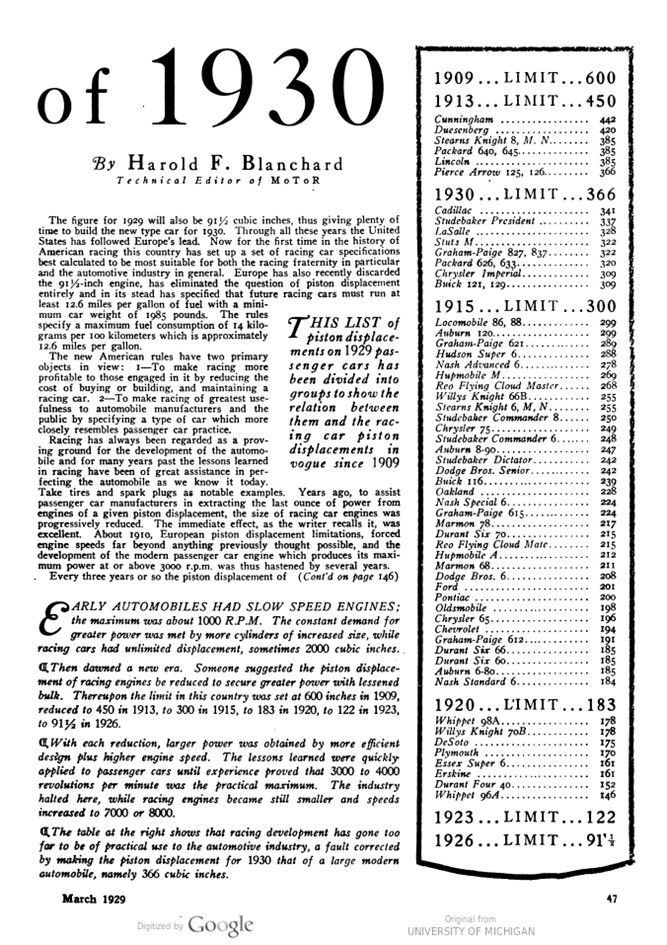
The table at the right shows that racing development has gone too far to be of practical use to the automotive industry, a fault corrected by making the piston displacement for 1930 that of a large modern automobile, namely 366 cubic inches.
A NEW type of racing car will make its debut at the 1930 Indianapolis race. The engine will be vastly larger with a maximum piston displacement of 366 cubic inches, which is more than four times the present limit of 91½ cubic inches. Offsetting this increase, is the elimination of super-chargers on four-cycle engines, although a positive displacement supercharger may be used on two-cycle designs.
If the engine has poppet valves, only two per cylinder may be used. But one carburetor can be fitted although it may be a duplex type. The weight of the car in racing trim cannot be less than 7½ pounds per cubic inch of piston displacement nor less than 1750 pounds in any case. Minimum body width is 31 inches and a mechanic’s seat must be placed alongside the driver’s seat although it may be staggered as much as 12 inches. The car must have adequate brakes.
These rules were drawn by the National Technical Committee of the American Automobile Association and, after due consideration, were adopted by the Indianapolis Motor Speedway for its annual 500-mile race on May 30, Decoration Day, 1930. The present 91½ cubic inch cars will be raced without change during 1929.
The Indianapolis speed classic overshadows all other races in this country in importance and therefore it is to be assumed that the new car will also be specified at other major races during the year 1930, although there is nothing to prevent other tracks from continuing with the 912-inch cars if they so wish. But Indianapolis has set the style in the past and probably will continue to do so in the future.
This new car, incidentally, rather closely follows the specifications listed in an article entitled, „Who Wants 91½ Cubic Inch Engines?“, which appeared in the July 1928 issue of MOTOR.
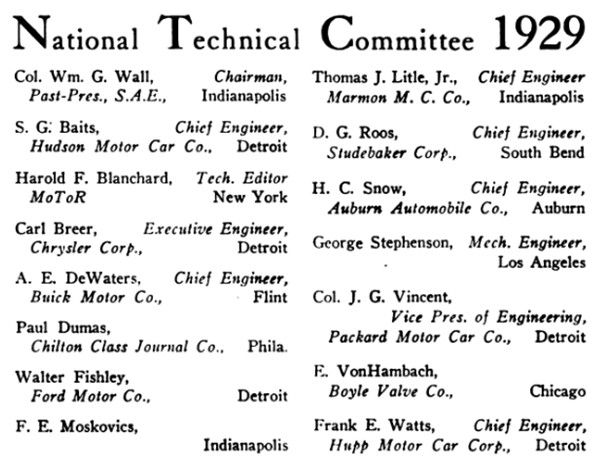
The proposed 1930 racing car represents the culmination of much thought on the subject during the past few months by men interested in racing, and in particular by members of the Technical Committee. In the past it has been customary to use a given type of racing car three years, and then change it as experience dictated. Thus for the years 1926, 1927 and 1928 the 9½ inch limit was in vogue. For the three previous years the limit was 122 cubic inches; and prior to that the figures were 183, 300, 450 and 600 cubic inches. Going back still further the limit was not on piston displacement but on weight, the maximum being 2204 pounds.
The figure for 1929 will also be 91½ cubic inches, thus giving plenty of time to build the new type car for 1930. Through all these years the United States has followed Europe’s lead. Now for the first time in the history of American racing this country has set up a set of racing car specifications best calculated to be most suitable for both the racing fraternity in particular and the automotive industry in general. Europe has also recently discarded the 91½-inch engine, has eliminated the question of piston displacement entirely and in its stead has specified that future racing cars must run at least 12.6 miles per gallon of fuel with a minimum car weight of 1985 pounds. The rules specify a maximum fuel consumption of 14 kilograms per 100 kilometers which is approximately 12.6 miles per gallon.
The new American rules have two primary objects in view:
1 – To make racing more profitable to those engaged in it by reducing the cost of buying or building and maintaining a racing car.
2 – To make racing of greatest usefulness to automobile manufacturers and the public by specifying a type of car which more closely resembles passenger car practice.
Racing has always been regarded as a proving ground for the development of the automobile and for many years past the lessons learned in racing have been of great assistance in perfecting the automobile as we know it today. Take tires and spark plugs as notable examples. Years ago, to assist passenger car manufacturers in extracting the last ounce of power from engines of a given piston displacement, the size of racing car engines was progressively reduced. The immediate effect, as the writer recalls it, was excellent. About 1910, European piston displacement limitations, forced engine speeds far beyond anything previously thought possible, and the development of the modern passenger car engine which produces its maximum power at or above 3000 r.p.m. was thus hastened by several years.
Every three years or so the piston displacement of racing cars was reduced both here and abroad and each time engine speeds were increased. Superchargers became popular when the 912-inch limit came into use. In consequence of these factors, the modern racing car engine is forced to run at speeds ranging from 6500 to 8000 revolutions per minute. Perhaps a time may come when it will be practical to use such high-speed engines in passenger cars but if so there is no indication now.
ENGINES running at double the speed of current passenger car designs are too special to be of much interest to automotive engineers and automobile manufacturers. The supercharger, at least in its present state, is of small use to the automotive industry, particularly the high-speed, delicate types used on American racing cars.
The long and short of it is that the modern 91½-inch job has grown so far away from conventional passenger car design that today’s racing car is of slight practical interest to the automotive industry.
Then, too, these super-high-speed engines are very expensive to build, need frequent overhauling, and when something breaks it costs a lot of money to buy a new part and put it in. The unreliability of these cars in races, particularly the longer races, is an unsatisfactory feature both from the standpoint of those engaged in racing and those watching a race. It’s no fun to have the favorite retire five miles from the finish because some small engine part broke because of the excessively high engine speed.
There are so few major races in this country at the present time, and the total prize money is frankly such a relatively small sum, that it is impossible for more than a handful of the leaders each year to make a living at it. A change in racing car specifications will not increase the amount of prize money but if it does reduce the cost of racing cars and their maintenance the net profit will be greater.
The Technical Committee therefore had a two-fold problem to solve:
1-To make racing of more value to automobile manufacturers.
2-To make racing more profitable to those engaged in it by reducing the upkeep.
It was generally agreed that both aims might be realized by setting up rules which would make it desirable to build future racing cars out of production units, and in fact there is nothing in the new rules to prevent a man racing a stock car, although of course it would have to be properly tuned up and fitted with a racing body of low wind resistance.
At this date it is not easy to say just how the rules will be applied by those who build racing cars for 1930 but it is instructive to speculate how the new rules may work out. For example:
A COMPETENT racing mechanic, in partnership with some driver, will select a promising production engine. He will take it apart and tune it up as S. Dick Woods suggested in the January 1929 issue of MoTOR, page 289. Certain changes which his racing experience dictate will be made. All reciprocating parts, of course will be carefully balanced. Quite likely he will put in a new camshaft with greater lift and perhaps with different timing. He will put on a larger carburetor of racing design. He may devise a new intake manifold. The compression will be raised. In such fashion he will go over the whole engine.
He will probably buy a stock clutch and transmission and use them with very few changes. He may use stock axles and steering but more likely will employ special units.
Possibly he will build a special frame but more likely he will shorten a stock frame or perhaps use the frame as is.
A well-streamlined racing body will be made.
There is, however, nothing to prevent him from designing and building an out-and-out racing car starting from the ground up. But it is believed that he will find production units sufficiently satisfactory so that the far greater expense involved in special designs will be hardly worthwhile.
The rules also have been purposely drawn so as to permit the racing of a modified stock chassis. That is, a regular production car can compete although in such a case it is to be expected that in order to secure adequate speed a racing body would be fitted, and the engine modified in the manner already mentioned.
However, the rules do not permit any car to resemble the product of any American automobile manufacturer unless by the consent of the manufacturer involved. This means that a Buick, for example, entered without the manufacturer’s permission, must have all distinguishing marks eliminated. A new radiator, hood and body must be installed, hub cap identifications removed, etc., and it could not be called a Buick.
The new cars are likely to be much faster than the old in spite of the fact that one of the original aims in developing the new type car was to cut down the maximum speed because the present cars are too fast to be adequately controlled.
It is quite probable that in a race of any length, the factor limiting the maximum speed will not be the power of the engine but the ability of the tires to stand up under the increased weight. The 9½-inch cars weigh about 1500 pounds while the new type may weigh 2750 pounds or more.
TIRE manufacturers may be able to produce racing tires to carry this greater weight but if not, medium weight cars of medium piston displacement may prove the most desirable. In short, for this and other reasons, some experts believe that the best 1930 cars may have a piston displacement of about 250 inches rather than the full maximum of 366.
Originally it was intended that the piston displacement be limited to 300 cubic inches. Then somebody on the committee pointed out that this limit should be raised somewhat to permit the use of some of the larger eights such as Packard and Cadillac. Then a second man suggested that „while we were at it the limit should be raised to 6 litres since the litre is the measure of piston displacement in Europe. This idea was adopted and so the piston displacement became 366.14 cubic inches.
There was much discussion among the members of the committee as to whether poppet valve engines should be limited to two valves, or whether the valve question should be left open. Those in favor of only two valves argued that there was little incentive to go to the extra expense of an overhead camshaft in two-valve engines, and for that matter Stutz already has this feature. Whereas if three or four valves were allowed, the first man to spend the money for two overhead camshafts would have the fastest car and the others would be forced to follow.
On the other hand, proponents of three or four valves argued that a two-valve limitation was unduly restricting development, that two valves would make engines of twelve- or sixteen-cylinders desirable since two valves in a small cylinder are much more effective than two valves in a large cylinder. The use of two valves would eliminate some of the fastest foreign semi-stock cars having three or four valves. Finally, was it logical to restrict poppet valves to two per cylinder and to place no restriction on all other valve types?
The decision for two valves, however, was eventually made on a basis of expediency. The majority finally took the view that manufacturers would be more likely to assist racing if the two-valve restriction were maintained, and also it seemed that the grooming of stock engines would be rendered less expensive.
THE supercharger was eliminated because of its expensiveness, its unreliability, and because it was felt that automobile manufacturers would be more greatly interested in racing if the device were removed.
It should be noted, however, that these rules are only effective for 1930, and may be modified in 1931. In short, more than two valves per cylinder may be desirable at some later date. Similarly, it is likely that sooner or later the supercharger will come back. But for the present at least it was believed that the industry would prefer to see further improvement in un-supercharged engines.
One carburetor was specified because maximum power in an un-supercharged engine is secured when there is a carburetor for each cylinder. This would be just as troublesome and expensive as the supercharger and of even less interest to the industry. After some discussion as to how many carburetors should be allowed it was decided to permit only one – it may be a duplex type with a single float chamber.
There is no restriction on wheelbase. Because of the larger, longer engines wheelbases of 110 or 120 inches are required in order to properly balance the engine in the chassis -it does not do to have a heavy engine too far forward. While it used to be believed that long wheelbases were dangerous and unwieldly, both Fred Duesenberg and Wade Morton of Auburn, who has had considerable experience driving passenger cars at speeds in excess of 100 miles per hour, felt that there was no good reason for limiting the maximum wheelbase. In speedway driving, at least, they say, cars of 130- or 140-inch wheelbases handle much more satisfactorily than the little 100-inch wheelbase jobs used today.
THE minimum weight has been placed at 7½ pounds per cubic inch of piston displacement but cannot be less than 1750 pounds. The minimum permits the racing of all pro- duction chasses now on the American market as is, provided the piston displacement is less than 366 cubic inches. The principal object of the minimum weight provision is to remove the temptation of cutting down the weight to a point where parts are seriously weakened.
The minimum body width of 31 inches and the provision for a mechanic’s seat has several advantages. It enables a racing car to be marketed to the public with a minimum of change; it permits the entry of semi-stock foreign cars all of which carry a mechanic; and it enables new racing drivers to be properly trained.
A minimum tread of 54 inches is specified for safety. The narrower the tread the less the wind resistance and the faster the car but it would be unwise to allow racing car constructors to reduce the tread to a point where the car would be unstable. The maximum tread is 60 inches.
Adequate brakes are specified. The specifications say: „Two independently operated systems of brakes will be required on every car. The secondary system must not be vulnerable to any failure of the primary system. The primary system must operate effectively on all four wheels and be capable of continued use without failure and of arresting the car within reasonable limits. A standard test as to braking effectiveness will be devised by the Indianapolis Race Committee. The secondary system need be effective on but two wheels and must be capable of arresting the car from a hundred-mile-an-hour speed not less than five times in succession without failure. A detailed test for both effectiveness and for repeated operation will be laid down by the Indianapolis Race Committee.
Offhand it may seem unfair to owners of expensive 9½-inch cars to put these new rules into effect, particularly at a time when there isn’t much profit in racing anyhow. But there are several things to be said on the other side of the question. In the past it has been customary to change the limitations every 3 years, but the 912-inch jobs will have had 4 years. These little cars should be pretty well worn out by 1930, and if not, there are still numerous secondary races. Finally, it is emphasized, that one of the reasons for changing the limits every three years or so, is to bring out a crop of new cars, feeling that for speedway racing, at least, cars should not be used too long because of safety.
IT is hoped that with these new rules a number of automobile manufacturers will once more support racing actively. One nice feature of the situation is that a manufacturer may build a set of cars and race them incognito. If he wins he may announce the fact. Definite steps have been taken by the governing body to prevent the selling of racing car names.
THIS LIST of piston displacements on 1929 passenger cars has been divided into groups to show the relation between them and the racing car piston displacements in vogue since 1909