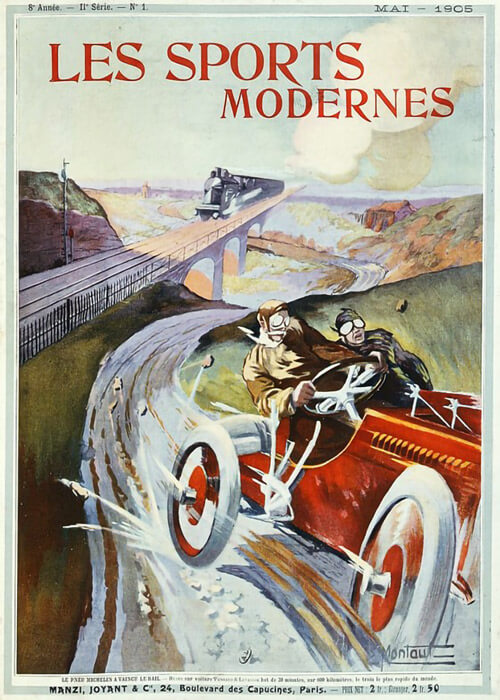
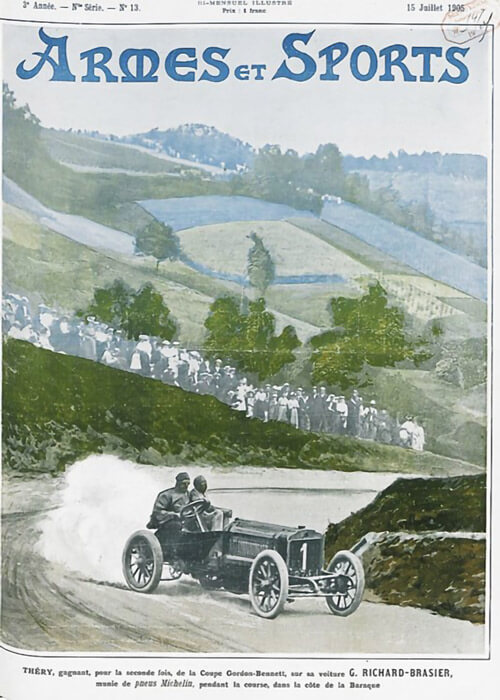
This July 1903 article, finalizing The Automobile series of the 1903 Ireland Gordon Bennett Cup Race, comprises not only the complete race of seven rounds, but also gives an impression of some of the preparations for the cup race, such as the unloading of the cars. A very long read, confirming most of those day’s reports of long, long writing at large events. In those days, words seemed to be more important than images; quite a different culture than today.
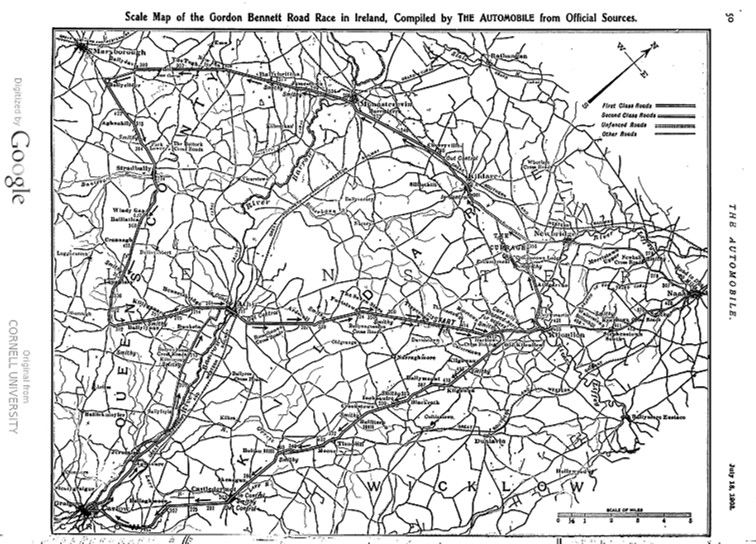
Text and photos with courtesy of hathitrust hathitrust.org, compiled by motorracingistory.com.
THE AUTOMOBILE – Vol. 9, No. 3, July 18, 1903
Narrative of the International Cup Contest.
Complete Reports of the Gordon Bennett Race and Scenes and Incidents on Irish Soil, with Photographs of the Contestants before Starting and during the Contest. SPECIALLY REPORTED BY EDWARD KENEALY.
DUBLIN, July 3. – At the close of the Gordon Bennett race it was almost certain that the trophy would go to Germany, although no official confirmation of this was possible until all of the figures had been carefully worked out. Second place was claimed by friends of both M. de Knyff and M. Farman. The French team play was. the best of the day. They were the only competitors, all of whose cars finished.
The English team had bad luck Edge did not do nearly as well as his car should have done, for it made the first circuit in cup winning time. Jarrott, the second English competitor, had a wreck through taking a curve at too high speed, and Stocks got into trouble also and was compelled to withdraw.
The American cars were very unfortunate. Mr. Winton was unable to start until forty minutes after schedule time. His car was not in racing trim. Mooers made a round in 3:11: 10, but subsequently had to withdraw owing to tire troubles. Percy Owen staid in the race for a while, but the time on his third lap was 5:9: 24. The departure for the scene of the start was an early one. People in Kilcullen got up before they went to bed, as an Irishman expressed it. From Dublin there was a stream of arrivals by car, foot and bicycle throughout the night.
Weather conditions were ideal. There was no bright sunlight, and it was not too hot. The Automobile Club rendezvous at Ballyshannon House gave comfortable accommodation to the motorists who swarmed in dusty but cheerful and stalled their vehicles in the charming grounds.
The racing cars were of course early in line just south of the grand stand. The racers had turned in early the night before, and they looked fresh and eager.
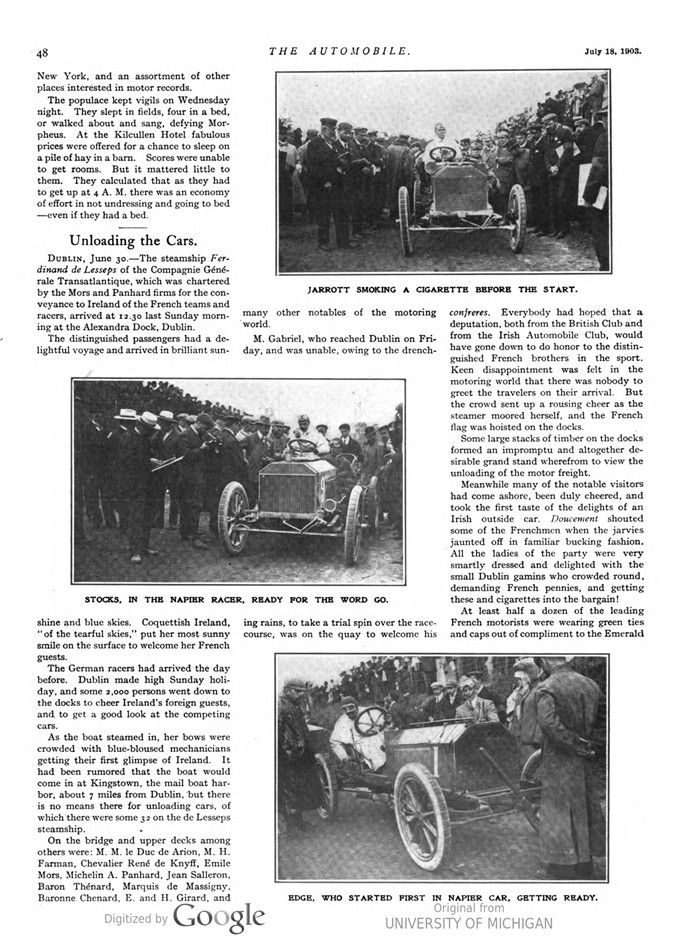
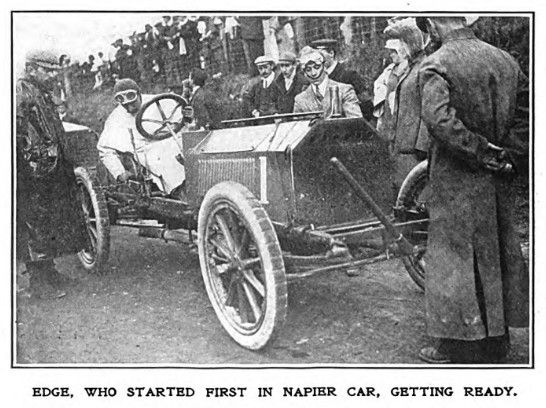
Edge, holder of the Cup, was at the head of the line. He wore a green cloth cap and a white mackintosh. With him in his Napier car was his cousin, Cecil Edge. The starter, Major Lindsay Lloyd, put him on the line, carefully seeing that the car was not even an inch too near the finish or an inch too far from it. There were cheers as Mr. Edge took his seat. Mr. Napier, the builder of the car, and Mr. Jarrott, who was to drive and try to beat him, stood by the car and cordially shook the hand of the first starter, just before he flew up the road and vanished in a cloud of dust.
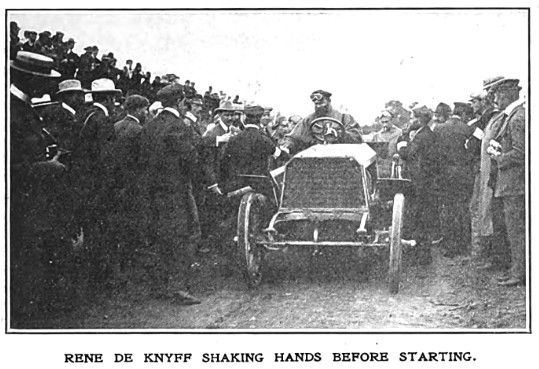
The second to face the starter was the Chevalier René de Knyff, the French driver, on his Panhard. He wears a brown beard and has a most good-humored smile. The French adherents gesticulated vivaciously as he started, and there were cries of Vive perhaps meant for Vive la France, but the last two words were drowned by the noise of the exhaust.
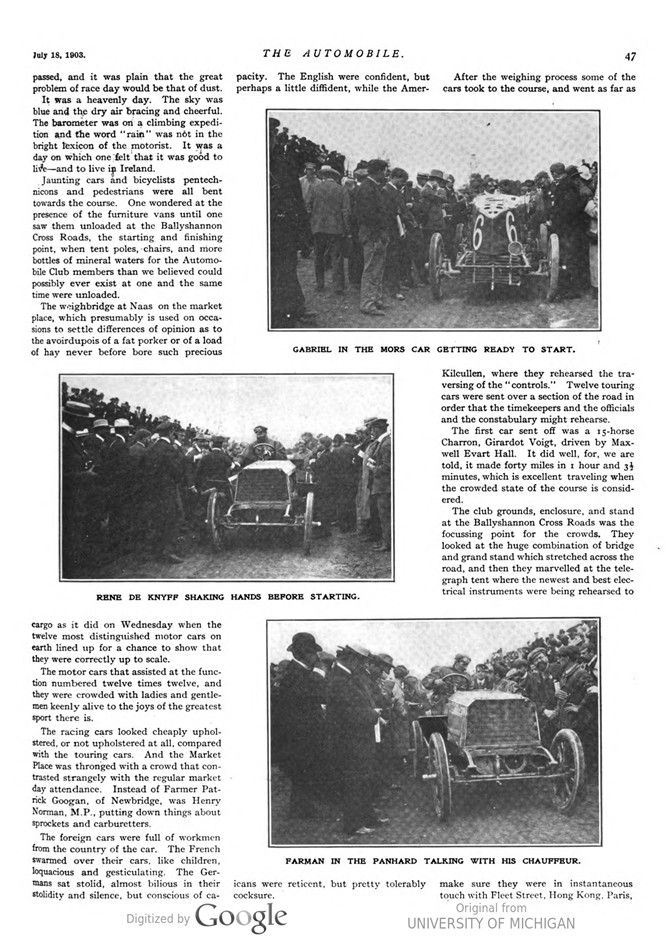
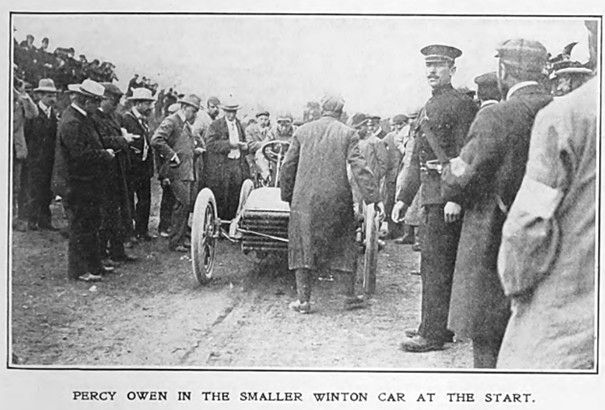
Owen was third, one of the American team, driving a four-cylinder Winton, the tires of which seemed not to have enough touching surface, suggesting a deficient hold upon the ground. Mr. Owen sported a black mackintosh and a brown cap. He made a slow start, being late in getting on the top speed-in fact both the Americans who started suggested rather overwrought nerves.
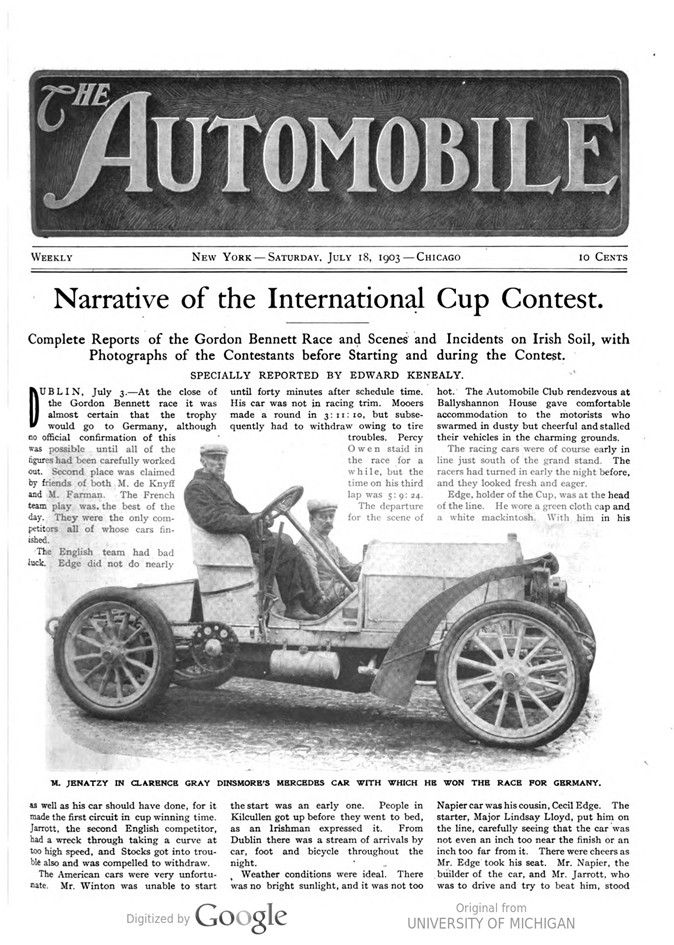
The best to get away of the first four was Jenatzy, on his Mercedes. He changed speed at exactly the right second. He drove for Germany.
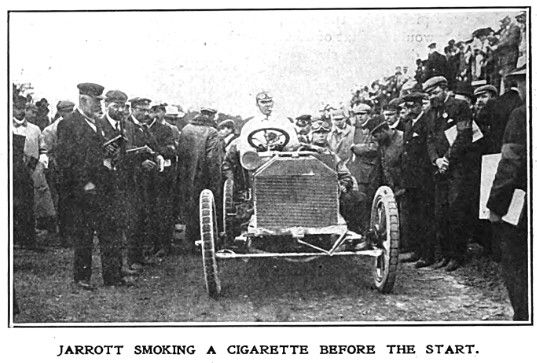
Jarrott was smoking a cigarette when he took his seat. He made a good start, and that he was a popular candidate for the Cup was shown by the applause that followed him up the road.
The road was accessible only to the racers, the police and those who wore green ribbon badges announcing them as either officials or reporters. There was a battery of cameras, and the biograph man was there grinding out views.
Henry Norman, M.P., acted as official interpreter. He did not come into action however as regarded the American racers, although they used expressions not understood of everyone.
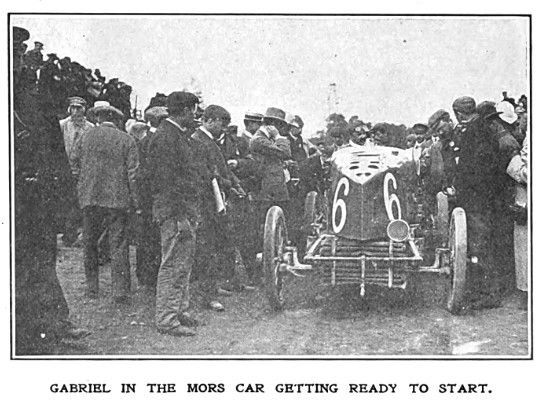
Gabriel, on his Mors, was the sixth away, and probably the favorite among the foreigners. The bonnet of his car suggested a forty-two inch artillery shell-only there isn’t such a thing.
At this stage a small donkey drawing a small cart was brought on the track to remove some earth – no one knew why. A rumor was circulated that this team was to be the thirteenth starter.
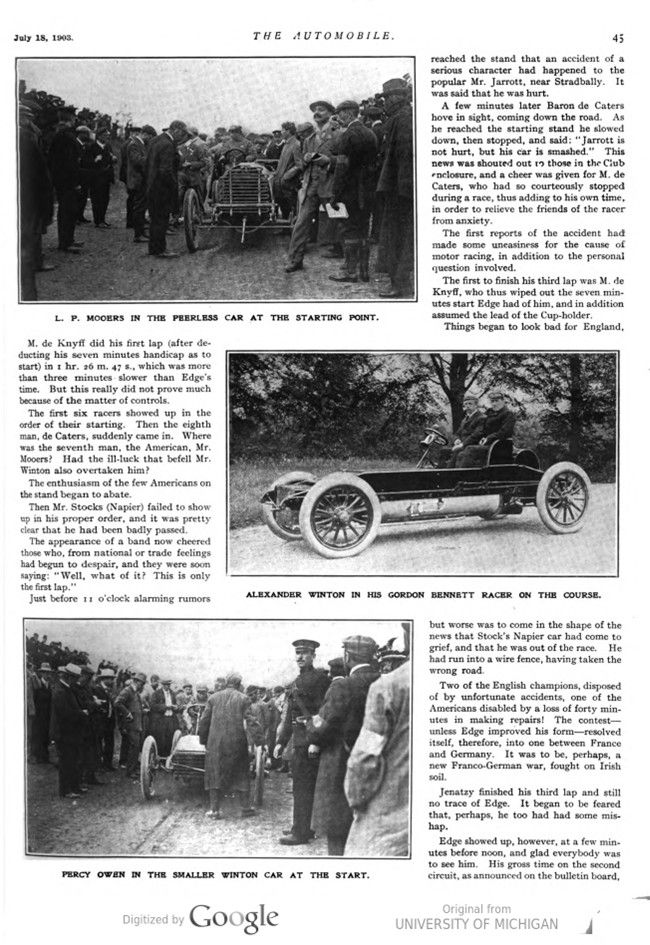
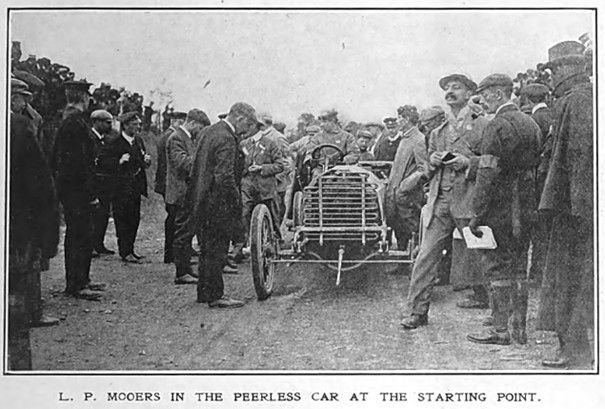
Mooers, American, driving a Peerless, was the seventh man. He had a small American flag pinned on his coat and wore black goggles. He made a bad start. His gear is apparently so high that he could not start on it, and his chauffeur pushed the car and then made a flying leap on board. Mr. Mooers was slightly nervous.
De Caters, German, on his Mercedes made one of the best starts. He was the quickest in reaching top speed.
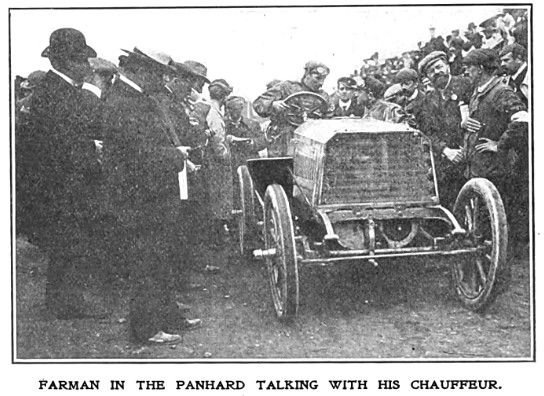
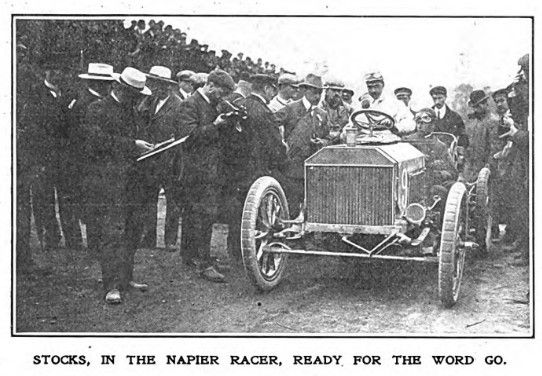
Stocks, the last English champion, on his Napier, made a somewhat slow start. Henri Farman, Frenchman on a Panhard, was tenth man. He, too, had bad luck. He slipped his clutch in too quickly and the engine came to a dead stop. This is about as embarrassing a thing as can happen to a racer under the gaze of a grand stand full of beauty. The delay, however, was not great, and he was soon on the way.
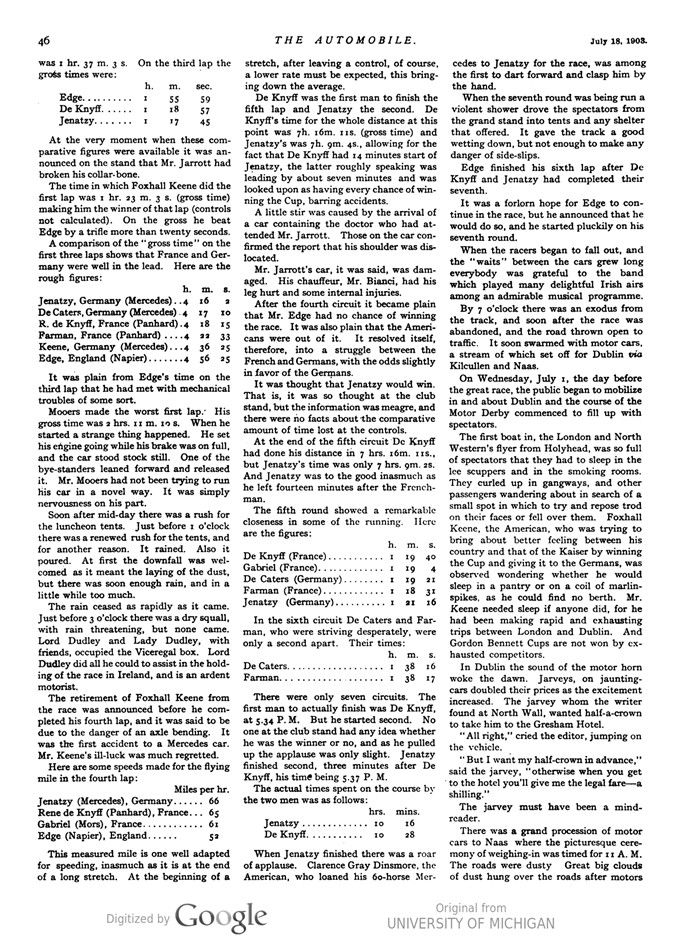
Then came the turn of Winton, the American, on his eight-cylinder Winton. His carburetter wanted adjusting, and he was unable to start. He left forty minutes later after some careful adjustments of his engine.
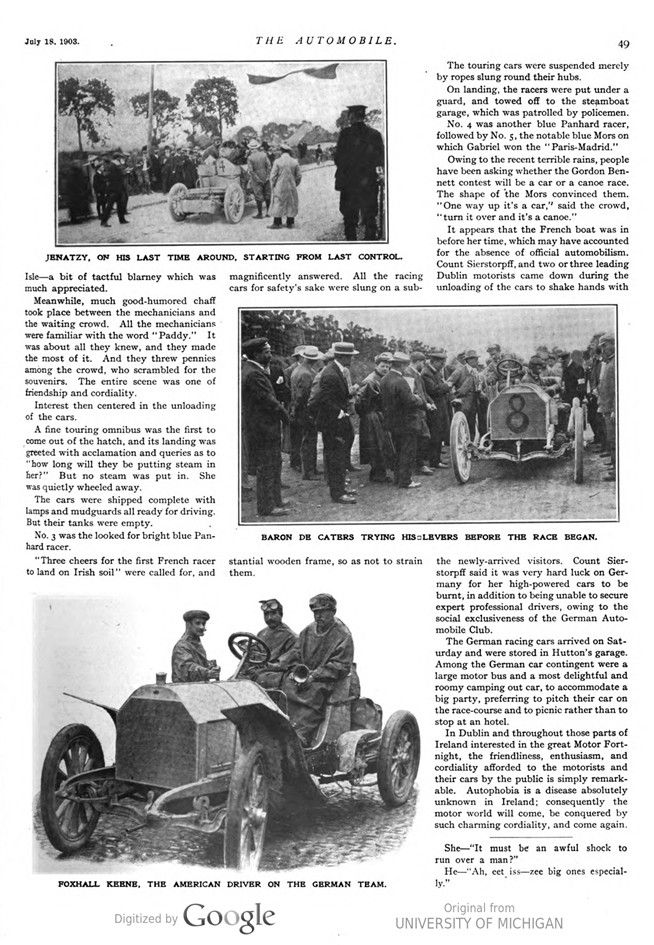
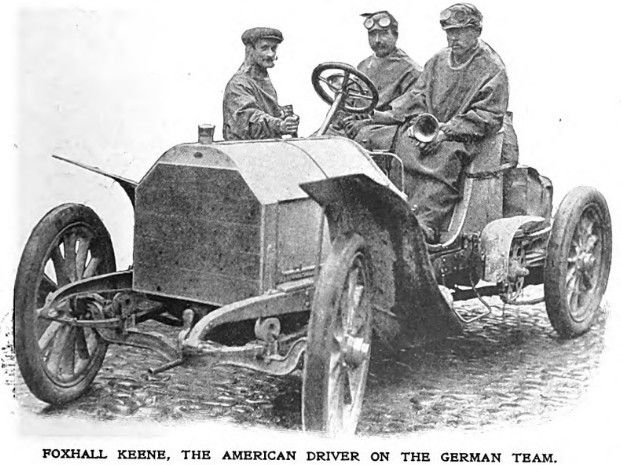
Foxhall Keene, who drove a German Mercedes, started and his engine stopped. He was too anxious to get away and slipped in his clutch too quickly.
CONSIDERATION.
In the field near the Club ground was an engine intended to assist in the manipulation of a balloon, but it served a much more useful purpose, for part of its mechanism was a steam whistle, and this was sounded on the approach of a car. The shriek of the whistle was the signal for those in the grounds to rush to the roadway and get a fleeting glimpse of a racer as he went by.
The spectators had to wait until 8.23 before Edge was sighted. He was the first man to start, and when he appeared it was. certain that, however well anyone else might have done, M. de Knyff at any rate had not beaten him by seven minutes.
The whistle sounded and Edge came whizzing by. He was going at a good speed, but the apparatus for taking the flying mile was not then working, and his last lap of the mile was not given. It was seen, however, that he had made the gross time of 1 hr. 23 m. 23 3-5s. on the 45 miles of the. eastern circuit, but the information as to how much must be deducted for the controls was not available.
M. de Knyff did his first lap (after deducting his seven minutes handicap as to start) in 1 hr. 26 m. 47 s., which was more than three minutes slower than Edge’s time. But this really did not prove much because of the matter of controls.
The first six racers showed up in the order of their starting. Then the eighth man, de Caters, suddenly came in. Where was the seventh man, the American, Mr. Mooers? Had the ill-luck that befell Mr. Winton also overtaken him?
The enthusiasm of the few Americans on the stand began to abate.
Then Mr. Stocks (Napier) failed to show up in his proper order, and it was pretty clear that he had been badly passed.
The appearance of a band now cheered those who, from national or trade feelings had begun to despair, and they were soon saying: “Well, what of it? This is only the first lap.”
Just before 11 o’clock alarming rumors reached the stand that an accident of a serious character had happened to the popular Mr. Jarrott, near Stradbally. It was said that he was hurt.
A few minutes later Baron de Caters hove in sight, coming down the road. As he reached the starting stand he slowed down, then stopped, and said: “Jarrott is not hurt, but his car is smashed.” This news was shouted out to those in the Club enclosure, and a cheer was given for M. de Caters, who had so courteously stopped during a race, thus adding to his own time, in order to relieve the friends of the racer from anxiety.
The first reports of the accident had made some uneasiness for the cause of motor racing, in addition to the personal question involved. The first to finish his third lap was M. de Knyff, who thus wiped out the seven minutes start Edge had of him, and in addition assumed the lead of the Cup-holder. Things began to look bad for England, but worse was to come in the shape of the news that Stock’s Napier car had come to grief, and that he was out of the race. He had run into a wire fence, having taken the wrong road.
Two of the English champions, disposed of by unfortunate accidents, one of the Americans disabled by a loss of forty minutes in making repairs!
The contest – unless Edge improved his form – resolved itself, therefore, into one between France and Germany. It was to be, perhaps, a new Franco-German war, fought on Irish soil.
Jenatzy finished his third lap and still no trace of Edge. It began to be feared that, perhaps, he too had had some mishap.
Edge showed up, however, at a few minutes before noon, and glad everybody was to see him. His gross time on the second circuit, as announced on the bulletin board, was 1 hr. 37 m. 3 s. On the third lap the gross times were:
Edge in 1 55 59 h. m. sec. – De Knyff in 1 18 57 h. m. sec. – Jenatzy in 1 17 45 h. m. sec.
At the very moment when these comparative figures were available it was announced on the stand that Mr. Jarrott had broken his collar-bone.
The time in which Foxhall Keene did the first lap was 1 hr. 23 m. 3 s. (gross time) making him the winner of that lap (controls not calculated). On the gross he beat Edge by a trifle more than twenty seconds.
A comparison of the “gross time” on the first three laps shows that France and Germany were well in the lead. Here are the rough figures:
—————————————– h. m. s.
Jenatzy, Germany (Mercedes) 4 16 2
De Caters, Germany (Mercedes) 4 17 10
R. de Knyff, France (Panhard). 4 18 15
Farman, France (Panhard) 4 22 33
Keene, Germany (Mercedes) 4 36 25
Edge, England (Napier) 4 56 25
It was plain from Edge’s time on the third lap that he had met with mechanical troubles of some sort.
Mooers made the worst first lap. His gross time was 2 hrs. 11 m. 10 s. When he started a strange thing happened. He set his engine going while his brake was on full, and the car stood stock still. One of the bye-standers leaned forward and released it. Mr. Mooers had not been trying to run his car in a novel way. It was simply nervousness on his part.
Soon after mid-day there was a rush for the luncheon tents. Just before 1 o’clock there was a renewed rush for the tents, and for another reason. It rained. Also it poured. At first the downfall was welcomed as it meant the laying of the dust, but there was soon enough rain, and in a little while too much.
The rain ceased as rapidly as it came. Just before 3 o’clock there was a dry squall, with rain threatening, but none came. Lord Dudley and Lady Dudley, with friends, occupied the Viceregal box. Lord Dudley did all he could to assist in the holding of the race in Ireland, and is an ardent motorist.
The retirement of Foxhall Keene from the race was announced before he completed his fourth lap, and it was said to be due to the danger of an axle bending. It was the first accident to a Mercedes car. Mr. Keene’s ill-luck was much regretted. Here are some speeds made for the flying mile in the fourth lap:
————————————– Miles per hr.
Jenatzy (Mercedes), Germany 66
Rene de Knyff (Panhard), France 65
Gabriel (Mors), France 61
Edge (Napier), England 52
This measured mile is one well adapted for speeding, inasmuch as it is at the end of a long stretch. At the beginning of a stretch, after leaving a control, of course, a lower rate must be expected, this bringing down the average.
De Knyff was the first man to finish the fifth lap and Jenatzy the second. De Knyff’s time for the whole distance at this point was 7h. 16m. 118. (gross time) and Jenatzy’s was 7h. 9m. 4s., allowing for the fact that De Knyff had 14 minutes start of Jenatzy, the latter roughly speaking was leading by about seven minutes and was looked upon as having every chance of winning the Cup, barring accidents.
A little stir was caused by the arrival of a car containing the doctor who had attended Mr. Jarrott. Those on the car confirmed the report that his shoulder was dislocated.
Mr. Jarrott’s car, it was said, was damaged. His chauffeur, Mr. Bianci, had his leg hurt and some internal injuries.
After the fourth circuit it became plain that Mr. Edge had no chance of winning the race. It was also plain that the Americans were out of it. It resolved itself, therefore, into a struggle between the French and Germans, with the odds slightly in favor of the Germans.
It was thought that Jenatzy would win. That is, it was so thought at the club stand, but the information was meagre, and there were no facts about the comparative amount of time lost at the controls. At the end of the fifth circuit De Knyff had done his distance in 7 hrs. 16m. 11s., but Jenatzy’s time was only 7 hrs. 9m. 2S. And Jenatzy was to the good inasmuch as he left fourteen minutes after the Frenchman.
The fifth round showed a remarkable closeness in some of the running. Here are the figures:
———————————— h. m. s.
De Knyff (France) 1 19 40
Gabriel (France) 1 19 4
De Caters (Germany) 1 19 21
Farman (France) 1 18 31
Jenatzy (Germany) 1 21 16
In the sixth circuit, De Caters and Farman, who were striving desperately, were only a second apart. Their times:
——————– h. m. s.
De Caters 1 38 16
Farman 1 38 17
There were only seven circuits. The first man to actually finish was De Knyff, at 5.34 P. M. But he started second. No one at the club stand had any idea whether he was the winner or no, and as he pulled up the applause was only slight. Jenatzy finished second, three minutes after De Knyff, his time being 5.37 P. M.
The actual times spent on the course by the two men was as follows:
—————- hrs. min.
Jenatzy 10 16
De Knyff 10 28
When Jenatzy finished, there was a roar of applause. Clarence Gray Dinsmore, the American, who loaned his 60-horse Mercedes to Jenatzy for the race, was among the first to dart forward and clasp him by the hand.
When the seventh round was being run, a violent shower drove the spectators from the grand stand into tents and any shelter that offered. It gave the track a good wetting down, but not enough to make any danger of side-slips.
Edge finished his sixth lap after De Knyff and Jenatzy had completed their seventh.
It was a forlorn hope for Edge to continue in the race, but he announced that he would do so, and he started pluckily on his seventh round.
When the racers began to fall out, and the “waits” between the cars grew long everybody was grateful to the band which played many delightful Irish airs among an admirable musical programme.
By 7 o’clock there was an exodus from the track, and soon after the race was abandoned, and the road thrown open to traffic. It soon swarmed with motor cars, a stream of which set off for Dublin via Kilcullen and Naas.
On Wednesday, July 1, the day before the great race, the public began to mobilize in and about Dublin and the course of the Motor Derby commenced to fill up with spectators.
The first boat in, the London and North Western’s flyer from Holyhead, was so full of spectators that they had to sleep in the lee scuppers and in the smoking rooms. They curled up in gangways, and other passengers wandering about in search of a small spot in which to try and repose trod on their faces or fell over them. Foxhall Keene, the American, who was trying to bring about better feeling between his country and that of the Kaiser by winning the Cup and giving it to the Germans, was observed wondering whether he would sleep in a pantry or on a coil of marlin-spikes, as he could find no berth. Mr. Keene needed sleep if anyone did, for he had been making rapid and exhausting trips between London and Dublin. And Gordon Bennett Cups are not won by exhausted competitors.
In Dublin the sound of the motor horn woke the dawn. Jarveys, on jaunting-cars doubled their prices as the excitement increased. The jarvey whom the writer found at North Wall, wanted half-a-crown to take him to the Gresham Hotel. “All right,” cried the editor, jumping on the vehicle. “But I want my half-crown in advance,” said the jarvey, “otherwise when you get to the hotel you’ll give me the legal fare-a shilling.” The jarvey must have been a mindreader. There was a grand procession of motor cars to Naas where the picturesque ceremony of weighing-in was timed for 11 A. M. The roads were dusty Great big clouds of dust hung over the roads after motors passed, and it was plain that the great problem of race day would be that of dust.
It was a heavenly day. The sky was blue and the dry air bracing and cheerful. The barometer was on a climbing expedition and the word “rain” was not in the bright lexicon of the motorist. It was a day on which one felt that it was good to live-and to live in Ireland.
Jaunting cars and bicyclists pentechnicons and pedestrians were all bent towards the course. One wondered at the presence of the furniture vans until one saw them unloaded at the Ballyshannon Cross Roads, the starting and finishing point, when tent poles, chairs, and more bottles of mineral waters for the Automobile Club members than we believed could possibly ever exist at one and the same time were unloaded.
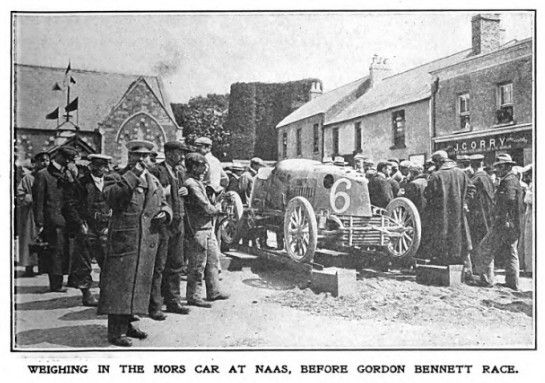
The weighbridge at Naas on the market place, which presumably is used on occasions to settle differences of opinion as to the avoirdupois of a fat porker or of a load of hay never before bore such precious cargo as it did on Wednesday when the twelve most distinguished motor cars on earth lined up for a chance to show that they were correctly up to scale.
The motor cars that assisted at the function numbered twelve times twelve, and they were crowded with ladies and gentlemen keenly alive to the joys of the greatest sport there is.
The racing cars looked cheaply upholstered, or not upholstered at all, compared with the touring cars. And the Market Place was thronged with a crowd that contrasted strangely with the regular market day attendance. Instead of Farmer Patrick Googan, of Newbridge, was Henry Norman, M.P., putting down things about sprockets and carburetters.
The foreign cars were full of workmen from the country of the car. The French swarmed over their cars, like children, loquacious and gesticulating. The Germans sat stolid, almost bilious in their stolidity and silence, but conscious of capacity. The English were confident, but perhaps a little diffident, while the Americans were reticent, but pretty tolerably cocksure.
After the weighing process some of the cars took to the course, and went as far as Kilcullen, where they rehearsed the traversing of the “controls.” Twelve touring cars were sent over a section of the road in order that the timekeepers and the officials and the constabulary might rehearse.
The first car sent off was a 15-horse Charron, Girardot Voigt, driven by Maxwell Evart Hall. It did well, for, we are told, it made forty miles in 1 hour and 3½ minutes, which is excellent traveling when the crowded state of the course is considered.
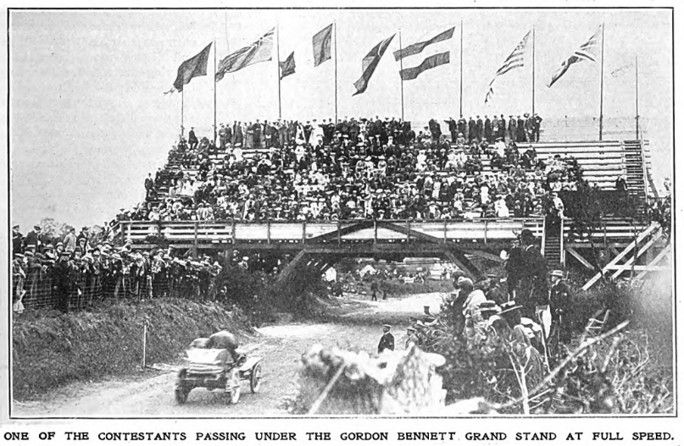
The club grounds, enclosure, and stand at the Ballyshannon Cross Roads was the focussing point for the crowds. They looked at the huge combination of bridge and grand stand which stretched across the road, and then they marvelled at the telegraph tent where the newest and best electrical instruments were being rehearsed to make sure they were in instantaneous touch with Fleet Street, Hong Kong, Paris, New York, and an assortment of other places interested in motor records.
The populace kept vigils on Wednesday night. They slept in fields, four in a bed, or walked about and sang, defying Morpheus. At the Kilcullen Hotel fabulous prices were offered for a chance to sleep on a pile of hay in a barn. Scores were unable to get rooms. But it mattered little to them. They calculated that as they had to get up at 4 A. M. there was an economy of effort in not undressing and going to bed – even if they had a bed.
—–
Unloading the Cars.
DUBLIN, June 30. – The steamship Ferdinand de Lesseps of the Compagnie Générale Transatlantique, which was chartered by the Mors and Panhard firms for the conveyance to Ireland of the French teams and racers, arrived at 12.30 last Sunday morning at the Alexandra Dock, Dublin.
The distinguished passengers had a delightful voyage and arrived in brilliant sunshine and blue skies. Coquettish Ireland, “of the tearful skies,” put her most sunny smile on the surface to welcome her French guests.
The German racers had arrived the day before. Dublin made high Sunday holiday, and some 2,000 persons went down to the dooks to cheer Ireland’s foreign guests, and to get a good look at the competing cars.
As the boat steamed in, her bows were crowded with blue-bloused mechanicians getting their first glimpse of Ireland. It had been rumored that the boat would come in at Kingstown, the mail boat harbor, about 7 miles from Dublin, but there is no means there for unloading cars, of which there were some 32 on the de Lesseps steamship.
On the bridge and upper decks among others were: M. M. le Duc de Arion, М. Н. Farman, Chevalier René de Knyff, Emile Mors, Michelin A. Panhard, Jean Salleron, Baron Thénard, Marquis de Massigny, Baronne Chenard, E. and H. Girard, and many other notables of the motoring world.
M. Gabriel, who reached Dublin on Friday, and was unable, owing to the drenching rains, to take a trial spin over the race- course, was on the quay to welcome his confreres. Everybody had hoped that a world. deputation, both from the British Club and from the Irish Automobile Club, would have gone down to do honor to the distinguished French brothers in the sport. Keen disappointment was felt in the motoring world that there was nobody to greet the travelers on their arrival. But the crowd sent up a rousing cheer as the steamer moored herself, and the French flag was hoisted on the docks.
Some large stacks of timber on the docks formed an impromptu and altogether desirable grand stand wherefrom to view the unloading of the motor freight.
Meanwhile many of the notable visitors had come ashore, been duly cheered, and took the first taste of the delights of an Irish outside car. “Doucement”, shouted some of the Frenchmen when the jarvies jaunted off in familiar bucking fashion. All the ladies of the party were very smartly dressed and delighted with the small Dublin gamins who crowded round, demanding French pennies, and getting these and cigarettes into the bargain!
At least half a dozen of the leading French motorists were wearing green ties and caps out of compliment to the Emerald Isle-a bit of tactful blarney which was much appreciated.
Meanwhile, much good-humored chaff took place between the mechanicians and the waiting crowd. All the mechanicians were familiar with the word “Paddy.” It was about all they knew, and they made the most of it. And they threw pennies among the crowd, who scrambled for the souvenirs. The entire scene was one of friendship and cordiality. Interest then centered in the unloading of the cars.
A fine touring omnibus was the first to come out of the hatch, and its landing was greeted with acclamation and queries as to “how long will they be putting steam in her?” But no steam was put in She was quietly wheeled away.
The cars were shipped complete with lamps and mudguards all ready for driving. But their tanks were empty. No. 3 was the looked for bright blue Panhard racer.
“Three cheers for the first French racer to land on Irish soil” were called for, and magnificently answered. All the racing cars for safety’s sake were slung on a substantial wooden frame, so as not to strain them.
The touring cars were suspended merely by ropes slung round their hubs.
On landing, the racers were put under a guard, and towed off to the steamboat garage, which was patrolled by policemen.
No. 4 was another blue Panhard racer, followed by No. 5, the notable blue Mors on which Gabriel won the “Paris-Madrid.”
Owing to the recent terrible rains, people have been asking whether the Gordon Bennett contest will be a car or a canoe race. The shape of the Mors convinced them. “One way up it’s a car,” said the crowd, “turn it over and it’s a canoe.”
It appears that the French boat was in before her time, which may have accounted for the absence of official automobilism. Count Sierstorpff, and two or three leading Dublin motorists came down during the unloading of the cars to shake hands with the newly-arrived visitors. Count Sierstorpff said it was very hard luck on Germany for her high-powered cars to be burnt, in addition to being unable to secure expert professional drivers, owing to the social exclusiveness of the German Automobile Club.
The German racing cars arrived on Saturday and were stored in Hutton’s garage. Among the German car contingent were a large motor bus and a most delightful and roomy camping out car, to accommodate a big party, preferring to pitch their car on the race-course and to picnic rather than to stop at an hotel.
In Dublin and throughout those parts of Ireland interested in the great Motor Fortnight, the friendliness, enthusiasm, and cordiality afforded to the motorists and their cars by the public is simply remarkable. Autophobia is a disease absolutely unknown in Ireland; consequently, the motor world will come, be conquered by such charming cordiality, and come again.
—–
She – “It must be an awful shock to run over a man?” He – “Ah, eet iss – zee big ones especially.”
Photos.
Page 43.
M. JENATZY IN CLARENCE GRAY DINSMORE’S MERCEDES CAR WITH WHICH HE WON THE RACE FOR GERMANY.
Page 44.
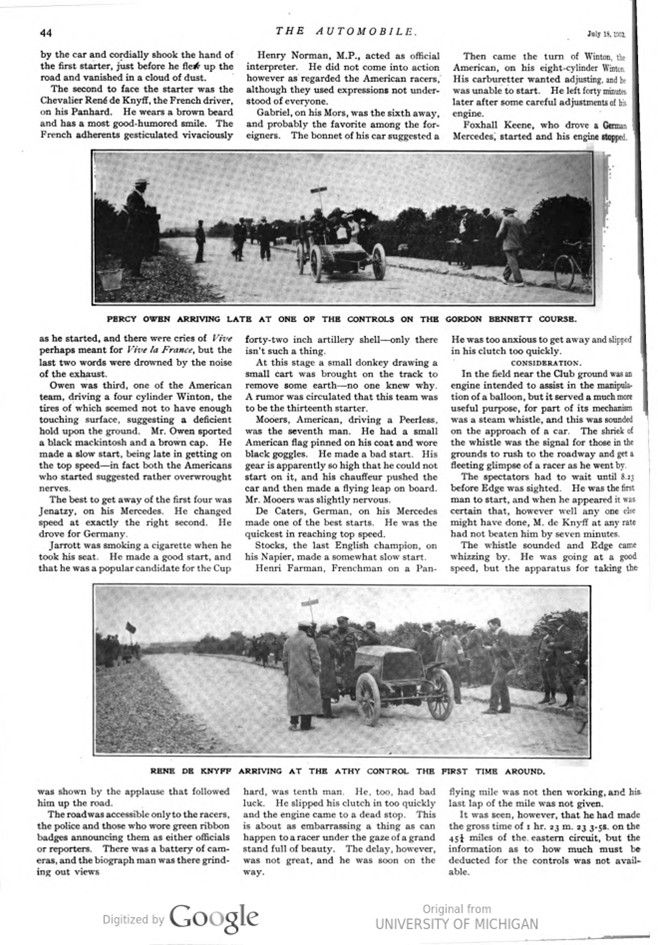
PERCY OWEN ARRIVING LATE AT ONE OF THE CONTROLS ON THE GORDON BENNETT COURSE.
RENE DE KNYFF ARRIVING AT THE ATHY CONTROL THE FIRST TIME AROUND.
Page 45.
L. P. MOOERS IN THE PEERLESS CAR AT THE STARTING POINT.
ALEXANDER WINTON IN HIS GORDON BENNETT RACER ON THE COURSE.
PERCY OWEN IN THE SMALLER WINTON CAR AT THE START.
Page 47.
GABRIEL IN THE MORS CAR GETTING READY TO START.
RENE DE KNYFF SHAKING HANDS BEFORE STARTING
FARMAN IN THE PANHARD TALKING WITH HIS CHAUFFEUR.
Page 48.
JARROTT SMOKING A CIGARETTE BEFORE THE START.
STOCKS, IN THE NAPIER RACER, READY FOR THE WORD GO.
EDGE, WHO STARTED FIRST IN NAPIER CAR, GETTING READY.
Page 49.
JENATZY, ON HIS LAST TIME AROUND, STARTING FROM LAST CONTROL.
BARON DE CATERS TRYING HIS LEVERS BEFORE THE RACE BEGAN FOXHALL KEENE, THE AMERICAN DRIVER ON THE GERMAN TEAM.