Text and photos with courtesy of hathitrust hathitrust.org, compiled by motorracingistory.com.
THE AUTOMOBILE – Vol. 9, No. 1, July 4, 1903
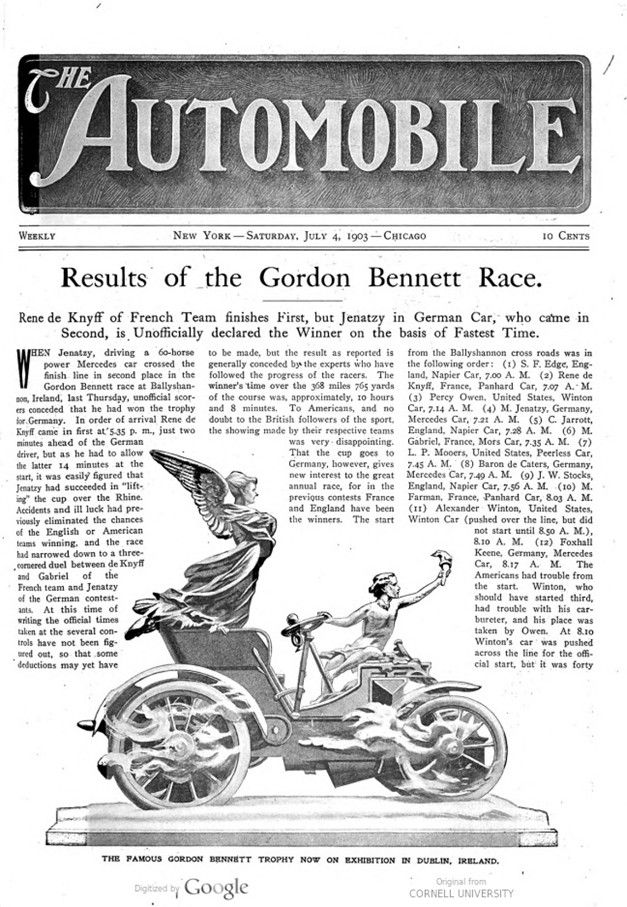
Results of the Gordon Bennett Race.
Rene de Knyff of French Team finishes First, but Jenatzy in German Car, who came in Second, is Unofficially declared the Winner on the basis of Fastest Time.
WHEN Jenatzy, driving a 60-horsepower Mercedes car crossed the finish line in second place in the Gordon Bennett race at Ballyshannon, Ireland, last Thursday, unofficial scorers conceded that he had won the trophy for Germany. In order of arrival Rene de Knyff came in first at 5.35 p. m., just two minutes ahead of the German driver, but as he had to allow the latter 14 minutes at the start, it was easily figured that Jenatzy had succeeded in “lifting” the cup over the Rhine. Accidents and ill luck had previously eliminated the chances of the English or American teams winning, and the race had narrowed down to a three-cornered duel between de Knyff and Gabriel of the French team and Jenatzy of the German contestants. At this time of writing the official times taken at the several controls have not been figured out, so that some deductions may yet have to be made, but the result as reported is generally conceded by the experts who have followed the progress of the racers. The winner’s time over the 368 miles 765 yards of the course was, approximately, 10 hours and 8 minutes. To Americans, and no doubt to the British followers of the sport, the showing made by their respective teams was very disappointing. That the cup goes to Germany, however, gives new interest to the great annual race, for in the previous contests France and England have been the winners.
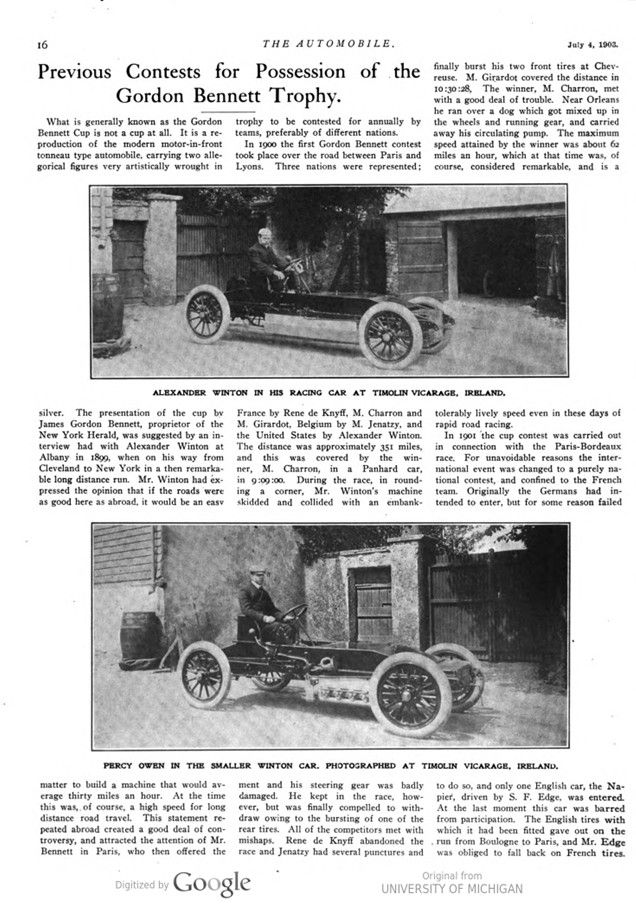
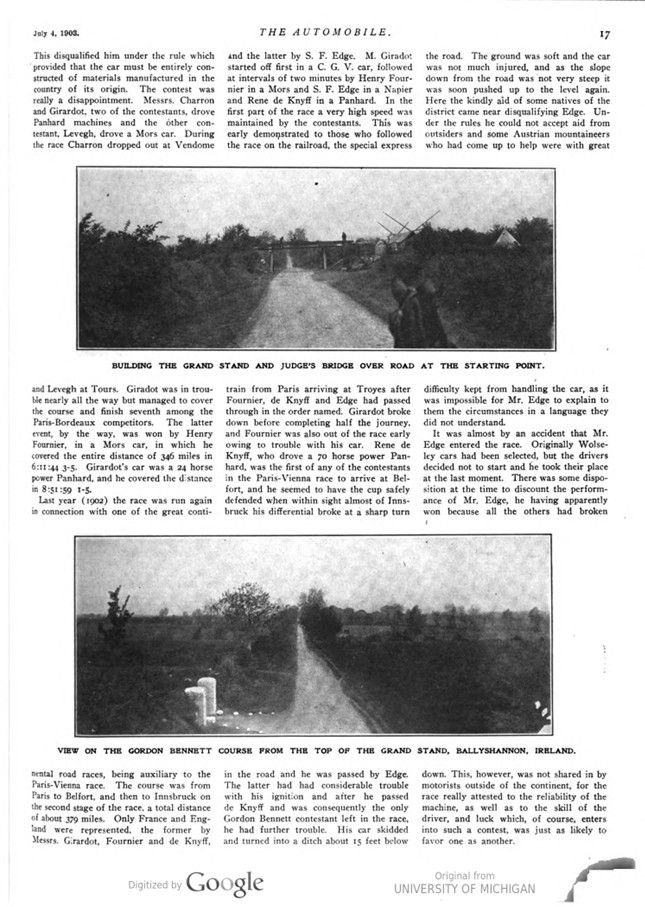
The start from the Ballyshannon cross roads was in the following order: (1) S. F. Edge, Eng- land, Napier Car, 7.00 A. M. (2) Rene de Knyff, France, Panhard Car, 7.07 A. M. (3) Percy Owen, United States, Winton Car, 7.14 A. M. (4) M. Jenatzy, Germany, Mercedes Car, 7.21 A. M. (5) C. Jarrott, England, Napier Car, 7.28 A. M. (6) M. Gabriel, France, Mors Car, 7.35 A. M. (7) L. P. Mooers, United States, Peerless Car, 7.45 A. M. (8) Baron de Caters, Germany, Mercedes Car, 7.49 A. M. (9) J. W. Stocks, England, Napier Car, 7.56 A. M. (10) M. Farman, France, Panhard Car, 8.03 A. M. (11) Alexander Winton, United States, Winton Car (pushed over the line, but did not start until 8.50 A. M.), 8.10 A. M. (12) Foxhall Keene, Germany, Mercedes Car, 8.17 A. M.
The Americans had trouble from the start. Winton, who should have started third, I had trouble with his carbureter, and his place was taken by Owen. At 8.10 Winton’s car was pushed across the line for the official start, but it was forty minutes later before he was able to get away, and meanwhile four of the contestants who had started among the leaders finished their first lap. Winton reached the control at Athy at 9.54, having lost thirty five minutes through clogging of the inlet valve of his carbrueter with dirt in the gasoline.
Mooers lost several seconds at the start, making a blunder in engaging his clutch while the brakes were still set. He had a succession of troubles with his machine after the race started, various reports stating that he lost a pin from the change speed gears, that he struck a bank at a sharp turn near Maryboro early in the race, breaking a gear, and that two tires came off. Mooers escaped unhurt, but had to withdraw from the contest.
Owen, too, was a little slow in getting away, first of the American team and cheered by the American onlookers. He also had trouble with his car, being overtaken and passed in the grand stand stretch by Jenatzy going at more than seventy miles an hour.
The English team had as bad luck as the American. The favorite, Charles Jarrott, was thrown out near Stradbally and had his collar bone broken, while his mechanic, Bianci, was caught under the overturned car and had his leg crushed and was seriously injured internally. The accident was first reported to have occurred through attempting to take a turn too short and fast, but later advices state that while descending a hill his car broke in two. Despite his broken shoulder, Jarrott lifted Bianci from under the wreck.
Baron de Caters, who was following close behind, narrowly missed running into the wreck. The German driver stopped to see how badly the Englishman was hurt, losing several seconds, and, to allay the anxiety of Jarrott’s friends, stopped at the grand stand as he passed to tell them that the injuries were not serious. This act of sportsmanship won the Baron loud cheers. Jarrott, too, showed himself a sportsman, as, when he withdrew from the race, he asked the newspaper men to pass lightly over his accident in order not to spoil the interest and enjoyment of the spectators.
Stocks ran off the course onto a wrong road and into a wire fence, and, though himself escaping without injuries, a wheel on his Napier was broken and he, too, had to retire.
Edge, third member of the English team, and winner of the cup last year, who was first of all to start, is reported to have had some trouble with his change speed gear near Athy, but was able to continue in the race and finished his fifth circuit at 3.34. He was also reported to have burst two tires.
Foxhall Keene, the American who drove a 60-horsepower Mercedes on the German team, made a fine showing through about half of the contest, being second to De Knyff at Ballyshannon at the finish of the third circuit. On the next lap, however, he had trouble with his engine, and on dis- mounting to examine it he made the fortunate discovery that one of the axles was fractured and on the point of giving way. Naturally, he, too, pulled out. It was very disappointing, as he had made the best gross time on the first lap, and finished his third circuit at 12.54, his elapsed time being 4:37 from the start.
After the first circuit the Belgian, Jenatzy, driving a Mercedes, made each round in the fastest time. He made the best start of all, leading off for the German team with a fine flying start in fourth place, and drove throughout with consummate nerve, doing each successive round in almost the same time as the preceding one. He steadily gained on De Knyff, who had started fourteen minutes ahead of him, until at the close of the race he was only two minutes behind the Frenchman.
De Knyff, however, had not been letting any weeds sprout under his wheels, but had gone through in his big Panhard apparently without a hitch, turning off miles at the rate of sixty-four to the hour in favored stretches. He drove in a determined manner, and in the first 150 miles had passed Edge, who was the only Englishman left in the race. The fight was now between Germany and France, Winton and Owen being far behind. Entering the third loop the French driver was first.
An hour and a half before the finish it was apparent that the race was between Jenatzy, De Knyff and Gabriel. Although Gabriel, of the French team, did not get a very quick start, he soon got into a good swing and kept well to the front through- out, but Henry Farman, also of the French team, made a long, hard dash near the close of the race and stole his chances away, himself running de Knyff close for second place on a time basis.
Unofficial computations seem to give the Montagu cup, for team work, to the French team.
An enormous crowd gathered to see the contest, aggregating several hundred thousands. They began to gather at the Kingsridge station in Dublin as early as 2 A. M., and by the time the gates opened 5,000 were besieging it and fought for seats in the first train. Trains were dispatched as rapidly as possibly until the race was under way.
Following five successive days of rain, the weather cleared up and was ideal in the morning and at the start of the race, but later on it began raining again, and the contest finished in a downpour.
Many of the spectators and those connected with the contest remained up all night at the important controls, while others slept in tents, wagons and any makeshift place.
The course was excellently guarded by 6,000 men of the Royal Irish constabulary, reducing to a minimum all danger to spectators and contestants. Every precaution had been taken to prevent accidents, even to treating parts of the course with oil to lay the dust, but under a broiling sun and the traffic of hundreds of automobiles, a thick layer of dust was created in places, which was raised in clouds as the racing cars passed over at speeds from sixty to seventy miles an hour. In other places the oil had been put on so thick that it lay in pools. L. P. Mooers expressed considerable dissatisfaction with the condition of the course on this account.
Two pilot cars were sent over the course in opposite directions at 6 o’clock, an hour before the official start, which was made promptly on time. Edge, in his big Napier, was prompt at the line and got away in good style at the shot of the pistol. De Knyff, who started across at 7.14, in a big Panhard, made a fair start amid great enthusiasm in the groups of French spectators. Owen, who traded places with Winton, and was the first of the Americans to leave, was slow in getting away. He had said that he would run a safe race. The best start of all was made by Jenatzy.
Among the multiplicity of arrangements necessary for the successful carrying out of the great international race, the detail of weighing the cars was of prime importance. Under the rules of the contest the cars were limited in weight to 1,000 kilos, or 2,204.62 pounds, weighed without water, gasoline or batteries. As no accurate weighing apparatus was located on or near the course it was decided to use two small platform scales; these were placed facing each other and on the top of the scale beds two channel irons were laid, the cars being run up on these, the tires fitting in the channel irons. The intention was to weigh the cars at Naas on July 1 and then transfer the scales to the starting point where the cars would be re-weighed immediately after the race.
To make it possible for Fernand Gabriel to compete in the race as a member of the French team, he was elected a member of the Automobile Club of France on June 13. He takes the place of Henry Fournier.
THE AUTOMOBILE – Vol. 9, No. 1, July 4, 1903
Previous Contests for Possession of the Gordon Bennett Trophy.
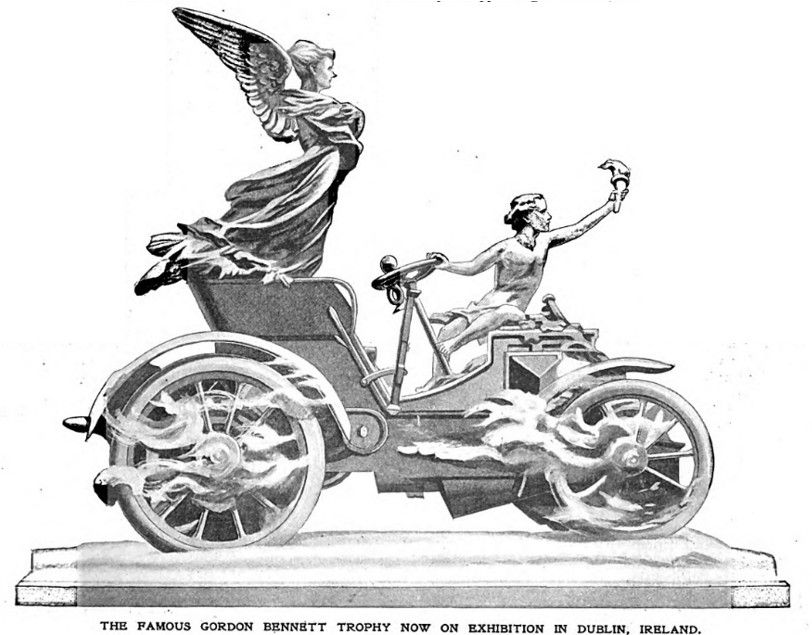
What is generally known as the Gordon Bennett Cup is not a cup at all. It is a reproduction of the modern motor-in-front tonneau type automobile, carrying two allegorical figures very artistically wrought in silver. The presentation of the cup by James Gordon Bennett, proprietor of the New York Herald, was suggested by an interview had with Alexander Winton at Albany in 1899, when on his way from Cleveland to New York in a then remarkable long-distance run. Mr. Winton had expressed the opinion that if the roads were as good here as abroad, it would be an easy matter to build a machine that would average thirty miles an hour. At the time this was, of course, a high speed for long distance road travel. This statement repeated abroad created a good deal of controversy, and attracted the attention of Mr. Bennett in Paris, who then offered the trophy to be contested for annually by teams, preferably of different nations.
In 1900 the first Gordon Bennett contest took place over the road between Paris and Lyons. Three nations were represented: France by Rene de Knyff, M. Charron and M. Girardot, Belgium by M. Jenatzy, and the United States by Alexander Winton. The distance was approximately 351 miles, and this was covered by the winner, M. Charron, in a Panhard car, in 9:09:00. During the race, in rounding a corner, Mr. Winton’s machine skidded and collided with an embankment and his steering gear was badly damaged. He kept in the race, however, but was finally compelled to withdraw owing to the bursting of one of the rear tires. All of the competitors met with mishaps. Rene de Knyff abandoned the race and Jenatzy had several punctures and finally burst his two front tires at Chevreuse. M. Girardot covered the distance in 10:30:28, The winner, M. Charron, met with a good deal of trouble. Near Orleans he ran over a dog which got mixed up in the wheels and running gear and carried away his circulating pump. The maximum speed attained by the winner was about 62 miles an hour, which at that time was, of considered remarkable, and is a tolerably lively speed even in these days of rapid road racing.
In 1901 the cup contest was carried out in connection with the Paris-Bordeaux race. For unavoidable reasons the international event was changed to a purely national contest, and confined to the French team. Originally the Germans had in- tended to enter, but for some reason failed to do so, and only one English car, the Napier, driven by S. F. Edge, was entered. At the last moment this car was barred from participation. The English tires with which it had been fitted gave out on the run from Boulogne to Paris, and Mr. Edge was obliged to fall back on French tires.
This disqualified him under the rule which provided that the car must be entirely constructed of materials manufactured in the country of its origin. The contest was really a disappointment. Messrs. Charron and Girardot, two of the contestants, drove Panhard machines and the other contestant, Levegh, drove a Mors car. During the race Charron dropped out at Vendome and Levegh at Tours. Giradot was in trouble nearly all the way but managed to cover the course and finish seventh among the Paris-Bordeaux competitors. The latter event, by the way, was won by Henry Fournier, in a Mors car, in which he covered the entire distance of 346 miles in 6:11:44 3-5. Girardot’s car was a 24 horsepower Panhard, and he covered the distance in 8:51:59 1-5.
Last year (1902) the race was run again in connection with one of the great continental road races, being auxiliary to the Paris-Vienna race. The course was from Paris to Belfort, and then to Innsbruck on the second stage of the race, a total distance of about 379 miles. Only France and England were represented, the former by Messrs. Girardot, Fournier and de Knyff, and the latter by S. F. Edge. M. Giradot started off first in a C. G. V. car, followed at intervals of two minutes by Henry Fournier in a Mors and S. F. Edge in a Napier and Rene de Knyff in a Panhard. In the first part of the race a very high speed was maintained by the contestants. This was early demonstrated to those who followed the race on the railroad, the special express train from Paris arriving at Troyes after Fournier, de Knyff and Edge had passed through in the order named. Girardot broke down before completing half the journey, and Fournier was also out of the race early owing to trouble with his car. Rene de Knyff, who drove a 70 horsepower Panhard, was the first of any of the contestants in the Paris-Vienna race to arrive at Belfort, and he seemed to have the cup safely defended when within sight almost of Innsbruck his differential broke at a sharp turn in the road and he was passed by Edge. The latter had had considerable trouble with his ignition and after he passed de Knyff and was consequently the only Gordon Bennett contestant left in the race, he had further trouble. His car skidded and turned into a ditch about 15 feet below the road. The ground was soft and the car was not much injured, and as the slope down from the road was not very steep it was soon pushed up to the level again. Here the kindly aid of some natives of the district came near disqualifying Edge. Under the rules he could not accept aid from outsiders and some Austrian mountaineers who had come up to help were with great difficulty kept from handling the car, as it was impossible for Mr. Edge to explain to them the circumstances in a language they did not understand.
It was almost by an accident that Mr. Edge entered the race. Originally Wolseley cars had been selected, but the drivers decided not to start and he took their place at the last moment. There was some disposition at the time to discount the performance of Mr. Edge, he having apparently won because all the others had broken down. This, however, was not shared in by motorists outside of the continent, for the race really attested to the reliability of the machine, as well as to the skill of the driver, and luck which, of course, enters into such a contest, was just as likely to favor one as another.