For the first time since 1911, Marmon entered two „Marmon Specials“ in the 1928 Indianapolis 500 Race. Engine was a supercharged eight-in-liner and, more interesting, the car was equipped with front-wheel drive. The two-speed (front) transmission was designed by Earl Cooper and Col. Howard Marmon; although it showed very much resemblance with the Miller transmission. I’m not sure whether the engine is a self-build one.


Text and jpegs by courtesy of hathitrust.org www.hathitrust.org, compiled by motorracinghistory.com
Automotive Industries, Vol. 58, No. 18, May 5, 1928
Marmon Enters Indianapolis Race With Front-Drive Specials
First time company has competed in 500-mile classic since winning first event in 1911.
Cars are powered by eight-in-line engines. Compression 7.25:1.
By M. Warren Baker
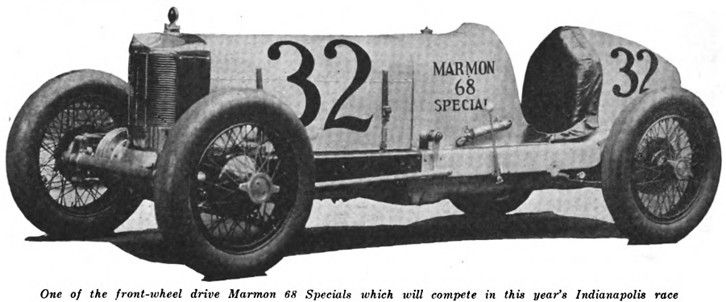
THREE front-wheel-drive, eight-cylinder Marmon 68 „Specials,“ combining in their construction the racing knowledge of Earl Cooper and the engineering ideals of Col. Howard Marmon, will be entered in the 16th International 500-mile race at the Indianapolis Speedway, May 30.
Two cars will be numbered 32 and 34 – the 32 commemorating the old Marmon „Wasp“ with which Ray Harroun won the first speed classic at Indianapolis in 1911, and the 34 doing honor to the Model 34, considered by Marmon the most advanced development of its day.
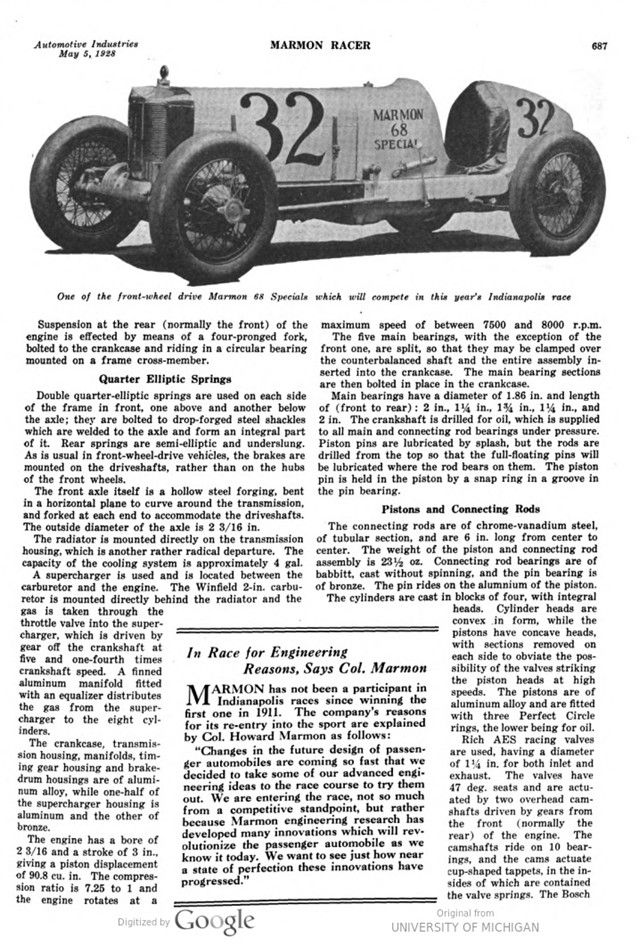
In appearance, the Marmon Specials closely resemble the little 91½ cu. in. race jobs that appeared on the speedway at the last two races. The radiator shell, however, incorporates the familiar Marmon pyramid and on the front is attached the lightning flash which was shown for the first time on the new 68 and 78 lines this year.
The wheelbase of the cars is 100 in., the tread is 49 in., and the greatest height from the road is 42 in. With the tires inflated there is a road clearance of approximately 6 in., which leaves 1 in. clearance when the tires are removed, thus preventing scraping of the car’s bottom should a tire blow.
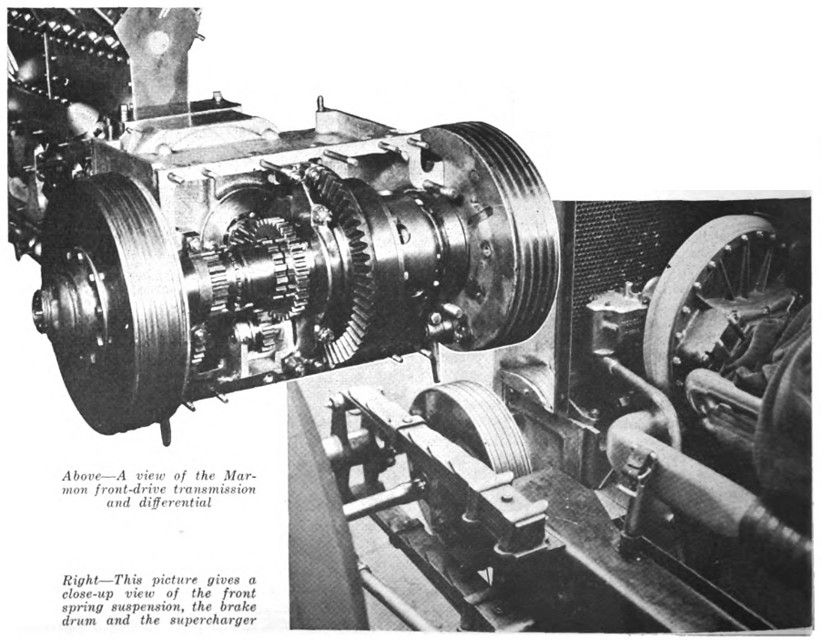
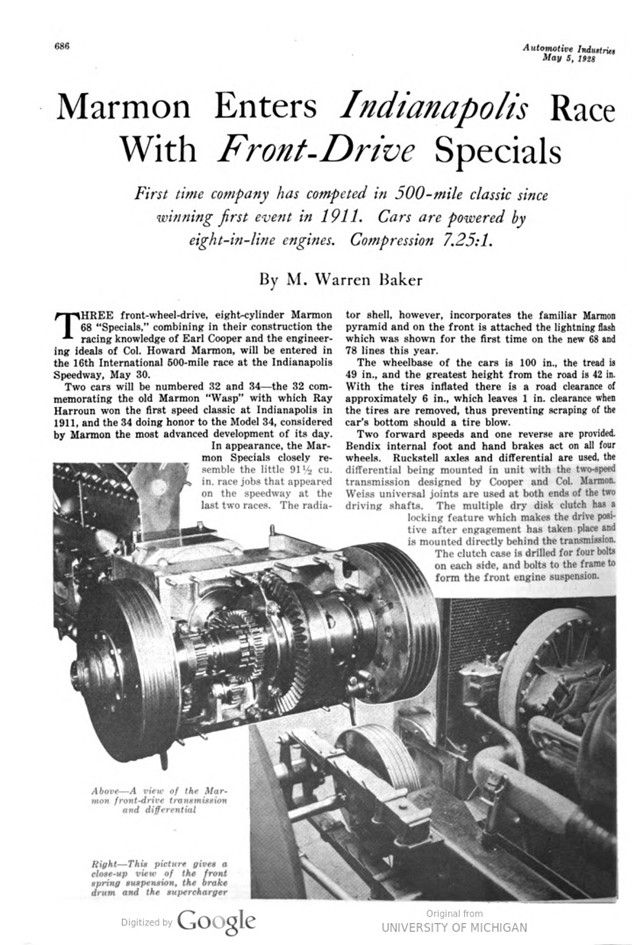
Two forward speeds and one reverse are provided. Bendix internal foot and hand brakes act on all four wheels. Ruckstell axles and differential are used, the differential being mounted in unit with the two-speed transmission designed by Cooper and Col. Marmon. Weiss universal joints are used at both ends of the two driving shafts. The multiple dry disk clutch has a locking feature which makes the drive positive after engagement has taken place and is mounted directly behind the transmission. The clutch case is drilled for four bolts on each side, and bolts to the frame to form the front engine suspension.
Suspension at the rear (normally the front) of the engine is effected by means of a four-pronged fork, bolted to the crankcase and riding in a circular bearing mounted on a frame cross-member.
Quarter Elliptic Springs
Double quarter-elliptic springs are used on each side of the frame in front, one above and another below the axle; they are bolted to drop-forged steel shackles which are welded to the axle and form an integral part of it. Rear springs are semi-elliptic and underslung. As is usual in front-wheel-drive vehicles, the brakes are mounted on the driveshafts, rather than on the hubs of the front wheels.
The front axle itself is a hollow steel forging, bent in a horizontal plane to curve around the transmission, and forked at each end to accommodate the driveshafts. The outside diameter of the axle is 2 3/16 in.
The radiator is mounted directly on the transmission housing, which is another rather radical departure. The capacity of the cooling system is approximately 4 gal.
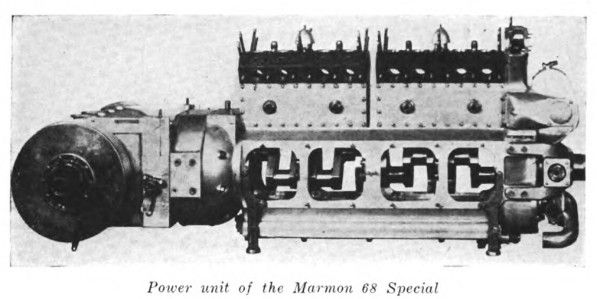
A supercharger is used and is located between the carburetor and the engine. The Winfield 2-in. carburetor is mounted directly behind the radiator and the gas is taken through the throttle valve into the supercharger, which is driven by gear off the crankshaft at five and one-fourth times crankshaft speed. A finned aluminum manifold fitted with an equalizer distributes the gas from the supercharger to the eight cylinders.
The crankcase, transmission housing, manifolds, timing gear housing and brake-drum housings are of aluminum alloy, while one-half of the supercharger housing is aluminum and the other of bronze.
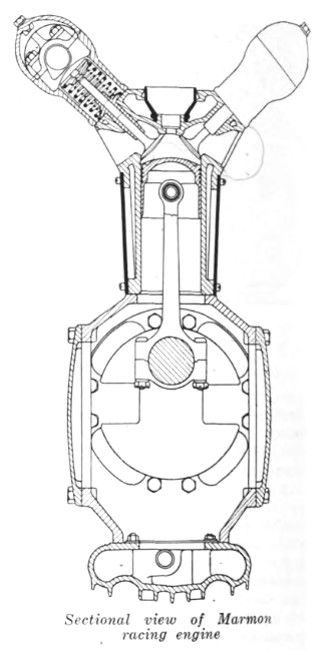
The engine has a bore of 2 3/16 and a stroke of 3 in., giving a piston displacement of 90.8 cu. in. The compression ratio is 7.25 to 1 and the engine rotates at a maximum speed of between 7500 and 8000 r.p.m.
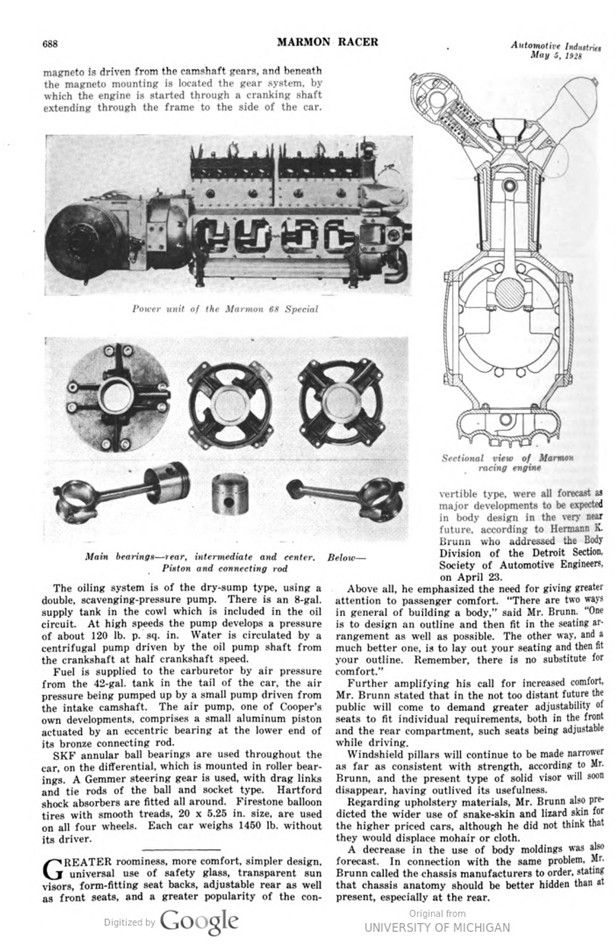
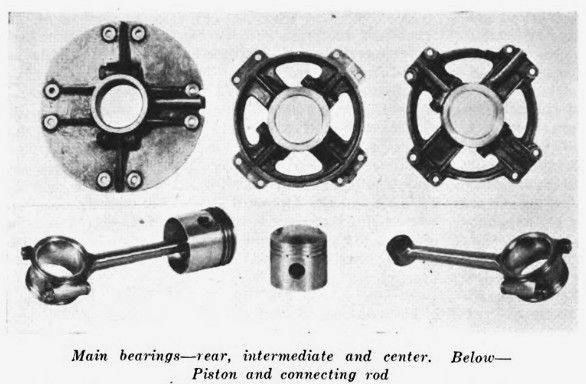
The five main bearings, with the exception of the front one, are split, so that they may be clamped over the counterbalanced shaft and the entire assembly inserted into the crankcase. The main bearing sections are then bolted in place in the crankcase.
Main bearings have a diameter of 1.86 in. and length of (front to rear): 2 in., 14 in., 134 in., 14 in., and 2 in. The crankshaft is drilled for oil, which is supplied to all main and connecting rod bearings under pressure. Piston pins are lubricated by splash, but the rods are drilled from the top so that the full-floating pins will be lubricated where the rod bears on them. The piston pin is held in the piston by a snap ring in a groove in the pin bearing.
Pistons and Connecting Rods
The connecting rods are of chrome-vanadium steel, of tubular section, and are 6 in. long from center to center. The weight of the piston and connecting rod assembly is 23½ oz. Connecting rod bearings are of babbitt, cast without spinning, and the pin bearing is of bronze. The pin rides on the alumnium of the piston.
The cylinders are cast in blocks of four, with integral heads. Cylinder heads are convex in form, while the pistons have concave heads, with sections removed on each side to obviate the possibility of the valves striking the piston heads at high speeds. The pistons are of aluminum alloy and are fitted with three Perfect Circle rings, the lower being for oil.
Rich AES racing valves are used, having a diameter of 1¼ in. for both inlet and exhaust. The valves have 47 deg. seats and are actuated by two overhead camshafts driven by gears from the front (normally the rear) of the engine. The camshafts ride on 10 bearings, and the cams actuate cup-shaped tappets, in the in- sides of which are contained the valve springs. The Bosch magneto is driven from the camshaft gears, and beneath the magneto mounting is located the gear system, by which the engine is started through a cranking shaft extending through the frame to the side of the car.
The oiling system is of the dry-sump type, using a double, scavenging-pressure pump. There is an 8-gal. supply tank in the cowl which is included in the oil circuit. At high speeds the pump develops a pressure of about 120 lb. p. sq. in. Water is circulated by a centrifugal pump driven by the oil pump shaft from the crankshaft at half crankshaft speed.
Fuel is supplied to the carburetor by air pressure from the 42-gal. tank in the tail of the car, the air pressure being pumped up by a small pump driven from the intake camshaft. The air pump, one of Cooper’s own developments, comprises a small aluminum piston actuated by an eccentric bearing at the lower end of its bronze connecting rod.
SKF annular ball bearings are used throughout the car, on the differential, which is mounted in roller bearings. A Gemmer steering gear is used, with drag links and tie rods of the ball and socket type. Hartford shock absorbers are fitted all around. Firestone balloon tires with smooth treads, 20 x 5.25 in. size, are used on all four wheels. Each car weighs 1450 lb. without its driver.
In Race for Engineering Reasons, Says Col. Marmon
MARMON has not been a participant in Indianapolis races since winning the first one in 1911. The company’s reasons for its re-entry into the sport are explained by Col. Howard Marmon as follows:
„Changes in the future design of passenger automobiles are coming so fast that we decided to take some of our advanced engineering ideas to the race course to try them out. We are entering the race, not so much from a competitive standpoint, but rather because Marmon engineering research has developed many innovations which will revolutionize the passenger automobile as we know it today. We want to see just how near a state of perfection these innovations have progressed.“