As the 1926 winner of the Indianapolis 500 Race, Frank Lockhart was keen on breaking the speed record. On the Daytona Beach in February 1928, he tried once to break Malcolm Campbells record. Alas, to no avail. His car somersaulted into the ocean, with Lockhart pinned in the seat and unable to get out. Spectators pulled car and driver from the water. The cars‘ frame was distorted and in some way, the driver too. But next to that, some bruises were the only remeniscence to that crash. Some months later, he tried again, but now with a tragic ending for the young 25 year aged racing driver.
Text and jpegs by courtesy of hathitrust.org www.hathitrust.org, compiled by motorracinghistory.com
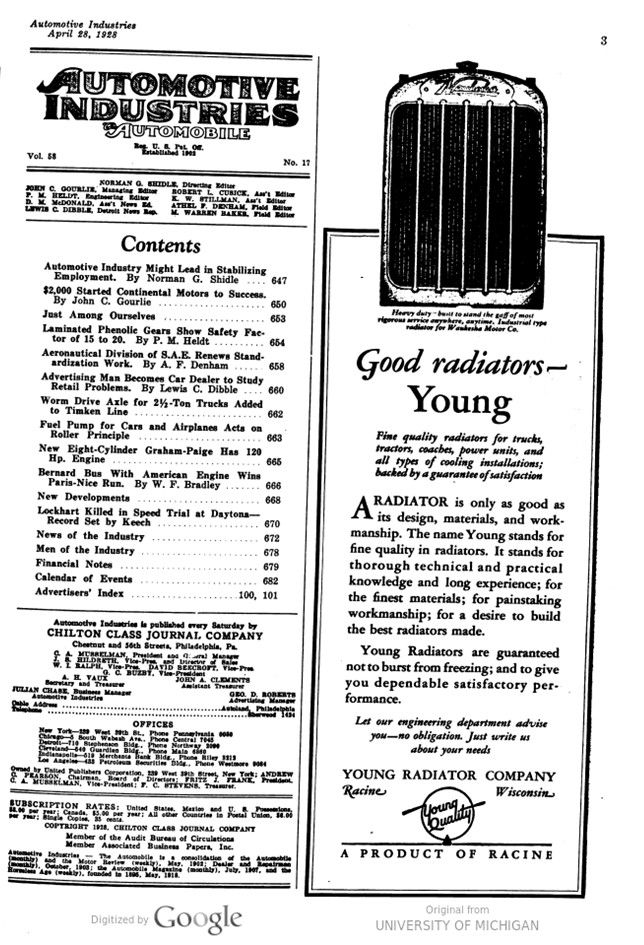
Automotive Industries, Vol. 58, No. 17, April 28, 1928
Lockhart Killed in Speed Trial at Daytona- Record Set by Keech
Ace of American racing drivers meets death when car gets beyond control while traveling 200 m.p.h.
Was trying to better competitor’s time
THE death of Frank Lockhart and the setting of a new record by Ray Keech brought to a climax this week the one-mile international automobile speed contests which have been under way intermittently for the last year at Daytona Beach, Fla.
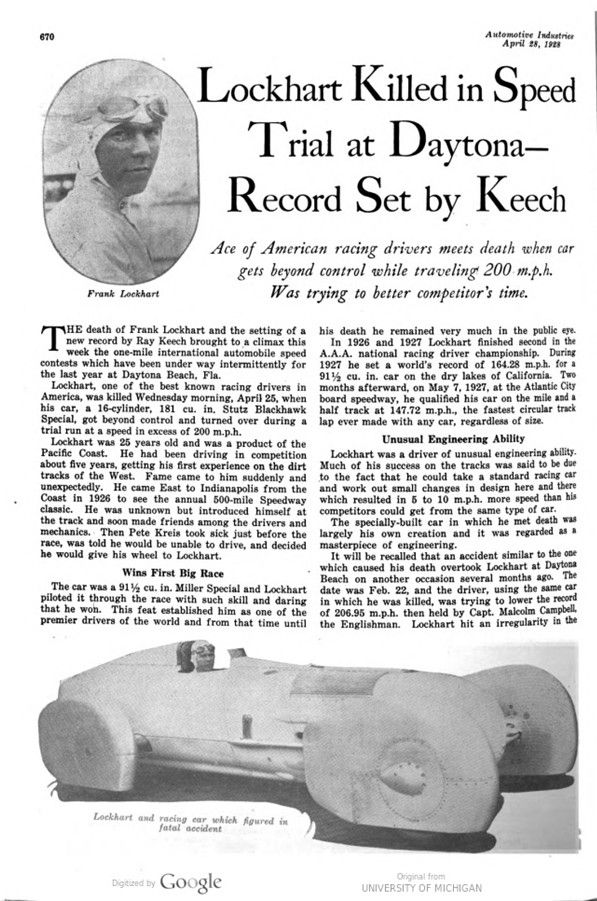
Lockhart, one of the best known racing drivers in America, was killed Wednesday morning, April 25, when his car, a 16-cylinder, 181 cu. in. Stutz Blackhawk Special, got beyond control and turned over during a trial run at a speed in excess of 200 m.p.h.
Lockhart was 25 years old and was a product of the Pacific Coast. He had been driving in competition about five years, getting his first experience on the dirt tracks of the West. Fame came to him suddenly and unexpectedly. He came East to Indianapolis from the Coast in 1926 to see the annual 500-mile Speedway classic. He was unknown but introduced himself at the track and soon made friends among the drivers and mechanics. Then Pete Kreis took sick just before the race, was told he would be unable to drive, and decided he would give his wheel to Lockhart.
Wins First Big Race
The car was a 91½ cu. in.. Miller Special and Lockhart piloted it through the race with such skill and daring that he won. This feat established him as one of the premier drivers of the world and from that time until his death he remained very much in the public eye.
In 1926 and 1927 Lockhart finished second in the A.A.A. national racing driver championship. During 1927 he set a world’s record of 164.28 m.p.h. for a 912 cu. in. car on the dry lakes of California. Two months afterward, on May 7, 1927, at the Atlantic City board speedway, he qualified his car on the mile and a half track at 147.72 m.p.h., the fastest circular track lap ever made with any car, regardless of size.
Unusual Engineering Ability
Lockhart was a driver of unusual engineering ability. Much of his success on the tracks was said to be due to the fact that he could take a standard racing car and work out small changes in design here and there which resulted in 5 to 10 m.p.h. more speed than his competitors could get from the same type of car.
The specially-built car in which he met death was largely his own creation and it was regarded as a masterpiece of engineering.
It will be recalled that an accident similar to the one which caused his death overtook Lockhart at Daytona Beach on another occasion several months ago. The date was Feb. 22, and the driver, using the same car in which he was killed, was trying to lower the record of 206.95 m.p.h. then held by Capt. Malcolm Campbell, the Englishman. Lockhart hit an irregularity in the sand while traveling at terrific speed and catapulted into the ocean. He escaped then, however, with minor injuries.
Lockhart was perhaps the most popular driver of his day. His youth, his skill and his daring made a strong appeal to the public and whenever he appeared in competition he was the center of interest and the favorite of the fans. The other drivers admired and respected him, and also feared him, for he drove a furious race and invariably set the pace in any event that he entered. Only mechanical trouble could slow him down.
Among those who knew him personally there is universal grief over his death. He lived as he raced – “clean“ – had an extremely likeable personality, conducted himself always as a gentleman and took his honors modestly. His going is a distinct loss to American automobile racing.
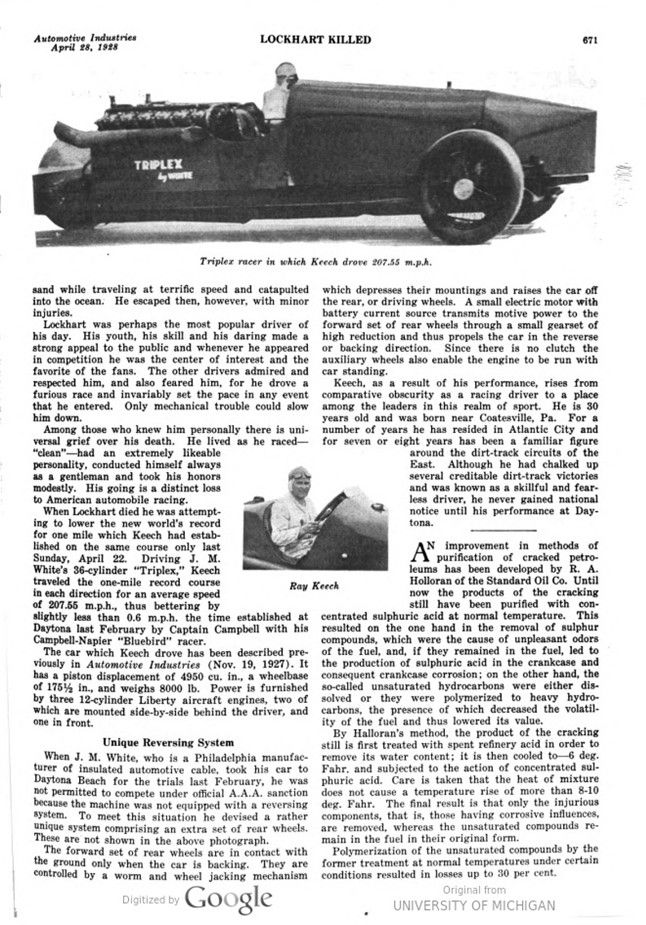
When Lockhart died, he was attempting to lower the new world’s record for one mile which Keech had established on the same course only last Sunday, April 22. Driving J. M. White’s 36-cylinder „Triplex,“ Keech traveled the one-mile record course in each direction for an average speed of 207.55 m.p.h., thus bettering by slightly less than 0.6 m.p.h. the time established at Daytona last February by Captain Campbell with his Campbell-Napier „Bluebird“ racer.
The car which Keech drove has been described previously in Automotive Industries (Nov. 19, 1927). It has a piston displacement of 4950 cu. in., a wheelbase of 175½ in., and weighs 8000 lb. Power is furnished by three 12-cylinder Liberty aircraft engines, two of which are mounted side-by-side behind the driver, and one in front.
Unique Reversing System
When J. M. White, who is a Philadelphia manufacturer of insulated automotive cable, took his car to Daytona Beach for the trials last February, he was not permitted to compete under official A.A.A. sanction because the machine was not equipped with a reversing system. To meet this situation he devised a rather unique system comprising an extra set of rear wheels. These are not shown in the above photograph.
The forward set of rear wheels are in contact with the ground only when the car is backing. They are controlled by a worm and wheel jacking mechanism which depresses their mountings and raises the car off the rear, or driving wheels. A small electric motor with battery current source transmits motive power to the forward set of rear wheels through a small gearset of high reduction and thus propels the car in the reverse or backing direction. Since there is no clutch the auxiliary wheels also enable the engine to be run with car standing.
Keech, as a result of his performance, rises from comparative obscurity as a racing driver to a place among the leaders in this realm of sport. He is 30 years old and was born near Coatesville, Pa. For a number of years he has resided in Atlantic City and for seven or eight years has been a familiar figure around the dirt-track circuits of the East. Although he had chalked up several creditable dirt-track victories and was known as a skillful and fearless driver, he never gained national notice until his performance at Daytona.
Photos.
Page 34. Frank Lockhart – Lockhart and racing car which figured in fatal accident
Page 35. Triplex racer in which Keech drove 207.55 m.p.h. (TRIPLEX by WHITE) – Ray Keech